Key takeaways
- Split the plot into 3-4 rooms so you never see the whole length at once
- Move the path to one side or curve it, as a straight central path makes the corridor
- Put a focal point 6-8m down the garden to stop the eye
- Give the fence borders 60-90cm of depth to blur the long lines
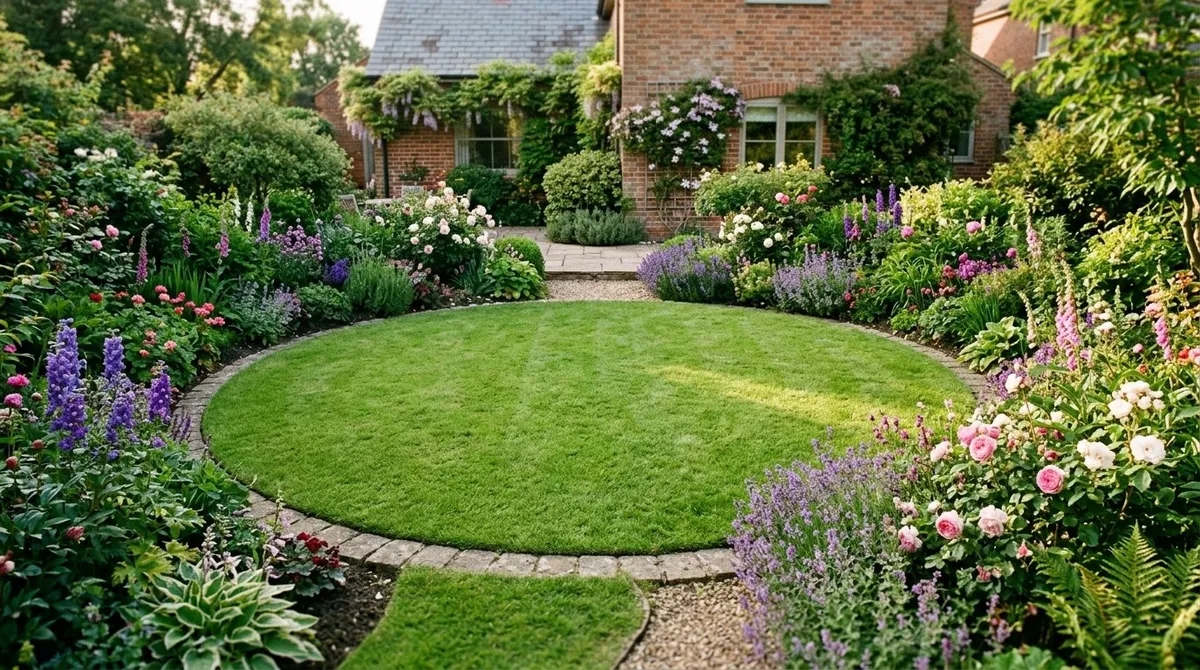
- Use features that run across the width, like a round lawn, to make it feel wider
A long thin garden is the usual shape behind British terraced and Victorian houses, and it’s the trickiest to get right. Run a straight path down the middle and it looks like a bowling alley, with your eye zooming straight to the back fence. The answer isn’t more stuff. It’s breaking the garden into rooms so you can’t see the whole length at once.
Here’s why narrow gardens feel like corridors, how to plan one step by step, and a worked example on a typical 5.5m x 22m terrace plot. Get the bones right and a narrow plot feels bigger than it is.
Why long thin gardens feel like a corridor
It’s because you can see all the way to the end. When you can see from the back door to the rear fence in one glance, the garden reads as one long tube. A straight central path makes it worse by drawing a line right to the end.
Three things add up. The central path is a runway for the eye. Matching fence panels down both long sides look like corridor walls. And with only a shed at the far end, there’s no reason to stop anywhere on the way.
The fix for all three is a bit of mystery. If part of the garden is hidden, you stop, wonder what’s round the corner, and the space feels bigger. Every idea below does one job: stop the eye reaching the back fence.
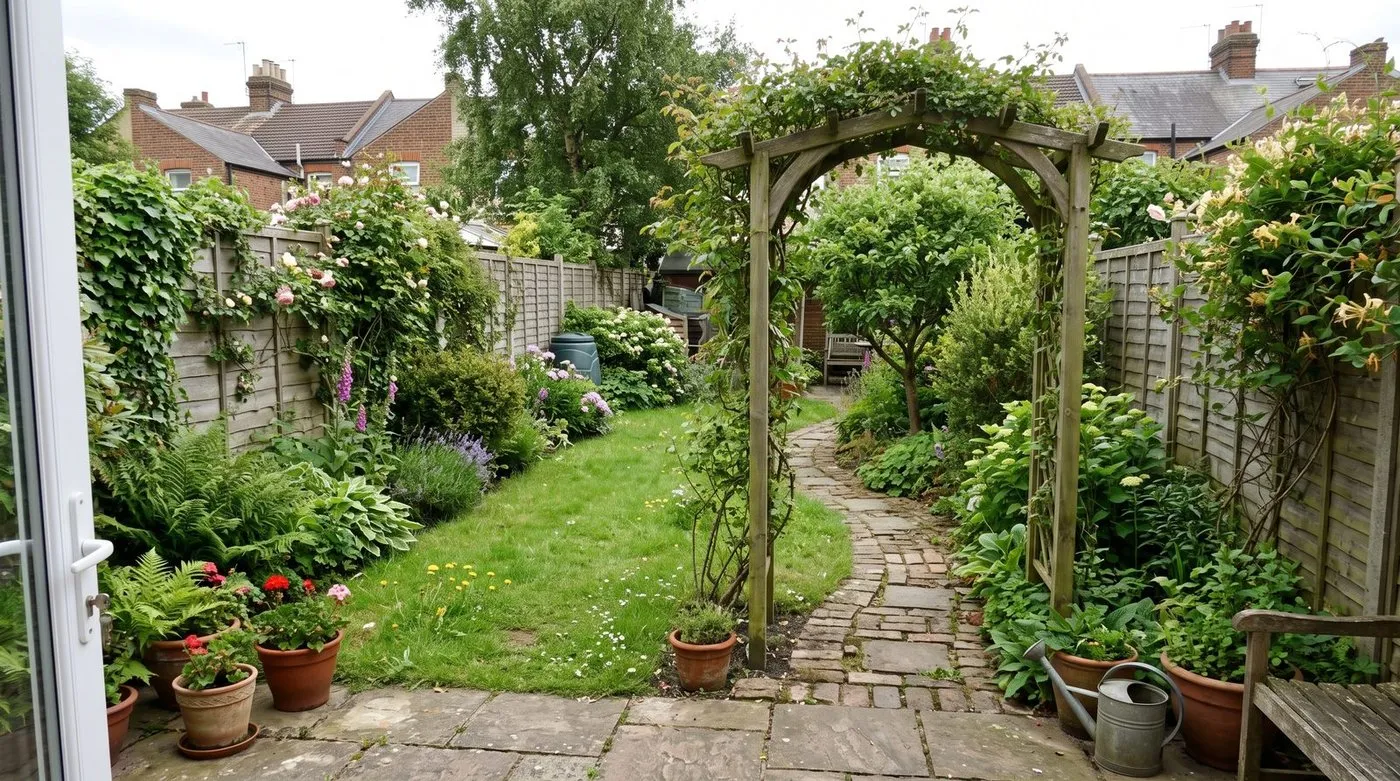 A curving path, an arch and a tree break the garden into rooms, so you can’t see the end all at once.
How to plan a long narrow garden step by step
Work in this order and you’ll avoid costly mistakes.
- Measure the plot. Note the length, width and any slopes. A typical terrace garden is 5 to 6m wide and 18 to 25m long. Mark the back door, drains, manholes and the sunniest corner.
- Watch the sun. Note where it falls in the morning, early afternoon and evening. In a narrow garden, one long fence often shades the bed below it for most of the day.
- Decide on rooms. Split the length into three or four rooms of 4 to 7m each. Give each one a job: eating, lawn, growing or a quiet seat.
- Place the dividers. Put a screen, arch or block of planting between each room so the next one is partly hidden.
- Move the path off-centre. Draw a path that weaves between the rooms instead of cutting them in half.
- Add focal points. Put one eye-catching feature 6 to 8m from the house and something worth walking to at the far end.
- Plant the fences. Give the long sides borders 60 to 90cm deep to soften the lines.
- Do it in stages. Start with the room by the house and work back as your budget allows.
Dividing a narrow garden into rooms
Making rooms is the most powerful thing you can do. The aim is to break up the view every so often, not to box the garden in.
A divider can be solid or see-through. A hazel hurdle, trellis covered in a climbing rose, a row of pleached trees or a low hedge all do the job. A change of level works too. A single step between two areas says “new room” without any screen at all.
 A hazel hurdle and a simple arch split this garden into two rooms. You can’t see the far one until you walk through.
Layouts that pull the eye across the width
Make the most of the width, not the length. Five or six metres of width is more than you think, and the right layout makes you notice it.
Round lawns, circular patios and paving laid on the diagonal all lead the eye from side to side.
 A round lawn and diagonal paving make this narrow plot feel broad rather than long.
Design techniques to beat the corridor effect
Some ideas do more than others. Here’s how they compare.
| Idea | What it does | Suits | Effort |
|---|---|---|---|
| Split into rooms | Hides part of the garden, makes a journey | Any plot over about 12m long | High |
| Off-centre or curved path | Breaks the straight view | All narrow plots | Medium |
| Diagonal or round layout | Leads the eye across the width | Plots 4-6m wide | Medium |
| Focal point part-way down | Stops the eye and makes you pause | Any long plot | Low |
| Deep, layered fence planting | Softens the long fences | Plots with bare fence panels | Medium |
| Repeat plants left to right | Ties the two sides together | Plots over about 18m long | Low |
Splitting into rooms is the big one, because it’s the only idea that hides the full length completely. The others soften or distract. No one trick works alone, though. A focal point on its own still leaves a corridor behind it, and a curved path through an open plot still shows the back fence. Rooms, an off-centre path and fence planting together give the best result.
Gardener’s tip: Stand at the back door and take a photo before you start. If you can see the back fence clearly, your first job is a screen to hide it. Take another photo after each divider goes in.
A worked example on a 5.5m by 22m terrace plot
Room one, 0 to 6m, the dining terrace. A porcelain patio sits by the house for sun and easy access. A raised planter along the wall lifts the eye and softens the brick.
Room two, 6 to 13m, the gravel garden. A hazel screen with an arched gap separates it from the terrace. Inside, a gravel path curves through grasses past a multi-stemmed Amelanchier lamarckii, the focal tree, about 7m from the house so it stops the view from the back door.
Room three, 13 to 19m, the lawn. A 4m oval lawn pulls the eye sideways. Borders 75cm deep run along both long sides, filled with shrubs and perennials.
Room four, 19 to 22m, the hidden nook. A low yew hedge hides a small seating area with a bench facing back towards the house. It’s the treat at the end of the walk.
The Amelanchier is a great focal tree, with spring blossom and autumn colour. Our mixed border planting plan works well for those 75cm fence borders.
 The worked example from above: four rooms, an S-shaped path and a focal tree about 7m from the house.
A month-by-month plan for a UK garden redesign
Spreading the work over a year spreads the cost and lets you plant at the right time. Timings suit most of the UK, a week or two later in the north.
| Month | Job |
|---|---|
| January | Measure up and draw the plan |
| February | Order materials and bare-root hedging |
| March | Plant bare-root hedges and pleached trees before the buds open |
| April | Build the dining terrace by the house |
| May | Put up screens and arches, and lay the path |
| June | Plant the focal tree and main shrubs |
| July | Water new plants in dry spells |
| August | Keep watering, and mulch the beds |
| September | Plant perennials and bulbs in the fence borders. Sow or lay the lawn |
| October | Add lighting along the path and at the focal point |
| November | Plant climbers against screens and walls |
| December | Check the views and plan the next stage |
Boundary planting and screening for narrow plots
The long fences shout “corridor” loudest, so dress them up. Give both sides borders 60 to 90cm deep, not a thin 30cm strip. The extra depth lets you layer plants and hide the flat fence.
Pick upright, slim plants that won’t flop onto the path. Pleached hornbeam or lime gives a neat screen on a clear stem, so you get height without losing ground space. For evergreen cover, try a slim yew hedge or clump-forming bamboo. Climbers like star jasmine or a climbing rose cover trellis and fences with hardly any border needed. Our bamboo alternatives for privacy avoid bamboo’s spreading habit altogether.
Avoid one long line of the same shrub. It just looks like another fence. Mix leaf shapes and heights, and add a few bold leaves like Fatsia japonica, so the boundary feels like a garden, not a wall. The RHS advice on hedges and screening lists good plants for small plots.
Warning: Only plant running bamboo with a deep root barrier. In a narrow garden it can soon spread into your neighbour’s plot.
Use hazel hurdles for quick screening
Hazel hurdles give you instant rooms. They look softer than a solid fence, weather to a lovely grey, and can screen a space while a hedge or climber grows up behind.
They also let you try out a layout first. Move one a metre and see how the view changes before you dig a single post hole.
 Pleached limes and a deep mixed border hide the long fence of a city terrace garden.
Common mistakes that make a narrow garden worse
Most narrow garden designs trip up in the same few ways.
- A straight path down the middle. The biggest cause of the tunnel. Move it to one side or curve it.
- One open view to the back fence. Seeing everything at once spoils the journey. Hide at least one room.
- Skinny fence borders. A thin strip can’t hold layered planting, so the fence still dominates. Give them 60 to 90cm.
- Too many features. A narrow garden needs restraint. A few well-spaced focal points beat a dozen fighting for attention.
- Matching both sides. Identical fences and planting down both sides look like corridor walls. Make one side different.
How layout and materials affect the budget
Doing it in stages keeps costs down. Hazel hurdles, gravel and a single focal tree are a cheap way to make rooms.
Watch for hidden costs. The base under paving often costs as much as the slabs. Soil along old fences and walls is usually dry and poor, so budget for compost and grit to dig in. Working room by room, starting by the house, spreads the cost over two or three seasons without the garden being a building site all year.
Frequently asked questions
How do you make a long narrow garden look wider?
Lead the eye across the garden, not down it. Use planting that runs side to side, a round lawn or patio, and bold leaves on both sides. Repeating a plant or material from left to right helps too. Warm, bright colours at the far end make it feel closer.
Why does my long garden feel like a corridor?
Usually a straight path down the middle. Your eye shoots straight to the back fence, so the garden feels like a tunnel. Matching fence panels down both sides make it worse. Screens, an off-centre path and a focal point part-way down fix it fastest.
How do you divide a long thin garden into zones?
Use screens, arches, hedges or a step every 5-7m. Each one should partly hide the next space. Trellis with climbers, a row of pleached trees or a hazel hurdle all work. Leave a gap or an arch about 90cm wide to lead people through.
Should a path go straight down a long garden?
No, move it to one side or curve it. A path that runs along one side, then crosses to the other, breaks up the tunnel. An S-curve or staggered stepping stones make the eye move across the plot. Save straight paths for formal designs.
What plants suit a long narrow garden boundary?
Upright plants that screen without spreading wide. Pleached hornbeam, clump-forming bamboo, climbing roses and mixed shrub borders all suit narrow plots. Avoid a single row of one shrub, which just looks like another fence. Mix heights and leaf shapes instead.
How much does it cost to redesign a long thin garden in the UK?
It depends how much you do yourself. A DIY scheme with hurdles, gravel and a focal tree costs far less than a professional design and build. Doing it one room at a time spreads the cost over a few seasons.
Our team produces practical UK gardening guidance from source research, contributor records and established horticultural practice. Editorial standards are overseen by Matt W.