Key takeaways
- V. bodnantense 'Dawn' brings scented pink flowers from November to March
- V. tinus is evergreen, flowers in winter and makes a great hedge
- Most viburnums are happy in clay, chalk and part shade
- Prune straight after flowering, taking out a few of the oldest stems
- Guelder rose is a UK native with red berries that birds love
- V. davidii needs a male and female plant nearby to get its blue berries
Viburnums are some of the hardest-working shrubs you can grow. Pick the right ones and you’ll have flowers, scent, berries for birds or evergreen screening at every time of year. From the sweetly scented winter flowers of V. bodnantense ‘Dawn’ to the glowing red berries of our native guelder rose, there’s a viburnum for almost every garden.
Which viburnums grow best in the UK?
These eight are the most reliable in British gardens. Between them they cover every season and most spots, from windy hedgerows to shady town gardens.
Viburnum bodnantense ‘Dawn’
The star of the winter garden. Clusters of sweetly scented pink flowers appear on bare stems from late November to early March. On a still day you’ll smell it before you see it. It grows about 2.5 to 3m tall with an upright shape, in sun or light shade, on clay or chalk. It’s one of the best winter flowering shrubs you can buy.
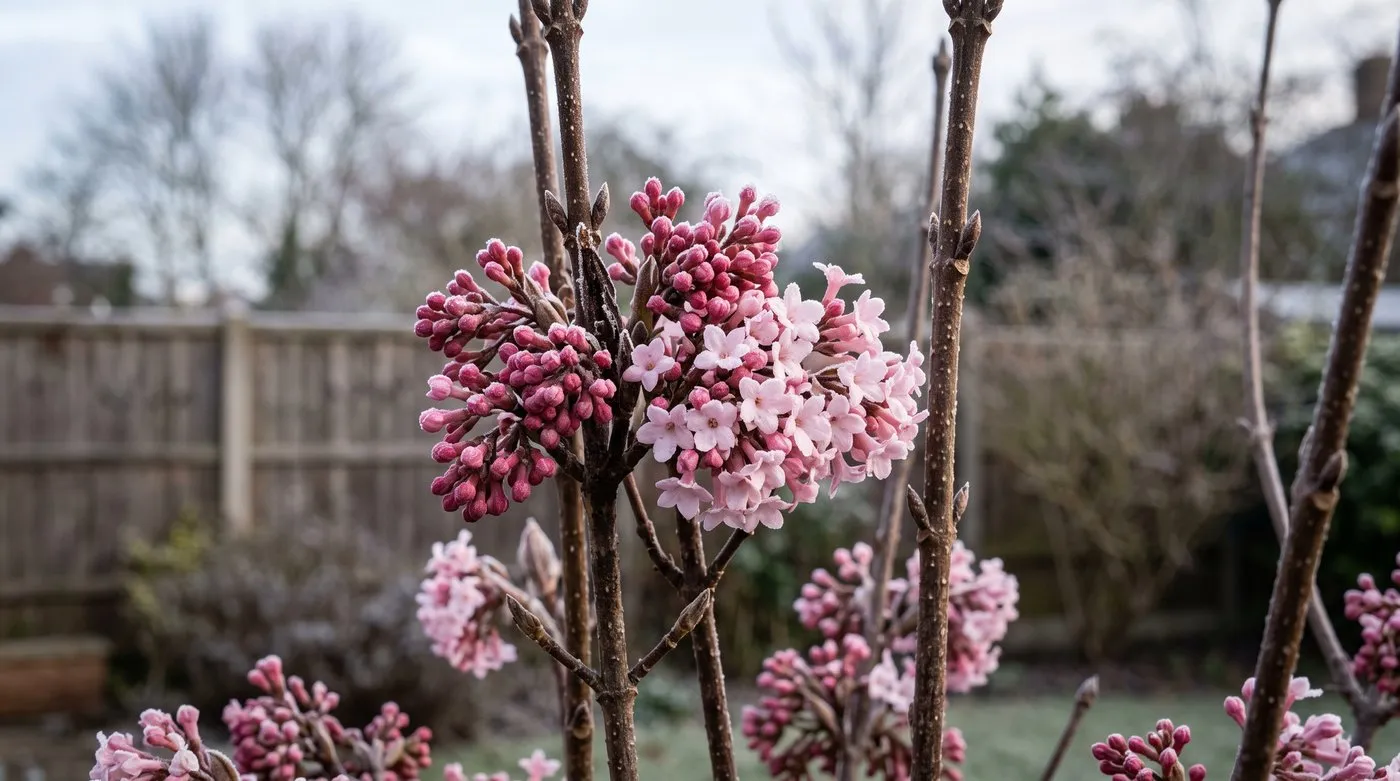
‘Dawn’ flowers on bare stems from late November to March. Plant it near a path or door so you catch the scent on still days.
Viburnum tinus (laurustinus)
The go-to evergreen viburnum. Dense, dark green leaves stay all year, so it’s great for hedges and screens. Pink buds open to white flowers from November to April, followed by blue-black berries. It reaches 2 to 3m if left alone and copes with shade, clay, sea air and town gardens. ‘Eve Price’ is a more compact choice with darker pink buds. ‘Gwenllian’ is another popular variety.
Viburnum opulus (guelder rose)
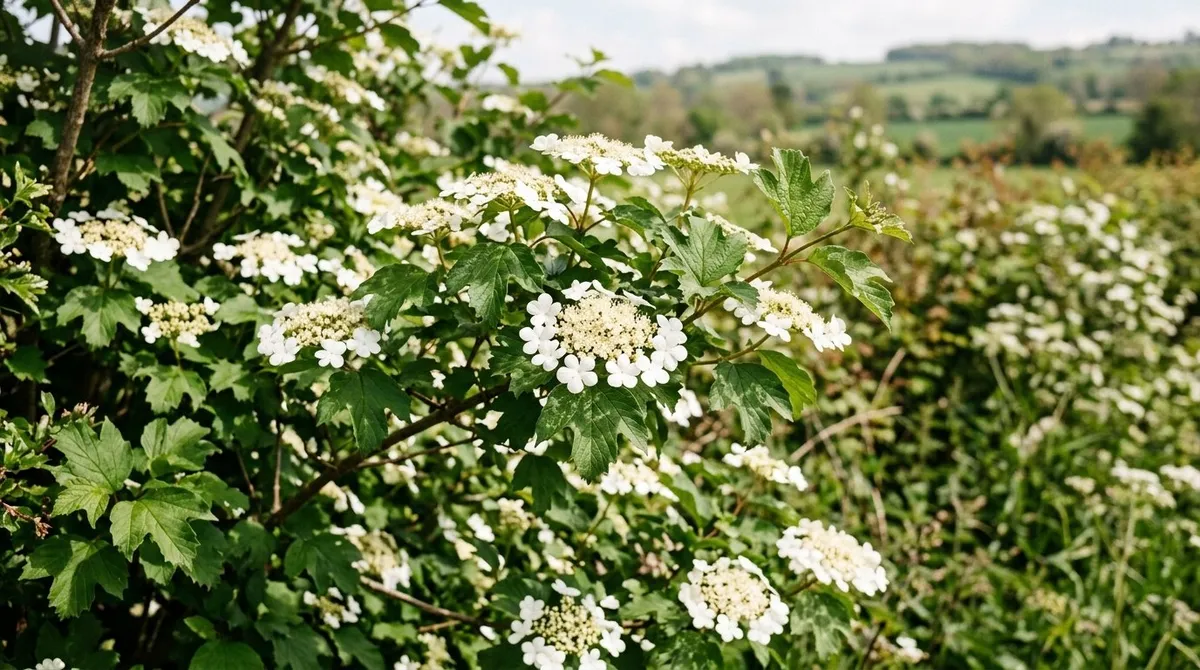
Our native viburnum, found in hedgerows and damp woodland edges. Flat white flower heads appear in May and June, then shiny red berries from September that bring birds to the garden through winter. The leaves turn bright red in autumn. It grows 3 to 4m tall and is the best viburnum for damp ground and clay soil. ‘Compactum’ stays at about 1.5m and berries well.

Guelder rose berries hang in glossy red clusters from September, until the birds strip them in winter.
Viburnum davidii
A low evergreen mound, just 1 to 1.5m tall. The big dark leaves have deep lines running along them. Female plants carry striking metallic blue berries in autumn, but only with a male plant nearby. It’s lovely as ground cover in shade, under trees or at the front of a shrub border. It doesn’t like very dry, chalky soil.
Viburnum plicatum ‘Mariesii’
Grown for its flat, layered branches. White lacy flowers line the top of each tier in May and June, like a wedding cake. It grows 2 to 3m tall and up to 4m wide, so give it room. It needs sun or very light shade, as deep shade spoils the layered shape. Make it the star of a lawn or wide border.
Viburnum carlesii
Grow this for its gorgeous spring scent. Pink buds open to waxy white flowers in April and May, with a sweet, spicy perfume. It grows 1.5 to 2m tall, and the leaves turn wine-red in autumn. It likes moist, rich soil in sun or part shade. ‘Aurora’ has deeper pink buds and is the one you’ll usually find.
Viburnum burkwoodii
A tough, scented, semi-evergreen. Clusters of fragrant white flowers appear in spring. The glossy leaves drop in hard winters but hang on in mild ones. It grows 2 to 2.5m tall, copes with most soils and light shade, and handles exposed gardens well.
Viburnum lantana (wayfaring tree)
A native shrub of chalk downs. Creamy flowers in May are followed by berries that turn from red to black, often both colours on one cluster. The soft, grey-green leaves cope with wind and dry spells. It grows 3 to 5m tall and loves thin, chalky soil. It’s a great choice for an informal hedge.
Viburnums at a glance
| Type | Evergreen? | Height | Flowers | Berries | Shade |
|---|---|---|---|---|---|
| V. bodnantense ‘Dawn’ | No | 2.5-3m | November to March, pink | Rarely | Light shade |
| V. tinus | Yes | 2-3m | November to April, white | Blue-black | Deep shade |
| V. opulus | No | 3-4m | May to June, white | Red | Part shade |
| V. davidii | Yes | 1-1.5m | June, white | Metallic blue | Shade |
| V. plicatum ‘Mariesii’ | No | 2-3m | May to June, white | Red to black | Sun |
| V. carlesii | No | 1.5-2m | April to May, white | Some | Part shade |
| V. burkwoodii | Partly | 2-2.5m | Spring, white | Some | Light shade |
| V. lantana | No | 3-5m | May, cream | Red to black | Light shade |
How to plant viburnum
Plant in autumn if you can. The soil is still warm and the rain keeps roots moist while they settle in. Spring planting is fine too, but water weekly through the first summer.
Dig a hole twice as wide as the rootball and just as deep. Set the plant with the top of the rootball level with the soil. Backfill, firm with your heel and water well. Add a thick mulch of bark or garden compost, keeping it a hand’s width from the stems.
On heavy clay, plant a little high so water drains away from the stems. Guelder rose is the exception, as it’s happy in damp ground.
For V. davidii, plant at least one male with your females. If plants aren’t labelled, buy three or more to give yourself a good chance of a mix.

Viburnum tinus makes a dense evergreen hedge that flowers through winter. Clip it once in late spring.
What soil does viburnum need?
Most viburnums aren’t fussy. Clay, loam, chalk and sandy soils are all fine. Here’s a quick guide to which suits what.
| Type | Clay | Chalk | Sandy | Wet ground |
|---|---|---|---|---|
| V. bodnantense | Yes | Yes | Yes | No |
| V. tinus | Yes | Yes | OK | No |
| V. opulus | Yes | OK | No | Yes |
| V. davidii | Yes | No | No | No |
| V. plicatum | OK | Yes | Yes | No |
| V. carlesii | Yes | Yes | No | No |
| V. burkwoodii | Yes | Yes | Yes | No |
| V. lantana | No | Yes, loves it | Yes | No |
On heavy clay, guelder rose, V. bodnantense and V. tinus are the safest bets. On thin chalk, try V. lantana or V. burkwoodii. Avoid V. davidii on dry chalk or sand.
Mix some garden compost into the soil when you plant. After that, viburnums need very little feeding.
When and how to prune viburnum
Prune straight after flowering. Leave it later and you’ll cut off next year’s flowers.
Winter-flowering types (V. bodnantense, V. farreri): prune in March or April once the flowers fade. Take out about one in five of the oldest stems at ground level. Don’t cut the whole shrub back hard, as viburnums don’t regrow well from stumps.
Late spring and summer-flowering types (V. opulus, V. carlesii): prune just after flowering in early summer, again taking out a few of the oldest stems. Leave V. plicatum mostly alone to keep its layered shape. Just remove dead, damaged or crossing branches.
Evergreens (V. tinus, V. davidii): trim lightly in late spring after the main flowering. Shorten any stray shoots. A V. tinus hedge can be clipped more firmly. Avoid cutting into old bare wood. Our guide to pruning shrubs has more detail.
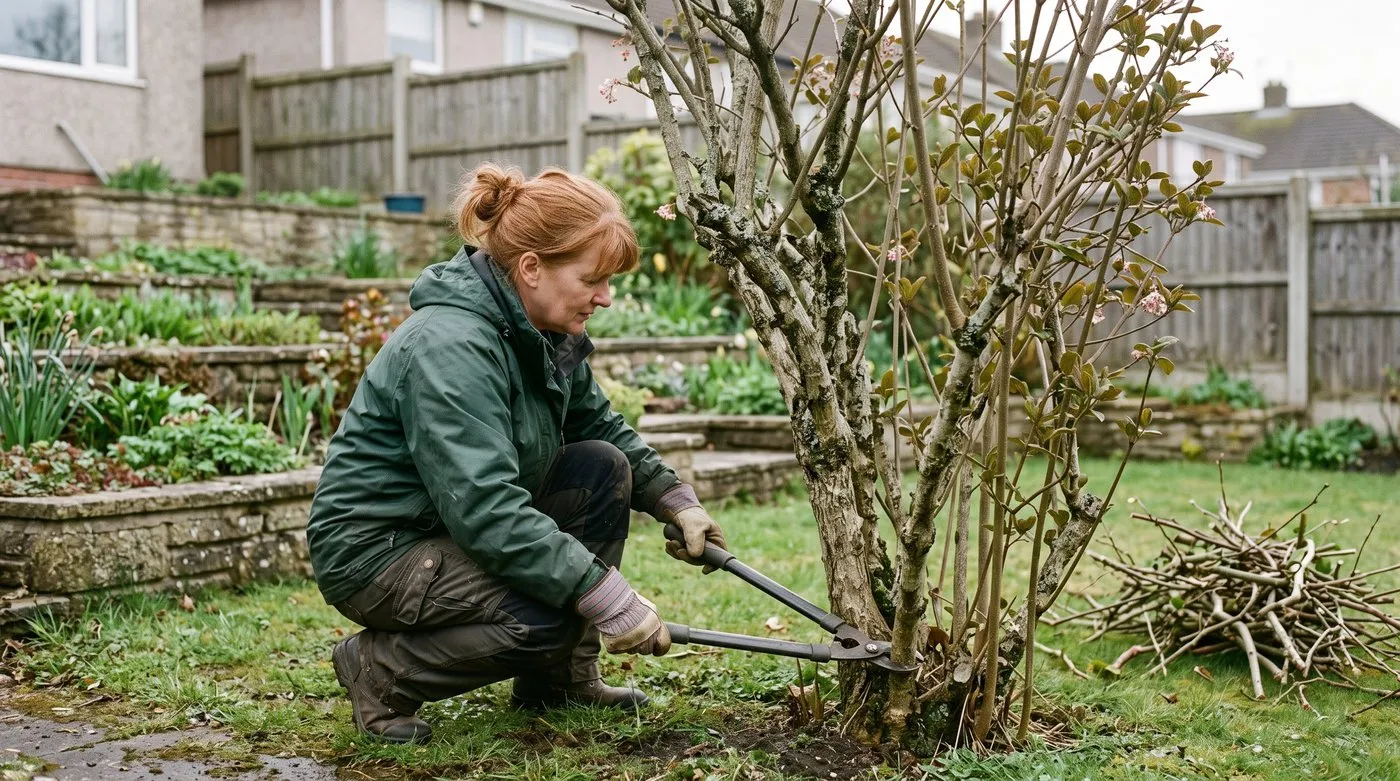
Take out about one in five of the oldest stems at the base after flowering. Viburnums don’t regrow well if you cut the whole shrub back hard.
Viburnum through the year
Grow three or four types and you’ll have something to enjoy every month.
| Month | In flower | In berry |
|---|---|---|
| January | V. bodnantense, V. tinus | V. tinus |
| February | V. bodnantense, V. tinus | V. tinus |
| March | V. bodnantense, V. tinus, V. burkwoodii | V. tinus |
| April | V. tinus, V. burkwoodii, V. carlesii | - |
| May | V. opulus, V. plicatum, V. carlesii, V. lantana | - |
| June | V. opulus, V. plicatum, V. davidii | - |
| July | - | V. tinus |
| August | - | V. opulus and V. lantana ripening |
| September | - | V. opulus, V. lantana, V. davidii |
| October | V. bodnantense starts | V. opulus, V. davidii |
| November | V. bodnantense, V. tinus | V. opulus, V. davidii |
| December | V. bodnantense, V. tinus | Whatever the birds have left |
For colour all year, try V. bodnantense ‘Dawn’ for winter flowers, guelder rose ‘Compactum’ for early summer flowers and autumn berries, and V. tinus ‘Eve Price’ for evergreen leaves and winter flowers. All three are happy in the same clay border.

Viburnum davidii only makes its metallic blue berries when male and female plants grow close together.
How to propagate viburnum
Cuttings root easily in summer. Here’s how.
Softwood cuttings (June): take 10cm tips of this year’s growth. Strip the lower leaves, dip in rooting powder and push into pots of half perlite, half compost. Cover with a clear bag and keep somewhere bright, out of direct sun. Roots form in four to six weeks. Grow on for a year before planting out.
Semi-ripe cuttings (August): take 15cm pieces where the base is starting to firm up. Treat them the same way. They root a little slower but make sturdier plants.
Layering (autumn): peg a low branch to the ground, cover that bit with soil and leave it for a year. Then cut it from the parent and replant. This works well for V. plicatum and V. davidii. Our propagation guide covers more methods.
Common viburnum problems
Viburnum beetle
The main pest to watch for. Small yellowish larvae shred leaves in April and May, then adult beetles chew holes in summer. Guelder rose and wayfaring tree are hit hardest, while V. tinus and V. davidii are rarely bothered. Check under the leaves in spring and pick larvae off by hand. The RHS viburnum beetle page has photos to help you spot them.
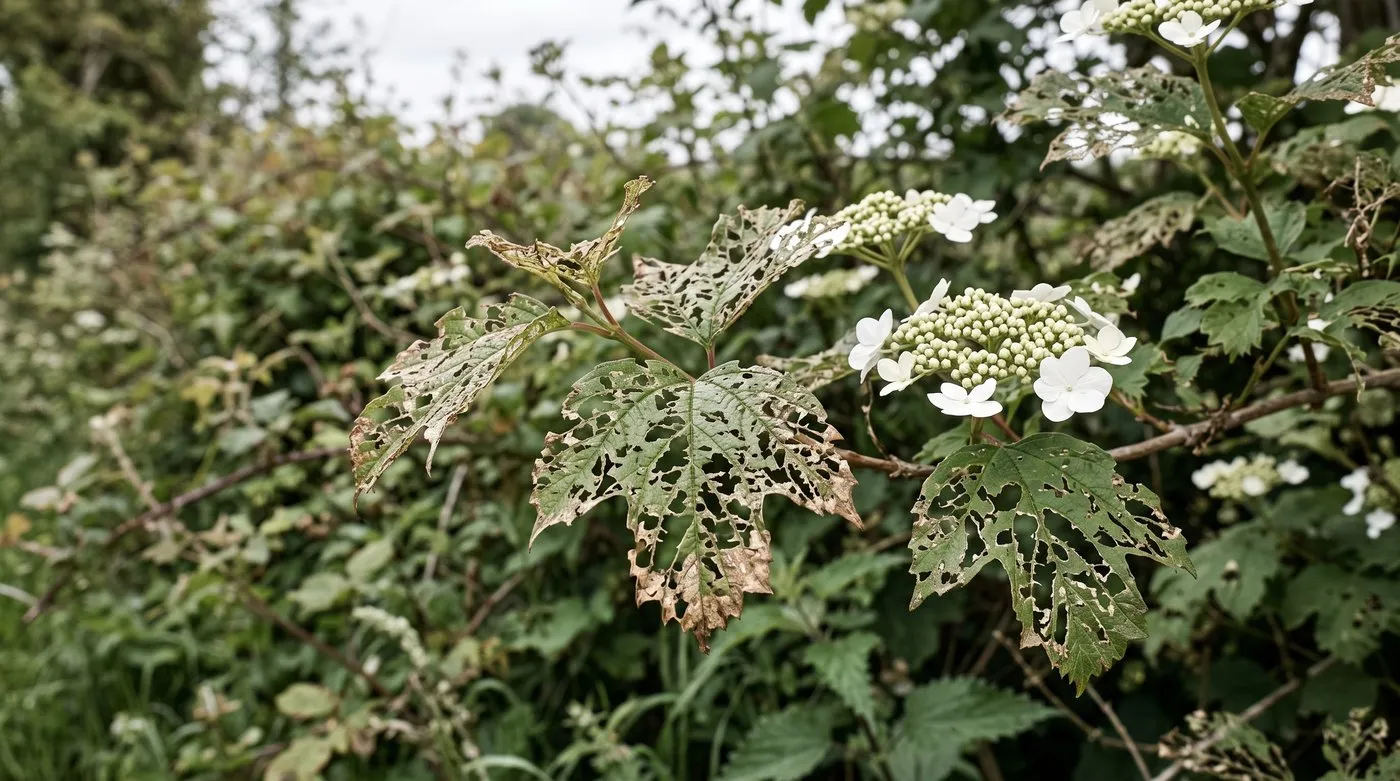
Lacy, shredded leaves on guelder rose in spring point to viburnum beetle. Check under the leaves in April and pick the larvae off by hand.
Leaf spot
Brown or black spots on leaves in wet summers. Pick off badly spotted leaves and thin out crowded branches to let air through. Water at the base, not over the leaves. Healthy plants shrug it off.
No berries on V. davidii
You probably only have one sex. Females need a male nearby to make berries. Buy labelled plants, or plant three or more. A cold, wet June can also mean fewer berries that year.
Dieback on V. tinus
Wilting brown shoots usually mean the roots are too wet. This root rot is most common on waterlogged clay. Cut affected branches back to healthy wood. If it keeps happening, move the shrub to better-drained ground.
Viburnum for wildlife
Viburnums are brilliant for wildlife. Winter flowers on V. bodnantense and V. tinus feed early bumblebees. Guelder rose flowers feed hoverflies and solitary bees, and its berries are a favourite with thrushes. The Wildlife Trusts rate guelder rose highly as a native shrub.
For a wildlife border, combine guelder rose, V. tinus and wayfaring tree. They give flowers, berries and thick cover for nesting birds. Add some bee-friendly plants to keep pollinators fed from spring to autumn.
Thick evergreen shrubs like V. tinus and V. davidii also give birds shelter from wind and rain in winter.
Using viburnum in your garden
There’s a viburnum for almost every job.
Hedges: V. tinus clips into a dense, tidy hedge from about 1.5 to 3m tall, leafy right to the ground. Clip once in late spring and plant about 60cm apart. It’s a great hedge plant for shady, north-facing boundaries.
A single star plant: V. plicatum ‘Mariesii’ looks wonderful in a lawn, where you can see its layered branches from all sides.
Shady borders: V. davidii and V. tinus cope with deep shade. Use V. davidii at the front of shady borders and V. tinus behind.
Mixed borders: V. bodnantense ‘Dawn’ and V. carlesii sit happily with other flowering shrubs like philadelphus, weigela and deutzia. The viburnums cover winter and spring, and the others take over in summer.
Native hedgerows: guelder rose and wayfaring tree mix well with hawthorn, blackthorn and field maple. Plant bare-root plants about 45cm apart between November and March.
To fill the gaps around your viburnums, take a look at our best perennial plants for UK gardens.
Frequently asked questions
What is the best viburnum for a small UK garden?
V. davidii is a great pick at 1 to 1.5m. It makes a neat evergreen mound with blue berries in autumn if a male plant grows nearby. V. tinus ‘Eve Price’ is another good choice, flowering from November to April. Both cope with shade and clay.
When should I prune viburnum?
Prune straight after it finishes flowering. Winter-flowering types like V. bodnantense are pruned in March or April. Late spring-flowering types like guelder rose are pruned in early summer. Evergreens like V. tinus just need a light trim in late spring. Take out a few old stems rather than cutting the whole plant back.
Can viburnum grow in shade?
Most cope well with part shade. V. davidii and V. tinus are happy in quite deep shade. V. bodnantense and guelder rose flower best with some sun but manage in dappled shade. V. plicatum ‘Mariesii’ needs sun to grow its layered shape.
Is viburnum poisonous to dogs or cats?
The berries can upset a pet’s stomach if eaten. They taste very bitter, so pets rarely eat many. Watch for sickness or diarrhoea and call your vet if you’re worried. Our guide to plants toxic to dogs lists others to watch.
How fast does viburnum grow?
Most grow at a steady, moderate pace. They don’t do much in the first year while the roots settle. From the second year they pick up speed. V. tinus and guelder rose are among the quicker ones, while V. davidii is slow. Watering well in the first summer helps them get going.
Why are there no berries on my viburnum?
You may need a second plant. V. davidii only berries when a male and female grow near each other. Other viburnums often berry better with another plant of the same kind nearby. A cold, wet spell during flowering can also mean fewer berries.
Does viburnum make a good hedge?
Yes, V. tinus makes a lovely evergreen hedge. It stays leafy to the ground, copes with shade, clay, chalk and coastal winds, and flowers in winter. Clip it once in late spring and plant about 60cm apart. Guelder rose suits a looser, wildlife-friendly hedge.
Our team produces practical UK gardening guidance from source research, contributor records and established horticultural practice. Editorial standards are overseen by Matt W.