
Key takeaways
- Mopheads and lacecaps turn blue on acid soil and pink on chalky soil
- Panicle hydrangeas flower on new growth, so late frosts can't spoil the flowers
- Climbing hydrangea clings to a shady north wall with no trellis needed
- Oakleaf hydrangeas give summer flowers, autumn leaf colour and peeling bark
- 'Annabelle' has huge white flower heads but may need support in rain
There are five main types of hydrangea grown in UK gardens, and each has its own flower shape, pruning needs and favourite spot. Knowing which one you have, or which one suits your garden, makes all the difference between a plant that flowers its socks off and one that sulks.
For planting, feeding and general care, see our guide on how to grow hydrangeas in the UK. This one is all about telling the types apart and choosing the right variety.
How to identify the five types of hydrangeas
The flower shape is the quickest way to tell them apart.
| Type | Flower shape | Changes colour with soil? | When to prune | Size |
|---|---|---|---|---|
| Mophead | Big round pompom | Yes, blue to pink | Light trim in spring | Medium |
| Lacecap | Flat, with a lacy centre | Yes, blue to pink | Light trim in spring | Medium |
| Panicle (paniculata) | Cone-shaped | No | Cut back in late February | Medium to large |
| Climbing | Flat lacecap, on a climber | No (white) | Tidy after flowering | Very large |
| Oakleaf | Cone-shaped, with oak-like leaves | No (white) | Light tidy in spring | Medium |
Use this to work out what you’ve already got, or to choose before you buy. Our guide on how to prune hydrangeas in the UK has the full pruning how-to.
Mophead hydrangeas (Hydrangea macrophylla)
Mopheads are the classic British hydrangea. Their big, round flower heads last for months, from summer well into autumn. The colour depends on your soil: blue on acid soil, pink on alkaline (chalky) soil, and mauve or purple in between.

Mophead (left) and lacecap (right). Both change colour with your soil.
They like light shade best, with morning sun and shelter from hot afternoon sun. In a hot, exposed spot the leaves can scorch and wilt in summer. They tend to do better in the damper west and north of the UK than in the dry east.
Identification
Round, dense flower heads with no visible centre. Broad, dark green, slightly glossy leaves. Stout woody stems that hold on to the old flower heads through winter.
Best UK mophead varieties
‘Endless Summer’ flowers on both old and new stems, so a late frost or an overkeen prune won’t cost you the whole show. Blue on acid soil, pink on alkaline. In a poor summer, the second flush can be a bit thin.
‘Nikko Blue’ gives a lovely deep blue on acid soil. It has a neat, compact shape and flowers through summer. On neutral soil it turns mauve, and on alkaline soil it goes pink.
‘Madame Emile Mouillère’ is a much-loved old white mophead. The white flowers have a little pink or blue eye, depending on your soil. It’s a strong grower that makes a good-sized shrub.
Want to change the colour? Our guide on how to change hydrangea colour explains how.
Lacecap hydrangeas (Hydrangea macrophylla)
Lacecaps are the same species as mopheads, just with a prettier, more relaxed flower. Each flat head has a ring of big petals around a centre of tiny flowers. It’s a lighter, more natural look.
They change colour, need pruning and like the same spots as mopheads. Bees and hoverflies love them, as they can reach the nectar in the tiny central flowers.
Identification
A flat, plate-like flower head with a clear centre. The outer ring is big and showy. The middle is a cluster of tiny flowers, often a slightly different colour. The leaves and stems look just like a mophead’s.
Best UK lacecap varieties
‘Lanarth White’ is a reliable lacecap with white outer petals around a blue or pink centre. It has a loose, open shape that suits woodland-style planting.
‘Blue Wave’ (also sold as ‘Mariesii Perfecta’) has big flat heads in deep blue on acid soil and rose-pink on alkaline soil. It’s a real showstopper on naturally acid ground.
The Teller range is a group of compact lacecaps, including Teller Blue, Teller Red and Teller White. They’re great for smaller gardens and for pots of ericaceous compost. You can check which hydrangeas hold the RHS Award of Garden Merit before you buy.
Lacecaps look lovely with shade-loving shrubs such as skimmia, mahonia and ferns. A lacecap in a big pot also makes a great centrepiece for container gardening.
Panicle hydrangeas (Hydrangea paniculata)
Panicle hydrangeas are the easiest and most adaptable type. They have cone-shaped flowers and bloom on this year’s growth. That means a late spring frost can’t spoil the buds, which is handy in our unpredictable weather. You can cut them back hard in late February.

‘Limelight’, a panicle hydrangea. As it flowers on new growth, pruning is much more forgiving.
They take more sun than mopheads, cope with clay and are very hardy. Soil doesn’t change their colour. Most open creamy white and then slowly blush pink or deep red by autumn.
Identification
Long, cone-shaped flower heads. The flowers start greenish or white, then turn pink and deeper red as the season goes on. The stems are strong and grow tall quickly after a hard prune.
Best UK paniculata varieties
‘Vanilla Fraise’ has a lovely two-tone look. The flowers open creamy white, then turn strawberry pink from the bottom up. It’s a fairly compact shrub that looks great in a border.
‘Little Lime’ is a small version of ‘Limelight’, with the same lime green to pink colour change. It’s ideal for a small garden or a big pot, and you can cut it back hard every February.
Panicle hydrangeas mix well with other sun-loving shrubs. They also go with acid-loving plants such as rhododendrons and pieris, as they’re happy on acid or neutral soil.
Climbing hydrangea (Hydrangea anomala subsp. petiolaris)
Climbing hydrangea is one of the best climbers for a shady wall. It clings to brick, stone and wood with little aerial roots, so you don’t need wires or trellis. White lacecap flowers appear in early summer. Given time, it can cover a whole house wall.

Climbing hydrangea on a north-facing wall. It’s slow to start but covers a lot of wall once settled.
The catch is patience. For the first year or two, not much seems to happen above ground, because it’s busy growing roots. After that it speeds up nicely. This is the hydrangea most people give up on just before it takes off.
Identification
Little aerial roots along the stems that grip walls and tree bark. Flat, lacecap-type white flowers. Oval, toothed, dark green leaves. Older plants have peeling cinnamon-brown bark that looks good in winter.
How to grow climbing hydrangea on a north wall
A north-facing wall gets little sun, which rules out most climbers. Climbing hydrangea grows up tree trunks in the wild, so it’s very happy in this kind of shade.
Planting: Plant at least 30cm away from the wall, leaning the stems in towards it. The soil right next to a wall stays dry, even in wet weather. Water well at planting and through the first two summers.
First two years: Don’t prune, and don’t expect much growth. Water in dry spells and add a layer of bark mulch each spring.
Once settled: After flowering, cut back any stems growing away from the wall and thin out crowded bits.
For more ideas for shady walls, see our guide to the best climbing plants for UK gardens.
Oakleaf hydrangea (Hydrangea quercifolia)
Oakleaf hydrangea looks good for three seasons. In summer it has white cone-shaped flowers. In autumn its oak-shaped leaves turn crimson, orange and burgundy. In winter its peeling, cinnamon-coloured bark adds interest.
It’s less common than mopheads because it needs a sheltered spot. Cold winds tear the big leaves, and it doesn’t like soggy clay. In a sheltered, partly shaded border with decent drainage, it’s a stunner.
Identification
Big leaves with lobes, shaped like oak leaves. No other hydrangea has them. White cone-shaped flower heads. Bark that peels in papery layers to show cinnamon-orange underneath.
Best UK oakleaf varieties
‘Snow Queen’ is a reliable choice, with upright white flowers from July and great autumn colour.
‘Alice’ is bigger and more vigorous, with larger flower heads. It suits a bigger garden and needs shelter in colder parts of the UK.
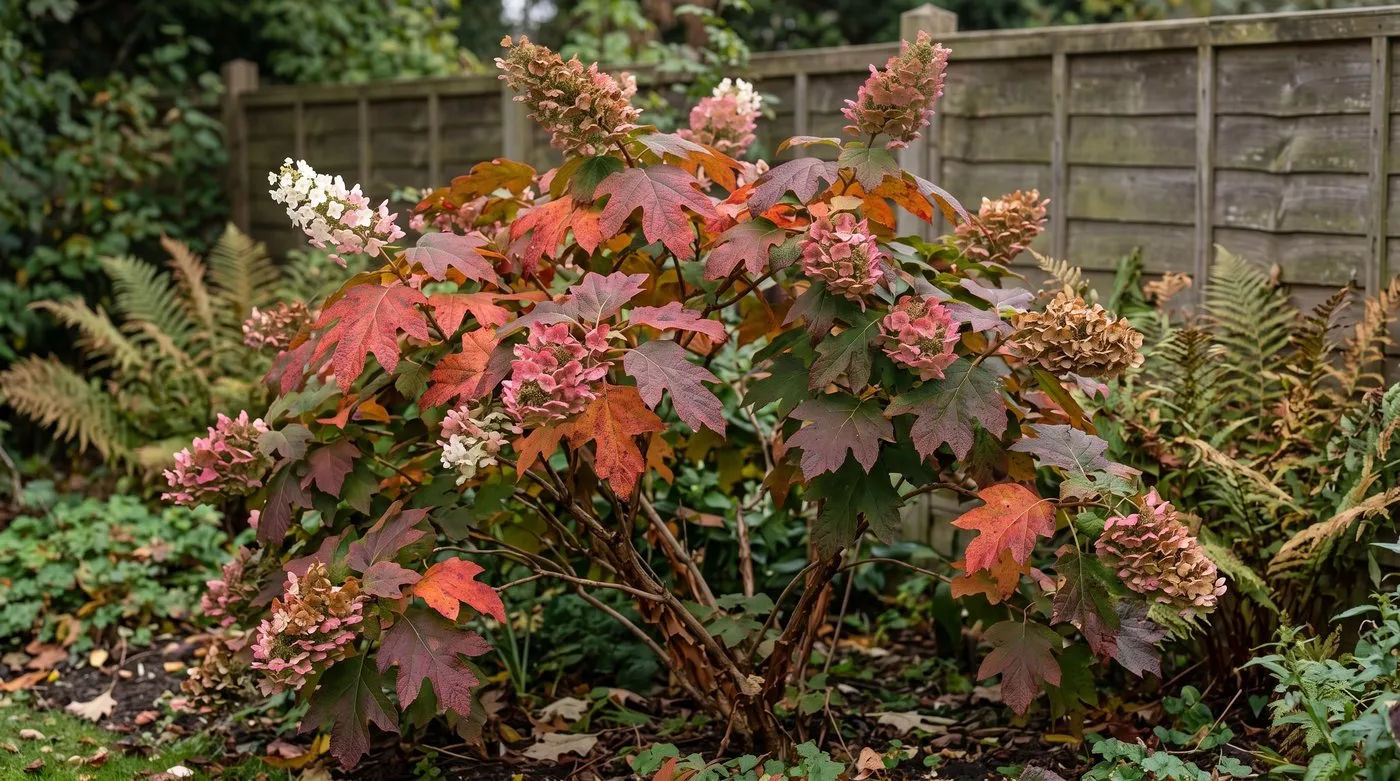
Those lobed, oak-shaped leaves are the giveaway: no other hydrangea has them. Give it a sheltered spot so the wind doesn’t tear them.
Hydrangea arborescens: the bonus type
Hydrangea arborescens is sometimes counted as a sixth type, mainly thanks to one famous variety.
‘Annabelle’ has huge, pure white flower heads. It flowers on new growth, so you can cut it back hard each February. It’s hardy, happy in light shade, and stays white whatever your soil.
The downside is that the big heads get heavy with rain and the stems can flop. In an exposed garden, a peony ring or a few canes keeps it upright. If that sounds like too much faff, try ‘Incrediball’, which has stronger stems that hold the big heads up on their own.
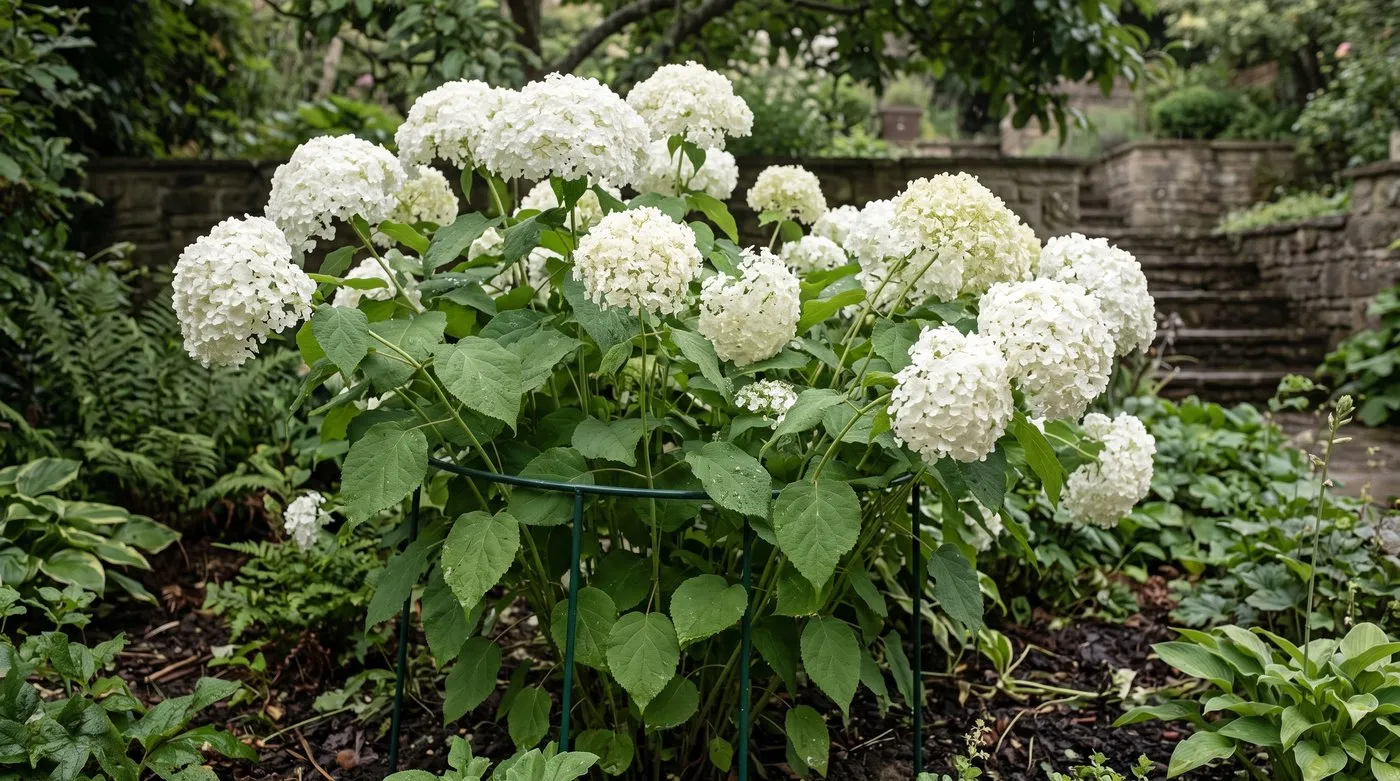
Annabelle’s big white heads get heavy after rain, so a peony ring put in early keeps the stems upright. It stays white whatever your soil.
Choosing the right type for your garden
Start with the table at the top, then ask yourself these questions.
Have you got a north-facing wall? Go for climbing hydrangea.
Is your garden cold or prone to late frosts? Choose a panicle hydrangea. Its flowers grow on new spring stems, so late frosts can’t spoil them. Mopheads and lacecaps can lose their buds to a late frost unless you protect them in April and May.
Would you like autumn colour too? Oakleaf hydrangea adds fiery leaves and winter bark.
Is your garden shady and damp? Mopheads and lacecaps are among the best plants for shade and love dappled light.
Do you want blue flowers? You’ll need a mophead or lacecap on acid soil, or in a pot of ericaceous compost. No other type turns blue. Our guide to soil testing and pH shows you how to check your soil.
Do you want the least pruning? Panicle hydrangea wins. Cut it back hard in February and that’s it.
Aspect and soil preferences at a glance
| Type | Best spot | Soil | Prune |
|---|---|---|---|
| Mophead | Part shade, sheltered | Moist, rich, acid for blue | Spring |
| Lacecap | Part shade, sheltered | Moist, rich, acid for blue | Spring |
| Panicle | Sun or part shade | Most soils, including clay | Late February |
| Climbing | Shade, including north walls | Moist, rich | After flowering |
| Oakleaf | Part shade, sheltered | Well-drained, rich | Light tidy in spring |
| Arborescens | Sun or part shade | Most soils | Late February |
Hydrangeas look great with other shade-tolerant flowering shrubs. Our guide to the best flowering shrubs for UK gardens has some good partners.
Frequently asked questions
What is the difference between mophead and lacecap hydrangeas?
They’re the same species with different flower shapes. Mopheads have big, round, pompom heads. Lacecaps have flat heads with a ring of large petals around a centre of tiny flowers. Both change colour with your soil, need the same pruning and like some shade. Lacecaps are better for bees, as they can reach the tiny central flowers.
Which hydrangea is easiest to grow in the UK?
Panicle hydrangea (Hydrangea paniculata) is the easiest. It flowers on this year’s growth, so late frosts can’t spoil the flowers. You can cut it back hard in February without losing a thing. It copes with clay and more sun than mopheads. ‘Limelight’ and ‘Vanilla Fraise’ are reliable choices.
Can I grow hydrangeas on a north-facing wall?
Yes, climbing hydrangea loves a north-facing wall. It clings on with little aerial roots, so it needs no trellis, and has white lacecap flowers in early summer. It’s slow for the first couple of years, then speeds up. Mopheads and lacecaps also cope in north-facing borders, though they flower less.
Do all hydrangeas change colour with soil pH?
No, only mopheads and lacecaps change colour. They go blue on acid soil and pink on alkaline soil. Panicle, climbing and oakleaf hydrangeas keep their own colours whatever your soil. White varieties of any type stay white.
When should I prune different types of hydrangeas?
It depends on the type. Mopheads, lacecaps and oakleaf hydrangeas flower on last year’s stems, so prune them lightly in spring. Climbing hydrangea gets a tidy after flowering. Panicle hydrangeas and ‘Annabelle’ flower on new growth, so cut them back hard in late February. Getting it wrong on a mophead can cost you a year’s flowers.
What is the best hydrangea for a small garden?
‘Little Lime’ is a great pick for small spaces. It’s a compact panicle hydrangea that suits small borders and big pots. ‘Bobo’ is another small panicle type with masses of white flowers. For a patio pot, try a compact mophead from the ‘Cityline’ range.
How long does it take climbing hydrangea to establish?
Usually two or three years before it really gets going. In that time it’s busy growing roots rather than stems. After that it speeds up and can eventually cover a whole house wall. Be patient, and don’t judge it on its first year.
Related reading
- How to grow hydrangeas in the UK, for planting, feeding and care through the year
- How to prune hydrangeas in the UK, with step-by-step pruning for each type
- How to change hydrangea colour, for turning flowers blue or pink
- Best plants for shade in UK gardens, for partners to grow alongside hydrangeas
- Best climbing plants for UK gardens, for more ideas for shady walls
Our team produces practical UK gardening guidance from source research, contributor records and established horticultural practice. Editorial standards are overseen by Matt W.


