
Key takeaways
- Choose a pot at least 40cm wide with drainage holes, and size up as the plant grows
- Compact varieties such as the Cityline range, Bobo and Little Lime suit pots best
- Ericaceous compost keeps blue hydrangeas blue; ordinary compost tends to turn them pink
- Potted hydrangeas dry out fast, so check them every day in summer
- Raise pots on feet and wrap them in hard frosts, as roots in pots are more exposed
- Hydrangeas are toxic to cats and dogs if chewed, so site pots with pets in mind
Yes, hydrangeas grow brilliantly in pots, and a big pot of mopheads can light up a shady patio for months. You just need a large enough pot, the right compost and a watering can that gets plenty of use.
Pots also give you more say over flower colour, because you choose the compost. This guide covers the best hydrangeas for containers, how to plant them, and how to keep them flowering year after year. For growing them in the ground, see our main guide to growing hydrangeas.
Which hydrangeas grow best in pots?
Compact varieties are the easiest, as they stay in proportion with the pot. Larger ones are fine too, but they need a big container.
- Cityline range: small mopheads bred for pots and patios, in pink, blue, red and purple.
- Bobo: a dwarf paniculata hydrangea with white cone-shaped flowers that blush pink as they age.
- Little Lime: a compact paniculata with lime-green flowers turning pink in autumn.
- Endless Summer: a mophead that flowers on old and new stems, so it still flowers after a cold spring.
- Lacecaps such as the Teller range: flat flower heads with tiny fertile flowers in the middle that bees can reach.
Paniculata types like Bobo and Little Lime flower on new growth. That means a late frost or a heavy-handed prune won’t cost you the summer’s flowers. They also cope with more sun than mopheads. Our guide to types of hydrangea explains the differences in more detail.
| Type | Examples | Flower colour | Prune |
|---|---|---|---|
| Compact mophead | Cityline range | Pink, blue, red | Lightly in spring |
| Repeat-flowering mophead | Endless Summer | Pink or blue | Lightly in spring |
| Lacecap | Teller range | Pink or blue | Lightly in spring |
| Dwarf paniculata | Bobo, Little Lime | White or lime, ageing pink | Harder in late winter |

A matching pair of potted hydrangeas makes a lovely welcome by a gate or front door. Glazed pots also hold moisture better than thin plastic.
What size pot does a hydrangea need?
Use a pot at least 40cm wide, with drainage holes in the base. Smaller pots dry out within hours on a warm day, and top-heavy plants blow over.
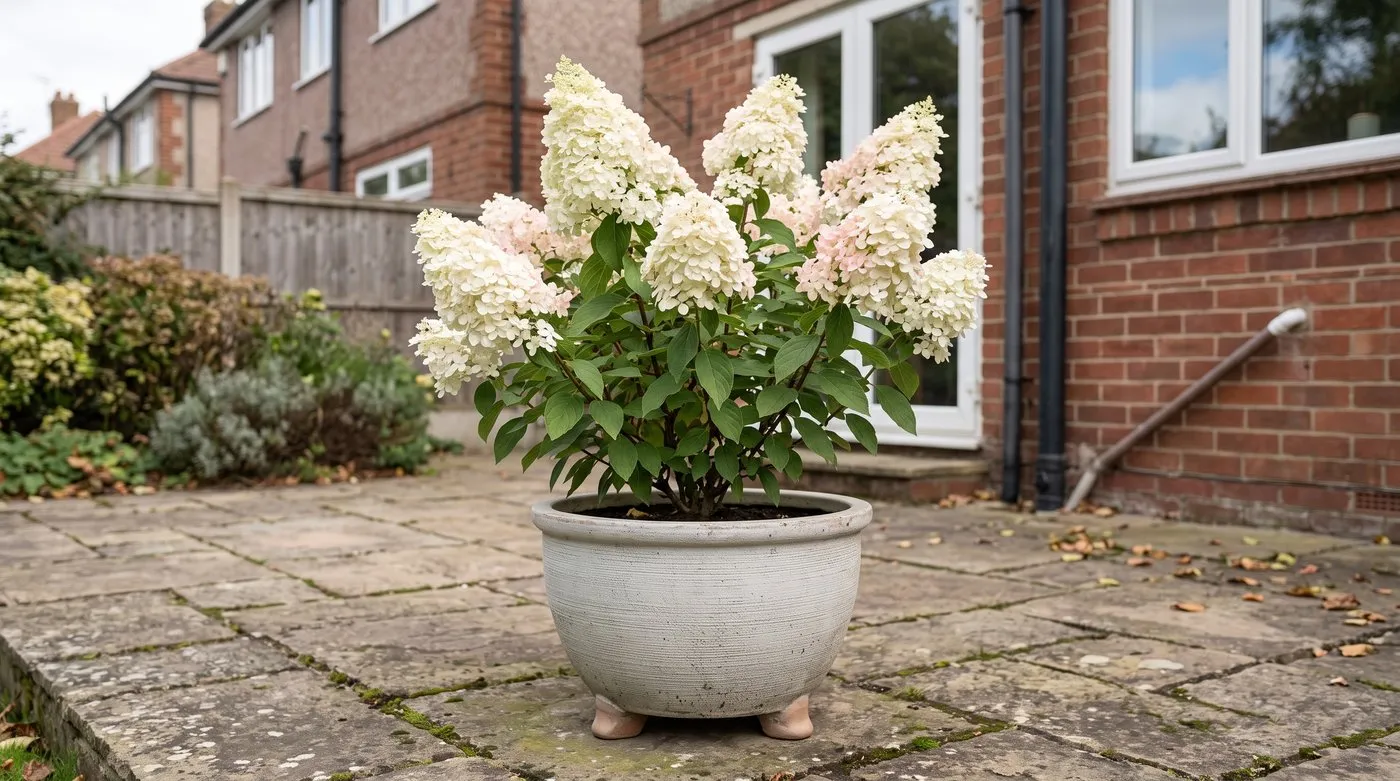
A 40cm-plus pot gives the roots room and holds enough water to see a hydrangea through a warm day.
Big mophead varieties eventually need a pot 50-60cm wide. Glazed ceramic and thick terracotta keep roots cooler than thin black plastic, which heats up in the sun. If you use plastic, choose a pale colour or slip it inside a decorative outer pot.
Drainage really matters. Hydrangeas like moist compost but hate sitting in water. Check the holes are clear, and stand the pot on feet rather than in a saucer, especially in winter.
Which compost is best for hydrangeas in pots?
Use ericaceous compost (compost for acid-loving plants) if you want blue flowers. Use a good peat-free multipurpose compost for pink or white ones.
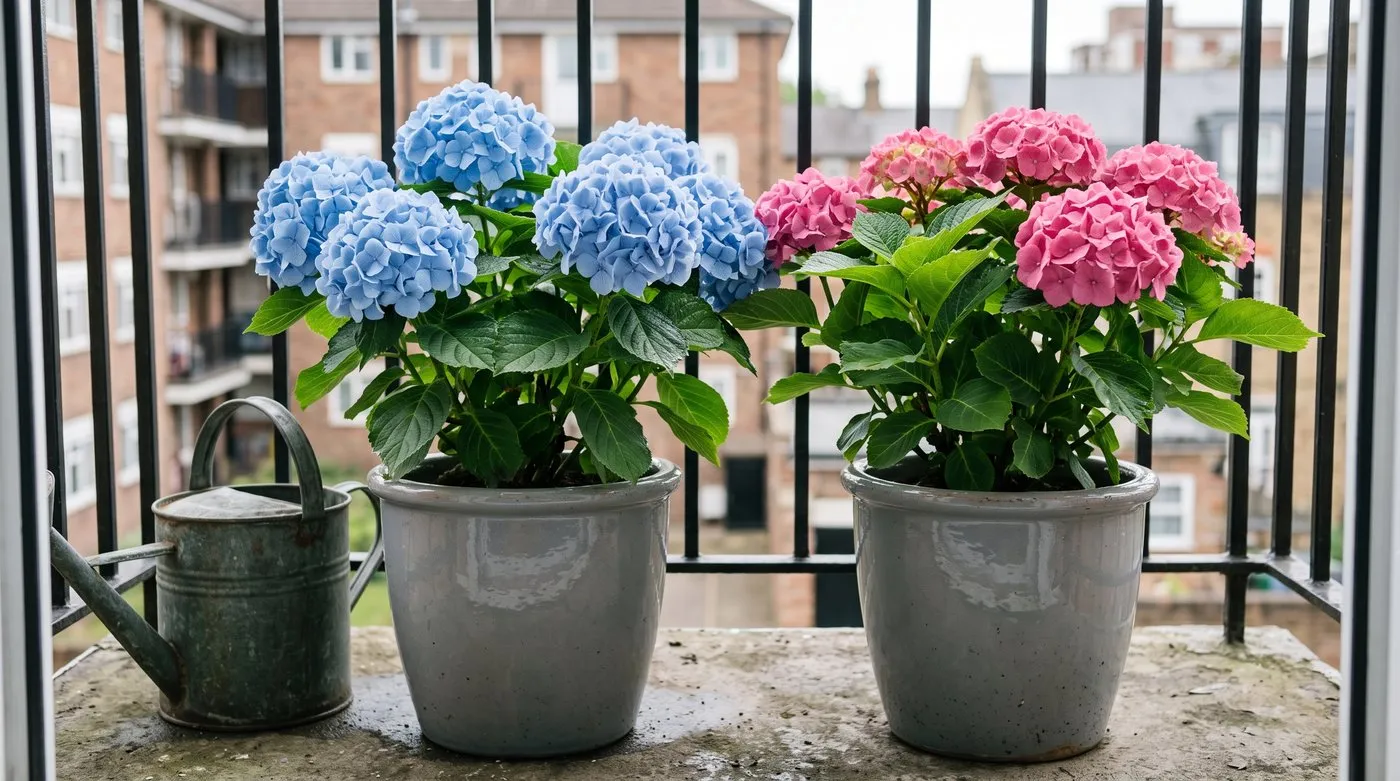
Same type of plant, different compost. Ericaceous compost and rainwater keep mopheads blue, while ordinary compost tends to turn them pink.
Compost choice affects colour only on mophead and lacecap hydrangeas. Acid conditions let the plant take up aluminium, which turns flowers blue. In ordinary or limy compost, the same plant flowers pink. Paniculata types stay white or lime-and-pink whatever you use.
For blue, water with rainwater where you can, as hard tap water slowly makes compost less acidic. A hydrangea colourant, used as the pack directs, helps keep them blue. Our guide to keeping hydrangeas blue goes into the detail. To switch from one colour to the other, read our guide on how to change hydrangea colour.
How to plant a hydrangea in a pot
Pot up in March or April, just before new growth starts. Early autumn also works.
- Soak the rootball in a bucket of water for half an hour.
- Put a few crocks or a little gravel over the drainage holes.
- Part-fill the pot with compost.
- Set the plant at the same depth it was in its old pot, never deeper.
- Fill around the rootball and firm gently with your fingers.
- Leave a gap of about 3cm below the rim for watering.
- Water well until it runs out of the bottom.
- Add a thin mulch of bark to help hold in moisture.
Stand the pot where it gets morning sun and afternoon shade. An east-facing patio or wall is ideal. Hot afternoon sun scorches mophead leaves and dries the compost fast, while deep shade means fewer flowers.
Pet note: Hydrangeas are toxic to cats and dogs if they chew the leaves or flowers. Keep pots away from pets that like to nibble.

Repotting in spring gives the roots fresh compost and room to grow. Tease out any roots circling the old rootball first.
Watering and feeding hydrangeas in pots
Watering is the make-or-break job. Those big leaves lose a lot of water, and a pot holds much less than open ground.
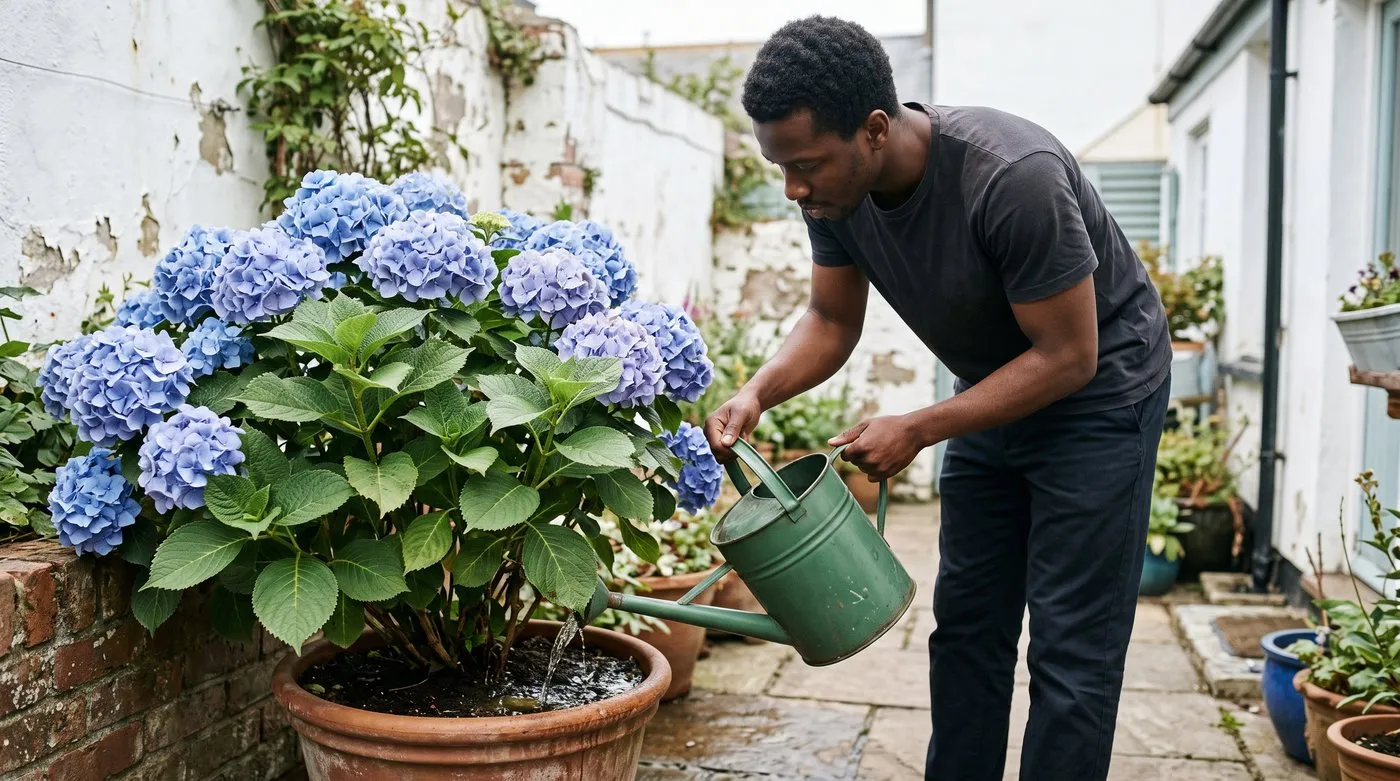
Water at the base, not over the flowers, and give it a proper soak. A morning drink sets it up for a warm day.
- Summer: check every day. Water whenever the top few centimetres are dry. In heatwaves that may be morning and evening.
- Spring and autumn: usually every few days.
- Winter: only when the compost is dry.
A hydrangea flopping on a hot afternoon often perks up by evening. If it’s still limp the next morning, the compost is dry and needs a long soak. Grouping pots together and mulching the surface both help.
Feed every two weeks from April to August. An ericaceous liquid feed suits blue hydrangeas. A general liquid feed or tomato feed is fine for pink and white ones. Stop feeding by September, so the stems firm up before winter.
How to prune hydrangeas in pots
How you prune depends on the type. Get it wrong and you cut off next year’s flowers.
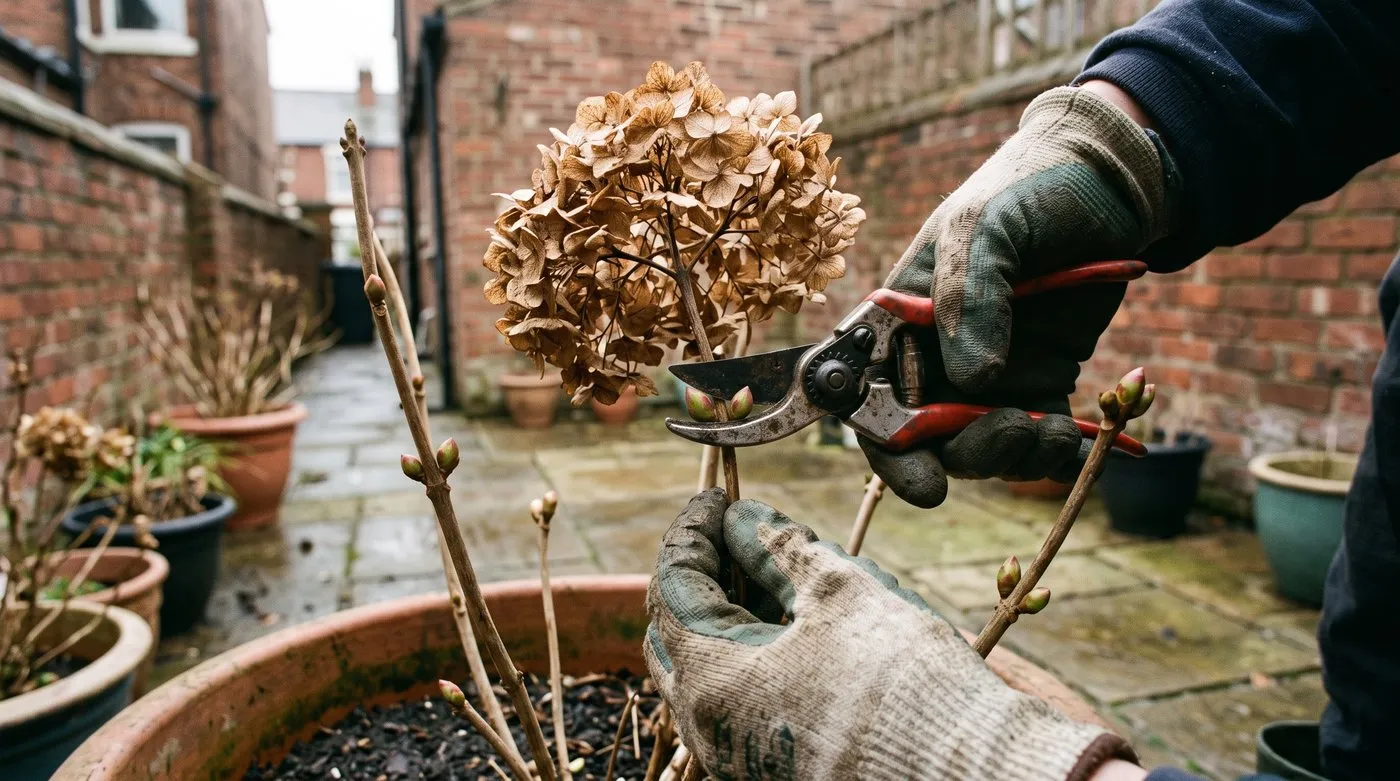
Cut back to the first pair of fat, healthy buds. Those buds carry this summer’s flowers, so leave them be.
Mopheads and lacecaps flower on stems grown the year before. Leave the dead flower heads on over winter, as they protect the buds below. In March or April, cut each old flower head back to the first pair of fat, healthy buds. Take out any dead or very weak stems at the base.
Paniculata types such as Bobo and Little Lime flower on new growth. Cut them back in late winter or early spring, to a low framework of stems a few buds from the base. This keeps them compact in a pot.
Our guide on pruning hydrangeas has step-by-step pictures for each type. If your plant is all leaves and no flowers, see why a hydrangea won’t flower.
Winter care for hydrangeas in pots
Roots in a pot get much colder than roots in the ground. A long freeze can damage them even though the plant is hardy in a border.
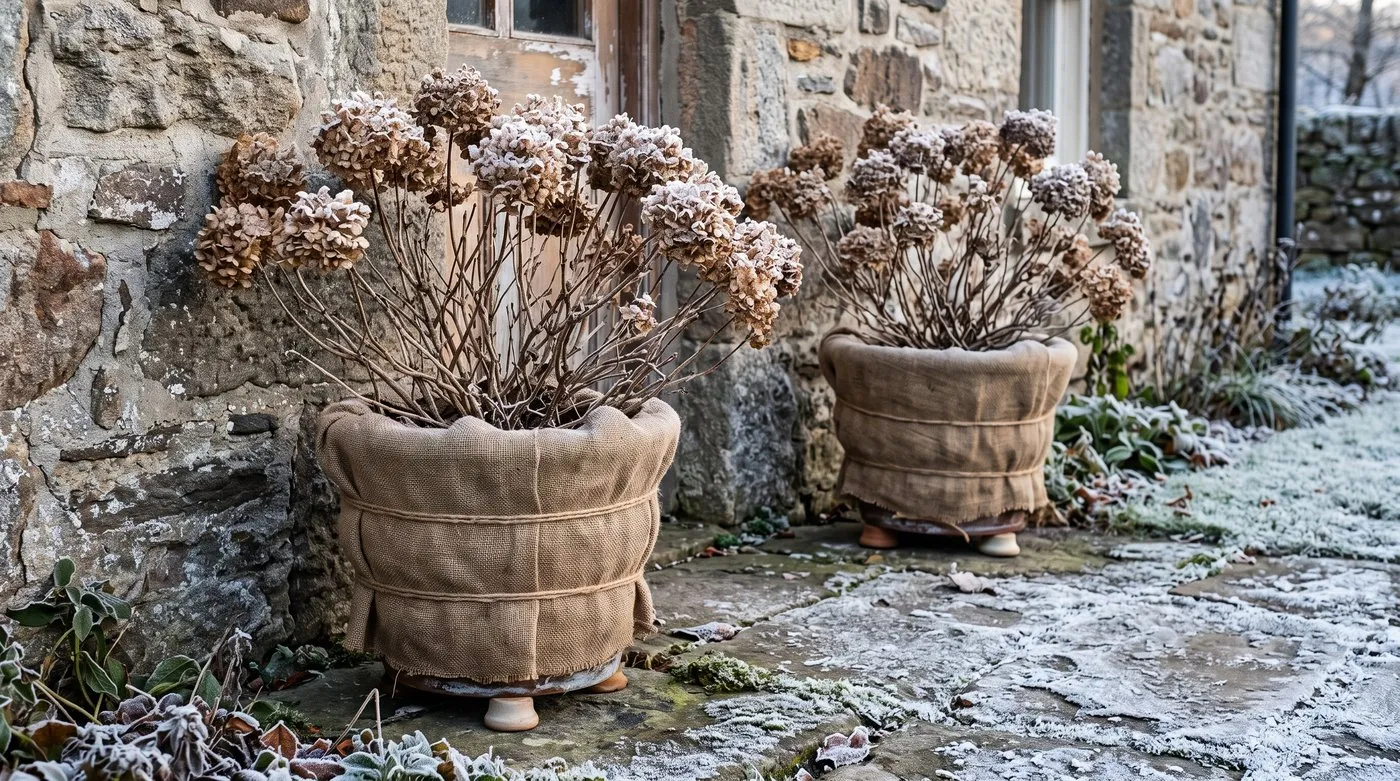
Wrapped, raised and tucked against a wall. Leave the old flower heads on too, as they shelter the buds below.
- Move pots to a sheltered spot by a wall, out of cold wind.
- Raise them on pot feet so they don’t sit in water, and remove saucers.
- In hard frosts, wrap the pot in bubble wrap or hessian.
- Cover the top of mopheads with fleece if a hard frost is forecast in spring, when the buds are swelling.
- In a really cold spell, an unheated greenhouse, shed or garage is a good bolt hole.
Don’t bring hydrangeas into a heated house. They need a cool winter rest to flower well the following summer.
Check the roots for vine weevil grubs when you repot. These C-shaped cream grubs eat roots in pots. Our guide to vine weevil treatment covers what to do.
Month-by-month care for hydrangeas in pots
| Month | What to do |
|---|---|
| January | Keep pots raised on feet. Wrap them in hard frosts |
| February | Prune paniculata types back to a low framework |
| March | Prune mopheads and lacecaps to the first fat buds. Repot if needed |
| April | Start feeding every two weeks. Fleece mopheads if a hard frost is forecast |
| May | Water more as leaves grow. Move pots to their summer spot |
| June | Flowers begin. Check watering every day |
| July | Peak flowering. Water morning and evening in hot spells |
| August | Last feed of the year. Take cuttings from shoots without flowers |
| September | Stop feeding. Water less as it cools |
| October | Remove saucers and raise pots on feet. Move to a sheltered spot |
| November | Wrap pots if a hard frost is forecast. Leave old flower heads on |
| December | Water only if dry. Check wraps after storms |
Common mistakes with hydrangeas in pots
A pot that’s too small. Small pots dry out in hours and blow over in wind. Start at 40cm wide and size up as it grows.
Sitting in a saucer all winter. Rain fills the saucer and the roots rot. Take saucers away in autumn and use pot feet.
Pruning mopheads in autumn. Next year’s flower buds are already at the stem tips. Leave the old heads on until spring.
Letting it dry out in summer. One very dry day can brown the flowers and crisp the leaves. Check every day in warm weather.
Using the wrong compost for blue. Multipurpose compost turns most blue hydrangeas pink or purple. Use ericaceous compost and rainwater for blue.
Once your hydrangea fills its pot, root pruning a pot-bound plant keeps it flowering at the same size. For more container ideas, browse the plants section.
Frequently asked questions
Can hydrangeas grow in pots all year round?
Yes, hydrangeas live happily in pots all year. Use a pot at least 40cm wide with drainage holes. In winter, move it somewhere sheltered, raise it on pot feet and wrap the pot in hard frosts, as roots in a container get colder than roots in the ground.
Why are my potted hydrangea leaves turning yellow?
Usually the compost is too alkaline, the pot is waterlogged, or it needs feeding. Yellow leaves with green veins point to alkaline compost, often from hard tap water. Repot into ericaceous compost, water with rainwater and feed with an ericaceous feed. Check the drainage holes aren’t blocked.
How often should I water hydrangeas in pots?
Check them every day in summer and water whenever the top few centimetres feel dry. In hot spells that may mean every day, or even twice. In spring and autumn, every few days is usually enough. In winter, water only if the compost is dry.
What size pot does a hydrangea need?
Start with a pot at least 40cm wide. Larger mophead varieties eventually need 50-60cm pots. Compact varieties manage in slightly smaller pots. Move up one pot size every couple of years, or root prune to keep the plant in the same pot.
Can I change my hydrangea colour in a pot?
Yes, and it’s easier in a pot than in the ground. For blue, use ericaceous compost, rainwater and a hydrangea colourant. For pink, use ordinary compost and tap water. Only mophead and lacecap hydrangeas change colour, and it takes a season to show.
When should I repot a hydrangea?
Repot in March or April, before new growth gets going. Move it into a pot a few centimetres wider, tease out circling roots and use fresh compost. Most potted hydrangeas need repotting every two or three years.
Do hydrangeas in pots need feeding?
Yes, feed every two weeks from April to August. A liquid ericaceous feed suits blue hydrangeas, and a general or tomato feed suits pink and white ones. Stop by September so the stems firm up before winter.
Our team produces practical UK gardening guidance from source research, contributor records and established horticultural practice. Editorial standards are overseen by Matt W.


