Key takeaways
- Mophead and lacecap hydrangeas flower on last year's stems, so don't cut them back in autumn or winter
- Prune them lightly in late March, just above the first pair of fat buds
- Late spring frost can kill the buds, so cover plants with fleece on frosty nights
- Too much nitrogen, often from lawn feed, gives lots of leaves and no flowers
- Hydrangeas need a few hours of sun, ideally in the morning
- Paniculata and 'Annabelle' types flower on new growth, so frost and hard pruning don't stop them
A hydrangea that’s all leaves and no flowers is a very common worry in UK gardens. The good news is that there’s usually a simple reason, and a simple fix. Nine times out of ten, it comes down to pruning at the wrong time or a late frost.
What causes a hydrangea not to flower?
There are seven usual suspects. Pruning at the wrong time is top of the list, followed by late frost and too much nitrogen feed. Find your symptoms in the table, then jump to the section that matches.
| Cause | What you’ll see | How common? | Fix |
|---|---|---|---|
| Pruning at the wrong time | Healthy plant, no flower buds at the stem tips | Very common | Prune mopheads in late March only |
| Late frost | Blackened buds and brown stem tips in spring | Common | Fleece on frosty nights, March to May |
| Too much nitrogen | Lush dark leaves, strong growth, no buds | Fairly common | Switch to a high-potash feed |
| Too much shade | Leggy stems, pale leaves, few flowers | Fairly common | Move it or let in more light |
| Young plant | Small plant, planted in the last couple of years | Common with new plants | Give it 2-3 years |
| Soil problem | Yellow leaves, slow growth | Less common | Test the soil and adjust |
| Drought | Wilting in summer, crispy edges, buds dropping | Less common in most of the UK | Mulch and water weekly in dry spells |

Plenty of leaves but no flowers usually means pruning at the wrong time or a late frost.
Did you prune at the wrong time?
This is the number one reason. Mophead and lacecap hydrangeas make next year’s flower buds on this year’s stems in late summer. Gardeners call this flowering on “old wood”. Cut the stems back in autumn, winter or early spring and you cut off every flower bud.
The correct pruning method for mopheads and lacecaps
Wait until late March. On each stem, find the first pair of fat, plump green buds below the old dead flower head. Cut just above them. Take out any dead, damaged or crossing stems at the base. That’s it.
Those fat buds are this summer’s flowers, so cutting above them keeps them safe. The RHS pruning guide for hydrangeas has handy pictures if you’d like to double-check.

Older stems with fat, rounded buds (left) will flower. Soft new green stems (right) won’t flower until next year.
Is late frost killing your flower buds?
Often, yes. The buds start to swell in early spring, and a hard frost in April or May can turn them brown. The plant then sprouts new leafy shoots lower down, so you get leaves but no flowers.
How to protect hydrangeas from late frost
When frost is forecast from March to May, drape horticultural fleece over the plant overnight. A double layer is better than one. Take it off in the morning so the plant gets light and air.
For the long term, plant mopheads by a south or west-facing wall, which stays a bit warmer at night. If you’re browsing plants that thrive in shade, remember hydrangeas still need at least 4 hours of light.
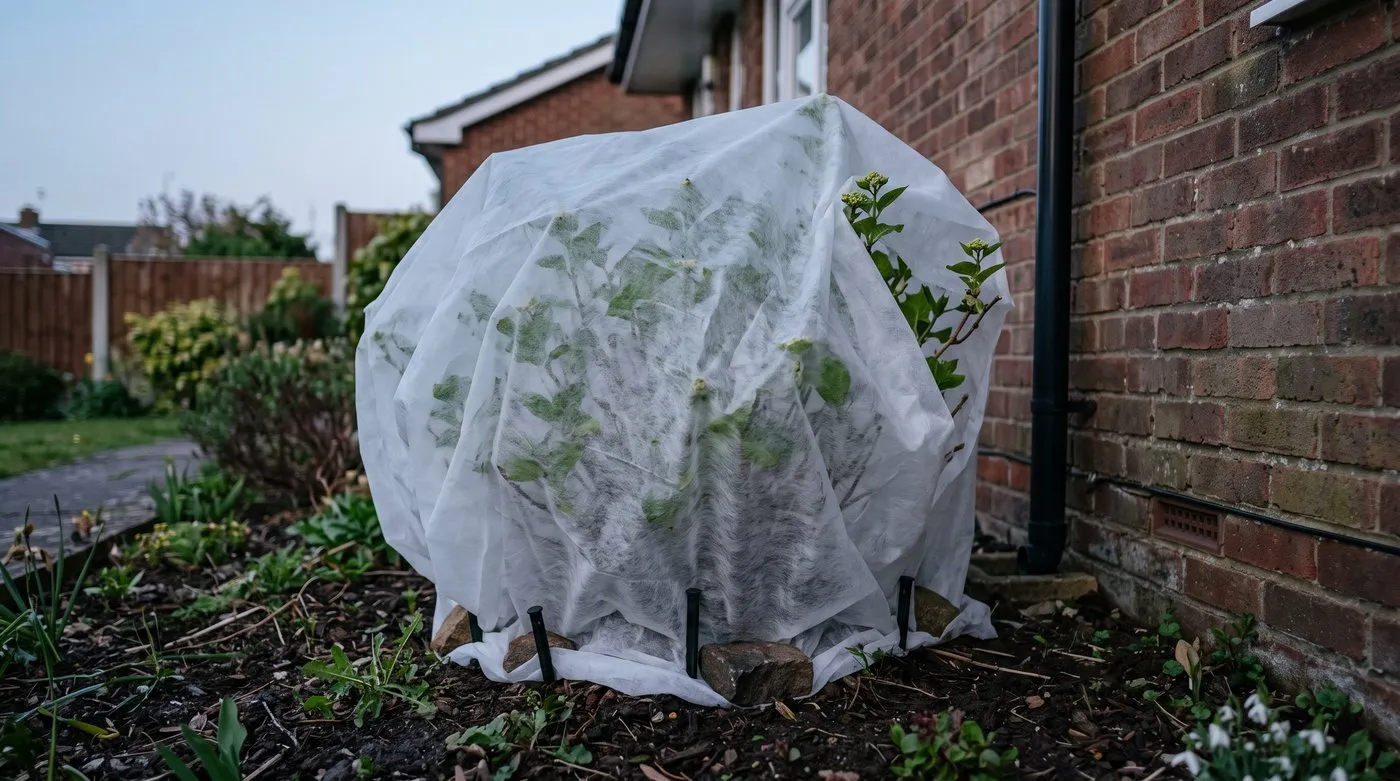
Swelling buds are most at risk from mid-March to mid-May. Fleece on frosty nights, then take it off in the morning.
Are you feeding too much nitrogen?
Nitrogen makes leaves. Give a hydrangea too much and you’ll get a big, lush, dark green plant with no flowers.
A sneaky source is lawn feed. Spring lawn feeds are rich in nitrogen, and rain can wash them into the border next to the grass. If your hydrangea sits at the edge of the lawn, it may be getting the lawn’s dinner.
The feeding fix
Switch to a high-potash feed such as tomato feed. Use it at half strength every two weeks from April to July, then stop so the stems can firm up before winter.
Prefer granules? Scatter sulphate of potash around the plant in March, following the rate on the pack.
| Feed | What it does | Use near hydrangeas? |
|---|---|---|
| Lawn feed | Lots of leaves, no flowers | No, keep it on the lawn |
| General-purpose feed | Steady growth, average flowers | It’s fine, but not the best |
| Tomato feed | Helps flower buds form | Yes, the best liquid choice |
| Sulphate of potash | A potash boost with no nitrogen | Yes, the best granular choice |
| Rose feed | Balanced feed for shrubs | Yes, a good alternative |
Is your hydrangea in too much shade?
Hydrangeas need around 4-6 hours of sun a day to flower well. The perfect UK spot gets morning sun and afternoon shade.
Signs it’s too dark: long stems leaning towards the light, pale leaves and few or no buds. Under a dense tree or on the north side of a house with no direct sun, shade is probably the problem.
What to do about shade
If the plant is small enough, move it in November to a spot with at least 4 hours of morning sun. If not, try lifting the lower branches of nearby trees to let more light in.
Dappled shade under an open tree is usually fine. It’s deep, year-round shade from buildings and evergreen hedges that causes trouble. For those really dark spots, camellias are a better bet.

Enough light, the right pruning and a potash feed: that’s the recipe for a hydrangea full of flowers.
How to prune each hydrangea type
Different hydrangeas need very different pruning, so check which one you have first. If you know the pruning groups for how to grow clematis, the idea is much the same.
Hydrangeas that flower on old wood
Mopheads and lacecaps (H. macrophylla), H. serrata and the oak-leaf hydrangea (H. quercifolia) flower on last year’s stems. Prune them in late March only, cutting back to the first pair of fat buds. Never cut them down hard. If one is overgrown, remove up to a third of the oldest stems at the base each year for three years.
Hydrangeas that flower on new wood
H. paniculata (such as ‘Limelight’ and ‘Vanilla Fraise’) and H. arborescens (such as ‘Annabelle’) flower on stems that grow this year. Prune them hard in late February or March. Harder pruning gives fewer but bigger flower heads.
Climbing hydrangeas
The climbing hydrangea (H. petiolaris) needs very little pruning. Just trim dead or wayward stems after it flowers in summer. It also copes with shade better than other hydrangeas.
| Type | Flowers on | When to prune | How hard | Popular varieties |
|---|---|---|---|---|
| Mophead | Old wood | Late March | Light, to the first fat buds | ’Nikko Blue’ |
| Lacecap | Old wood | Late March | Light, to the first fat buds | ’Mariesii’, ‘Blue Wave’ |
| H. serrata | Old wood | Late March | Light, to the first fat buds | ’Bluebird’, ‘Preziosa’ |
| Oak-leaf | Old wood | Late March | Light, just dead wood | ’Snow Queen’, ‘Alice’ |
| Paniculata | New wood | Late February-March | Hard, to 30-45cm | ’Limelight’, ‘Vanilla Fraise’ |
| Arborescens | New wood | Late February-March | Hard, to 15-30cm | ’Annabelle’, ‘Incrediball’ |
| Climbing | Old wood | After flowering (summer) | Very light, dead wood only | Species type |
Could frost damage be the hidden problem?
Frost damage is easy to miss, because the plant bounces back with healthy leaves. The buds die, new leafy shoots grow from lower down, and the plant looks fine, just without flowers.

Brown, blackened bud tips in spring are a sure sign of frost damage. Those buds won’t flower.
The risky time is from mid-March to mid-May, when the buds are swelling and tender. Dormant buds in winter are much tougher.
If your garden is a frost pocket, try H. paniculata instead. It flowers on new growth, so spring frost can’t take its flowers. ‘Limelight’ and ‘Little Lime’ are lovely, dependable choices. And if you fancy changing the colour of existing hydrangeas, only mopheads and lacecaps change colour with the soil.
Other causes of hydrangeas not flowering
Young plants need time
New hydrangeas spend their first year or two growing roots. That’s normal. Most flower properly in their second or third summer. Plants bought in flower may take a year off after planting out while they settle in.
Wrong soil pH
Hydrangeas grow in most soils, but very chalky or very acid soil can leave them short of nutrients. The RHS hydrangea growing guide suggests testing your soil before planting. Leaves that go yellow between the veins are a clue. On very chalky soil, mulch with ericaceous compost and use a sequestered iron feed. Our guide to plants for acid soil has more on acid-loving plants.
Drought stress
Hydrangeas have shallow roots and wilt quickly in dry weather. A long dry spell can make them drop their buds. Mulch with 8-10cm of bark or compost in spring, and give each plant a good soak of 10-15 litres once a week in dry spells. Hydrangeas in pots dry out even faster, as our guide to growing hydrangeas in pots explains.
Month-by-month hydrangea care calendar
| Month | What to do | Why |
|---|---|---|
| January | Leave alone | The old flower heads protect the buds |
| February | Work out which type you have | So you prune it the right way |
| March (late) | Prune | Mopheads lightly, paniculata and ‘Annabelle’ hard |
| March-May | Watch for frost | Fleece on frosty nights |
| April | First feed | Tomato feed at half strength, or sulphate of potash |
| May | Mulch | 8-10cm of bark or compost around the roots |
| June | Keep feeding | Tomato feed at half strength every two weeks |
| July | Last feed | Then stop, so stems firm up before autumn |
| August | Don’t prune | Next year’s buds are forming on old-wood types |
| September | Water less | Let the growth harden off |
| October | Leave alone | Old flower heads protect the new buds |
| November | Move if needed | Shift plants while they’re dormant |
| December | Leave alone | Nothing to do |
Common mistakes that stop hydrangeas flowering
1. An autumn tidy-up. Cutting mopheads back in October or November removes every bud. Leave the dead heads on over winter. They look lovely with frost on them and help protect the buds.
2. Lawn feed near the border. Keep lawn feed off the borders and away from your hydrangeas.
3. Deep shade. A dark north wall or a spot under evergreens gives you leaves but no flowers.
4. Hard pruning every type the same way. Paniculata and ‘Annabelle’ types like it. Mopheads and lacecaps don’t. Treat them all alike and half will sulk.
5. Ignoring spring frost forecasts. One hard frost can cost you a summer of flowers. A few minutes with some fleece is all it takes to save them.
Now you know what’s going on, our guide to the best fertilisers for UK gardens will help you get the feeding right for all your shrubs.
Frequently asked questions
Why is my hydrangea not flowering but has lots of leaves?
Too much nitrogen is the most likely cause. Rich feeds and lawn fertiliser washing into the border push out leaves instead of flowers. Switch to a high-potash feed like tomato feed in April and June, and flowers should return the following summer. Check it gets at least 4 hours of sun a day too.
When should I prune hydrangeas to avoid losing flowers?
Prune mopheads and lacecaps in late March only. Cut each stem back to the first pair of fat green buds below the old flower head. Never prune them in autumn or winter. Paniculata and ‘Annabelle’ types are different. Prune those hard in late February or March, as they flower on new growth.
Will a hydrangea that was pruned too hard flower again?
Yes, but it skips a year. A mophead or lacecap cut right down in winter grows lots of leafy stems that summer, but no flowers. Those stems make buds in late summer and flower the year after, as long as you don’t prune them again and frost doesn’t get them.
How do I protect hydrangea buds from late frost?
Cover plants with fleece on frosty nights from March to May. A double layer of horticultural fleece gives better protection. Take it off during the day so the plant gets light and air. A spot by a south or west-facing wall is warmer and safer.
Do hydrangeas need full sun to flower in the UK?
No, but they do need some sun. Aim for 4-6 hours a day. Morning sun with afternoon shade is perfect. Deep shade means few or no flowers. Hot afternoon sun in the south can scorch the leaves, while further north they cope with more sun.
What feed makes hydrangeas flower more?
A high-potash feed such as tomato feed. Use it at half strength every two weeks from April to July. Keep lawn feeds and other high-nitrogen fertilisers away from hydrangeas. If you prefer granules, scatter sulphate of potash around the plant in March, at the rate on the pack.
How long does it take for a new hydrangea to flower?
Usually two or three years after planting. In the first year a hydrangea puts its energy into growing roots. Most give their first proper flowers in the second summer. Plants bought already in bud may flower in their first year.
Our team produces practical UK gardening guidance from source research, contributor records and established horticultural practice. Editorial standards are overseen by Matt W.