Key takeaways
- Pyracantha grows in almost any soil, aspect and part of the UK
- Prune after flowering in July, so you don't cut off the berries
- Orange Glow and Soleil d'Or give big berry crops but can get scab
- The Saphyr range (Rouge, Orange, Jaune) was bred to resist scab
- Plant hedges 45cm apart for a thick, thorny boundary
- Blackbirds, thrushes, redwings and waxwings all feast on the berries
Pyracantha is one of the best shrubs for year-round interest in a UK garden. This thorny evergreen is covered in white flowers in early summer, then heavy clusters of berries from September well into winter. Birds love the berries in the coldest months, and the dense, spiky growth makes a brilliant natural barrier.
It’s often called firethorn and is a member of the rose family. The RHS pyracantha growing guide has more detail, and several varieties hold the RHS Award of Garden Merit. Whether you want it on a wall, as a hedge or as a shrub on its own, pyracantha delivers. Here’s how to plant, train, prune and look after it.
What is pyracantha?
Pyracantha is an evergreen shrub with sharp thorns. Its glossy dark leaves stay on all winter, giving your garden shape when other plants are bare. In early summer, every branch is covered in clusters of tiny white flowers that bees and hoverflies love.
The flowers turn into berries that ripen from September. Depending on the variety, they’re orange, red or yellow. They hang on for months until the birds strip them. A mature plant on a sunny wall can carry thousands of berries in a good year. Evergreen leaves, summer flowers, autumn berries and thorny security make it one of the most useful shrubs you can grow.

Pyracantha flowers in early summer are busy with bees and hoverflies.
Why grow pyracantha in your garden?
Pyracantha earns its place on practical grounds alone. The thorny growth makes a barrier nobody wants to push through, which makes it a popular choice for boundaries and under windows. It looks much nicer than a plain fence too.
For wildlife, it’s outstanding. The flowers feed pollinators in early summer. The berries feed blackbirds, thrushes, redwings and fieldfares through autumn and winter. The dense evergreen growth gives robins, wrens and dunnocks safe places to nest. One well-grown plant can help a lot of wildlife all year round.
Best pyracantha varieties for UK gardens
The right variety makes a difference. Berry colour, shape, size and scab resistance all vary. Here are five of the most reliable.
Orange Glow is the pyracantha you’ll see most in the UK. It has huge clusters of bright orange berries and grows strongly to about 4m. Its one weakness is scab in wet summers. Even so, it’s hard to beat for sheer berry numbers.
Soleil d’Or has golden-yellow berries that ripen a little later than orange ones. It grows to 3-4m and is slightly more upright. Birds often leave yellow berries until last, so the display can last longer.
Red Column grows tall and narrow, so it’s perfect for tight spaces. Bright red berries cover it from September. It reaches about 3m tall but stays around 1.5m wide. Choose this one for a narrow wall.
Mohave is an American variety with heavy crops of orange-red berries. It’s tough, vigorous and less prone to disease than Orange Glow.
The Saphyr range (Rouge, Orange and Jaune) was bred in France to resist scab. If scab is a problem near you, these are the answer. Berry crops are good, though not quite as heavy as Orange Glow.
How to plant pyracantha
Pyracantha copes with almost anything. It loves full sun but also grows in part shade and even on north-facing walls. Clay, loam, chalk or sand are all fine, as long as the ground doesn’t waterlog in winter. Pot-grown plants can go in any time, but autumn planting lets the roots settle before spring.
Dig a hole twice as wide as the root ball and the same depth. Mix in garden compost if the soil is poor. Plant at the same depth it was in its pot, water well and mulch with 5cm of bark or compost. Against a wall, plant 30-45cm out from the base, where the soil is less dry. Lean the stems towards the wall and tie them to wires from the start.
Water new plants regularly through their first two summers. After that, it only needs watering in a long drought. It rarely needs feeding either. A spring mulch of garden compost is plenty.
Training pyracantha against walls and fences
Training pyracantha flat against a wall gives you a neat, berry-covered screen that takes up little space. Fix horizontal galvanised wires to the wall every 30cm using vine eyes, starting 45cm from the ground. Use vine eyes that hold the wires about 10cm away from the bricks so air can move behind the plant.
Tie in the main stems in a fan shape, spread evenly across the wires, using soft twine or stretchy plant ties. As new side shoots grow through spring and summer, tie in the ones running along the wall. Remove or shorten those growing straight out. You’re aiming for a flat framework of branches that sits snugly against the wall.

A neatly clipped pyracantha hedge makes a thick, colourful boundary.
How to prune pyracantha for maximum berries
Timing is everything. Pyracantha flowers on short spurs that grow on older wood. Heavy pruning in winter or spring cuts off these spurs, and with them the year’s berries. The best time to prune is just after flowering, usually July.
Use sharp secateurs and loppers, and wear thick gloves and eye protection, because the thorns are vicious. Cut the soft new outward shoots back to two or three buds from the main framework. That keeps the plant flat to the wall while leaving the short spurs that carry flowers and berries. Take out any dead, damaged or crossing branches at the same time.
Freestanding shrubs need very little pruning. Trim after flowering if you want to shape them, but avoid cutting into old, bare wood unless you’re rescuing a neglected plant. Pyracantha does regrow after hard pruning, but it takes two or three years to berry well again.
Before trimming in summer, check for nesting birds. It’s against the law to disturb an active nest, so wait until the young have flown if you find one.
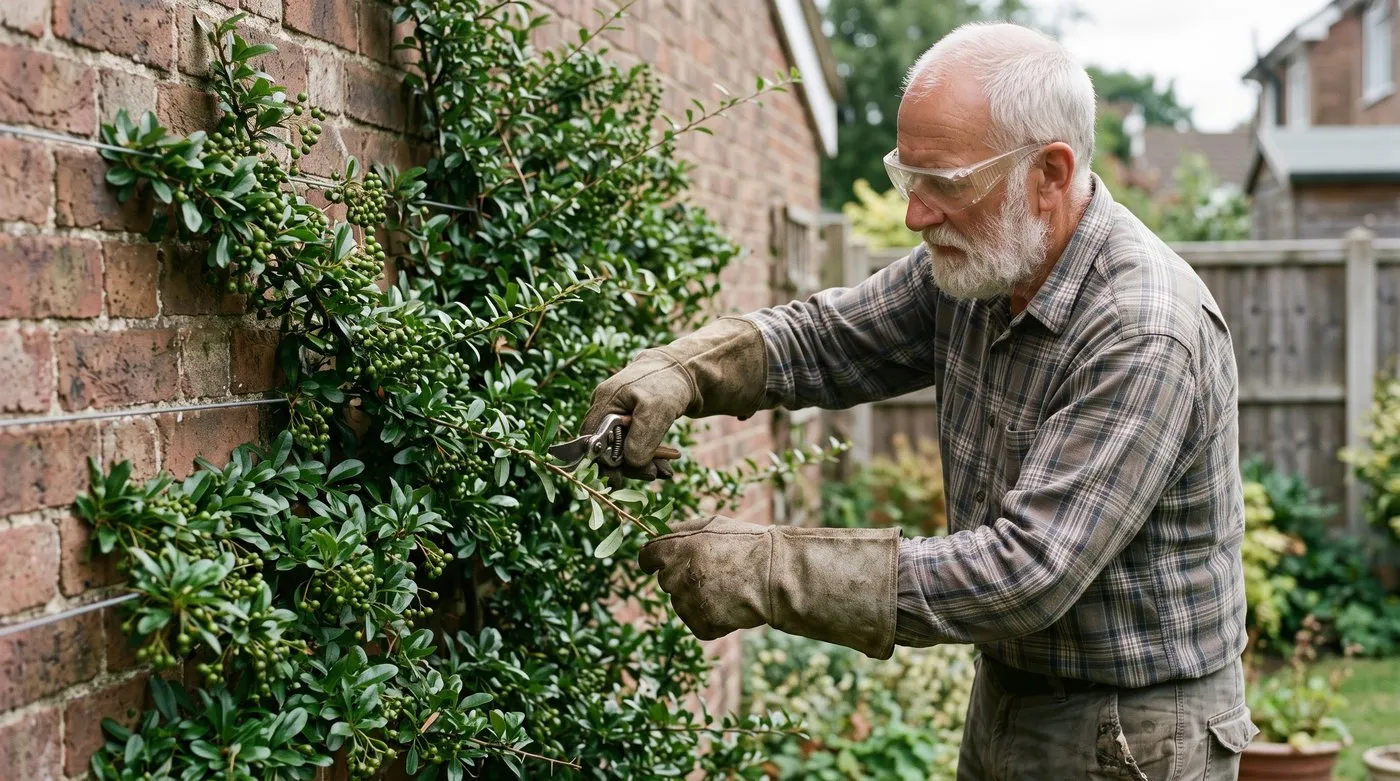
Prune just after flowering and cut soft outward shoots back to two or three buds. Leaving the short spurs keeps this year’s berries on the plant.
Growing pyracantha as hedging
Pyracantha makes one of the best security hedges you can plant. Dense evergreen growth and fierce thorns make a barrier nobody wants to push through, and it’s far better for wildlife than a fence.
Plant pot-grown plants 45cm apart in a single row. For an extra-thick barrier, plant a staggered double row with plants 60cm apart and 30cm between rows. Stick to one variety for a uniform look, or mix them for a blend of red, orange and yellow berries. Red Column suits hedging well thanks to its upright shape, while Orange Glow works if you have room for it to spread.
Trim twice a year: in July after flowering, and lightly again in early September. Use shears or a hedge trimmer. The July trim shapes the hedge, and the September trim tidies late shoots without losing many berries. A pyracantha hedge reaches its full 2-3m in about four or five years. Let it grow at least 60cm wide to make it properly impenetrable.
Pyracantha pests and diseases
Scab is the main problem. This fungal disease leaves olive-brown to black marks on berries and leaves. Infected berries shrivel and go dark, and in a bad year whole clusters are spoiled. Wet summers make it worse. Cut out and bin infected growth promptly and water the soil, not the leaves. If scab keeps coming back, switch to a Saphyr variety.
Woolly aphid sometimes appears as white, waxy tufts on the stems. It’s usually minor. Scrub the tufts off with a stiff brush and let ladybirds and lacewings do the rest. Sprays are rarely needed.
Fireblight is a bacterial disease that can hit pyracantha. Shoot tips turn black and wilt, as if scorched. Cut out affected growth well below the damage and clean your tools between cuts. It’s uncommon in garden pyracanthas.
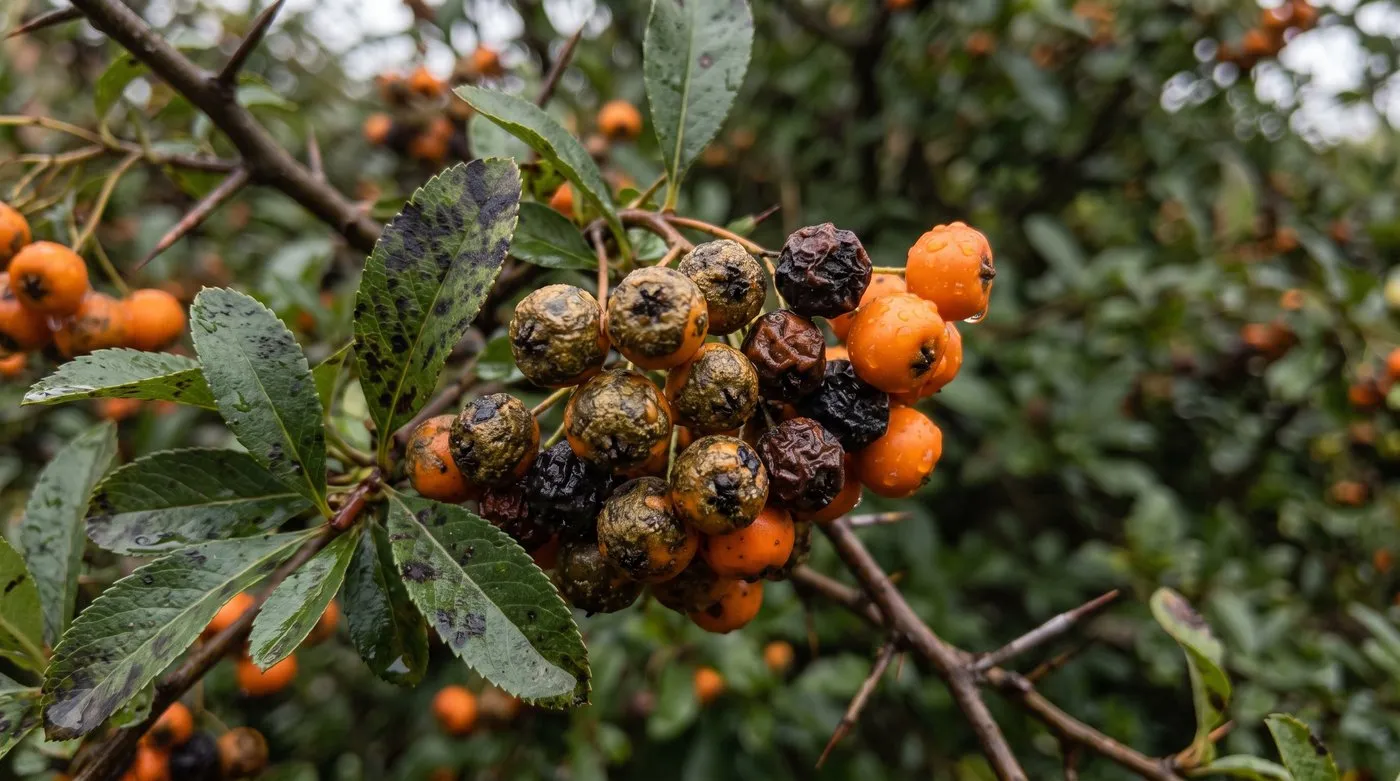
Dark, scabby blotches like these are pyracantha scab, worst in wet summers. If it keeps coming back, a scab-resistant Saphyr variety is the easy answer.
Birds and wildlife value
Pyracantha is one of the best garden plants for British birds. The berries ripen from September and can last into late winter. Blackbirds usually tuck in first, followed by song thrushes, mistle thrushes and starlings. In cold winters, redwings and fieldfares from Scandinavia arrive in flocks. Waxwings, the most exciting winter visitors, can strip a whole plant in a day.

Redwings from Scandinavia feast on pyracantha berries in the coldest months.
The dense, thorny growth gives smaller birds safe places to nest. Robins, wrens, dunnocks and blackbirds all nest in pyracantha, and the thorns help keep cats and magpies out. A pyracantha on a sheltered house wall makes a cosy nesting spot.
In early summer, the white flowers buzz with honeybees, bumblebees and hoverflies. That makes pyracantha a great addition to any pollinator-friendly planting.
Pyracantha variety comparison
| Variety | Berry colour | Size | Scab resistance | Shape |
|---|---|---|---|---|
| Orange Glow | Bright orange | Large (4m) | Low | Spreading |
| Soleil d’Or | Golden yellow | Large (3.5m) | Fair | Upright, spreading |
| Red Column | Bright red | Medium (3m) | Fair | Tall and narrow |
| Mohave | Orange-red | Large (4m) | Good | Vigorous, spreading |
| Saphyr Rouge | Deep red | Compact (2.5m) | Very good | Compact |
| Saphyr Orange | Orange | Compact (2.5m) | Very good | Compact |
| Saphyr Jaune | Yellow | Compact (2.5m) | Very good | Compact |
Orange Glow and Soleil d’Or give the biggest berry crops but are most prone to scab. The Saphyr range trades a few berries for strong scab resistance. Red Column is best for narrow spaces, wall training and neat hedges. Mohave is a safe all-rounder if you want good berries, decent disease resistance and strong growth.
For shady spots, all pyracanthas grow fine, though they carry fewer berries than in full sun. Even on a north-facing wall, it still gives a better winter berry show than most wall shrubs.
Companion planting and design ideas
Pyracantha looks great with other evergreen structure plants in a mixed border. Plant shade-lovers like epimedium, hellebores or brunnera underneath a wall-trained pyracantha. The dark leaves make a lovely backdrop for snowdrops and cyclamen in winter.
For a boundary, mix pyracantha with native hawthorn and holly for a wildlife-friendly hedge. Thorny berberis is another good partner in a security hedge, adding spring flowers and its own berries. Together they give birds berries over a long season. Let a climbing rose or clematis scramble through for summer colour between the flowers and berries.
In a formal garden, train pyracantha as an espalier with three or four flat tiers. It makes a smart feature with berries in neat bands. Clip carefully in July to keep the lines crisp.
Frequently asked questions
Is pyracantha easy to grow in the UK?
Yes, it’s one of the easiest shrubs you can grow. It’s happy in any well-drained soil, in sun or part shade, and it’s fully hardy across the UK. It copes with seaside wind, town pollution and neglect. The only thing it hates is soil that stays waterlogged in winter.
When is the best time to prune pyracantha?
Prune in July, once flowering has finished. Next year’s flowers grow from short spurs on older wood. A summer trim of the soft new shoots leaves those spurs alone. Heavy cutting in winter or early spring removes flower buds and berries. A light tidy in early September is fine too.
Does pyracantha damage walls and fences?
No, not if it’s trained properly. Unlike ivy, it has no clinging roots or sticky pads. You tie it to wires or a trellis fixed with vine eyes, and it simply rests against the wall. Use vine eyes that hold the wires about 10cm off the wall so air can move behind the plant.
How fast does pyracantha grow?
It grows about 30-60cm a year. A pot-grown plant from a garden centre can reach about 2m within three years. It grows fastest in full sun with regular watering in its first two summers. On a sunny wall, an established plant can reach 4m or more.
What is the best pyracantha variety for berries?
Orange Glow gives some of the heaviest berry crops. Soleil d’Or is the best yellow-berried variety. If scab is a problem, choose Saphyr Rouge or Saphyr Orange for good berries with scab resistance.
How do I treat pyracantha scab?
Cut out and bin affected growth. Scab shows as dark brown or black marks on berries and leaves. Thin out crowded branches so air can move, and water the soil rather than the leaves. The best long-term fix is a scab-resistant variety from the Saphyr range.
Can I grow pyracantha as a hedge?
Yes, it makes a fantastic hedge. Plant pot-grown plants 45cm apart for a thick barrier within a few years. Trim in July after flowering and again lightly in early September. The thorns make it a really effective boundary. A grown-up hedge reaches 2-3m tall.
Our team produces practical UK gardening guidance from source research, contributor records and established horticultural practice. Editorial standards are overseen by Matt W.