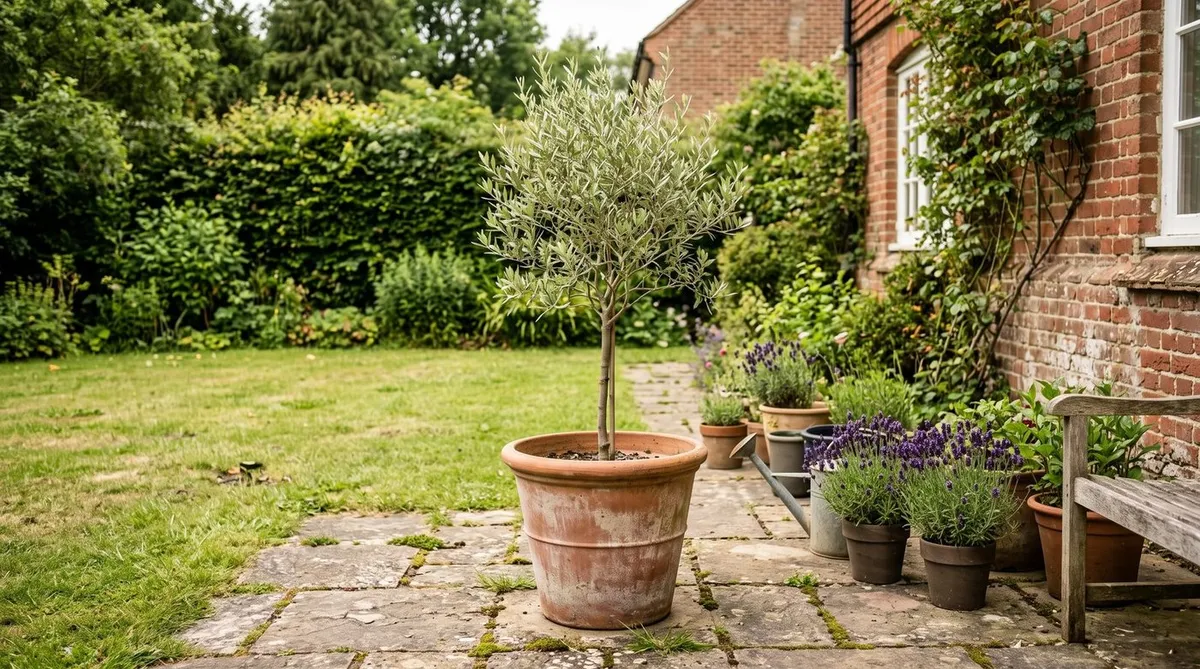
Key takeaways
- Yew and holly are the toughest evergreens, happy in sun or shade
- Strawberry tree and Japanese holly suit small gardens
- Plant between October and March, with the root flare at soil level
- Water new trees every week in dry spells for the first two summers
- Skip Leylandii in small gardens; Portugal laurel or yew make better screens
- Evergreens drop some old leaves each year, which is perfectly normal
The best evergreen trees for UK gardens are yew, holly, bay, Portugal laurel and strawberry tree. They give you shape, privacy and shelter for wildlife all year, with no bare winter months. The key is picking one that suits your soil and, above all, your space.
How evergreen trees establish and grow in UK conditions
Evergreens keep their leaves all year, so they keep using water even in winter. That’s why planting time, soil and watering matter so much in the first couple of years.
Root establishment: the first 18 months
Plant between October and March and the roots start growing straight away in the still-warm soil. Because the leaves stay on, the tree loses water through them all winter. The roots need to spread fast enough to keep up.
In clay soil, roots tend to spread outwards rather than down. They’ll keep growing through the first year, but they won’t reach far enough to look after the tree by themselves for a while. So keep watering through the first two dry summers.
Why autumn planting beats spring
Autumn gives the roots a head start. The soil is still warm, rain is reliable, and the tree isn’t growing much above ground. By the time summer comes, it has roots ready to find water. A tree planted in spring has to grow roots and cope with warm, dry weather at the same time, so it needs a lot more watering.
Leaf retention and the renewal cycle
Evergreens don’t keep each leaf forever. They drop some of their oldest leaves every year and grow fresh ones. Holly and yew hold on to each leaf for several years. Most of the shedding happens in late spring, and new growth soon fills any gaps.
So you’ll see a few fallen leaves under an evergreen tree. That’s normal, not a sign of disease.
 A mature yew with its dense, dark canopy. Few trees have more presence in a British garden.
12 best evergreen trees for UK gardens ranked
Not every evergreen suits every garden. A holm oak is magnificent in a park but a disaster in a small back garden. Use this table to find the right size and soil for your plot.
Evergreen tree comparison table
| Tree | Botanical name | Final size | Growth | Soil | Best for |
|---|---|---|---|---|---|
| English yew | Taxus baccata | Large | Slow | Most, including chalk | Specimen, hedge, topiary |
| Common holly | Ilex aquifolium | Large | Slow | Most, including clay | Wildlife, screening |
| Bay laurel | Laurus nobilis | Medium to large | Medium | Most, well-drained | Cooking, topiary, pots |
| Portugal laurel | Prunus lusitanica | Medium | Medium | Most | Screening, hedges |
| Strawberry tree | Arbutus unedo | Small to medium | Slow to medium | Most | Small gardens |
| Holm oak | Quercus ilex | Very large | Medium to fast | Most | Large and coastal gardens |
| Scots pine | Pinus sylvestris | Very large | Medium | Sandy, acid | Wildlife, native planting |
| Western red cedar | Thuja plicata | Large | Fast | Most | Hedging, screening |
| Japanese holly | Ilex crenata | Small | Slow | Acid to neutral | Box replacement, topiary |
| Photinia | Photinia x fraseri | Medium | Medium | Most | Colourful screening |
| Italian cypress | Cupressus sempervirens | Large, narrow | Medium | Well-drained | Tall accents, dry soil |
| Monterey cypress | Cupressus macrocarpa | Very large | Fast | Most | Coastal windbreaks only |
Top picks by garden size
Picking a tree that fits is the best way to avoid the classic mistake: a tree that swamps its spot within ten years.
Small gardens (under 50sqm)
Strawberry tree (Arbutus unedo) is the top pick for a small plot. It grows slowly and stays fairly narrow. White bell flowers appear in autumn alongside red fruits from the year before. It copes with poor soil, dry spells once settled, and seaside winds.
Japanese holly (Ilex crenata) is even more compact. It’s a great swap for box, which suffers badly from disease. Its tiny glossy leaves clip neatly into shapes, so it’s ideal for topiary and low hedges in small garden designs.
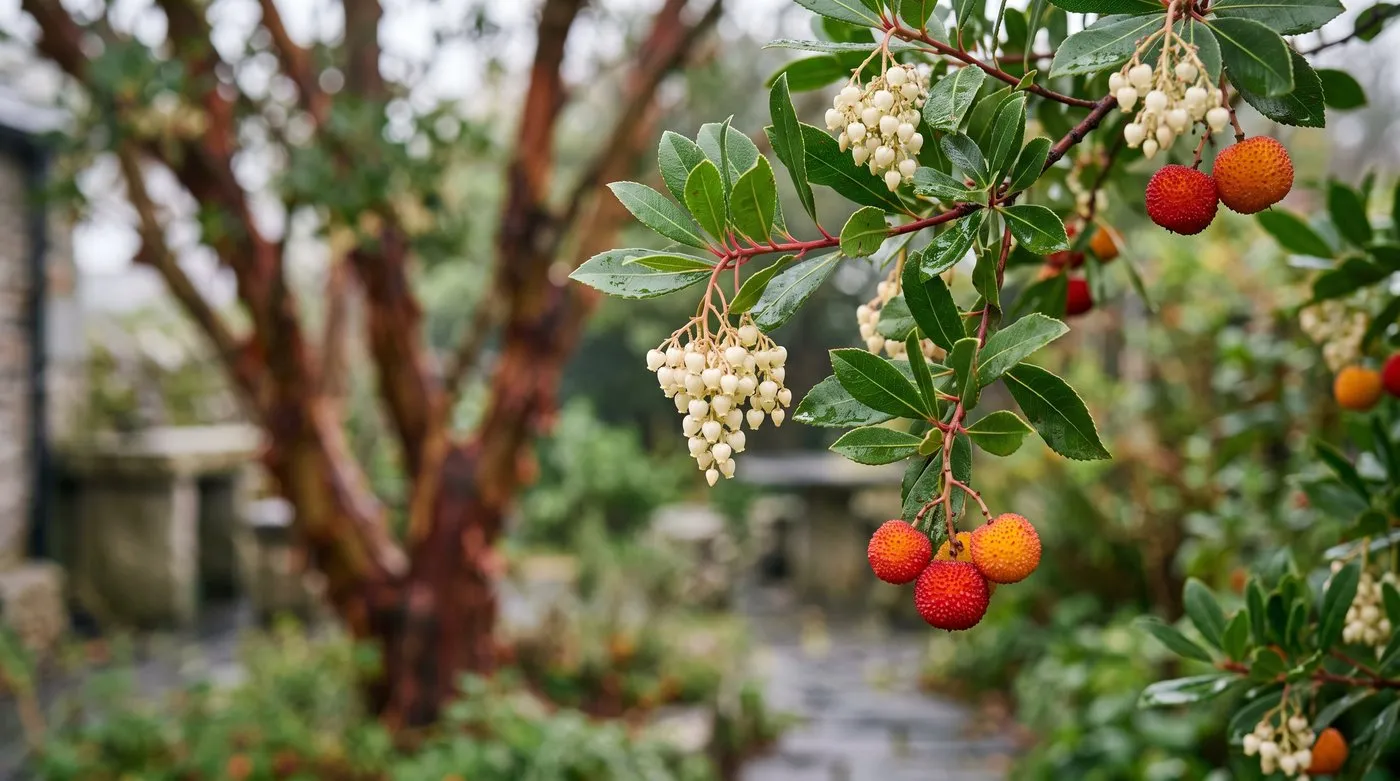
The strawberry tree flowers and fruits at the same time in autumn. It stays compact and shrugs off sea winds, so it’s ideal for a small plot.
Medium gardens (50-200sqm)
Portugal laurel (Prunus lusitanica) is the best screening tree for a medium plot. It has glossy dark leaves on red stems, scented white flowers in June and small purple fruits for birds. It takes hard pruning and grows on chalk, clay and loam. Plant about 1.5m apart for a privacy screen. See our hedge planting guide for spacing and preparation.
Bay laurel (Laurus nobilis) can grow big but is easily kept smaller by pruning. You can cook with the leaves, clip it into shapes or grow it in a large pot. Give it shelter from cold east winds in exposed gardens.
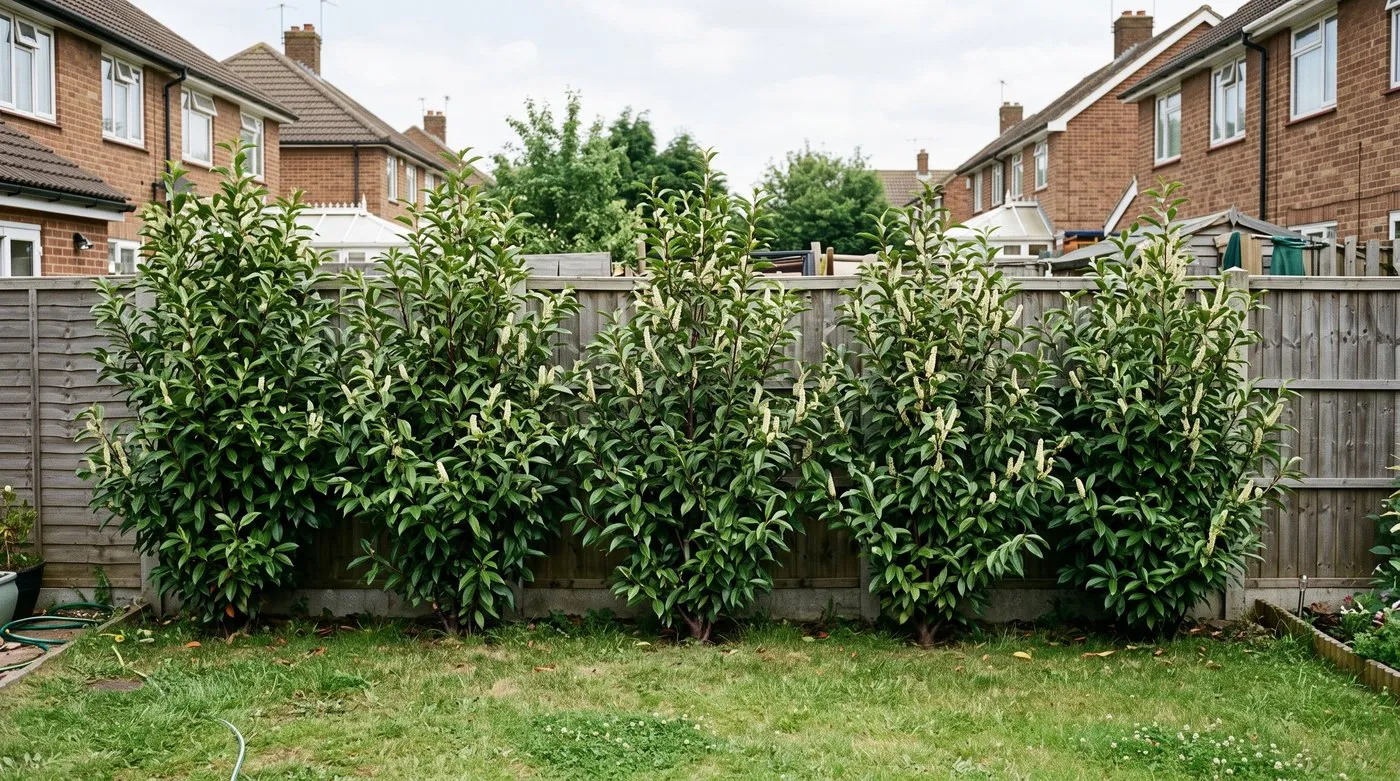
Portugal laurel makes a smart screen and takes hard pruning. Planting about 1.5m apart gives a solid wall of green within a few years.
Large gardens (200sqm+)
Holm oak (Quercus ilex) is a superb big evergreen. It grows into a large, rounded tree that copes with salty winds, drought and hard pruning. Give it plenty of space away from buildings. Its shade is deep, so pair it with plants from our list of best plants for shade.
Scots pine (Pinus sylvestris) is one of our few native evergreen conifers, along with yew and juniper. It loves sandy, acid soil and is brilliant for wildlife. In Scotland it’s home to red squirrels and crossbills.
Why the wrong evergreen fails: root cause analysis
Most evergreen failures come down to three things. Knowing them saves you money and heartache.
Wrong tree for the soil
Acid-loving plants on chalky soil are the most common mix-up. Pieris, camellias and rhododendrons get yellow leaves with green veins on chalk, because they can’t take up the iron they need. Feeding never fully fixes it. Test your soil with a cheap kit from the garden centre before you buy. On chalky soil, stick to yew, bay, holm oak or Italian cypress.
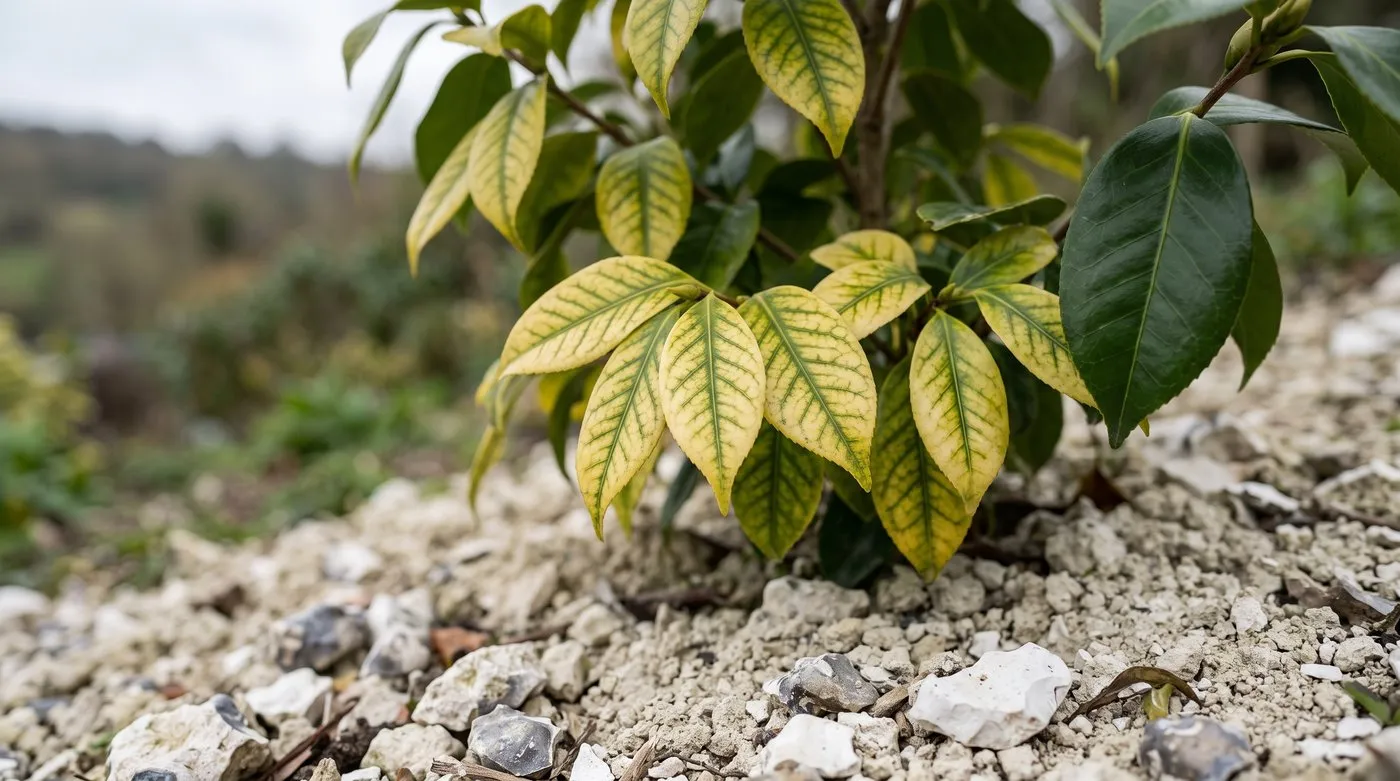
Yellow leaves with green veins are a classic sign of an acid-lover on chalk. Test your soil before you buy to avoid this.
Wrong tree for the space
Leylandii is still planted everywhere, and it causes more trouble than any other evergreen. It grows very fast and, left alone, gets enormous. In a small garden one unclipped Leylandii can shade the whole plot. It’s also behind more neighbour fall-outs than any other plant. Councils can step in over tall evergreen hedges that block light, as the RHS guide to high hedges explains.
Be honest about how much clipping you’ll do. If you won’t prune every year, choose a slow grower.
Wrong planting depth
Planting too deep is the silent killer. Buried bark stays wet and rots at the base. Signs show up a year or so later: yellow leaves, poor growth, peeling bark at ground level and a sour smell. By then it’s often too late, so get the depth right at the start.
Month-by-month evergreen tree care calendar
| Month | What to do |
|---|---|
| January | Check stakes and ties. Brush heavy snow off branches before they split. |
| February | Last chance for bare-root and root-balled planting. |
| March | Mulch with 5cm of composted bark in a ring around new trees, not touching the trunk. |
| April | Start watering new trees in dry spells, about 20-30 litres a week. |
| May | Clip yew, holly, bay and topiary. Take off no more than a quarter of the growth. |
| June | Keep watering new trees. Give a slow-release general feed, following the pack. |
| July | Water older trees too in a long dry spell. |
| August | Take cuttings from holly, yew and bay if you’d like more plants. |
| September | Order root-balled trees from a nursery for October planting. |
| October | The best month to plant. The soil is still warm and autumn rain helps. |
| November | Keep planting. Cover tender trees like bay and olive with fleece in hard frosts. |
| December | No pruning. Cut some holly for Christmas. Check new trees haven’t been rocked by wind. |
How to plant an evergreen tree correctly
Getting the planting right decides whether your tree thrives or struggles for years. These steps work for any evergreen.
Step-by-step planting method
Step 1: Dig a hole three times as wide as the root ball and no deeper. The root flare, where the trunk widens into the roots, should end up level with the ground.
Step 2: Loosen the sides and bottom of the hole with a fork. On heavy clay, add a layer of coarse grit at the bottom.
Step 3: Stand the tree in the hole. Lay a cane across the top to check the root flare is level with the soil. Add or remove soil underneath until it is.
Step 4: Fill in with your dug soil mixed with some composted bark. Firm it gently with your foot as you go. Don’t stamp hard.
Step 5: Knock in a short stake at an angle, leaning into the wind, and fix it with a rubber tree tie. Let the tree sway a little, as that makes it stronger.
Step 6: Water in well, with several full watering cans. Spread a 5cm mulch ring around the tree, keeping it a hand’s width away from the trunk.
Step 7: For the first two summers, give it 20-30 litres a week whenever it’s dry.
Tip: Planting in a lawn? Clear the grass in a circle at least 60cm out from the trunk. Grass is greedy and steals water from young trees.
 A newly planted holly at the right depth, with the root flare showing at ground level and a ring of bark mulch.
Best evergreen trees for wildlife
Evergreens give birds shelter and food in winter, when other trees are bare.
Holly is a star for wildlife. Its prickly leaves protect nesting birds, and the berries feed thrushes, blackbirds, redwings and fieldfares through winter. The caterpillars of the holly blue butterfly feed on its flower buds in spring.
Yew is a cosy winter roost for small birds like goldcrests. The RSPB has lots more ideas for wildlife-friendly planting.
Scots pine is home to a huge range of insects, and coal tits and goldcrests nest in it. Red squirrels love the seeds. If you’re making a wildlife-friendly garden, it’s the native evergreen to go for, space allowing.
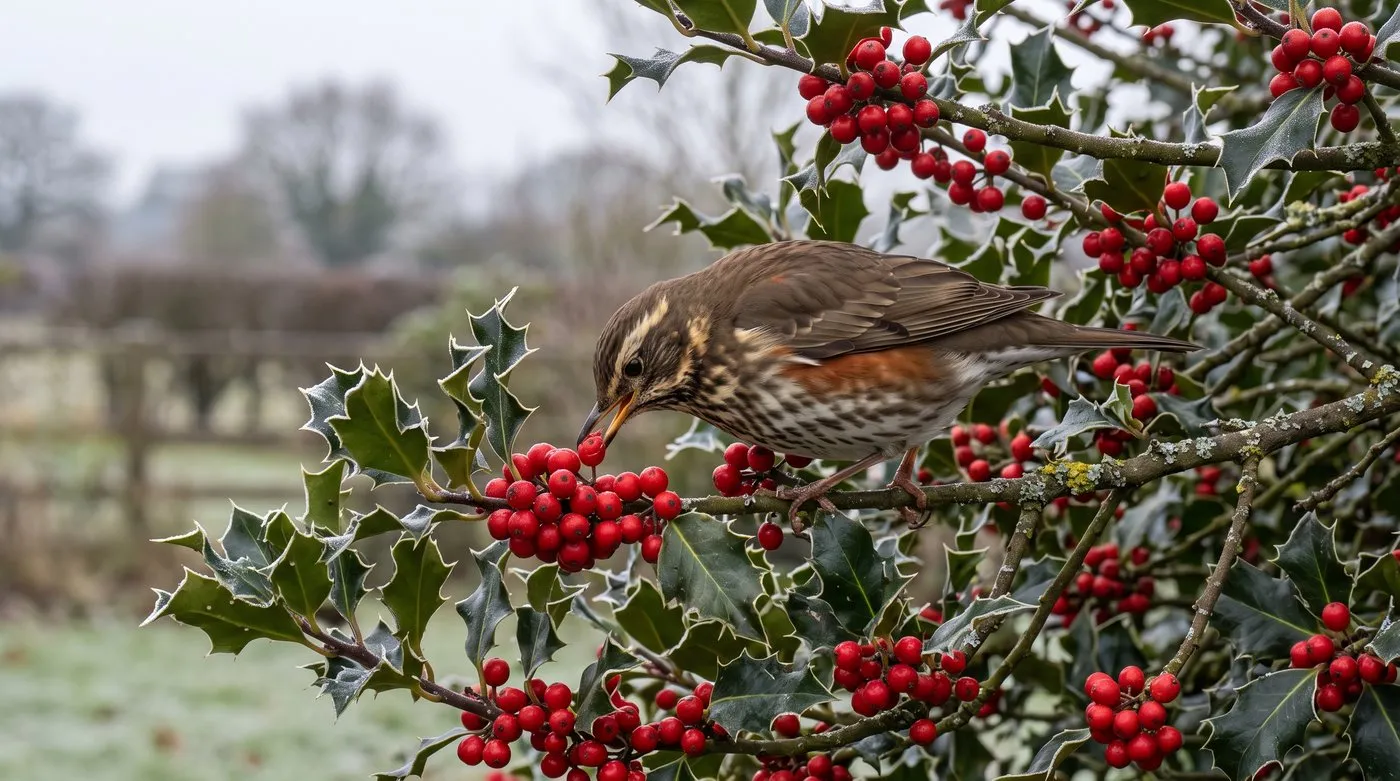
Holly berries are a lifeline for thrushes, redwings and fieldfares in winter. The prickly leaves give nesting birds safe cover in spring too.
Pruning evergreen trees: when and how
Most evergreens are best pruned in late spring, once the new growth has firmed up. Pruning too early risks frost damage to soft new shoots, and autumn cuts heal slowly before winter.
Pruning rules by species
| Tree | When | How it copes | Good to know |
|---|---|---|---|
| Yew | May to August | Very well, even from old wood | The one conifer that reliably regrows from bare stems |
| Holly | Late July to August | Well | Wait until nesting birds have finished. Use secateurs. |
| Bay laurel | May to June | Well | Trim off frost-damaged bits in April |
| Portugal laurel | May to June | Very well | Can be cut back hard if it’s overgrown |
| Leylandii | May and August | Badly | Never cut back into brown wood without green leaves |
| Scots pine | Not needed | Badly | Only remove dead or damaged branches |
Take off no more than a quarter of the tree in any one year. Hard cutting back works for yew, holly and Portugal laurel, but kills most conifers. Growing climbers alongside? See our guide to the best climbing plants for UK gardens.
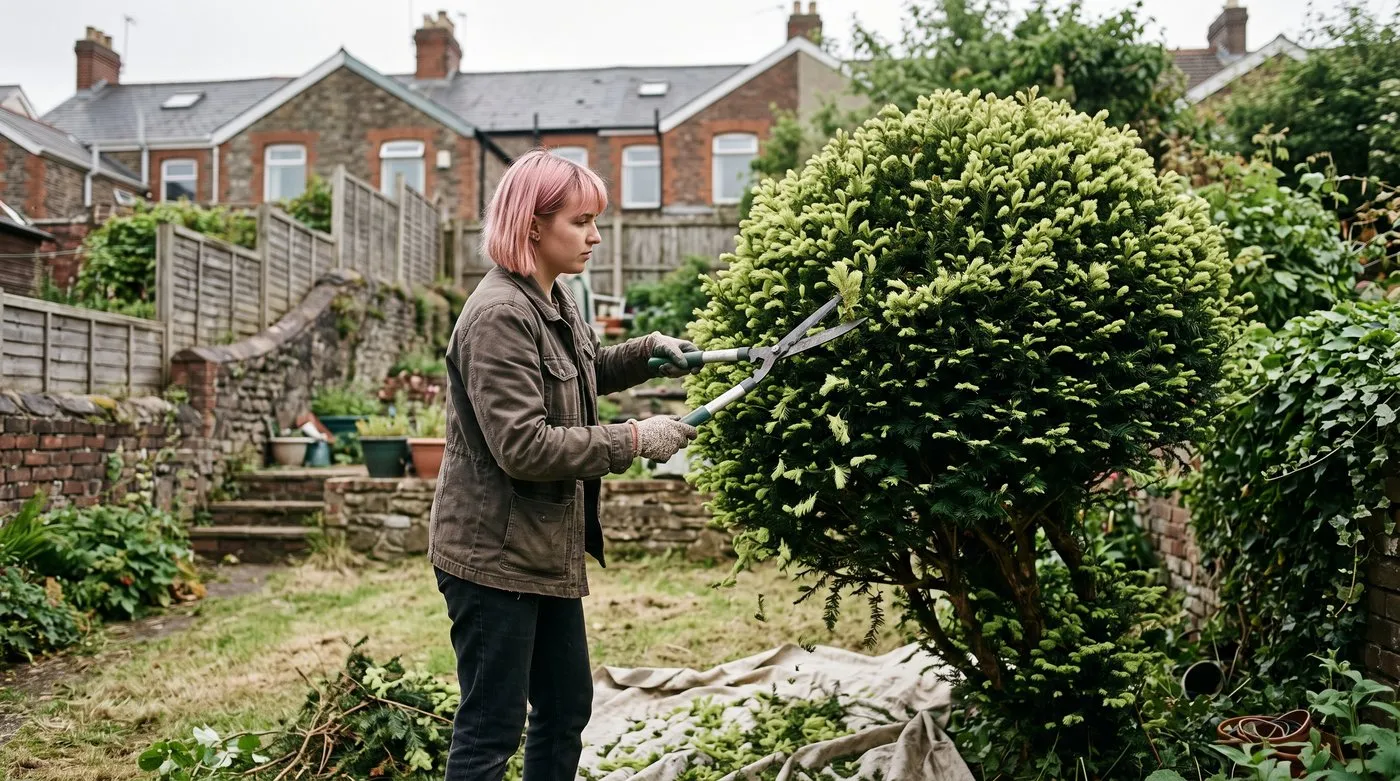
Late spring, once the new growth has firmed up, is the time to clip yew. Take off no more than a quarter in a year.
Common mistakes when choosing evergreen trees
Planting Leylandii in a small garden
Leylandii shoots up fast and soon dominates a small garden. Its dense shade kills lawns and leaves nothing growing underneath. Choose Portugal laurel or yew for screening instead. Both take pruning well and stay manageable.
Ignoring soil pH
Acid-lovers like camellias, pieris and rhododendrons turn yellow and struggle on chalky soil. Test before you buy. If your soil is chalky, our camellia growing guide explains how to grow them in pots of ericaceous compost.
Forgetting to water after planting
Evergreens lose water through their leaves all year. Without extra water in the first two summers, the roots can’t get going. Set a reminder to water 20-30 litres a week from April to September in dry spells. After two years, you can relax.
Planting too close to buildings
Plant no closer to a building than the tree’s final height. On clay soil, which shrinks and swells as it dries and wets, big tree roots near a house can cause problems. Give large trees like holm oak plenty of room.
Choosing based on colour alone
Photinia ‘Red Robin’ is loved for its bright red new leaves. But it gets big, needs regular trimming to keep the colour, and can suffer from leaf spot in wet western areas. A variegated holly like ‘Golden King’ gives you colour with much less fuss.
Costs and where to buy evergreen trees in the UK
Smaller trees cost much less but take longer to make an impact.
| Size when you buy | Cost | Best for |
|---|---|---|
| Bare-root whip (60-90cm) | Cheapest | Hedges, planting lots |
| In a pot (1-1.5m) | Moderate | Single garden trees |
| Root-balled (1.5-2.5m) | Pricey | Quick impact |
| Semi-mature (3-4m) | Very pricey | Instant screening |
Specialist tree nurseries usually offer better quality and a wider choice than garden centres. Bare-root hedging whips of native holly, yew and Scots pine are the cheapest way to plant lots.
Order root-balled trees in September or October for the best choice, as popular sizes often sell out by November.
Evergreen trees to avoid in most UK gardens
Some evergreens cause more trouble than they’re worth in an ordinary garden.
Eucalyptus gunnii grows very fast and very tall, and can blow over in storms. It also drops bark all year. Only plant it if you have lots of space and are happy to cut it back hard regularly.
Monterey cypress suits seaside gardens but often gets cypress canker inland, which kills branches and can’t be cured.
Leylandii grown as a single tree gets huge and blocks light for you and your neighbours. Single trees also aren’t covered by the high hedge rules, which can make disputes harder to sort out.
Good to know: Big evergreens already on your plot may be protected, so check our guide to checking for a tree preservation order before you cut.
Now you know which evergreen trees suit your garden, read our guide on best trees for small UK gardens for more ideas, including deciduous trees that go well with evergreens.
Frequently asked questions
What is the best evergreen tree for a small UK garden?
The strawberry tree (Arbutus unedo) is a lovely choice. It copes with most UK soils and has white flowers and red fruits together in autumn. Portugal laurel is another good option and copes better with shade. Both can be kept compact with a little pruning.
How fast do evergreen trees grow in the UK?
It depends on the tree. Yew and holly are slow growers. Bay and Portugal laurel are medium-paced. Holm oak is fairly quick once settled. Leylandii is the fastest by far and needs cutting every year to keep it in check.
Can evergreen trees grow in heavy clay soil?
Yes, several do well in clay. Holly, yew and Portugal laurel are all happy there. Mix some composted bark into the soil when you plant to help drainage. Avoid Mediterranean trees like olive and Italian cypress on wet clay.
When is the best time to plant evergreen trees?
October to March is best. Trees planted in autumn grow roots while the soil is still warm and rain is plentiful, so they’re ready for summer. Trees in pots can go in at any time of year, but they’ll need much more watering if you plant in spring or summer.
Do evergreen trees drop their leaves?
Yes, a few at a time. They shed some of their oldest leaves each year, often in late spring. New growth soon fills the gaps, so the tree always looks green. It’s normal and nothing to worry about.
Are evergreen tree roots invasive?
Most garden evergreens are well behaved. Holly, yew, bay and strawberry tree are fine in most gardens. Big trees like holm oak need plenty of room. As a simple rule, plant no closer to a building than the tree’s final height.
What is the best evergreen tree for screening?
Portugal laurel is the best all-round screening tree. It takes hard pruning well and stays leafy right down to the ground. Plant about 1.5m apart for a screen. Western red cedar (Thuja plicata) is a good, faster conifer alternative.
How do I stop an evergreen tree getting too big?
Prune once a year in late spring. Take off no more than a quarter of the growth in one go. Yew, holly and Portugal laurel all cope with hard pruning. Never cut Leylandii back into old brown wood, as it won’t grow back from bare stems.
Our team produces practical UK gardening guidance from source research, contributor records and established horticultural practice. Editorial standards are overseen by Matt W.