Key takeaways
- Choose a named hardy variety such as Arbequina or Leccino
- Drainage matters most. Olives die in wet ground faster than from cold
- Plant in late spring, by a sunny wall or in a big pot of gritty compost
- Fleece the tree and wrap the pot when nights fall below about -5C
- Prune in late spring once the hard frosts are over
- Olives are possible in the south after a hot summer, but most UK trees are grown for looks
Olive trees are one of the toughest Mediterranean plants you can grow in Britain. Their silvery evergreen leaves and twisty trunks make a lovely centrepiece in a pot or border. Pick the right variety, give it good drainage and a little winter help, and it can live for decades.
Can olive trees survive UK winters?
Yes. Hardy varieties cope with short frosts when they’re established in free-draining soil. How much damage cold does depends on three things: how cold it gets, how long it lasts and how wet the soil is.
A sharp overnight frost does little harm to an established tree in dry soil. A long cold spell can kill back branches, especially on young trees. The real danger is wet soil in cold weather. Soggy roots freeze, then rot when they thaw.
Buy carefully: Choose olive trees from a reputable nursery, ideally UK-grown. Imported trees can carry Xylella, a serious plant disease spreading in Mediterranean olive groves. The RHS olive growing guide has the latest advice.
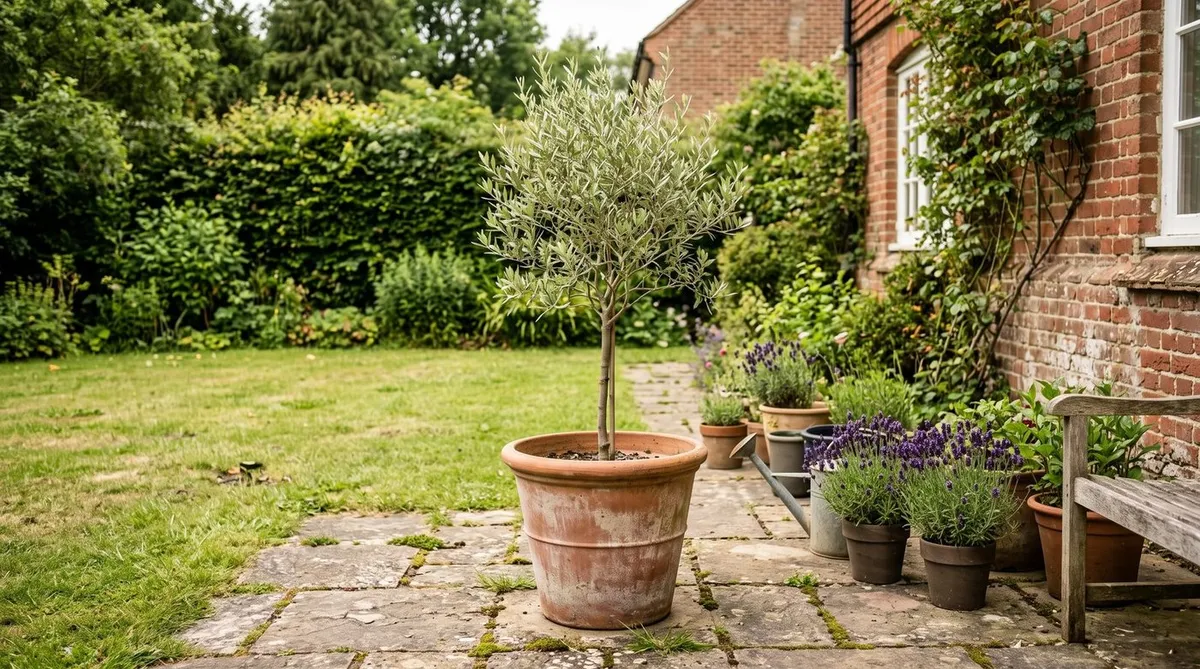
 An olive tree happy against a sunny stone wall, with lavender and rosemary for company.
Best olive tree varieties for UK gardens
Not every olive suits Britain. The best ones are tough, compact and fruit on their own. Here are four good choices.
| Variety | Size | Fruits on its own? | Best for |
|---|---|---|---|
| Arbequina | Compact | Yes | Pots and small gardens |
| Leccino | Medium to large | Partly | Colder, more exposed gardens |
| Cipressino | Tall and narrow | Yes | Narrow spaces and screening |
| Frantoio | Large | No | Big, warm southern gardens |
Arbequina
Arbequina is the best all-rounder for British gardens. It stays compact, so it’s perfect in a pot or a small garden. It’s self-fertile, so one tree can fruit on its own, and it’s the most likely to give you olives after a warm summer in the south.
Leccino
Leccino is a tough choice for colder or more exposed gardens. It has handsome leaves with silvery backs and grows quite strongly. It fruits better with a partner such as Frantoio nearby. A good pick for the Midlands, the north and sheltered Scottish gardens.
Cipressino
Cipressino grows tall and slim, so it fits narrow spaces. Use it to frame a doorway, line a path or stand against a wall. It’s self-fertile, and its neat shape means less pruning than spreading varieties.
Frantoio
Frantoio is a classic Italian olive grown for oil. It’s the least hardy of these four and needs a partner to fruit. Choose it only if you have a big, sheltered garden in London, on the south coast or in the south-west and fancy trying for a proper harvest.
Pots or the ground?
Both work in the UK. It depends on your garden and how much winter fuss you’re happy with. If you grow other fruit in pots, our guide to growing fruit in pots and containers has handy tips on compost and feeding.
Planting in the ground
A tree in the ground usually does best in the long run. Its roots spread out, which keeps them warmer in frost and helps the tree cope with dry spells. Against a south-facing wall it gets extra warmth and stays drier.
What it needs:
- A south or west-facing spot with at least six hours of sun
- Free-draining soil, such as sandy, gravelly or chalky
- Shelter from cold north and east winds
- Room to spread, about 3-4m across when mature
On heavy clay, build a raised mound 30-40cm high using half topsoil, half grit, with a layer of gravel in the bottom of the hole. Clay that stays wet around the roots in winter will kill an olive.
Growing in a pot
Pots let you move the tree to the sunniest spot in summer and somewhere sheltered in winter. They also keep it smaller. A pomegranate is happy grown the same way.
What a potted olive needs:
- A pot at least 50cm across, terracotta or frost-proof
- Drainage holes covered with crocks
- John Innes No. 3 mixed with plenty of grit
- Pot feet so it never sits in water
- A slightly bigger pot every three or four years
Water when the top 5cm of compost is dry from April to September. From November to February, water only enough to stop the compost going bone dry. Feed every two weeks with half-strength tomato feed from May to August. Our guide to drought-tolerant plants has more plants that like the same treatment.
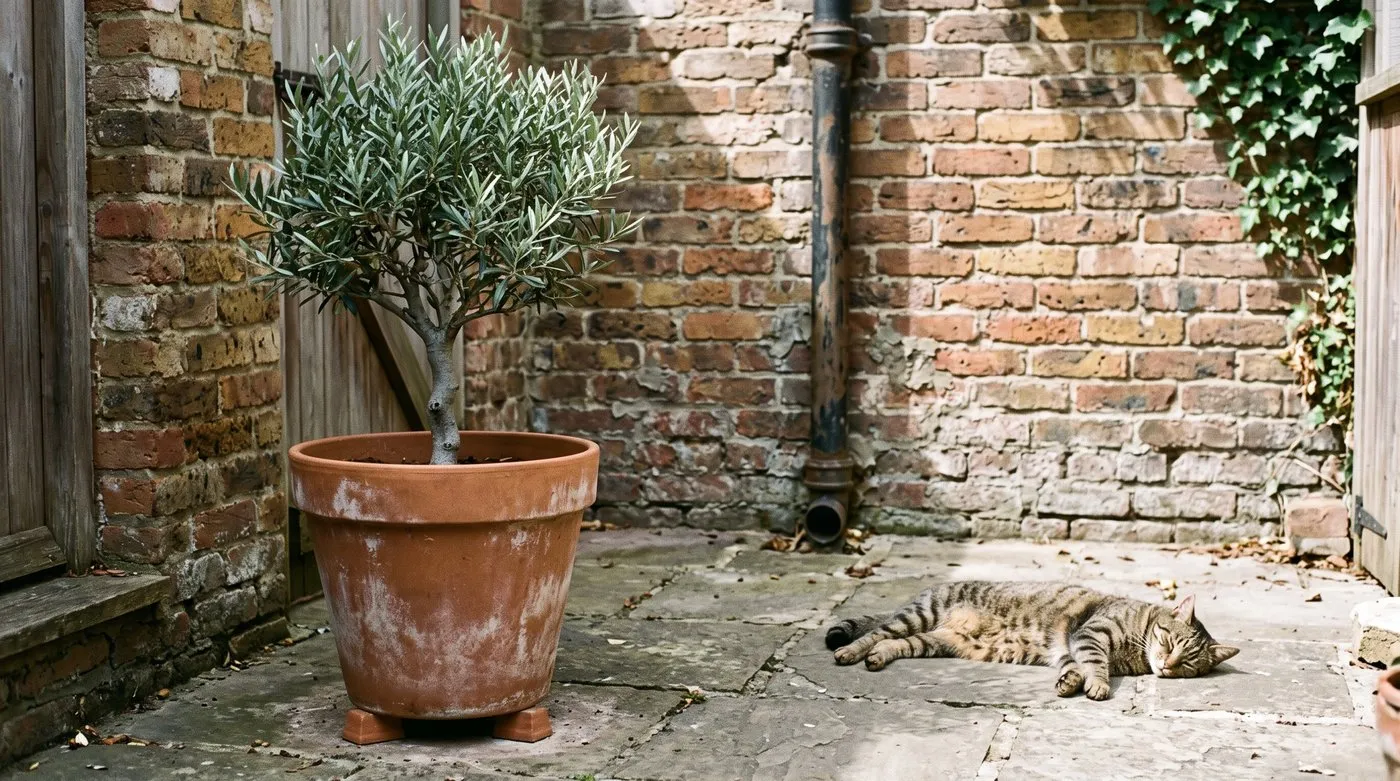
Pot feet keep the base out of puddles, which matters more than you’d think. A pot lets you shuffle the tree into the sunniest spot for summer.
Soil and drainage
Drainage is the most important thing for an olive in the UK. One in poor, stony soil will do better than one in rich, moist loam. Olives grow wild on thin, rocky soils around the Mediterranean, so they don’t want rich ground.
What they like
- Soil type: Sandy, gravelly or chalky. Most soils from slightly acid to chalky are fine
- Drainage: Water should drain away in minutes, not hours
- Richness: Low to average. Don’t add compost or manure when planting
Heavy soil
On clay or heavy soil, either grow it in a pot or make a raised mound. Dig out an area about 1m across and 40cm deep, and refill it with half soil, half grit, raised 30-40cm above the ground around it. Mulch with gravel, not bark. Gravel keeps the base of the trunk dry and bounces warmth back up. Bark holds moisture.
How to protect olive trees in winter
 Fleece over the branches and bubble wrap round the pot keep an olive snug in a hard frost.
Most UK winters need very little from you. Act when a hard frost of about -5C or colder is forecast.
Trees in the ground
Established trees in a sheltered spot rarely need help in the south. In colder areas or a big freeze, drape two layers of fleece loosely over the branches and take it off once it warms up. Never use plastic sheeting, which traps damp and does more harm than the cold.
Trees in pots
Roots in a pot feel the cold from every side, so they need more help. When a hard frost is forecast:
- Move the pot against a south-facing wall
- Wrap the pot in bubble wrap or hessian
- Drape fleece over the branches, doubled in a hard freeze
- Stand the pot on feet so it doesn’t freeze to the ground
- Unwrap it once the cold spell is over
Don’t bring it into a warm house. Central heating makes olives drop leaves and invites scale insects. In a really harsh spell, a cold greenhouse or porch is fine. Our guide to protecting plants from frost has more ideas.
Pruning olive trees
Prune in late spring, from late April to May, once the hard frosts are over. By then you can see and cut out any winter damage. Olives take pruning well, even hard pruning.
Yearly tidy-up
- Cut out dead, damaged and crossing branches
- Thin the middle so air can move through
- Shorten shoots that spoil the shape by about a third
- Remove suckers from the base of the trunk
- Trim to keep the height and spread you want
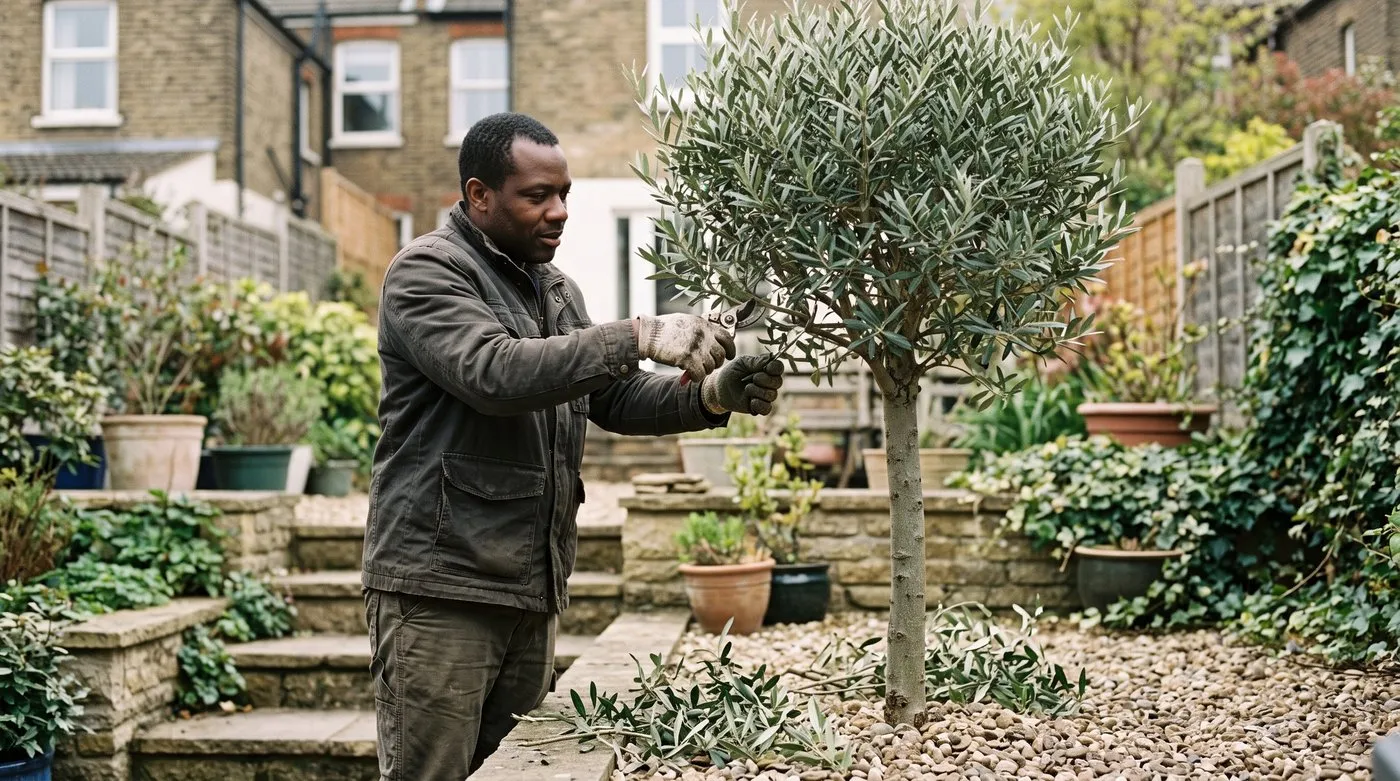
Late April is a good time for the yearly trim, once the hard frosts have passed. Thinning the middle lets air move through and keeps the shape neat.
Shaping
You can grow an olive as a lollipop on a single stem, as a multi-stemmed bush or let it grow naturally. For the classic lollipop, remove the low side branches over two or three years until you have a clear trunk, then trim the top into a rounded head each year.
Hard pruning an old tree
A neglected olive can be cut back hard in late April. Unlike lavender, olives regrow from old wood. Cut the main branches back to 60-90cm and new shoots will appear over the summer. Keep four or five well-spaced shoots to make the new framework and remove the rest. It’s one reason olives are among the best evergreen trees for UK gardens.
Will my olive tree produce fruit?
 Little green olives on a UK tree after a warm summer. It can happen in the south with the right variety.
You might get olives in the UK, but it’s never a sure thing. Olives need a cool winter followed by a long, hot summer. Our winters are cold enough, but many summers aren’t hot enough.
Where it happens
In London, the south coast, East Anglia and the south-west, self-fertile varieties like Arbequina can give a small crop after a hot summer. Further north it’s rare.
Giving it the best chance
- Choose a self-fertile variety such as Arbequina or Cipressino
- Plant against a south-facing wall for warmth
- Use a gravel mulch to bounce heat back up
- Avoid high-nitrogen feeds, which give leaves instead of fruit
- Be patient. Young trees rarely fruit
Using your olives
If your tree does fruit, pick the olives when they turn from green to purple-black, usually in October or November. There won’t be enough for oil, but you can cure them as table olives. Soak them in fresh water for a couple of weeks, changing it daily, then keep them in salty brine for several weeks before eating.
Tips for buying an olive tree
Garden centres sell olives all year, but the best choice is from March to June. Big, gnarled old trees cost a lot more than young ones.
What to look for:
- Bushy, well-branched growth, not one bare stem
- Healthy silver-green leaves with no yellowing or brown edges
- A named variety on the label, not just “olive tree”
- UK-grown stock if you can find it
- Firm roots with white tips showing at the drainage holes
Avoid trees standing in waterlogged trays or with yellow lower leaves, as the roots may already be damaged. Cheap unnamed olives may not be very hardy.
For other compact trees, see our guide to the best trees for small gardens. Olives also look great with other sun-lovers in a Mediterranean garden planting scheme.
Month-by-month olive tree care
| Month | What to do |
|---|---|
| January | Check fleece on potted trees. Water a little only if the compost is bone dry. |
| February | Order new trees for spring. Check stems for scale insects. |
| March | Take off winter fleece once the hard frosts are over. Get planting spots ready. |
| April | Plant new trees. Start feeding pots. Start pruning. |
| May | Finish pruning. Water pots as needed. Mulch with gravel. |
| June | Enjoy the new growth. Water pots in dry spells. Flowers may appear in warm areas. |
| July | Water pots regularly. |
| August | Keep watering pots. Feed less often. |
| September | Stop feeding. Water less. Pick any ripe olives in the south. |
| October | Move pots somewhere sheltered. Pick late olives. |
| November | Wrap pots if a hard frost is forecast. Water only to stop the compost drying out completely. |
| December | Check the fleece. Water only if the compost is completely dry. |
Frequently asked questions
Can olive trees survive UK winters?
Yes, hardy varieties get through most UK winters fine. Established trees in free-draining soil cope with short frosts well. Long cold spells can kill back branches, especially on young trees. Olives in pots are more at risk because the roots freeze faster. Wrap pots in bubble wrap and fleece the tree when nights drop below about -5C.
Do olive trees fruit in the UK?
Sometimes, mostly in southern England after a hot summer. Self-fertile varieties like Arbequina can crop on their own. It takes a long, warm summer, so further north fruit is rare. Most people in the UK grow olives as handsome evergreens rather than for the olives.
What is the best olive tree variety for the UK?
Arbequina is a great all-rounder for British gardens. It’s self-fertile, compact enough for a pot and the most likely to fruit in the south. Leccino is a good pick for colder or more exposed gardens.
How big do olive trees grow in the UK?
In the ground, they slowly reach about 3-5 metres over many years. They grow much more slowly here than around the Mediterranean. Olives in pots stay smaller, depending on the pot. Pruning keeps them whatever size you like.
When should I plant an olive tree in the UK?
Plant in late spring, from mid-April to early June. That gives the roots a whole summer to settle before winter. Avoid autumn and winter planting, when cold, wet soil can rot the roots. Potted trees can be moved into bigger pots any time from April to September.
Do olive trees need feeding in the UK?
Only a little. Give trees in the ground a general slow-release feed in April. Olives in pots like a liquid tomato feed every couple of weeks from May to August. Don’t overdo it, as too much feed makes soft growth that frost damages easily.
Should I bring my olive tree indoors for winter?
No, a warm house does more harm than good. Central heating makes them drop leaves and invites pests. Leave trees outside and fleece them when a hard frost is coming. Move pots against a sheltered south-facing wall. In a really harsh cold spell, a cold greenhouse or porch is fine for a pot.
Our team produces practical UK gardening guidance from source research, contributor records and established horticultural practice. Editorial standards are overseen by Matt W.


