Key takeaways
- Give pomegranate the hottest, sunniest wall you have
- Wet roots in winter kill it more often than cold does, so drainage is key
- In colder areas, grow it in a pot and move it under cover for winter
- Dwarf 'Nana' stays about 1m tall and flowers well in UK summers
- Feed with tomato food, not high-nitrogen feeds, to get flowers
- A greenhouse gives fruit the extra warmth it needs to ripen
Growing pomegranate in the UK comes down to two things: the right variety and the right spot. This Mediterranean fruit tree is tougher than most people think. Hardier varieties cope with frost when they’re planted in free-draining soil against a warm wall.
With milder winters and hardier varieties, fruit is now a real possibility across much of southern and central England. In cooler areas, a pot or a greenhouse makes pomegranate a fun and rewarding plant to grow.
Which pomegranate variety should I grow?
The variety makes the biggest difference. Some pomegranates are mainly ornamental, while others can give you edible fruit here.
‘Provence’ is a top choice for growing outdoors. It comes from southern France, is one of the hardier types and has medium-sized fruit with sweet-sharp red seeds. It ripens earlier than most, which really helps in a short UK summer.
‘Nana’ is the best dwarf. It grows just 80-100cm tall, so it’s perfect for pots and small gardens. Scarlet flowers appear all through July to September. The fruit is small and mostly ornamental, but the seeds are edible.
‘Kazake’ is another of the hardier pomegranates, as long as its roots stay dry. The fruit is smaller than ‘Provence’, with pink seeds and a sweeter taste. The RHS plant page has more on hardiness and care.
| Variety | Toughness | Size | Fruit | Best for |
|---|---|---|---|---|
| ’Provence’ | Hardier | 2-3m | Medium, sweet-sharp | Wall training outdoors |
| ’Nana’ | Fairly hardy | 0.8-1m | Small, mostly for show | Pots, ornamental |
| ’Kazake’ | Hardier | 2-2.5m | Medium, sweet | Colder gardens |
| ’Mollar de Elche’ | Tender | 3-4m | Large, very sweet | Greenhouse only |
| ’Wonderful’ | Tender | 3-5m | Large, sharp | Heated greenhouse |
| ’Acco’ | Tender | 2.5-3m | Medium-large, sweet | Conservatory or greenhouse |
How to plant and position a pomegranate in the UK
Find the hottest, most sheltered spot in your garden. A south or south-west-facing wall is ideal. The wall soaks up heat by day and gives it back at night, keeping the plant warmer than open ground.
The soil must drain freely. Pomegranates are happy in poor, stony soil but die fast in waterlogged ground. On heavy clay, build a raised mound 15-20cm high from roughly half topsoil and half grit. On clay, this is the most important step.
How to plant: Dig a hole 60cm wide and 40cm deep. Mix the soil you dug out with an equal amount of grit. Plant at the same depth it was in its pot. Fill in, firm gently and water well. Mulch with 5cm of gravel or grit around the base. Avoid bark mulch, which holds damp against the stem.
Plant between late March and mid-May, once the worst frosts are over. Don’t plant in autumn, because a young plant needs a whole summer to root before its first winter. Space wall-trained plants 2-2.5m apart.
If you’re also growing fig trees, the same rules apply: a warm wall and good drainage.
 A pomegranate fan-trained on wires against a south-facing wall, soaking up all the sun and warmth it can get.
How to wall-train a pomegranate
Training it flat against a warm wall is the best way to get fruit outdoors. The plant catches the most sun and enjoys the heat coming off the bricks.
Wires: Fix horizontal galvanised wires to the wall every 30cm, starting 45cm from the ground. Use vine eyes in the mortar joints, holding the wires 8-10cm off the wall so air can move. A frame up to 2-2.5m high is enough for most plants.
First two years: After planting, choose 4-6 strong shoots and tie them to the wires at about 45 degrees. Remove the rest. In year two, let these branches grow on and pick side shoots to fill gaps in the fan. Tie everything in with soft twine, not too tight.
From year three: In late March, shorten side shoots to 4-5 buds. Remove shoots growing straight towards or away from the wall. In July, pinch the tips of very vigorous shoots so the plant puts its energy into fruit.
The same approach works for grape vines and other wall-trained fruit.
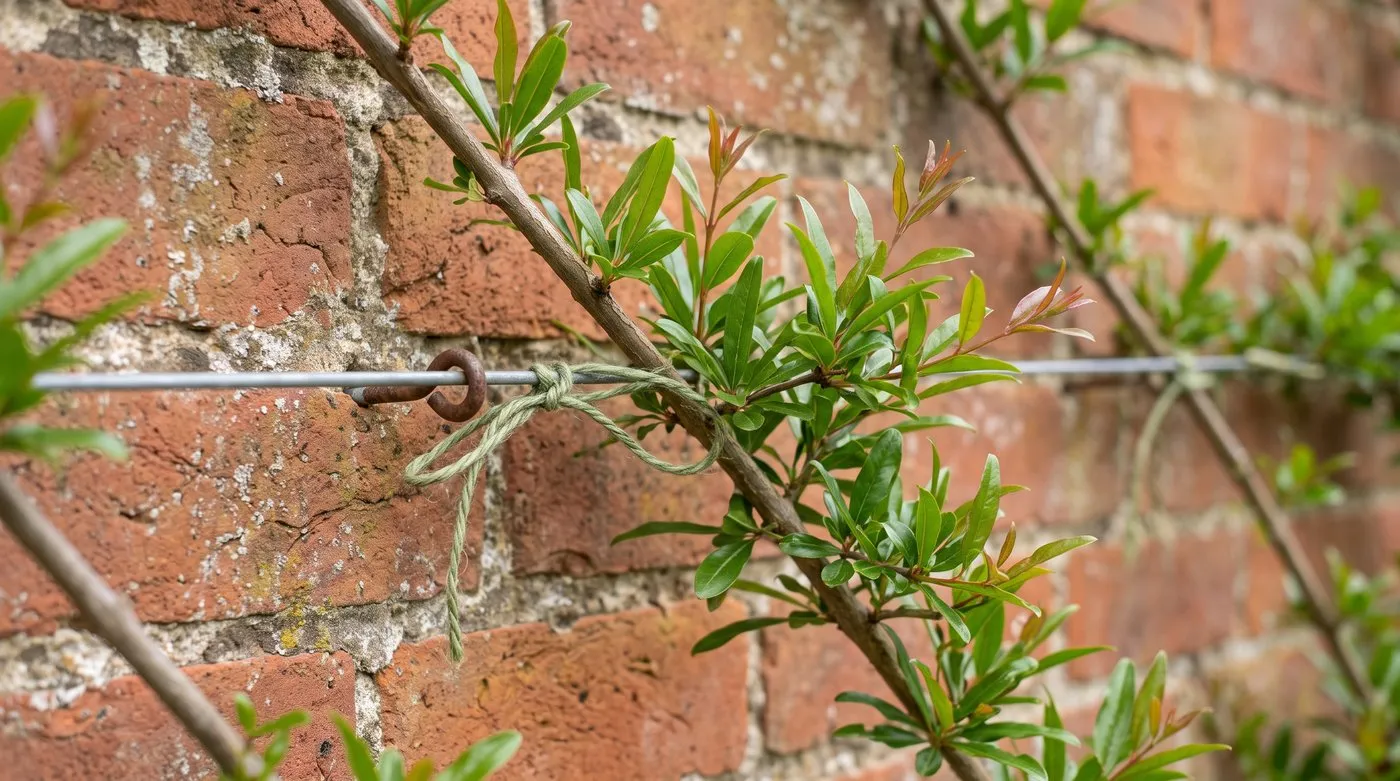
Vine eyes hold the wires off the wall so air can move behind the branches. Tie shoots in loosely with soft twine and they’ll fill out the fan.
Growing pomegranate in containers
A pot is the safest option for most of the UK. You can move it somewhere frost-free in winter and into the sunniest spot in summer.
Pot size: Start with a 30-40cm pot and move up a size every 2-3 years. A grown-up ‘Provence’ needs a 50-60cm pot. ‘Nana’ is happy in a 30-40cm pot for good. Terracotta with drainage holes is ideal, as it’s heavy and helps stop the compost staying wet.
Compost: Use about 60% John Innes No.3 and 40% grit. That gives weight, food and the drainage pomegranates need. Multipurpose compost on its own stays too wet in winter.
Watering and feeding: Water well when the top few centimetres feel dry. From April to September, feed every fortnight with tomato feed. Stop feeding in October and keep the compost just moist in winter.
Winter: From November to March, move pots into an unheated greenhouse, conservatory or against a sheltered house wall. If it stays outside, wrap the pot in bubble wrap, because the roots feel the cold more than the branches. Pots cope with a light frost but need protecting in a hard one.
Our guide to growing fruit in pots and containers covers the basics for all fruit in pots.
 A pomegranate in a pot on a sunny patio. Move it around to follow the sun through the summer.
Growing pomegranate in a greenhouse
A greenhouse makes pomegranate much easier in the UK. The extra warmth in spring and autumn is often enough to ripen fruit that would stay green outdoors.
Warmth: Pomegranates love heat and stop growing when it turns cool. They go dormant in winter. In northern England, a greenhouse kept just frost-free over winter is ideal.
Ventilation: Open vents and doors on hot days. Pomegranates enjoy dry heat, but still, humid air encourages mould. Automatic vent openers are handy.
Pollination under glass: With fewer insects about indoors, it helps to give pollination a hand. Use a small, soft paintbrush and dab it into each open flower in turn. Do this every day or two while it’s in full flower in July and August.
Space: In a big pot (60-80cm), a pomegranate needs a floor space of about 2m by 2m when grown. Grow it alongside other Mediterranean plants like citrus trees to make the most of the warm space.
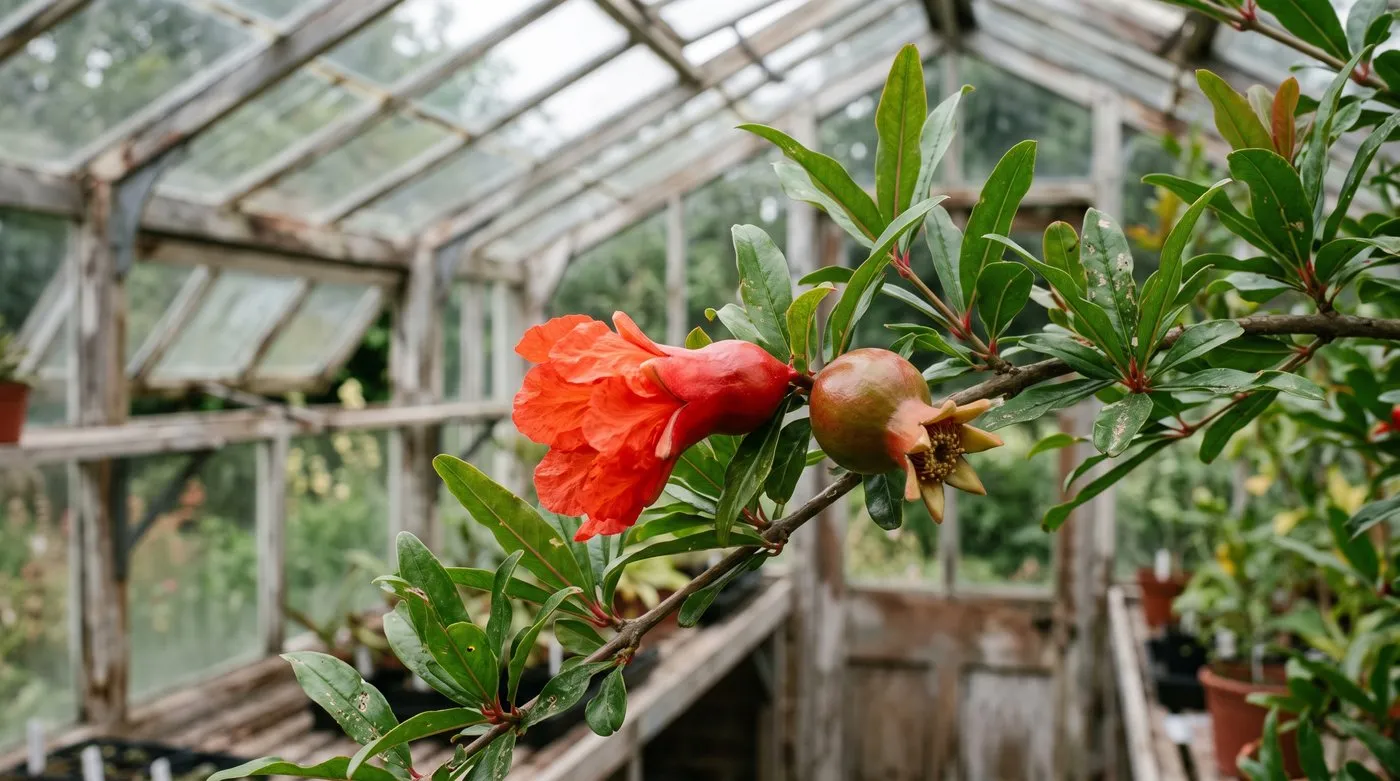
A swelling base with the little crown on top means a fruit has set. Under glass, a daily dab with a soft brush helps more flowers do this.
Month-by-month pomegranate care calendar
| Month | Task |
|---|---|
| January | Check winter protection on pots. Order plants for spring. |
| February | On mild days, cut out dead and damaged wood. Check wall wires are tight. |
| March | Main pruning time. Shorten side shoots to 4-5 buds. Plant new pomegranates from late March. |
| April | Start regular watering and fortnightly feeding of pots. Mulch outdoor plants with gravel. |
| May | Tie in new growth on wall-trained plants. Move pots into full sun. Watch for greenfly. |
| June | Flower buds appear. Keep feeding with tomato food. |
| July | Peak flowering. Hand-pollinate under glass. Pinch out very vigorous shoots. |
| August | Fruit swells. Water evenly to stop fruit splitting. |
| September | Early fruit may ripen on warm walls. Pick when the skin colour deepens. |
| October | Final picking. Move pots to sheltered spots. Water outdoor plants less. |
| November | Move pots into an unheated greenhouse or conservatory. Fleece outdoor plants in exposed gardens. |
| December | Rest time. Leaves drop. Water pots lightly about once a month. |
Common mistakes when growing pomegranate in the UK
Planting in wet soil. This kills more UK pomegranates than cold does. In their homelands the soil is stony and dry. British clay soaked with winter rain rots the roots quickly. Plant on a raised, gritty mound.
Choosing the wrong variety. ‘Wonderful’ is the pomegranate you’ll see most often, but it’s one of the more tender ones. For outdoor growing, look for ‘Provence’ or ‘Kazake’ from a specialist fruit nursery.
Too much nitrogen. High-nitrogen feeds give lots of leaves and few flowers. Tomato feed from April to September is all a pomegranate needs. Never use lawn feed on it.
Pruning too hard. Heavy pruning removes the wood that would carry flowers. Prune lightly in late March only. Remove dead wood and shorten side shoots, but leave the main framework alone.
Pomegranate pests and diseases in the UK
Pomegranates are pleasingly trouble-free here. They don’t suffer from the big diseases that bother apple trees and plums.
Greenfly and blackfly are the most common pests, clustering on soft shoots in May and June. Blast them off with a jet of water or squash small groups by hand. Ladybirds and hoverflies will help too. For a bad attack, use an approved product exactly as the label says.
Red spider mite can be a nuisance under glass in hot, dry summers. Damp down the greenhouse floor daily to raise the humidity. The predatory mite Phytoseiulus persimilis is a very good biological control indoors.
Grey mould can appear on flowers in cool, damp summers. Good airflow prevents it. Space branches 15-20cm apart on wall-trained plants and ventilate greenhouses well.
Fruit splitting happens when heavy rain follows a dry spell during ripening. Water evenly through August and September. In pots, don’t let the compost dry right out and then flood it.
Buying plants: buy from a UK nursery. Plants brought in from abroad can carry serious diseases such as Xylella, which has no cure.
 A ripe pomegranate split open to show its ruby-red seeds. Under glass, fruit usually ripens by late October.
How to harvest and store pomegranate
Pick at the right moment, because pomegranates don’t ripen after picking. Fruit ripens from late September to November, depending on variety and where you live.
Signs it’s ripe: The skin deepens from green-yellow to red or pink, and the fruit feels heavy for its size. Tap it with a knuckle: a ripe one sounds hollow and metallic rather than dull.
How to pick: Cut the fruit off with secateurs, leaving a short bit of stalk. Pulling can damage the branch. Handle gently, as the skin bruises more easily than you’d think.
Storage: Whole pomegranates keep for weeks in a cool room and a few weeks in the fridge. The seeds freeze well in bags.
Cost of growing pomegranate in the UK
Here’s a simple shopping list to get started. Costs vary, and a larger, older plant costs more but should fruit sooner.
| Item | What it’s for |
|---|---|
| Named plant such as ‘Provence’ | Wall training or a big pot |
| Dwarf ‘Nana’ | Pots and small spaces |
| Terracotta pot, 50cm, with saucer | Growing in a container |
| John Innes No.3 compost | Potting mix |
| Horticultural grit | Drainage in pots and on clay |
| Galvanised wire and vine eyes | Training on a wall |
| Tomato feed | Summer feeding |
| Fleece | Winter protection |
Specialist fruit tree nurseries are often the best place to find named pomegranate varieties.
Now you know how to grow pomegranate in the UK, try our guide on growing olive trees, another Mediterranean tree that loves a sunny British wall.
Frequently asked questions
Can pomegranate trees survive UK winters?
Yes, outdoors in mild areas if the roots stay dry. Hardier varieties such as ‘Provence’ and ‘Kazake’ are the best bets outside. Cold plus wet roots is what kills them, so drainage matters most. Plant against a south-facing wall for warmth and shelter. Further north, grow it in a pot and keep it in an unheated greenhouse or porch for winter.
How long does a pomegranate tree take to fruit in the UK?
A young nursery plant usually fruits in about 3-4 years. Seedlings take longer. A named variety from a specialist nursery saves years of waiting. Whether fruit sets and ripens depends a lot on summer heat, so expect small fruit at first.
Do pomegranates need a greenhouse to fruit in the UK?
No, but a greenhouse helps a lot in cooler areas. Wall-trained plants can fruit outdoors in southern England, London and sheltered coastal spots. Under glass, the extra warmth in spring and autumn often makes the difference between green and ripe fruit. An unheated polytunnel works well too.
What is the best pomegranate variety for the UK?
‘Provence’ is a good all-round choice for growing outdoors. It’s one of the hardier types, with medium-sized, sweet-sharp fruit that ripens fairly early. For pots and small gardens, choose ‘Nana’. It stays about 1m tall and flowers freely, though its fruit is small and mostly for show.
Can I grow a pomegranate from seed in the UK?
Yes, but seedlings are slow and unpredictable. Sow fresh seeds from a ripe fruit in spring somewhere warm, at 20-25°C. They usually sprout within a few weeks. Seedlings won’t be the same as the parent and may never give good fruit, so buy a named variety if you want a crop. Seedlings make nice ornamental plants.
When should I prune a pomegranate tree in the UK?
Prune in late March, after the worst frosts. Do it before new growth starts. Take out dead, damaged and crossing branches first. Prune lightly, as heavy cutting removes flowering wood. On wall-trained plants, tie in new leaders and shorten side shoots to 4-5 buds. A light trim in July lets air in.
Why is my pomegranate tree not flowering?
Not enough sun is the most common reason in the UK. Pomegranates need at least 6 hours of direct sun a day to flower. Too much nitrogen feed, heavy pruning and simple youth can also stop flowers. Most don’t flower well until they’re 3-4 years old. Move pots to the sunniest spot you have.
Our team produces practical UK gardening guidance from source research, contributor records and established horticultural practice. Editorial standards are overseen by Matt W.