
Key takeaways
- Buddleja, lavatera, elder and dogwood are among the quickest flowering and stem shrubs
- Photinia Red Robin, Elaeagnus ebbingei and Viburnum tinus give fast evergreen cover
- Most shrubs grow slowly in year one, then speed up once their roots are settled
- Plant from autumn to early spring and water well through the whole first summer
- Fast growth means yearly pruning, or the shrub soon outgrows its space
The fastest-growing shrubs for UK gardens are buddleja, lavatera, elder and dogwood for flowers and stems, and Photinia Red Robin, Elaeagnus and Viburnum tinus for evergreen cover. They’re ideal for a bare new-build plot, a fence you’d rather not see, or a border with a big gap. Pick the right one for the job, plant it well, and keep the secateurs handy.
This guide is about single shrubs and mixed borders. If you want a fast hedge line, the guide to fast-growing hedging plants covers spacing and hedge species.
What counts as a fast-growing shrub?
A fast-growing shrub puts on noticeably more height and spread each year than an average shrub. The quickest, such as buddleja, can grow well over a metre in a single season after being cut back hard.
Almost every shrub starts slowly. The old saying is “first year it sleeps, second year it creeps, third year it leaps”. A fast grower just leaps higher and sooner once its roots are settled.
There’s always a trade-off. The same vigour that fills a gap keeps going, so fast shrubs need more pruning. Use them for jobs that suit speed, and mix them with slower, choicer shrubs for the long term. The guide to the best flowering shrubs has plenty of slower companions.

A quick-growing shrub can fill a border in a season or two. Plan to prune it, because it won’t stop.
The best fast-growing evergreen shrubs
For year-round cover, these evergreens grow quickly and work every month, not just in summer.
- Photinia Red Robin: glossy leaves with bright red new growth in spring. It takes trimming well, so it works as a single shrub or a screen. The guide to growing Photinia Red Robin covers pruning for more red shoots.
- Elaeagnus ebbingei: tough and dense, with silvery-backed leaves and small scented flowers in autumn. It copes with wind and seaside gardens.
- Viburnum tinus: steady rather than racing, but gives evergreen cover plus white or pink flowers through winter.
The guide to evergreen shrubs has more choices for year-round structure.

Photinia Red Robin’s red spring shoots look great, and it grows quickly into a dense evergreen screen.
The best fast-growing flowering shrubs
For flowers, colour and wildlife in the first summer, these deciduous shrubs are the quickest.
- Buddleja (butterfly bush): the speed champion. It flowers on new growth, so a hard prune in March gives tall stems and long purple, white or pink flower spikes by late summer. Deadhead to stop it seeding around. The guide to growing buddleja has more detail.
- Lavatera (shrubby mallow): pink or white flowers all summer from a standing start. It can be short-lived, so it’s best as a quick filler.
- Elder (Sambucus): grows fast in sun or part shade. Dark-leaved forms such as ‘Black Lace’ look lovely in a border.
- Dogwood (Cornus): quick, with bright red, orange or lime winter stems when cut back each spring.

Buddleja grows fast and flowers the same summer after a hard prune. Butterflies love it.
Fast-growing shrubs compared
Match the plant to the job. This table gives a rough guide.
| Shrub | Type | Speed | Light | Best for |
|---|---|---|---|---|
| Buddleja | Deciduous, flowering | Very fast | Full sun | Instant flowers and butterflies |
| Lavatera | Deciduous, flowering | Very fast | Full sun | Quick summer colour |
| Elder | Deciduous, flowering | Fast | Sun or part shade | Foliage, flowers, wildlife |
| Dogwood | Deciduous, coloured stems | Fast | Sun or part shade | Winter stem colour |
| Photinia Red Robin | Evergreen | Fast | Sun or part shade | Screen or single shrub |
| Elaeagnus ebbingei | Evergreen | Fast | Sun or part shade | Windy or seaside gardens |
| Viburnum tinus | Evergreen | Moderate | Sun or shade | Cover plus winter flowers |
In a new garden, use a few of each. Fast flowering shrubs give a quick lift, while evergreens give structure all year. For darker corners, the guide to shrubs for shade has more options.
How to plant shrubs so they establish fast
How you plant decides how soon a shrub gets going. Plant from autumn to early spring while the soil is moist, and water well through the whole first summer.
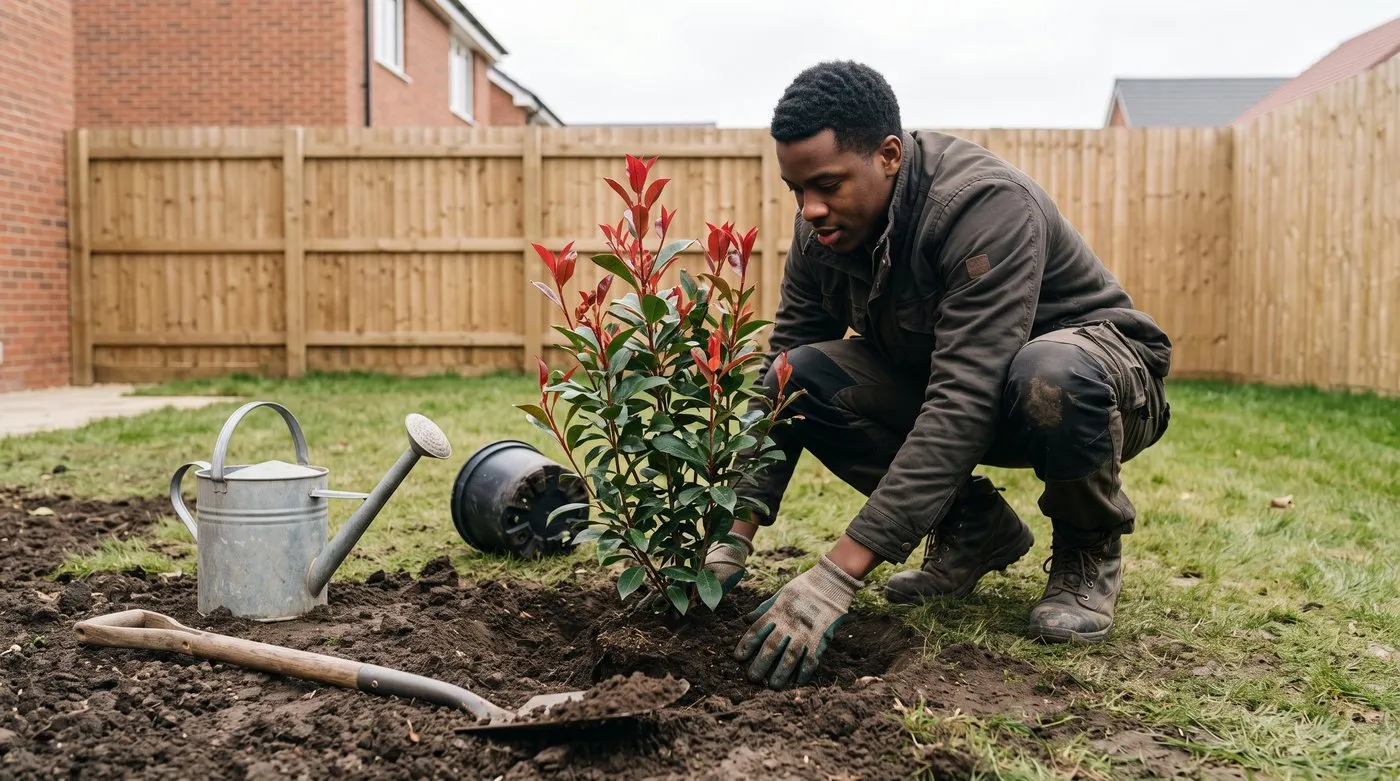
Plant at the same depth it sat in the pot, firm in gently and water well. Then keep it watered through its first summer.
- Dig over the whole planting area and work in garden compost or well-rotted manure.
- Dig a hole about twice as wide as the rootball, but no deeper.
- Loosen the sides of the hole and gently tease out circling roots.
- Plant at the same depth it grew in the pot, backfill with the soil you dug out, and firm in.
- Water thoroughly, then add a mulch around the base, keeping it off the stems.
Watering in the first summer matters most. A shrub that dries out in year one can sulk for the next year too. One kept moist grows away strongly.
Keeping fast growth in check
Fast shrubs need pruning every year to stay in bounds, flower well and avoid going bare at the base.
- Shrubs that flower on new growth, such as buddleja and lavatera, get a hard cut in early spring to a low framework.
- Dogwoods are cut hard in early spring for the brightest winter stems.
- Evergreens such as Photinia and Elaeagnus get a trim once or twice in the growing season.
- Shrubs that flower on last year’s growth are pruned just after flowering.
Always check for nesting birds before trimming in spring and summer, as disturbing an active nest is an offence. The guide to pruning shrubs explains the cuts in more detail.

A hard prune in March keeps buddleja compact and flowering well. New shoots soon follow.
Common mistakes with fast-growing shrubs
- Planting too close to a fence or path. Check the final spread on the label and allow for it.
- Skipping pruning for a few years. Fast shrubs get leggy and bare low down, and recovery is slow.
- Not watering in year one. Dry roots in the first summer slow everything down.
- Expecting instant height from evergreens. They’re quick for evergreens, but slower than buddleja.
- Using only fast growers. Mix in some slower shrubs so the garden still looks good in ten years.
Frequently asked questions
What are the fastest-growing shrubs in the UK?
Buddleja, lavatera, elder and dogwood are among the fastest. For evergreen cover, Photinia Red Robin, Elaeagnus ebbingei and Viburnum tinus are quick. Buddleja can grow well over a metre in a single season after a hard spring prune. Choose by whether you want flowers or year-round cover.
What is the fastest shrub for screening?
Photinia Red Robin and Elaeagnus ebbingei are hard to beat for fast evergreen screening. Both give year-round cover and take trimming well. Buddleja gives quick height in summer but is bare in winter. Match the plant to whether you need cover all year or just in summer.
How fast do shrubs grow?
Most shrubs grow slowly in their first year, then speed up. Once the roots are settled, fast growers put on noticeably more height each year than average shrubs. Soil, water and sunlight all make a big difference, so good planting and watering in year one help most.
Do fast-growing shrubs need more pruning?
Yes, they need pruning every year to stay in bounds. Buddleja, lavatera and dogwood take a hard cut in early spring. Evergreens like Photinia need a trim once or twice a year. Skip it and a fast shrub soon outgrows its space and goes bare at the base.
When should I plant fast-growing shrubs?
Plant from autumn to early spring, when the soil is moist. Autumn planting gives the roots months to settle before the first dry spell. Container-grown shrubs can go in at other times if you water them well. Water through the whole first summer.
Which fast-growing shrubs grow in shade?
Elder, dogwood and Elaeagnus ebbingei all cope with part shade. They’ll grow a little slower and flower less than in full sun. Buddleja and lavatera need full sun, so keep them for your brightest spots.
Now you’ve picked your quick shrubs, read the guide to privacy screening with hedges and trees to plan cover for the whole garden, or browse more ideas in the plants section.
Our team produces practical UK gardening guidance from source research, contributor records and established horticultural practice. Editorial standards are overseen by Matt W.


