
Key takeaways
- A stroll garden is for walking through, while a zen gravel garden is for sitting and looking
- Plan the path first, so each bend hides the next view
- Give the route three or more pauses, each with its own small scene
- Use stepping stones about 35-50cm across to slow people down
- Hardy choices include Japanese maples, Scots or mountain pine, camellias and Hakonechloa
- Keep maples out of frost pockets, as late spring frost scorches new leaves
A Japanese stroll garden is a garden you walk through rather than look at. A winding path leads you past a series of small scenes, each hidden until you turn the next bend. The UK’s damp, mild climate suits many of the plants, from Japanese maples to moss.
This guide covers the key ideas, how to plan the path, which plants are hardy here and how to fit water, stone and a summerhouse in. For the wider style, including zen gravel gardens, start with the guide to Japanese garden design.
What is a Japanese stroll garden?
A stroll garden, or kaiyu-shiki, is a walking garden. You follow a looping path past a series of staged scenes. Each one is hidden until you reach it.
It’s the opposite of a karesansui, the dry zen garden of raked gravel and rocks, such as Ryoan-ji in Kyoto. You sit and look at a zen garden from one place. In a stroll garden, you move and the garden unfolds around you.
The style grew up in Japan’s Edo period, from the 1600s. Korakuen in Okayama, Kenrokuen in Kanazawa and Ritsurin in Takamatsu are three famous examples you can still visit.
Does a stroll garden suit a UK garden?
Yes, many of the classic plants love our cool, damp weather. Japanese maples, camellias, ferns, moss and Japanese forest grass all do well in sheltered, moist UK gardens. Acid soil helps, and much of the north and west has it naturally.
The one weak spot is late spring frost. A cold night in late April or May can scorch freshly opened maple leaves. Plant maples away from frost pockets and out of early morning sun.
On chalky or limy soil, grow acid-lovers such as camellias and azaleas in large pots of ericaceous compost instead of in the ground.
The key design ideas
Five ideas shape every stroll garden. Get these right and it feels Japanese even on a small budget.
Hide and reveal
Nothing important should be visible from the entrance. The Japanese term is miegakure. The path turns, and a hedge, rock or shrub blocks the view. The next scene only opens when you reach it.
Borrowed scenery
Shakkei means using the view beyond your boundary. A neighbour’s big tree, a church tower or hills outside the fence become part of the picture. Keep your boundary planting low along that line of sight.

Low walls let the hills beyond become part of the garden. That’s borrowed scenery, and it costs nothing.
A string of scenes
Give the loop three or more stopping points, each with its own small set piece. That might be a group of rocks, a view over water, a single tree or a lantern. Let the path widen a little at each one, so people naturally pause.
No straight lines or matching pairs
Avoid symmetry. Group stones, trees and lanterns in odd numbers, such as three or five, at uneven distances. A central axis or neat pairs feel stiff in this style.
Suggest, don’t copy
A small pond stands in for a lake. A group of boulders hints at a mountain. A pruned pine suggests a windswept coast. Don’t try to copy a full-size Japanese garden on a UK plot.
How to plan the path
The path is the design, so draw it before you choose a single plant. Sketch the garden to scale and mark the loop, the pauses and the views.
- Turn early. A gentle bend soon after the entrance hides what’s coming.
- Avoid long straights. Turn or interrupt the path every few metres.
- Mark the pauses. Plan three or more spots where the path widens and a view opens.
- Mix surfaces. Stepping stones slow people down, so use them where you want a pause. Gravel or flagstones suit the linking stretches.
- Hide the rest of the route. If you can see two parts of the path at once, the surprise is lost.
The guide to garden path ideas covers materials and building methods.
Setting stepping stones
Use stones about 35-50cm across, irregular in shape. Space them for a relaxed stride, slightly unevenly, so people look down and slow down.
Set each stone on a firm, compacted base with a bed of sharp sand. Keep the top a little above the surrounding ground, so it sheds water and isn’t slippery in winter. Granite and reclaimed York stone both weather well.

Chunky stones across a shallow stream slow you down and make you look. Check they’re firm and level each spring.
Hardy plants for a UK stroll garden
Keep the plant list short and repeat it. A few trees, a few shrubs and a few ground plants, used again and again, look calmer than a mixed border.
Trees
| Tree | Size | Why grow it |
|---|---|---|
| Japanese maple ‘Bloodgood’ | Small tree | Reliable deep red leaves |
| Japanese maple ‘Sango-kaku’ | Small tree | Coral-red winter stems |
| Japanese maple ‘Osakazuki’ | Small tree | Fiery red autumn colour |
| Cut-leaf maple (dissectum types) | Low, weeping | Small plots and pond edges |
| Mountain pine (Pinus mugo) | Compact shrub | Easy, takes pinching into shape |
| Scots pine (Pinus sylvestris) | Large tree | Native, can be pruned into cloud shapes |
| Great white cherry, Prunus ‘Tai-haku’ | Medium tree | Big white blossom in April |
Pines can be shaped Japanese-style by pinching back the new shoots, or candles, in late spring. Mountain pine is the easiest to start with. For siting, soil and pruning, see the Japanese maple care guide.
Shrubs
- Camellias such as Camellia japonica ‘Adolphe Audusson’ or Camellia × williamsii ‘Donation’, flowering late winter to spring. The guide on how to grow camellias covers acid soil and watering.
- Japanese evergreen azaleas such as ‘Hino-crimson’ and ‘Vuyk’s Scarlet’ for May colour.
- Pieris japonica ‘Forest Flame’ for red new shoots in spring.
- Skimmia japonica for neat evergreen mounds and winter buds.
Azaleas and pieris are poisonous to dogs and cats if chewed, so think twice where pets roam.
Grasses and ground cover
- Japanese forest grass (Hakonechloa macra) gives soft, flowing clumps for path edges.
- Ferns such as autumn fern and soft shield fern suit shady edges.
- Black mondo grass (Ophiopogon planiscapus ‘Nigrescens’) contrasts well with pale gravel.
- Moss carpets shady, acid ground. The guide to the Japanese moss garden explains how to grow it.

A maple in full autumn colour makes a perfect stopping point. Plant one where the path pauses.
Adding water to a stroll garden
Most stroll gardens have water, but it isn’t essential. A pond, a stream or a simple stone basin all work.
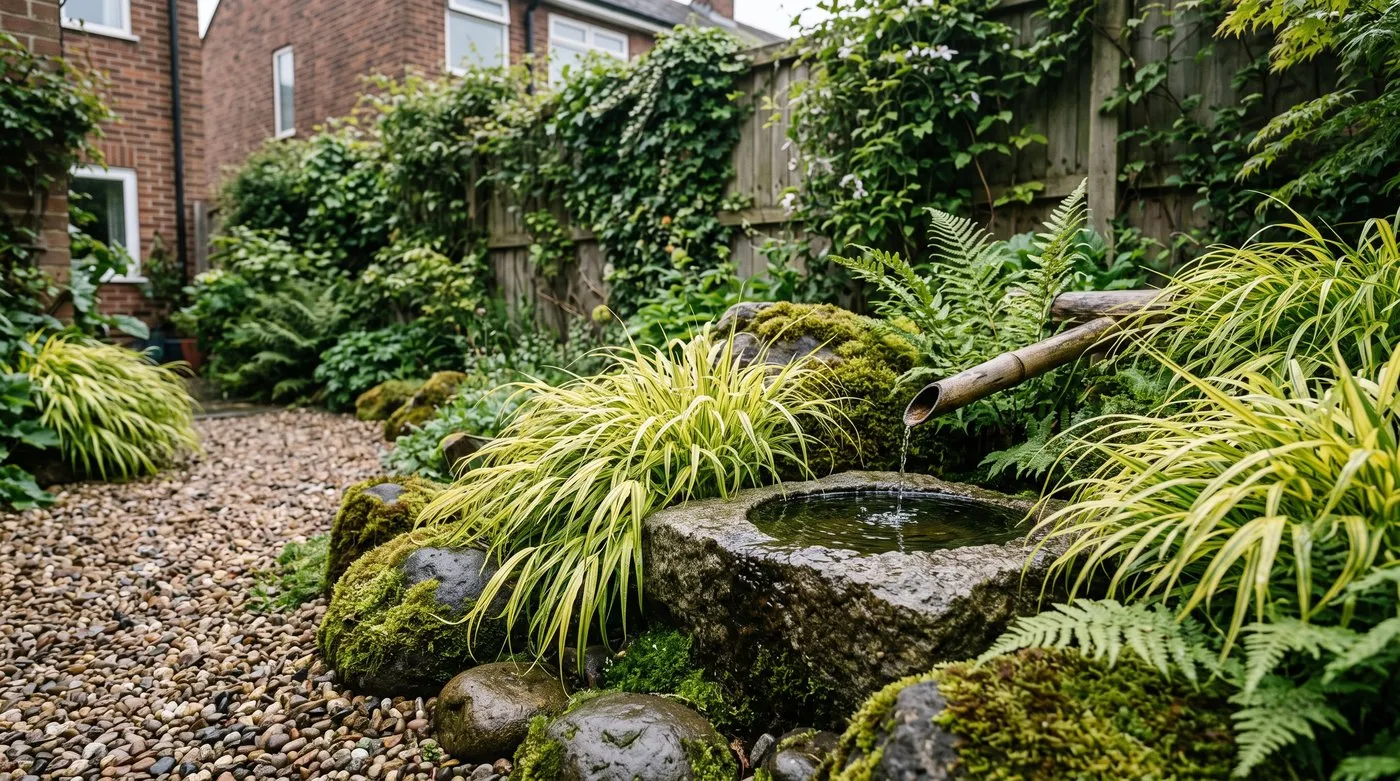
A stone basin with a gentle trickle brings the sound of water to even a small stroll garden.
- A small pond stands in for a lake. A flexible liner lets you make a natural, irregular shape. The guide on how to build a garden pond covers digging and lining.
- A short stream running into a pond adds sound and movement. It needs a pump and careful levels.
- A stone water basin, or tsukubai, with a slow trickle is the simplest option for a small garden.
Set rocks in and around the water in odd-numbered groups, with the tallest off-centre. Plant Japanese water iris (Iris ensata) or native flag iris at the margins.
Summerhouses as tea houses
A simple timber summerhouse can stand in for a Japanese tea house. Look for a low pitched roof, a single sliding or narrow door, and plain timber with no fussy trim. A dark stain helps it sit back into the planting.
Keep it small. A large building reads as a shed. Set it at one of the path’s pauses, ideally looking over water or a borrowed view.
Most garden buildings don’t need planning permission, but limits apply. For example, a building within 2m of a boundary must be no more than 2.5m tall. Check with your council if you’re unsure.

A simple timber summerhouse with a low roof and screen-style windows makes a lovely tea-house stop beside water.
Gravel areas, stones and lanterns
A small patch of raked gravel makes a calm pause along the path. Use angular granite chippings, which hold rake lines far better than round pea gravel. Lay them about 5cm deep over a membrane, with a firm edge.
Rake ripples around one or two upright stones. Rain softens the lines, so re-rake every week or two. The guide to creating a gravel garden covers base layers and edging.

Ripples raked around a single boulder make a quiet pause. A low hedge keeps the gravel in and frames the scene.
Stone lanterns anchor a scene. A low, broad snow-viewing lantern (yukimi) suits a pond edge. A small one sits nicely among ferns or moss. One lantern is usually enough. Two or three start to compete.
Set the lantern among two or three rocks of different heights, never centred and never on the path. It should be found, not announced.
A weathered stone Buddha statue works the same way. Set it low among ferns or moss at a pause in the path, half hidden rather than centred. One figure is a focal point, while a row of them looks like a garden centre display.

Half hidden among ferns, the lantern rewards a closer look. That’s far more Japanese than placing it in full view.
Stroll garden jobs month by month
| Month | What to do |
|---|---|
| January | Clear debris from paths, check pond pumps |
| February | Prune maples lightly while dormant if needed |
| March | Re-level any stepping stones that have moved, top up gravel |
| April | Mulch maples, camellias and azaleas with ericaceous compost |
| May | Pinch pine candles, watch for late frosts on maples |
| June | Trim hedges once birds have finished nesting, weed gravel |
| July | Rake gravel, keep ponds topped up in dry spells |
| August | Weed and water new plants, trim hedges if needed |
| September | Plant new trees and shrubs, divide grasses |
| October | Enjoy the maples, start clearing leaves |
| November | Clear leaves from moss, paths and ponds |
| December | Check lanterns and stones after frosts |
Before trimming any hedge, check for active nests. Damaging one is an offence, so avoid cutting from March to August where you can.
Common stroll garden mistakes
Choosing plants before the path. The path is the design. Draw it first, with every pause marked.
Too many kinds of plant. A packed mixed border doesn’t suit the style. Pick a few and repeat them.
Symmetry. Neat pairs and straight lines kill the relaxed look. Use odd numbers and uneven spacing.
Too many ornaments. One lantern, one basin and one rock group is plenty for most gardens.
Forgetting late frost. Maples in frost pockets get scorched in May. Site them carefully.
Frequently asked questions
What is a Japanese stroll garden?
It’s a garden made to be explored on foot along a winding path. The Japanese name is kaiyu-shiki. Scenes open up one at a time as you walk. The style grew up in Japan’s Edo period, and Korakuen in Okayama and Ritsurin in Takamatsu are famous examples.
How is a stroll garden different from a zen garden?
You walk through a stroll garden, but view a zen garden from one spot. Dry zen gardens, or karesansui, such as Ryoan-ji use raked gravel and stones inside an enclosure, seen from a veranda. A stroll garden uses a winding path to lead you past a series of small scenes.
What size garden do you need for a stroll garden?
A reasonably large garden, so the path has room to wind. It needs space to hide views and reveal new ones as you walk. In a small plot, the route doubles back too tightly and the effect is lost. There, borrow the ideas instead: a curving path, screened views and one surprise.
How wide should stepping stones be in a Japanese garden?
About 35-50cm across, wide enough to stand on comfortably. Space them for a natural, unhurried stride. Slightly uneven spacing makes people look down and slow their pace. Set each stone firmly on a compacted base, a little above the ground so it sheds water.
Will Japanese maples survive UK winters?
Yes, Japanese maples are hardy through UK winters. Late spring frost after the leaves open does more damage than winter cold. Avoid frost pockets and spots that catch early morning sun after a frosty night. Give them shelter from cold, drying winds and soil that doesn’t waterlog.
What is shakkei in Japanese garden design?
Shakkei means borrowed scenery. It uses things beyond your boundary, such as a neighbour’s tree, a church tower or a distant hill, as part of the design. Keep planting low along that line of sight so the eye travels out. Frame the view with plants nearer the house.
How much does a Japanese stroll garden cost to build in the UK?
It varies hugely with size, materials and whether you hire help. Reclaimed stone, a simple liner pond and small plants keep costs down. Streams, mature maples, natural stone lanterns and a summerhouse cost much more. Get several detailed quotes before you commit.
How much maintenance does a Japanese stroll garden need?
Regular, careful jobs rather than heavy work. The big ones are clearing leaves in autumn and weeding gravel and moss areas. Pines are shaped by pinching their new shoots, or candles, in late spring. Maples and clipped shrubs need light pruning to keep their shape.
Ready to start planting? Browse more garden design ideas or pick your trees with the guide to the best trees for autumn colour.
Our team produces practical UK gardening guidance from source research, contributor records and established horticultural practice. Editorial standards are overseen by Matt W.


