
Key takeaways
- Plant between November and early March while the tree is dormant
- Soak the roots for about 30 minutes and never let them dry out
- Dig a hole about three times as wide as the roots but no deeper
- Only stake larger trees, with a short stake, and take it off after two years
- Mulch round the base, keeping it 10cm clear of the trunk
- Water weekly in dry spells for the first two summers
Bare-root trees are grown in a field and lifted without any soil on their roots. You buy them while they’re dormant, from roughly November to March, when they have no leaves and don’t mind being moved. It’s the cheapest way to plant trees and hedges.
They’re cheaper than potted trees, come in far more varieties, and their roots have never circled a pot. Whether it’s one apple tree or a long native hedge, here’s how to choose, plant and look after them.
What does bare-root mean?
It means the tree was grown in an open field, then dug up while dormant with the soil shaken off. Once the leaves drop in late autumn, nurseries lift, sort and bundle them up to send out.
No heavy pot of soil means they’re light and cheap to post. The catch is timing. They have to be planted while dormant, before the buds open in spring.
You can buy fruit trees (apple, pear, plum, cherry), native trees (oak, birch, rowan, hazel, field maple) and ornamentals (crab apple, amelanchier, sorbus) this way. Bare-root hedging comes in hawthorn, beech, hornbeam, blackthorn, privet and native mixes.
Bare-root vs container-grown trees
Bare-root is cheaper with more choice. Potted trees can go in at any time of year.
| Bare-root | Container-grown | |
|---|---|---|
| Cost | Cheaper | Dearer |
| When to plant | November to March only | Any time |
| Choice | Widest, from specialist nurseries | Whatever the garden centre has |
| Roots | Spread straight out into your soil | Can circle round the pot |
| Weight | Light | Heavy |
| Sizes | Whips, young trees, 2-3 year trees | Usually older trees |
Roots that circle round a pot can carry on circling after planting and cause trouble years later. If you buy a potted tree, gently tease the roots out before planting.
Handy tip: Order bare-root trees in September or October. Popular varieties can sell out early.
When to plant bare-root trees
Plant between November and early March, while the tree is dormant. Earlier is better. November and December give the roots time to settle before spring. January and February are fine in mild spells. March works, but you’ll need to keep on top of watering through spring and summer.
Don’t plant into frozen or waterlogged ground. You can’t firm frozen soil round the roots, and soggy soil drowns them. If the weather’s bad when your trees arrive, heel them in until it improves.
In northern Scotland and on high, exposed sites, wait for a mild spell or plant in late winter.
How to choose healthy bare-root stock
Look for moist, fibrous roots, clean bark and tight, dormant buds. Check each one when your tree arrives.
Roots should be moist and well branched, spreading in all directions. They should smell fresh and earthy, not sour. Dry, brittle brown roots mean the tree has dried out and may not recover.
Stems should have smooth bark with no splits or sunken patches. On fruit trees, the graft (the knobbly joint just above the roots) should look clean and healed.
Buds should be plump and still closed. A tree that’s already in leaf will find the move harder.
Size: a one or two year old tree suits most gardens. Small whips are cheapest and settle quickly, but take longer to grow. Big trees look impressive but take longer to settle and need staking.
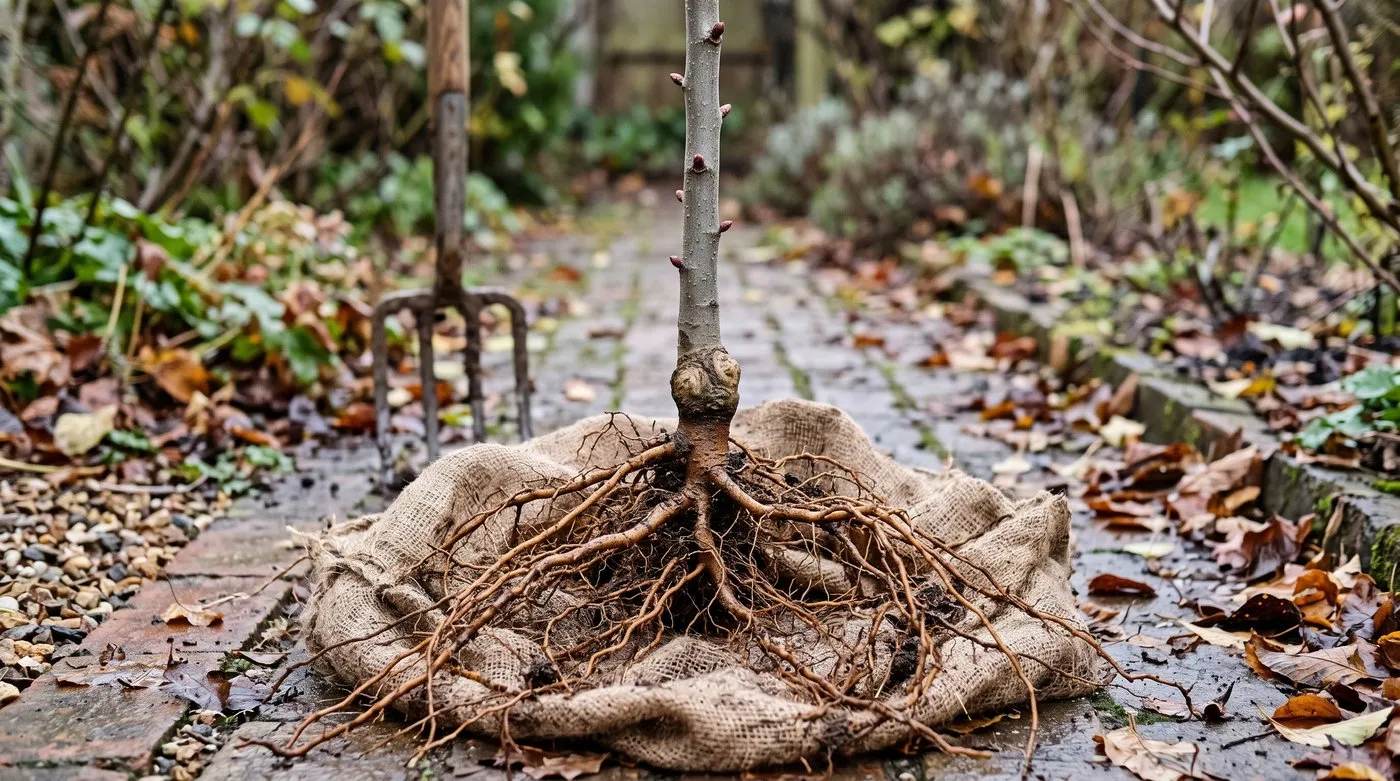
Healthy stock has moist, well-branched roots that smell earthy, smooth bark and plump, closed buds. Dry, brittle roots are a bad sign.
How to prepare the planting site
Clear the weeds and grass and check the drainage, ideally a few weeks before you plant.
Clear a circle about 1.2m across, and keep it weed-free for the first three years. Grass takes a lot of water from young trees. Never plant straight into a lawn without lifting the turf.
To check drainage, dig a hole and fill it with water. If there’s still water in it the next day, the spot is wet. On wet ground, plant on a low mound about 25-30cm high and 1m across, or pick a tree that likes damp soil, like willow or alder.
Pick trees that suit your soil rather than trying to change it. Most garden trees are happy in slightly acid to neutral soil. On chalk, go for beech, field maple or whitebeam.
Step-by-step planting guide
Before you start
Soak the roots in a bucket of water for about 30 minutes. Keep them covered until the moment they go in.
Snip off any broken or damaged roots with sharp secateurs.
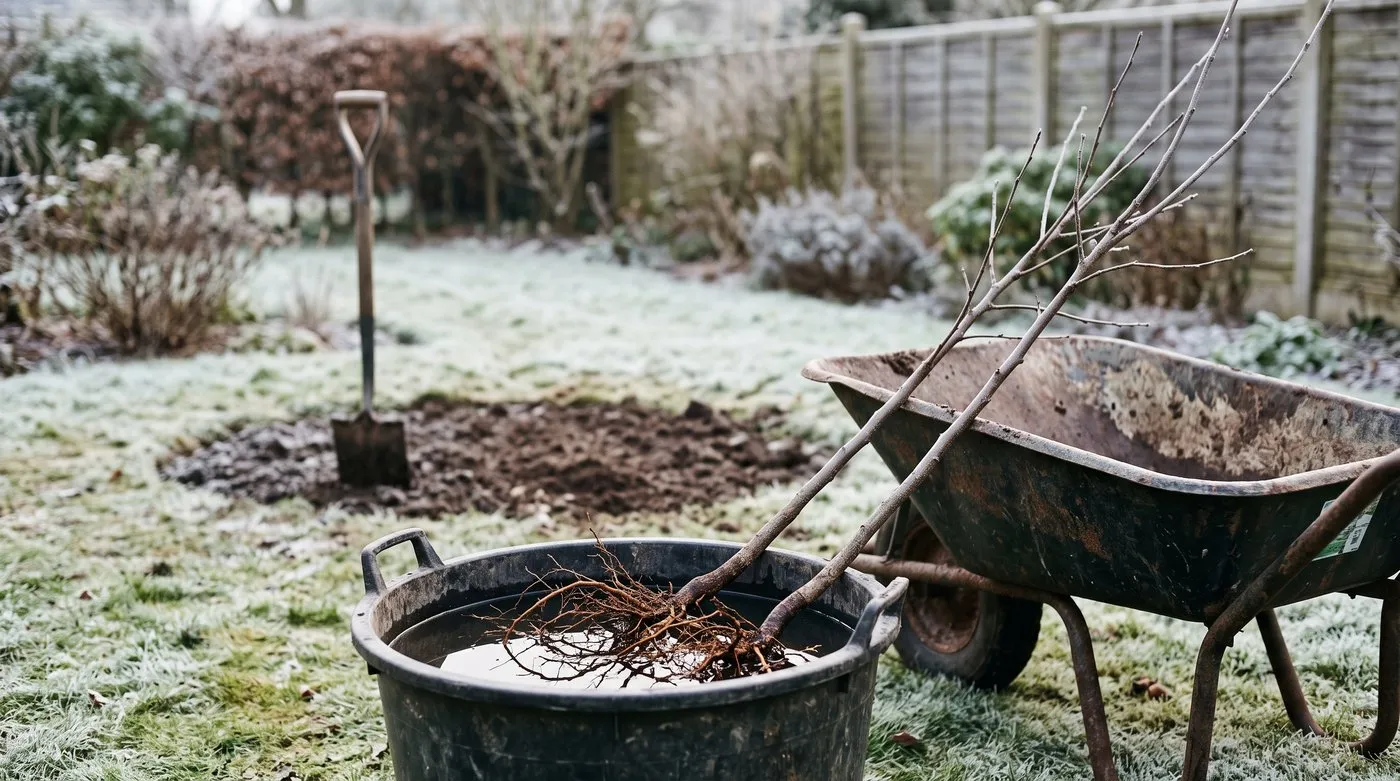
Soak the roots for about 30 minutes before planting. Keep them covered right up until they go in the ground.
Digging the hole
Dig a hole about three times as wide as the roots and no deeper. The point where the roots flare out from the trunk should end up level with the soil. Planting too deep is one of the most common reasons young trees die.
On fruit trees, keep the graft well above the soil. If it gets buried, the top part can grow its own roots and the tree ends up much bigger than you planned.
Loosen the bottom and sides of the hole with a fork, so roots can push out easily.
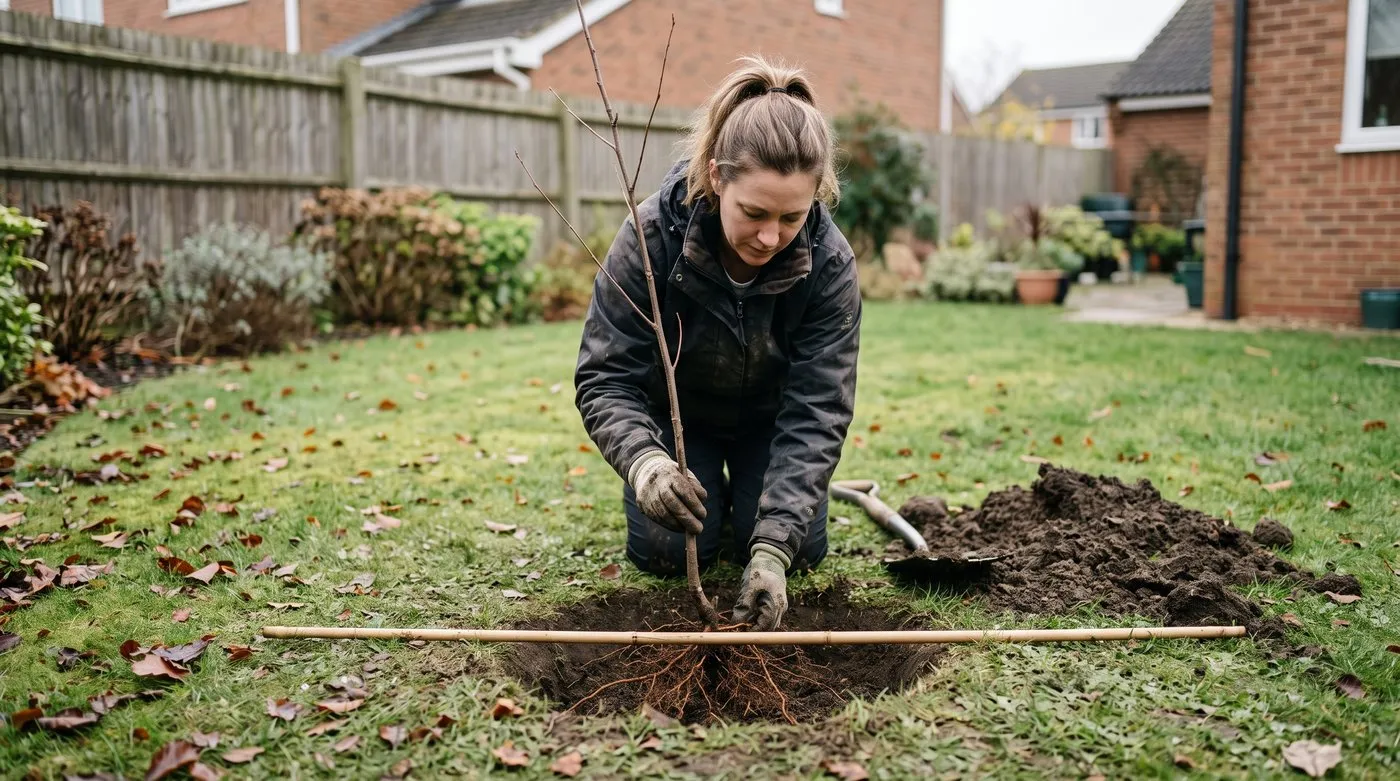
Dig wide, not deep. A cane laid across the hole shows you when the root flare is level with the soil.
Setting the stake
Small trees and whips don’t need a stake. For bigger or top-heavy trees, knock in a short stake before the tree goes in, so you don’t spear the roots. Put it on the windward side, usually the south-west.
A short stake, about a third of the trunk’s height above ground, lets the top sway in the wind. That’s what makes the trunk thicken and get strong.
Placing and backfilling
Sit the tree in the hole and spread the roots out evenly. Keep the trunk 5-8cm from the stake.
Fill the hole with the soil you dug out, nothing else. Compost in the hole rots down and the tree sinks. Fertiliser doesn’t help at this stage.
Fill a bit at a time, firming gently with your foot. Give the tree a gentle jiggle as you go so soil settles between the roots.
Should I use mycorrhizal fungi when planting?
It’s worth it on poor soil, but not needed on good garden soil. The RHS planting guide suggests it to help trees settle on poor ground.
These helpful fungi team up with the roots and help them find water and food. They need to touch the roots, so sprinkle them straight on. Don’t add fertiliser at the same time, as it can stop the fungi working. If the soil is very poor, feed a season after planting instead.
Securing the tie
Fix the tree to the stake with a rubber tree tie and a spacer, which stops the trunk rubbing on the stake. Check and loosen it each spring and autumn as the trunk grows. A tie that’s too tight can strangle the tree.
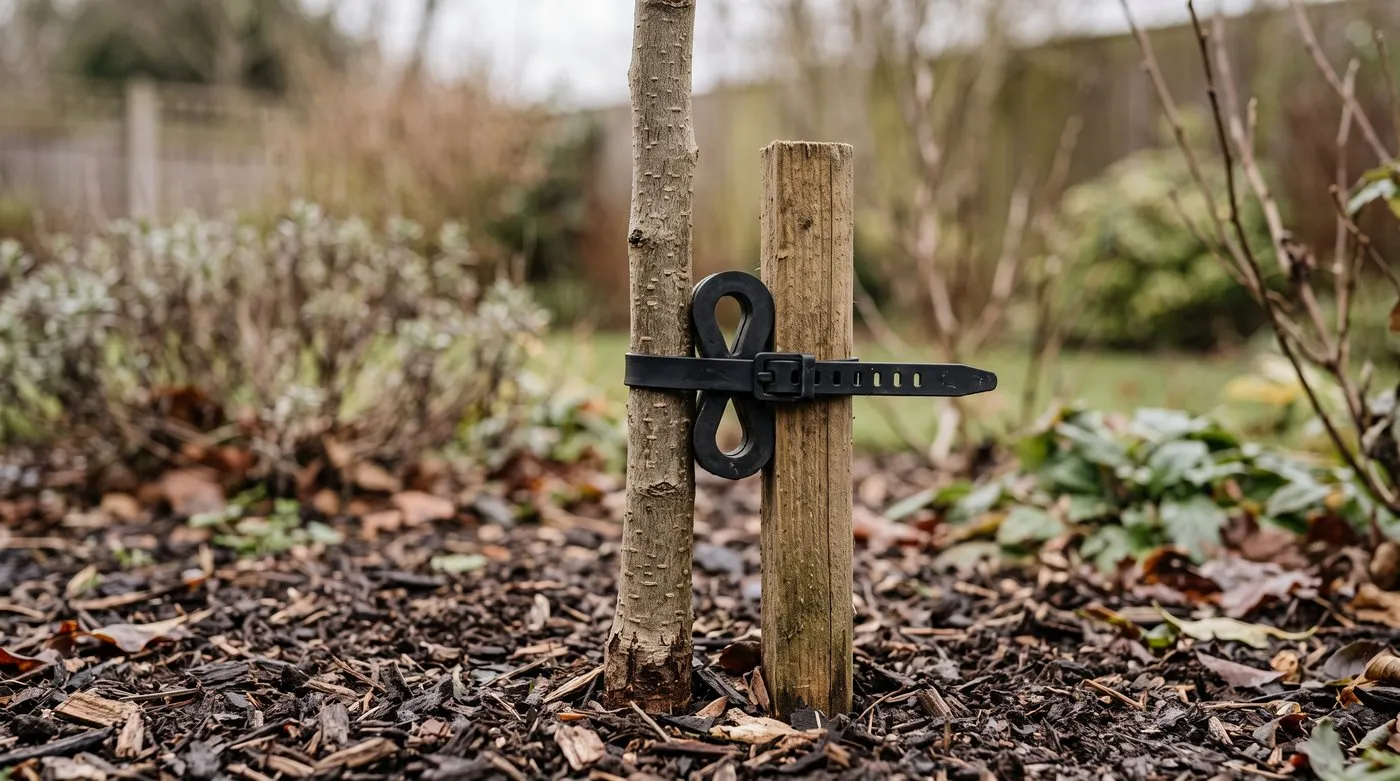
A spacer stops the trunk rubbing on the stake. Loosen the tie each spring and autumn so it never cuts into the bark.
Watering in
Water straight after planting, slowly round the base. It settles the soil round the roots. A hose on a gentle trickle for 15-20 minutes soaks in far better than a quick splash.
Mulching
Spread garden compost, well-rotted manure or bark at least 5cm thick over the weed-free circle. Keep it 10cm away from the trunk so the bark doesn’t rot. Mulch keeps weeds down and moisture in. Top it up each winter.
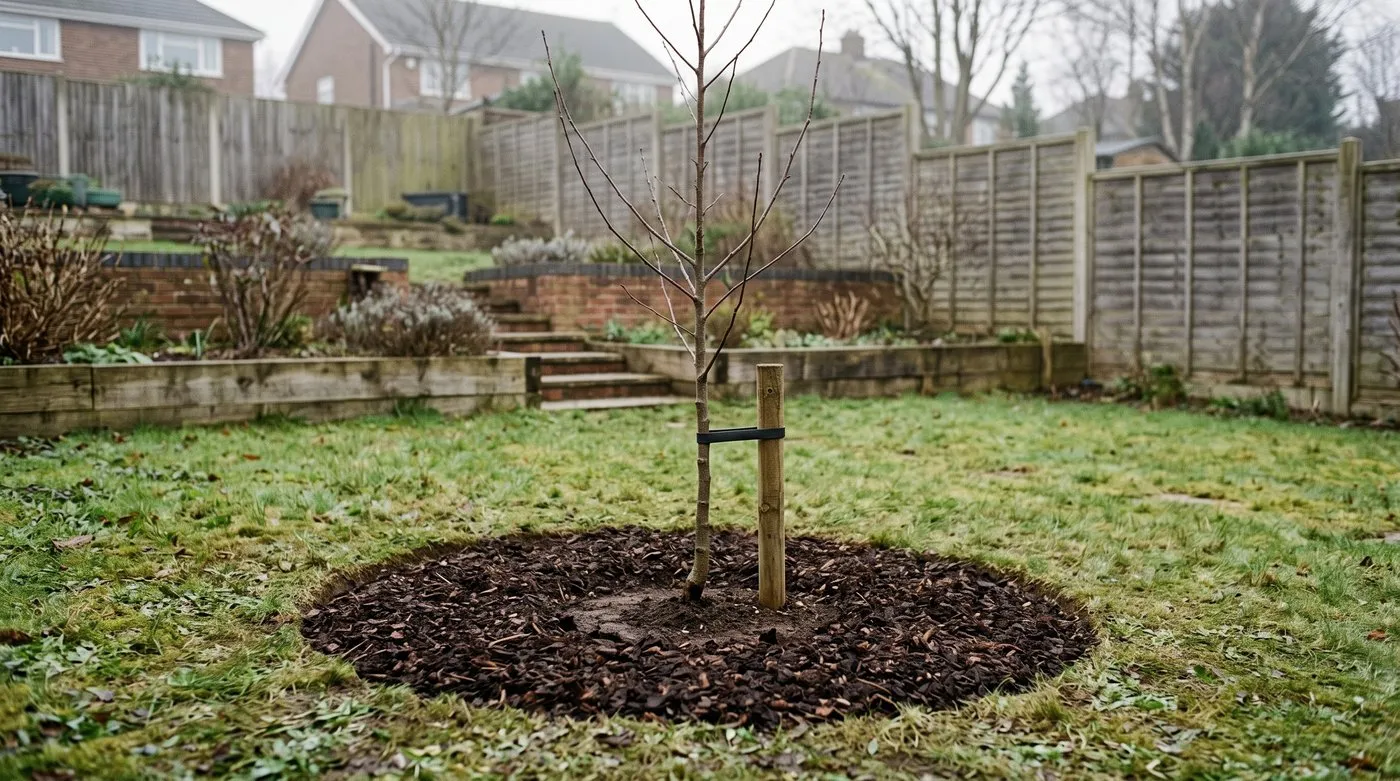
Keep a weed-free circle about 1.2m across for three years. Leave a 10cm gap around the trunk so the bark doesn’t rot.
Do bare-root trees need a rabbit guard?
Yes, if rabbits, deer or voles visit your garden. They can strip the bark off young trees, and a tree stripped all the way round usually dies.
Fit a spiral guard or a chicken wire guard at planting and push the bottom into the soil so voles can’t get under it. Spiral guards suit whips and hedging. Wider wire guards suit bigger trees. If deer visit, you’ll need a taller guard or a fence. Loosen or remove guards as the trunk grows.
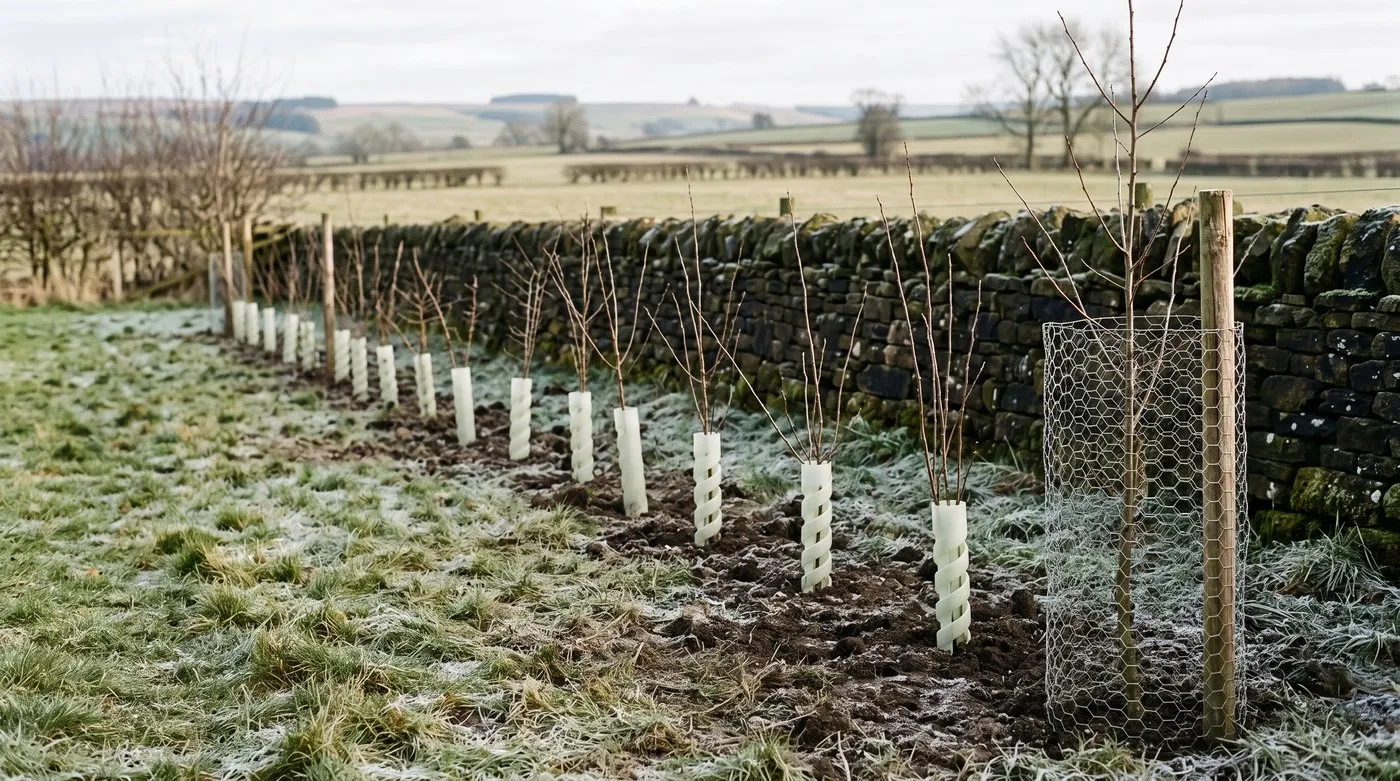
Push the bottom of the guard into the soil so voles can’t get under it. Loosen or remove guards as the trunks thicken.
Planting bare-root hedging
Hedging goes in the same way, just more of it. Popular choices are hawthorn (Crataegus monogyna), beech (Fagus sylvatica), hornbeam (Carpinus betulus), privet and mixed native hedging.
Spacing
For a single row, plant 30-60cm apart, depending on how big and fast the hedge is. For a thicker hedge, plant a double staggered row: two rows 45cm apart, with plants 90cm apart in each row. A double row fills out more and gives birds better cover. The RHS hedge planting guide has more on spacing.
A 10m hedge in a double staggered row takes about 22-24 plants. A single row at 30cm takes about 34.
Preparing the ground
Dig over a strip 60-90cm wide and a spade deep along the line of the hedge. Don’t put compost in the bottom of the trench, as it rots and the plants sink. On sandy or heavy clay soil, mix some into the soil you put back instead.
Get out every perennial weed, especially couch grass, bindweed and ground elder. They’re almost impossible to clear once the hedge is in.
Planting method
Set the plants in the trench at the right spacing and spread the roots out. Fill with the soil you dug out and firm round each plant. Water the whole line well. Keep a strip 45cm wide on each side clear of weeds, and mulch it.
Cut back deciduous hedging like hawthorn, beech and hornbeam just after planting and again the next winter. Trim the main shoots and long side shoots by about a third, just above a bud. This makes the hedge bushy from the bottom. Our hedge planting guide covers choosing plants and trimming in later years.
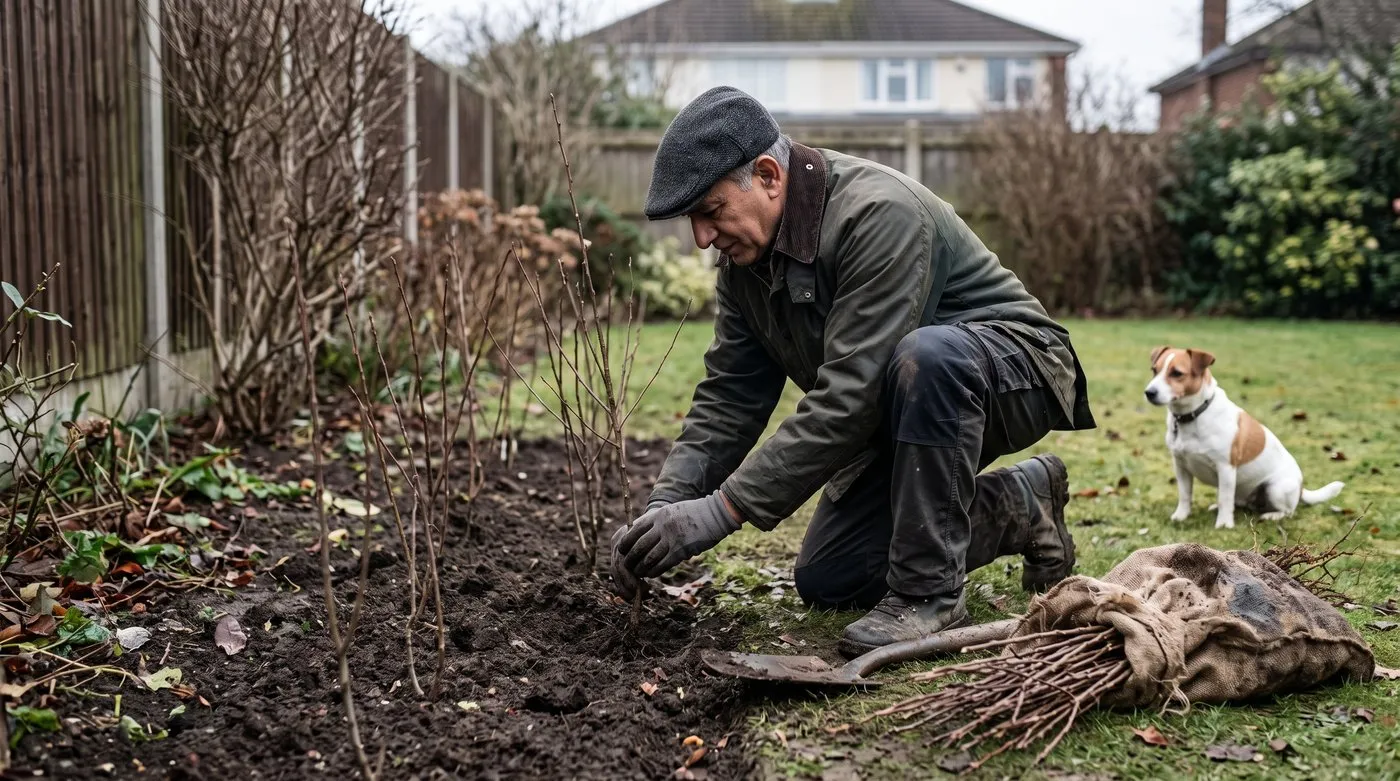
A double staggered row makes a thicker hedge and better cover for birds. Firm each plant in and water the whole line well.
First-year aftercare
The first spring and summer matter most. The tree has very few roots yet and relies on you for water.
Watering comes first. Water weekly in dry weather from April to September. Dig down a little beside the roots to check the soil first, because roots rot if the soil stays wet. Keep it up in dry spells through the second year too.
Weeding comes next. Keep that 1.2m circle clear for three years. Mulch helps, but pull any weeds that poke through.
Don’t feed in the first year. Fertiliser pushes leafy growth instead of roots. Only feed a season later if your soil is very poor.
Don’t prune in the first year, apart from dead, damaged or crossing branches. Start shaping fruit trees and ornamentals in the second winter. Our autumn gardening jobs cover getting young trees ready for winter.
Check ties each spring and autumn, as a tight tie can cut into the bark within months. Take the stake away after two growing seasons.
How do I know if my bare-root tree is alive?
Scratch a little bark on a twig with your thumbnail. Green underneath means it’s alive. Brown and dry means that bit has died.
Bare-root trees can be slow to leaf up, especially after late planting or a cold spring. Some, like ash and mulberry, are always late. Wait until early summer before giving up. Test a few twigs, working down towards the trunk. If the main stem is still green, it may sprout from lower down. Only a tree that’s brown right down to the graft or soil is truly gone.
Best bare-root trees for UK gardens
Fruit trees
Bare-root gives you the biggest choice of fruit trees. Specialist nurseries sell lots of apples on different rootstocks, plus pears, plums, cherries and gages. Buy from a nursery you trust so you get the right variety. Our guides to apple trees and pear trees explain rootstocks and pollination.
Native species
Native trees are brilliant for wildlife, and oak supports a huge range of it. Silver birch (Betula pendula) grows fast and casts light shade, but it gets tall, so check its final height for small gardens. Rowan (Sorbus aucuparia) has berries that feed thrushes, redwings and blackbirds. Hazel (Corylus avellana) gives early pollen for bees and nuts for squirrels and dormice.
Hedging plants
Hawthorn is a favourite. It grows on most soils, has white blossom in May and red berries in autumn, and makes a thick, thorny barrier. Beech keeps its brown leaves all winter when clipped, so it screens all year. Hornbeam looks similar but copes better with heavy, wet clay. A mixed native hedge is best for wildlife.
Month-by-month bare-root calendar
| Month | Jobs |
|---|---|
| September | Order bare-root trees and hedging |
| October | Get the site ready: clear weeds and check drainage |
| November | Best month to plant. Get trees in as soon as they arrive |
| December | Keep planting. Heel in anything you can’t plant yet |
| January | Plant in mild spells, avoiding frozen or soggy ground |
| February | Last reliable month in most areas |
| March | Last chance. Water and mulch well |
| April | Water in dry spells. Swelling buds show the tree is alive |
| May | Weed round the base. Top up mulch if it’s thin |
| June | Check ties and guards. Water weekly in dry spells |
| July to August | Keep watering in dry weather. Keep grass and weeds away |
| September | Water less as the rain returns. Order next season’s trees |
Common mistakes to avoid
Letting roots dry out
Fine roots dry out fast on a cold, windy day. Keep them wrapped in damp sacking or a plastic bag until they go in. Never leave them lying out while you dig.
Planting too deep
Burying the trunk below where the roots flare out makes the bark rot, especially in heavy soil. On fruit trees, a buried graft cancels out the dwarfing rootstock. Check the depth before firming, and again after watering.
Using enriched backfill
Filling the hole with rich compost seems kind, but it rots down and the tree sinks. Roots may also stay in the soft pocket rather than spreading out. Just use the soil you dug out.
Staking the wrong trees, or too long
Big trees left unstaked can rock and break their new roots. Small whips grow sturdier without one. Remove stakes after two growing seasons.
Forgetting to water
A tree planted in November still needs watering through its first summer. Its small roots can’t reach far for water. Check the soil weekly in dry spells from April to September.
Planting fruit? Read our guide on how to grow apple trees in the UK next.
Related reading: Planting near a protected tree comes with rules too. See what a TPO means for gardeners.
Frequently asked questions
When is the best month to plant bare-root trees in the UK?
November and December are ideal across most of the UK. The soil is still a little warm, so roots can start settling in. January and February are fine in mild spells. Just avoid frozen or waterlogged ground.
Can I plant a bare-root tree in March?
Yes, but earlier is better. Buds start swelling in March, and the tree soon needs water as the leaves open. Plant it as soon as it arrives and keep watering in dry spells through its first summer.
How long can I store a bare-root tree before planting?
Plant within a day or two if you can. If not, heel it in. Dig a trench somewhere sheltered, lay the tree in at an angle and cover the roots with moist soil. It will keep like that for several weeks. Never leave the roots where they can dry out.
Do bare-root trees need staking?
Small trees and whips don’t need a stake. Larger or top-heavy trees do. Use a short stake so the top of the trunk can sway and get stronger, and remove it after two growing seasons. Fruit trees on very dwarf rootstocks like M9 and M27 need a stake for life.
Why choose bare-root over container-grown trees?
They’re cheaper and come in many more varieties. Their roots have never gone round and round in a pot, either. The only catch is that you can only plant them from November to March.
Should I add compost or fertiliser to the planting hole?
No, just use the soil you dug out. Compost in the hole rots down and the tree sinks. Fertiliser doesn’t help at planting time. On poor soil, sprinkle a mycorrhizal product on the roots instead.
How often should I water a newly planted bare-root tree?
Once a week in dry weather, from April to September. Keep this up for the first two years. Water slowly at the base so it soaks in. Check the soil first, as roots can rot if it stays wet.
Our team produces practical UK gardening guidance from source research, contributor records and established horticultural practice. Editorial standards are overseen by Matt W.


