
Key takeaways
- Black mulberry gives the tastiest fruit and is the one to grow in UK gardens
- Plant bare-root trees from November to March in sun, sheltered from cold winds
- Trees usually start fruiting after five to eight years
- Prune only lightly, in early winter, as cuts at other times bleed sap
- Pick from late July when berries are dark purple-black and fall at a touch
Mulberry trees are long-lived, low-fuss and wonderfully generous fruit trees for a UK garden. Black mulberries have been grown in Britain for centuries. The fruit tastes like a richer, wine-dark blackberry, and the juice stains everything it touches.
Growing one is easy once you pick the right type and spot. They’re self-fertile, so one tree is enough, and they need very little pruning. A big tree gives you enough berries for the freezer, a few jars of jam and still some for the blackbirds.
Which mulberry species should I grow in the UK?
Three kinds of mulberry are around in the UK, but for fruit, black mulberry (Morus nigra) is the one to grow. It has by far the best flavour.
Black mulberry grows into a broad, spreading tree over many years. It has rough, heart-shaped leaves. The fruit ripens from late July to September, going from green to red to deep purple-black, with a sweet-sharp, rich flavour. It’s slow to get going, but it lives for a very long time.
White mulberry (Morus alba) grows faster and taller, with glossy, smooth leaves. It’s the one silkworms eat. The fruit is pale pink to white and much blander. It makes a nice shade tree, but it’s not one to grow for eating.
Red mulberry (Morus rubra) is a North American tree that’s rarely sold here. It doesn’t offer anything over black mulberry in British gardens.
| Black mulberry | White mulberry | Red mulberry | |
|---|---|---|---|
| Size | Medium, broad | Large | Medium to large |
| Growth | Slow | Fast | Medium |
| Fruit | Deep purple-black | White to pale pink | Dark red to purple |
| Flavour | Rich, sweet-sharp | Bland, sweet | Good |
| Easy to buy? | Yes | Yes | Rare |
| Best for | Fruit | Shade, looks | Collectors |
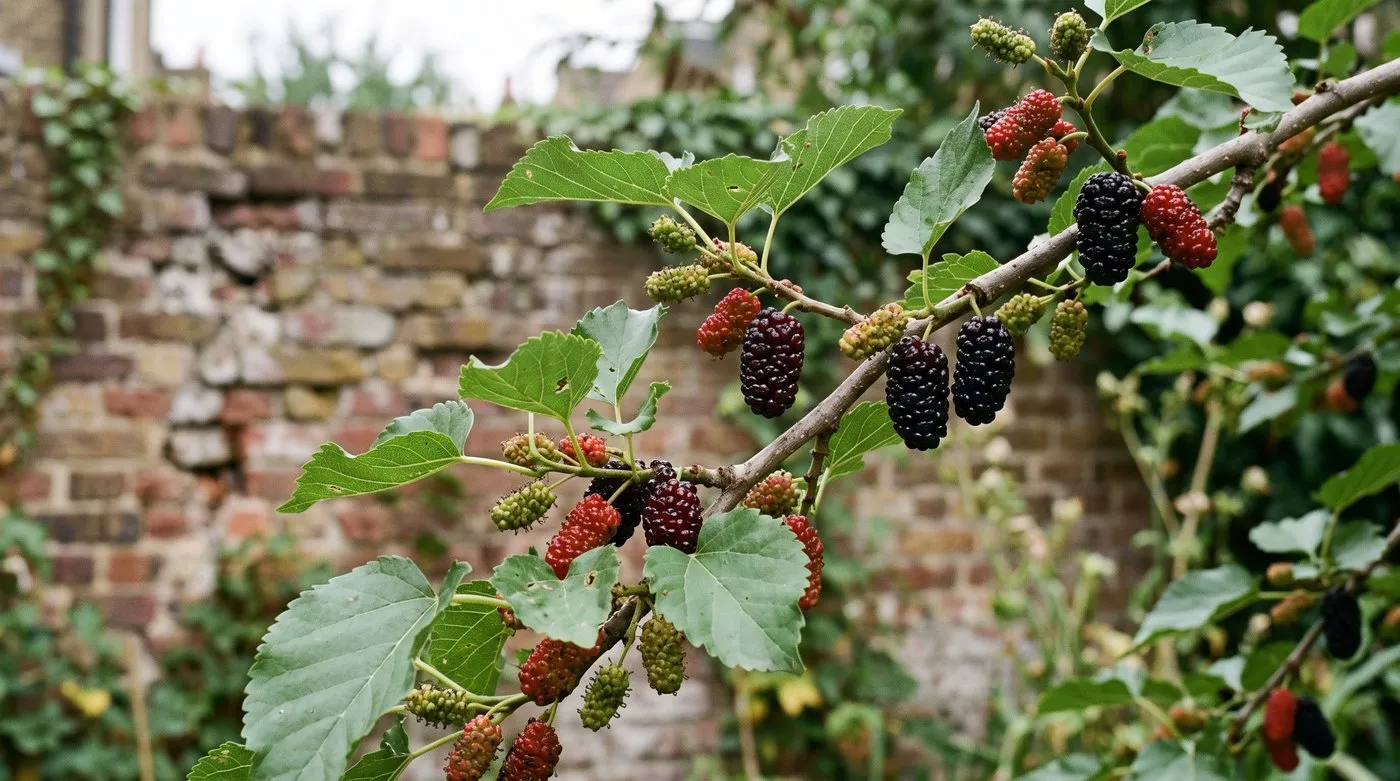
Black mulberry is the one to grow for flavour. The fruit turns from green to red to deep purple-black as it ripens.
How do I plant a mulberry tree?
Give your mulberry full sun and shelter from cold winds. A spot against a south or south-west facing wall is ideal. The warm brickwork helps the fruit ripen and protects new growth, just like it does for fig trees.
 A newly planted mulberry with its stake, tie and a ring of bark mulch against a sunny wall.
Getting the spot ready:
- Dig a hole about 60cm wide and 45cm deep
- Fork over the bottom to loosen it
- Mix the soil you dug out with a bucket of well-rotted manure
- On heavy clay, put a layer of gravel in the bottom to help drainage
- On rich soil, you can line the sides with paving slabs or use a root-control bag to keep the roots snug, which helps it fruit sooner
Planting (November to March for bare-root):
- Soak the roots in a bucket of water for a couple of hours
- Plant at the same depth as before, using the soil mark on the trunk as a guide
- Backfill and firm gently with your foot
- Knock in a stake at an angle on the windy side and fix it with a tree tie
- Water well and spread a bark mulch in a ring around the trunk, leaving a gap round the trunk itself
- In exposed gardens, give young trees some protection such as fleece for their first couple of winters
Spacing: A free-standing tree needs about 8-10m of space. A fan trained on a wall needs about 4-5m of wall.
How do I prune a mulberry tree?
Mulberries need very little pruning, which is one of their best points.
When: Prune only in late November or December, when the tree is fully dormant. Cut at other times of year and the tree bleeds sticky sap. This is the most important rule of mulberry care.
Young trees (first five years or so): Remove crossing branches and shoots growing into the middle. Aim for an open shape with four or five main branches spreading out from the trunk.
Older trees: Just remove dead, damaged or diseased wood, and any branches dragging on the ground. Old mulberries grow gnarled, low and leaning. That’s part of their charm, so don’t try to tidy them into a neat shape.
Wall-trained fans: In summer, tie new shoots to horizontal wires on the wall. Remove shoots growing straight out from the wall and strong upright shoots.
If you’re new to fruit tree care, mulberries are very forgiving. The biggest risk is doing too much, not too little.
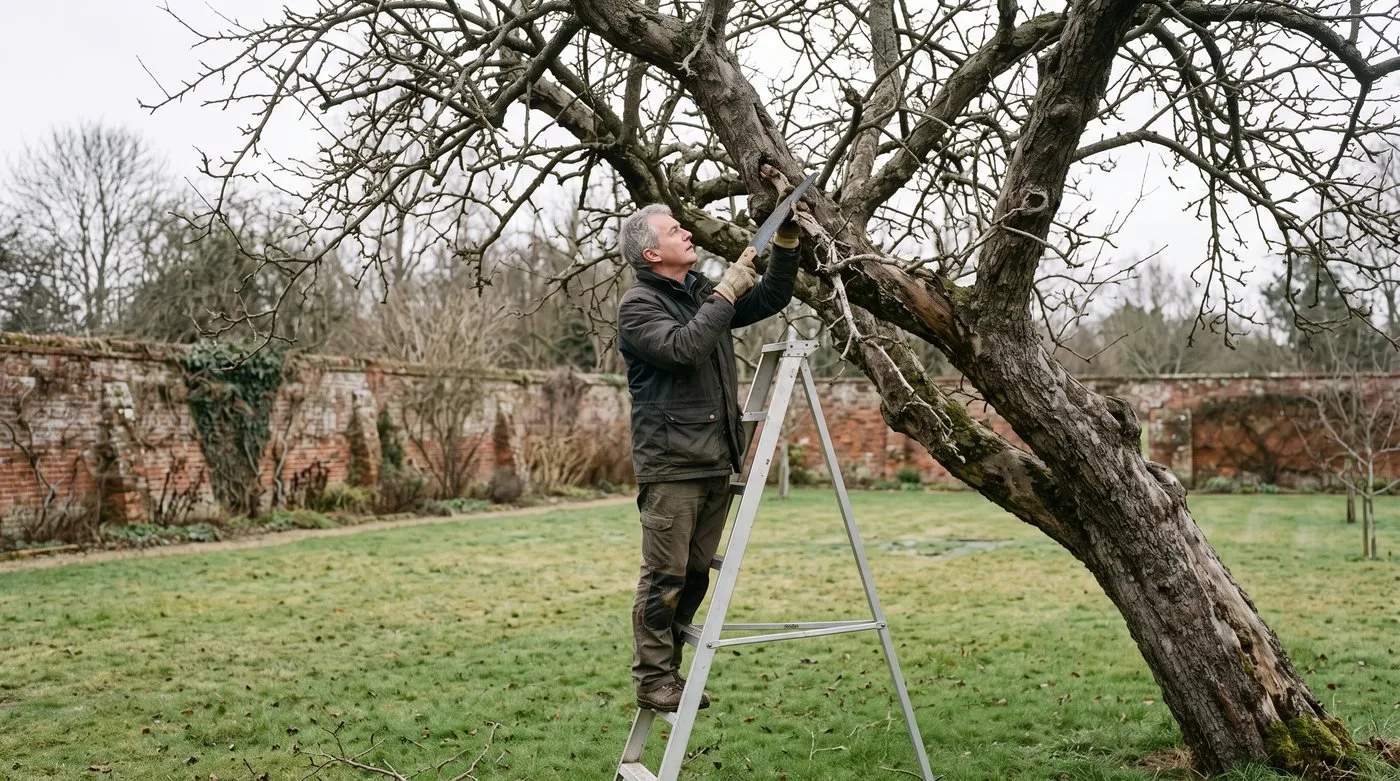
Prune only in late November or December, when the tree is fully dormant. At other times of year it bleeds sticky sap.
When and how do I harvest mulberries?
Ripe mulberries drop off at the slightest touch. That tells you they’re ready, and it’s also what makes picking a bit messy. They’re very soft and the juice stains purple.
 Picking mulberries by hand into a shallow basket. Check the tree daily from late July.
How to pick: Spread a clean old sheet under the tree and gently shake a branch, then gather up the fallen berries. Or pick by hand, taking only the ripe ones, as they squash easily. Wear old clothes!
When they’re ready: Berries go from green to red to deep purple-black. A ripe one comes away with no tug at all. Check the tree every morning in season. Fallen fruit left on the ground soon goes mushy and attracts wasps.
Keeping and using them:
- Fresh: Eat within a day or so. Don’t wash them until you’re ready to eat
- Frozen: Spread on a tray to freeze, then tip into bags
- Jam: 1kg berries, 750g sugar and the juice of 2 lemons, simmered to a soft set
- Cordial: Crush berries with sugar and water, strain through muslin and keep in the fridge
- Dried: In a dehydrator they turn into sweet, raisin-like nibbles
Mulberries are lovely in crumbles and summer puddings with other home-grown fruit.
Month-by-month mulberry care calendar
| Month | What to do |
|---|---|
| January | Check stakes and ties. Order bare-root trees. |
| February | Get the planting spot ready with well-rotted manure. |
| March | Plant bare-root trees before the buds open. Water well and mulch. |
| April | New leaves appear. Water young trees in dry spells. Watch for late frosts. |
| May | Sprinkle a general fertiliser such as blood, fish and bone. |
| June | Little fruits form. Water young trees in long dry spells. |
| July | First ripe berries late in the month. Lay sheets under the tree and pick daily. |
| August | Main harvest. Freeze any extra. Net the tree if birds are a problem. |
| September | Last berries ripen. Clear fallen fruit to avoid wasps. |
| October | Leaves turn yellow and fall. Compost them. |
| November | Prune only if needed (dead, damaged or crossing branches). |
| December | Plant bare-root trees. Mulch older trees with compost. |
See our companion planting guide for ideas on what to grow nearby.
Can I grow a mulberry tree in a small garden?
Yes, with the right variety and a little training. Mulberries are happy in a big pot or trained on a wall, which keeps them much smaller.
Good picks for small spaces:
- ‘Charlotte Russe’ (Morus rotundiloba) is a compact, bushy mulberry that stays small enough for a big patio pot and gives black fruit
- Morus nigra ‘Chelsea’ (also sold as ‘King James’) can be trained as a fan on a sunny wall
- Morus alba ‘Pendula’ is a small weeping tree, grown mainly for looks, with a few white fruits as a bonus
In a pot: Use a pot of at least 50 litres with drainage holes. Fill with John Innes No.3 with some perlite mixed in. Stand it in full sun, ideally by a sunny wall. Water daily in summer and give a tomato feed every couple of weeks from May to August. Every few years, repot with fresh compost.
Keeping the roots snug in a pot often helps mulberries fruit sooner, just as it does for dwarf fruit trees.
 A bowl of black mulberries, from red to deep purple-black. The darkest ones are fully ripe.
What pests and diseases affect mulberry trees?
Mulberries are pleasingly trouble-free. They have fewer problems than most fruit trees.
Coral spot shows as small coral-pink pimples on dead wood. Cut out affected branches back into healthy wood and get rid of the prunings. It mostly attacks trees stressed by waterlogging or drought. Our guide to canker in fruit trees covers other bark problems.
Leaf spot causes brown spots on leaves in wet summers. It’s only cosmetic, so no treatment is needed.
Birds are your main rivals for the fruit. Blackbirds, thrushes and starlings can strip ripe berries fast. Net small trees from early July, or just enjoy sharing.
Frost can scorch new shoots and flower buds in late spring, which means fewer berries that year. Cover young trees with fleece when frost is forecast. Older trees bounce back quickly.
What soil and conditions do mulberry trees need?
Mulberries grow in most UK soils, from heavy clay to sandy loam, as long as water drains away. They hate waterlogged ground.
On heavy clay: Dig in plenty of grit and well-rotted organic matter. In very wet gardens, plant on a low mound. Our clay soil guide has more tips.
On sandy soil: Mulch every year with well-rotted manure or compost to help hold moisture. Water young trees weekly in dry spells for their first few years.
Shelter: Mulberries come into leaf late, which helps them dodge most spring frosts. Cold north and east winds can still damage new growth, so plant on the sunny side of a wall, building or hedge.
Sun: The more sun, the better the fruit. In shade the tree grows fine but gives fewer, less sweet berries.
The RHS mulberry page has more on choosing and growing a mulberry.
Mulberry tree history in the UK
Mulberries have a long history in Britain. The Romans are thought to have brought the black mulberry here. Monasteries grew them in walled gardens, and grand Tudor and Jacobean houses planted them for fruit.
Some very old mulberries still grow at historic houses and Cambridge colleges, and many still fruit every summer. Plant one now and it could still be feeding people long after you.
Now you know how to grow a mulberry, try our guide to grafting fruit trees to learn how to make new trees from your favourite.
Frequently asked questions
How long does a mulberry tree take to fruit?
Usually five to eight years. Trees grown from cuttings or grafted trees fruit sooner than ones grown from seed. Restricting the roots, in a large pot or a slab-lined pit, can help it fruit a little earlier. Once it gets going, a mulberry crops every summer for many years.
Can you grow a mulberry tree in a pot?
Yes, in a big pot of 50 litres or more. Use loam-based compost such as John Innes No.3 with some perlite mixed in for drainage. A pot keeps the roots snug, which helps it fruit sooner. Compact types like ‘Charlotte Russe’ stay small enough for a patio. Water daily in summer.
What is the best mulberry tree for the UK?
Black mulberry (Morus nigra) is the best for UK gardens. It has the biggest, tastiest berries. ‘Chelsea’, also sold as ‘King James’, is a popular variety that’s easy to find in UK nurseries. White mulberry grows faster, but its fruit is much blander.
When should I plant a mulberry tree?
Plant bare-root trees between November and March while they’re dormant. Potted trees can go in at other times, but autumn and winter are best. Don’t plant into frozen or waterlogged soil. If you plant in spring, keep it well watered through its first summer.
Do mulberry trees damage foundations?
Mulberries aren’t known as a high-risk tree, but give them space. Plant well away from buildings, at least 5m, and further on shrinkable clay soil. If you’re worried about a tree near your house, ask a tree surgeon or surveyor for advice.
Are mulberries safe to eat straight from the tree?
Yes, ripe mulberries are lovely eaten straight from the tree. Pick only fully ripe berries, which are dark purple-black and fall off at a gentle touch. Unripe green or red berries can upset your stomach, so leave those to ripen.
Why is my mulberry tree not fruiting?
Usually it’s just too young. Mulberries often take five to eight years to start. Too much feeding can give you leaves instead of fruit, and too much shade cuts the crop. Late spring frosts can also kill the flower buds in exposed gardens. Full sun and restricted roots help most.
Our team produces practical UK gardening guidance from source research, contributor records and established horticultural practice. Editorial standards are overseen by Matt W.


