Key takeaways
- Plants and gravel clean the water, so there's no chlorine at all
- Give about half the pond to a shallow planted cleaning zone
- A professional build usually costs £15,000 to £45,000 and takes 4 to 8 weeks
- Planning permission isn't normally needed, but check in conservation areas
- It's much cheaper to run than a chlorinated pool
- Native plants like hornwort, water lilies and yellow flag iris do the cleaning
A natural swimming pond is a pond you can swim in, kept clean by plants and gravel rather than chlorine. No chemicals, no stinging eyes, and lots of wildlife. A professional UK build usually costs £15,000 to £45,000, and it’s much cheaper to run than a traditional pool.
How does a natural swimming pond work?
A swimming pond has two parts: a swimming zone and a regeneration zone. You swim in one. The other is a shallow, packed-full-of-plants area that cleans the water.
A small, low-energy pump moves water between the two. As it trickles through gravel and plant roots, friendly bacteria break down muck and the plants soak up nutrients. Clean water flows back to where you swim.
Give about half the pond to the planted zone. This is the most important design rule. Skimp on it and you’ll fight algae and murky water.
It works just like a healthy natural pond does. There’s nothing to buy in a bottle and no chlorine smell.
 The rubber liner going in over its protective underlay, with gravel for the planted zone in the front.
What are the different types of swimming pond?
Swimming ponds range from all-natural to nearly a pool. The more gadgets they use, the less planting they need.
| Type | How it’s cleaned | Planted area | Suits |
|---|---|---|---|
| Type 1 | Plants only, no pump | Most of the pond | Wildlife lovers with space |
| Type 2 | Plants plus a surface skimmer | About half | Most UK gardens |
| Type 3 | Plants, pump and a filter | Just under half | Families who want clearer water |
| Type 4 | Mostly a filter, fewer plants | A small part | Modern designs, smaller gardens |
| Type 5 | Mechanical and natural filters | Very little | Pool-like water with no chlorine |
Type 2 is the favourite for UK gardens. It looks natural, is great for wildlife and gives clear water without lots of machinery. Type 1 looks the wildest but needs the most room. Type 5 is really a pool with a natural filter.
Do you need planning permission?
Usually not. Garden ponds normally count as permitted development, as long as they don’t:
- Cover more than half the garden (counting sheds and extensions too)
- Sit in front of the house on the side facing a road
- Change drainage in a way that affects the neighbours
Do check with your local planning office if you’re in a conservation area or a National Landscape (formerly AONB), or near a listed building.
There’s no legal need to fence a private garden pond in England and Wales. If young children use the garden, though, think about safety. A lockable gate, a rigid safety cover or a shallow step at the entry point all help.
Our guide to building a wildlife pond has more on safe edges and children.
How to build a natural swimming pond
The build runs in five stages over about 4 to 8 weeks. Start in late spring or early summer so the plants settle before autumn.
Phase 1: Design and excavation (Week 1-2)
Mark out the shape with a hosepipe or spray paint. Most swimming ponds are 40 to 80 square metres in total. The swimming zone wants to be about 1.8m to 2.2m deep. The planted zone is much shallower, about 30-60cm.
You’ll dig out a lot of soil, so plan where it goes. Book skips, or use it to make raised beds or a mound. You’ll need room to get a mini digger in.
Phase 2: Liner installation (Week 2-3)
EPDM rubber liner is the usual choice. It’s flexible, tough and lasts for decades.
Lay a protective underlay first, so stones and roots can’t puncture it. Fold and tuck the liner neatly. Leave at least 50cm spare all round, tucked under stone edging or buried in a trench.
Phase 3: Gravel substrate and zoning (Week 3-4)
Spread washed, lime-free gravel (6-12mm) about 20-30cm deep in the planted zone. Bacteria live in this gravel and help clean the water. Avoid limestone gravel, which pushes up the pH and helps algae.
Build a low underwater wall or barrier between the two zones. Water flows through, but swimmers and floating bits stay put.
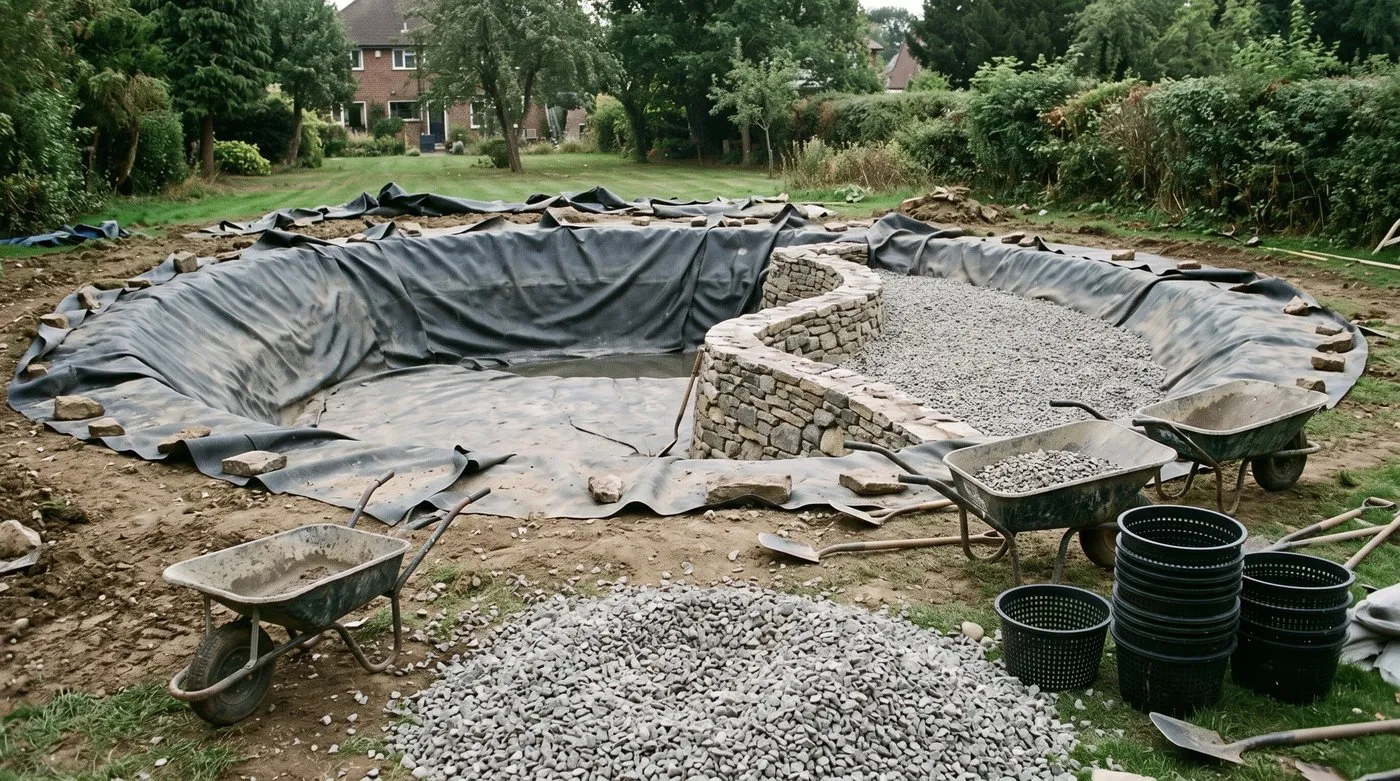
The gravel in the planting zone is home to the bacteria that clean the water. Use washed, lime-free gravel, as limestone helps algae.
Phase 4: Planting (Week 4-5)
Plant the shallow zone thickly with underwater, edge and floating plants. The RHS guide to pond planting is a great extra read.
Underwater plants: Hornwort (Ceratophyllum demersum), spiked water milfoil and water starwort. Plant about five bunches per square metre.
Edge plants: Yellow flag iris, purple loosestrife, marsh marigold and water mint. Pop them in aquatic baskets on shelves about 30-50cm deep.
Floating plants: White water lily and frogbit. They shade the water, which keeps it cooler and slows algae.
Our guide to the best pond plants for UK gardens has many more ideas.
 A planted zone after two summers. Water lilies shade the surface while edge plants soak up nutrients.
Phase 5: Filling and commissioning (Week 5-8)
Fill the pond with a hose from the mains. A medium pond takes a few days. Leave the water to stand for a couple of days before you switch on the pump, so the chlorine can escape.
The cleaning system takes a couple of months to get going. The water may look cloudy or green at first. That’s normal. By mid-summer of the first year it should be clear.
How much does a natural swimming pond cost?
The price depends on size, finish and whether you hire a specialist or manage the build yourself.
| What you’re paying for | Managing it yourself | Professional build |
|---|---|---|
| Design | £0-£500 | £1,000-£3,000 |
| Digging (50m² pond) | £2,000-£4,000 | £3,000-£6,000 |
| Liner and underlay | £1,500-£3,000 | £2,000-£4,000 |
| Gravel | £600-£1,200 | £800-£1,500 |
| Pump and skimmer | £500-£1,500 | £800-£2,000 |
| Aquatic plants | £400-£800 | £600-£1,200 |
| Stone edging | £1,000-£3,000 | £2,000-£5,000 |
| Decking (optional) | £1,500-£4,000 | £2,500-£6,000 |
| Plumbing and electrics | £500-£1,000 | £800-£1,500 |
| Total | £8,000-£19,000 | £15,000-£45,000 |
Managing the build yourself saves on labour, but you still need a qualified electrician for a mains-powered pump.
Running costs are low. The pump’s electricity is the main bill, plus the odd new plant and a little gravel. That’s a fraction of what a heated, chlorinated pool costs each year.
Maintenance calendar
A swimming pond needs little and often, following the seasons.
| Month | Job | Time |
|---|---|---|
| January-February | Cut dead edge plants back to about 10cm above the water | 2-3 hours |
| March | Check the pump and skimmer, clean the filters | 1-2 hours |
| April | Add new edge plants, split crowded clumps, top up water | 2-3 hours |
| May-August | Skim the surface weekly, check the pump every couple of weeks | 30 minutes a week |
| September | Net the pond to catch falling leaves | 1 hour |
| October | Take off the net, cut back dying leaves, empty the skimmer basket | 2-3 hours |
| November | Turn the pump down for winter | 1 hour |
| December | Float a pond heater if a long frost is coming, check the water level | 30 minutes |
Autumn leaves are the biggest job. If trees are nearby, net the pond in September and October. Rotting leaves feed algae the following spring.
Thin underwater plants once a year. Hornwort and milfoil grow fast and can clog the planted zone. Pull out up to a third each autumn and compost it. That takes the nutrients out with it.
Pair the pond with a wildlife-friendly garden and frogs, newts and dragonflies will soon move in. Hedgehogs need a sloped edge or ramp so they can climb out.
 A swimming pond in a suburban garden. The decking gives an easy way in, and the planted edges keep the water clean.
Natural swimming pond vs chlorinated pool
It comes down to what matters most to you.
| Natural swimming pond | Chlorinated pool | |
|---|---|---|
| Running costs | Low | High |
| Chemicals | None | Chlorine and others |
| Wildlife | Lots | None |
| Heating | Not practical | Common |
| Water | Clear, with a slight natural tint | Crystal clear |
| Look | Natural, part of the garden | Formal |
| Space | More, for the planted zone | Less |
A natural pond suits you if you want something that blends into the garden and helps wildlife. A pool suits you if you want warm, crystal-clear water.
Short on space? A container pond or a small garden pond still brings water and wildlife into the garden.
Common mistakes to avoid
A planted zone that’s too small. Skimp on it and the water turns murky by year two. Aim for about half the pond.
The wrong gravel. Fine gravel clogs up. Use 6-12mm washed, lime-free gravel.
Too few underwater plants. Plant thickly from day one, about five bunches per square metre. Otherwise algae gets there first.
Ignoring falling leaves. Big trees can drop a lot of leaves very quickly. Net the pond from September, or build it away from large trees.
Skipping the underlay. A sharp flint or root will find its way through the liner in time. Underlay is cheap compared with fixing a leak.
Our guide to pond problems and fixes covers algae, blanketweed and cloudy water.
Is a natural swimming pond right for your garden?
You’ll need about 40 square metres of space or more. A sunny spot, ideally facing south or west, suits the plants best.
It’s a big project, but it’s a lovely one. You get somewhere to swim, a home for frogs, newts and dragonflies, and low running costs.
If you’re still at the early stages of garden design, a swimming pond can be the centrepiece that shapes the rest of the garden.
Frequently asked questions
Do I need planning permission for a natural swimming pond?
Usually not, as most garden ponds count as permitted development. You may need it in a conservation area, near a listed building, or if the work changes drainage for neighbours. If in doubt, ask your local planning office before you dig.
How much does a natural swimming pond cost in the UK?
Most professional builds cost £15,000 to £45,000. A simple 40 square metre pond with a rubber liner and native plants sits at the lower end. A bigger pond with stone edging and decking costs more. Extras like underwater lighting push the price up further.
How long does it take to build a natural swimming pond?
The build itself takes about 4 to 8 weeks. Digging and fitting the liner take a week or two. Gravel and planting take another week or two, then the pond is filled. The water is usually clear enough to swim by the first summer.
Can you swim in a natural pond in winter?
Yes, if you enjoy cold-water swimming. The water gets very cold in winter, so it suits hardy, experienced swimmers. The plants and gravel slow down but keep working. In a long freeze, a floating pond heater keeps a patch of water open.
What plants are best for a natural swimming pond?
Hornwort, water lilies, yellow flag iris and purple loosestrife are great choices. Underwater plants like hornwort do much of the cleaning. Edge plants soak up spare nutrients in the shallow zone. Water lilies shade the surface, which helps keep algae down.
How do you maintain a natural swimming pond?
Expect a few hours of light jobs each month. Skim leaves weekly in autumn and cut back dead edge plants in late winter. Thin out underwater plants once a year. Check the pump and skimmer every month or so.
Do natural swimming ponds attract mosquitoes?
Mosquitoes are rarely a problem in a well-run pond. The pump and skimmer keep the surface moving, which mosquitoes dislike. Dragonfly larvae, water beetles and newts eat any larvae. Blocked gutters and plant saucers are far more likely to breed them.
Our team produces practical UK gardening guidance from source research, contributor records and established horticultural practice. Editorial standards are overseen by Matt W.