Key takeaways
- Margery Fish started her garden at East Lambrook Manor in Somerset in 1937
- A gently winding path makes a small garden feel bigger, if it leads somewhere
- One or two cosy planted rooms are plenty in a small plot
- Self-seeders are lovely, but thin them in May and September
- Ground cover keeps weeds down once settled, but needs watering at first
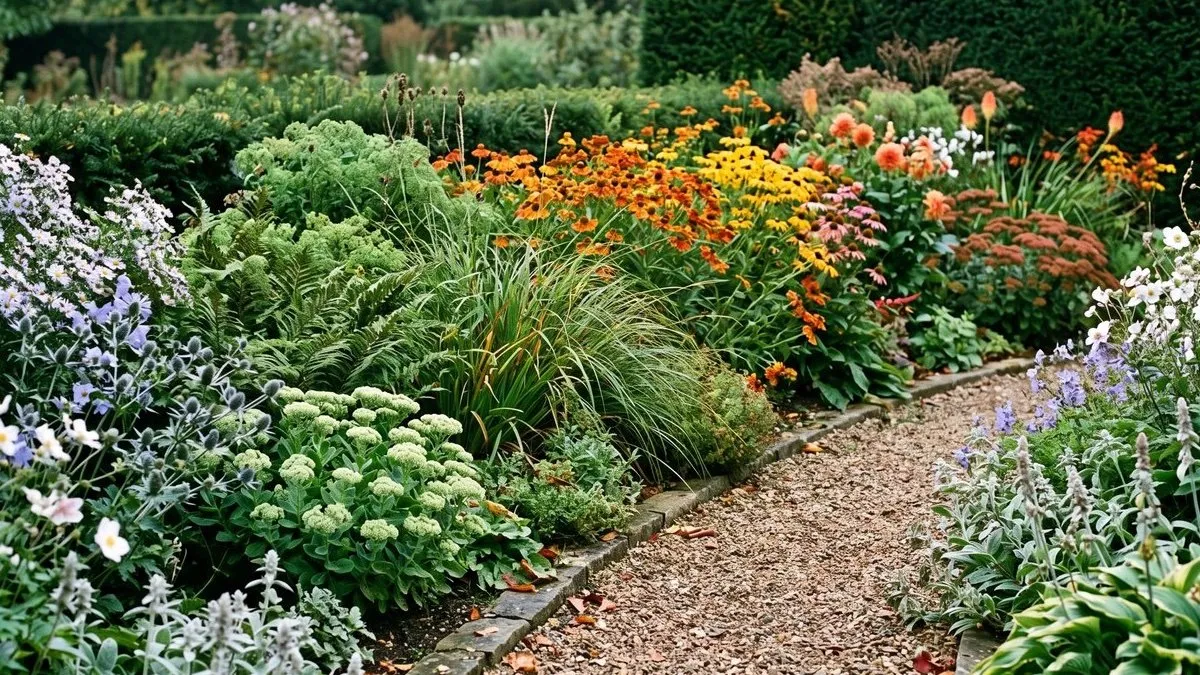
Margery Fish made cottage gardening look easy, but never careless. Her planting was generous and loose, yet paths and small garden rooms kept it in order. She let good plants seed into the gaps, then chose which ones stayed.
That balance really matters in a small garden, where a loose style can quickly feel cramped. Her approach is a great starting point: give the garden a route, make a reason to stop and sit, and let plants soften the edges.
Below are seven lessons, plus a simple 3m x 5m example plan. The pictures are modern illustrations, not photos of Margery Fish, East Lambrook or any private garden.
Who was Margery Fish?
Margery Fish was a writer and plantswoman, famous for a relaxed, modern take on the English cottage garden. She was born in 1892 and bought East Lambrook Manor in Somerset with her husband Walter in 1937.
The garden began as a neglected farmyard and rubbish heap. Paths, walls and terraces gave it its first shape, and she filled it with loose, informal planting around that framework.
The Gardens Trust history of East Lambrook describes its winding paths and themed areas, including a sunny Silver Garden, a White Garden and a damp, rocky spot called the Lido.
She wrote about making it in We Made a Garden, first published in 1956. The East Lambrook garden history points out that the garden has never stood still. Trees have grown, later owners made changes and the team there still keeps it evolving.
Fancy a visit? See our East Lambrook Manor Gardens profile. Here we focus on the ideas you can borrow for an ordinary garden.
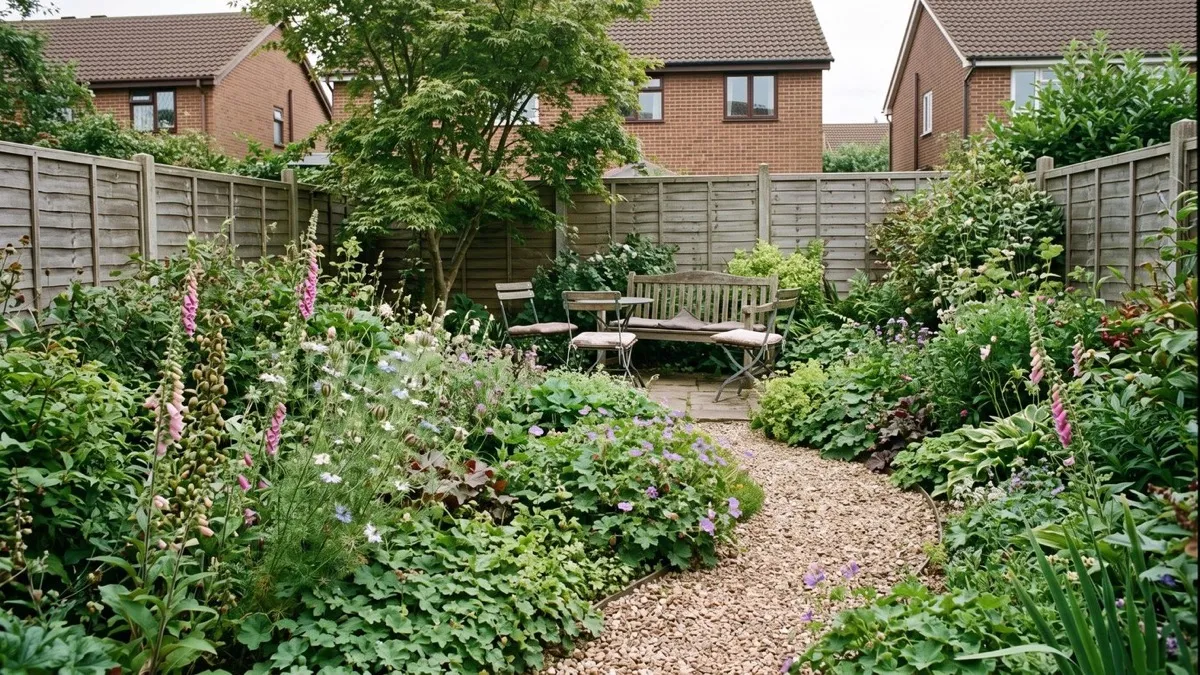 Illustration: a small modern garden with a winding path, layered planting and soft, self-seeded edges.
What made her garden special?
She mixed relaxed planting with a clear route and different little spaces. The layout gave the loose planting a frame.
Old cottage gardens could mean lots of seasonal replanting. She showed that ground cover, spreading perennials and self-seeders could give a long season of interest with far less of that. The work didn’t vanish. It changed from constant replanting to choosing what to keep.
She also planted for each spot. Sunny slopes, damp ground and shade under trees all got different plants. Low plants spilled between paving and over walls. Taller plants popped up here and there, rather than standing in a solid back row.
Her style welcomes change. A seedling may turn up in a better spot than its parent. A growing tree turns sun into shade. It stays a designed garden because you decide what stays.
For more on deciding what stays, read about Ellen Willmott’s approach to editing a garden over time.
| Her idea | In a small garden | Yearly job | Avoid |
|---|---|---|---|
| Winding paths | One path that hides its end | Neaten the edges in spring | Curves that lead nowhere |
| Themed areas | One sunny room and one shady corner | Check the edges in May | Lots of tiny themes |
| Ground cover | Repeat three or four reliable spreaders | Thin out crowded clumps | Thinking you’ll never weed again |
| Self-seeders | Keep seedlings that look good where they are | Tidy in May and September | Keeping every seedling |
| Changing seasons | Mix bulbs, perennials and seedheads | Note any gaps through the year | Only buying plants in midsummer |
Lesson 1: make a winding path worth its space
A curved path should hide what’s coming next. It needs somewhere to go, a hidden stretch or a reason to slow down.
In a narrow garden, a big snaking path eats up planting space. Go for one gentle curve instead. Around 80cm wide suits a private garden path. Make it about 90cm where people pass each other or you need to turn a wheelbarrow.
Lay a hosepipe along both edges to try out the line. Walk it both ways before you lift any turf. Let the path slip briefly out of sight behind planting, a low screen or a step. It should still feel like it goes somewhere real.
Let the path widen a little next to a seat, a bird bath or a favourite plant. That pause gives the curve a purpose, and makes a mini room without any extra materials.
Our guide to designing a garden from scratch shows how to measure up and note sun and existing features first. Draw your path once you know those.
Tip: Mark both edges of the path, not just the middle. A pretty centre line can still leave pinch points that are too narrow to walk.
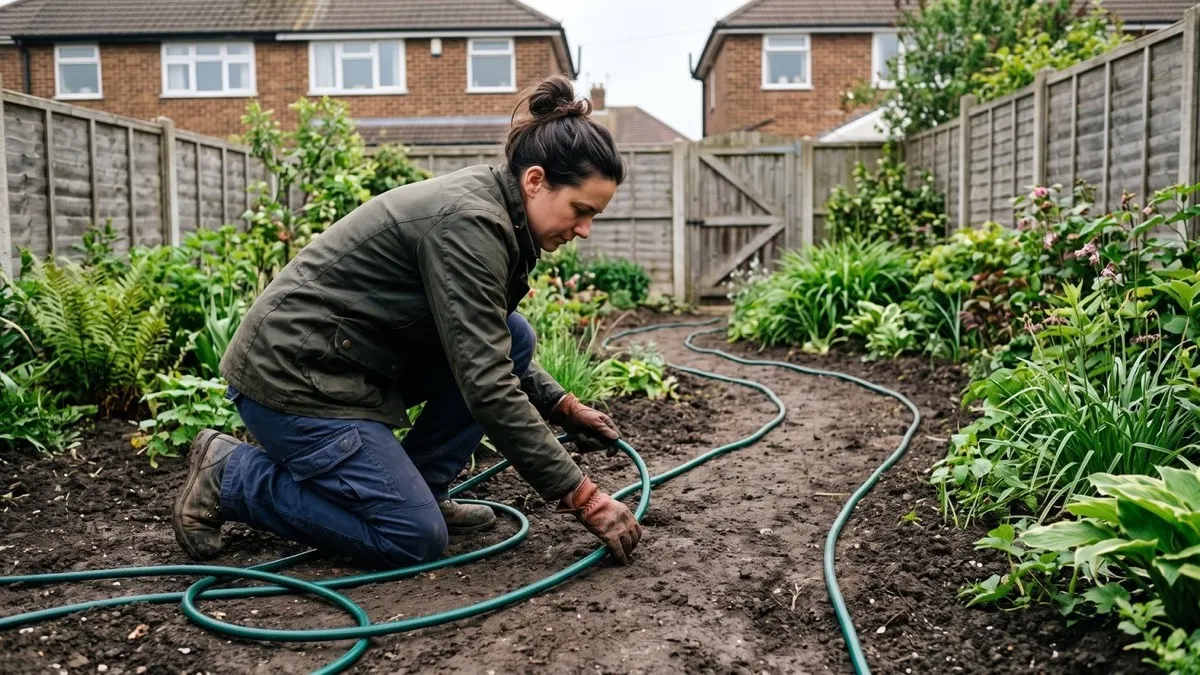 Illustration: a hosepipe tries out the path’s curve before any digging.
Lesson 2: make one or two cosy garden rooms
A small garden needs far fewer rooms than a big historic one. One place to sit and one planted corner are usually enough.
Use plants to suggest walls rather than building lots of screens. A waist-high evergreen, a loose shrub or a short bit of trellis is enough to break the view. Keep the next space partly visible, or a small plot feels boxed in.
Give each room one job. A morning seat goes where the early sun lands. A shady fern corner suits the cooler end. A mini White Garden works only if white flowers and pale leaves suit the light you actually have.
Repeat a plant across the edge between rooms. Hardy geranium, lady’s mantle or a neat grass ties the two spaces together.
The same idea works in a cottage garden planting plan. Keep the plant list short, then mix up height, texture and flowering time.
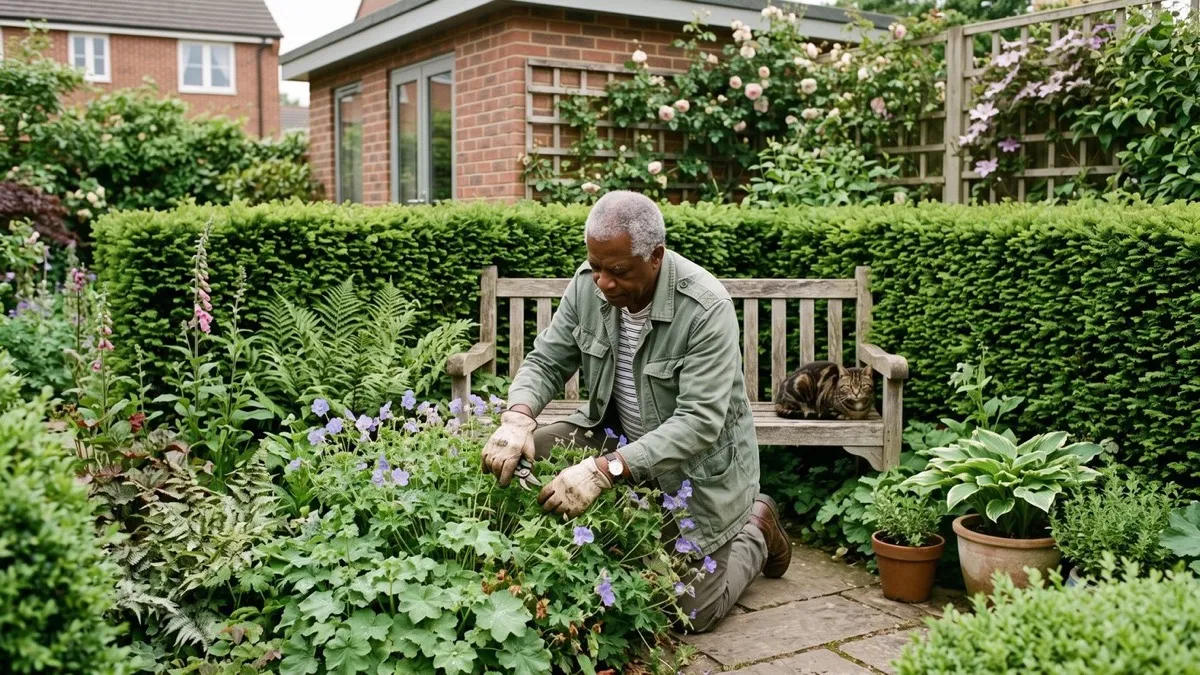 Illustration: low screening and repeated plants make a cosy room without closing the garden in.
Lesson 3: let plants self-seed, then edit
Self-seeders bring a garden to life, but only if you keep choosing. Keeping every seedling is neglect, not design.
Good ones to try are foxglove, nigella, honesty and forget-me-not. How they behave depends on your soil, light and winters, so start with one or two, not six.
Learn what the seedlings look like before you hoe. Keep ones that fill a real gap or link two groups. Pull out ones crowding a path, smothering slower plants or forming a solid clump.
Do two main tidy-ups. In May, thin crowded seedlings while they’re small. In September, remove seedheads you don’t want before they scatter, and leave the ones where you’d like more next year.
Moving a seedling? Pick a cool day, water it before you lift it and again after replanting. Small seedlings settle in much better than ones already in flower.
Our list of the easiest flowers to grow from seed will help you pick reliable ones.
Good to know: Don’t plant something just because it spreads. If your garden backs onto wild land, check the plant isn’t invasive, and pull it back if it escapes.
 Illustration: crowded seedlings are thinned, leaving the well-placed ones by the paving.
Lesson 4: plant in layers for a longer show
Layering lets several plants share the same patch at different times. It gets more out of a small space without needing non-stop colour.
Start with a ground layer. Hardy geraniums, lady’s mantle and ferns cover the soil and soften the edges. Add mid-height plants such as astrantia or pulmonaria. Let a few foxgloves or alliums rise up through them.
Spring bulbs pop up before the perennials leaf up. Then the summer plants hide the fading bulb leaves. In autumn, seedheads keep the shape going.
Space plants by their final size, not the size of the pot. Young plants can look sparse in spring and crowded by their second summer. If the label says a plant spreads to 60cm, give it about 60cm.
Our guide to year-round interest helps you spot the quiet months. Plan one nice thing for each season rather than chasing flowers every week.
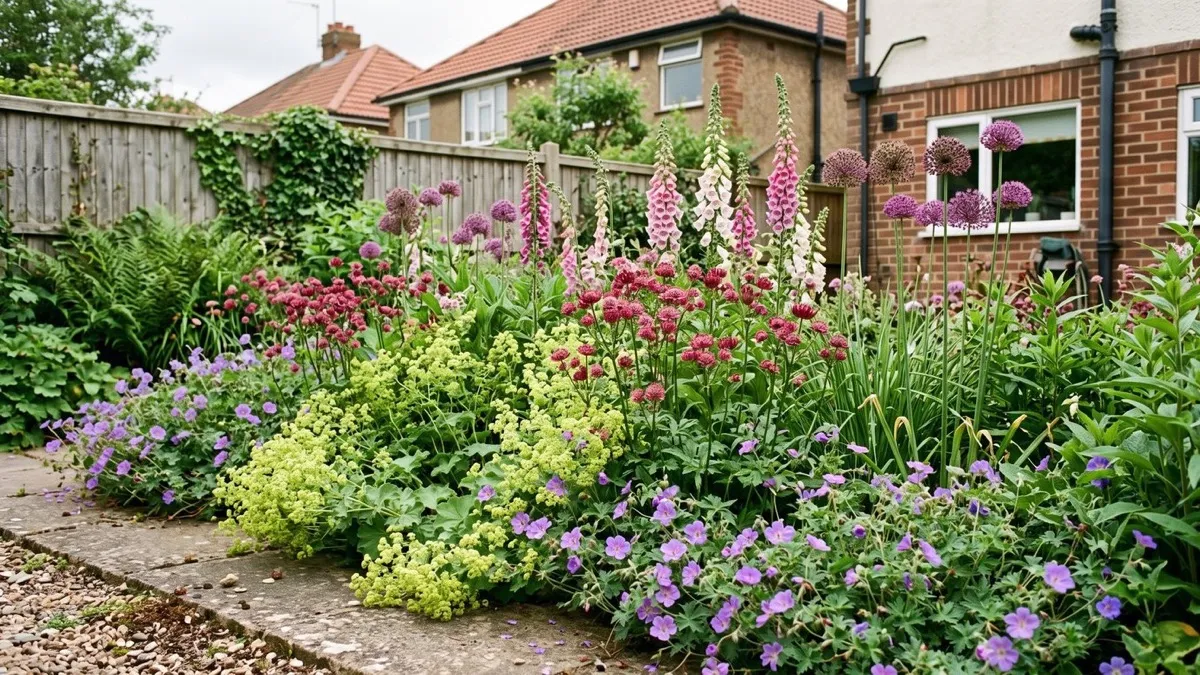 Illustration: ground cover, mid-height perennials and a few taller plants share one small border.
Lesson 5: cover the soil for less work
Ground cover means less bare soil and fewer weeds, but it needs help to get going. New plants still need water and room to grow.
Choose a few that suit your spot. Hardy geraniums cope with sun or part shade. Lady’s mantle likes ordinary soil that doesn’t dry out. Ferns suit cool shade. No single plant suits everywhere.
Plant at their final spacing, then mulch the bare soil about 5cm deep. Keep mulch off the plant crowns and stems.
Water in dry spells through the first year. Check under the leaves before watering, as thick foliage can hide dry soil. Pull out perennial weeds before the plants close over.
Once settled, the ground cover leaves weeds little room. You’ll still need to thin it now and then where one plant swamps its neighbours.
For more ideas, see our guide to low-maintenance garden plants. Think of low maintenance as fewer jobs, not no jobs.
Lesson 6: plant for the light you have
The light in a garden changes as trees and shrubs grow. Margery Fish’s garden changed partly because growing trees altered the shade.
Note where the sun falls in spring, midsummer and autumn. A spot that’s sunny in June may be much shadier in April or September. Walls, fences and next door’s trees all play a part.
Use what you see to place your plants. Silver-leaved plants usually want sun and good drainage. Ferns and many spring woodland plants like cool shade. Damp corners and dry soil under a tree need different plants again.
Don’t try to force a famous plant list into the wrong spot. The real lesson is to work with your garden. A healthy, ordinary plant repeated is better than a fussy one struggling.
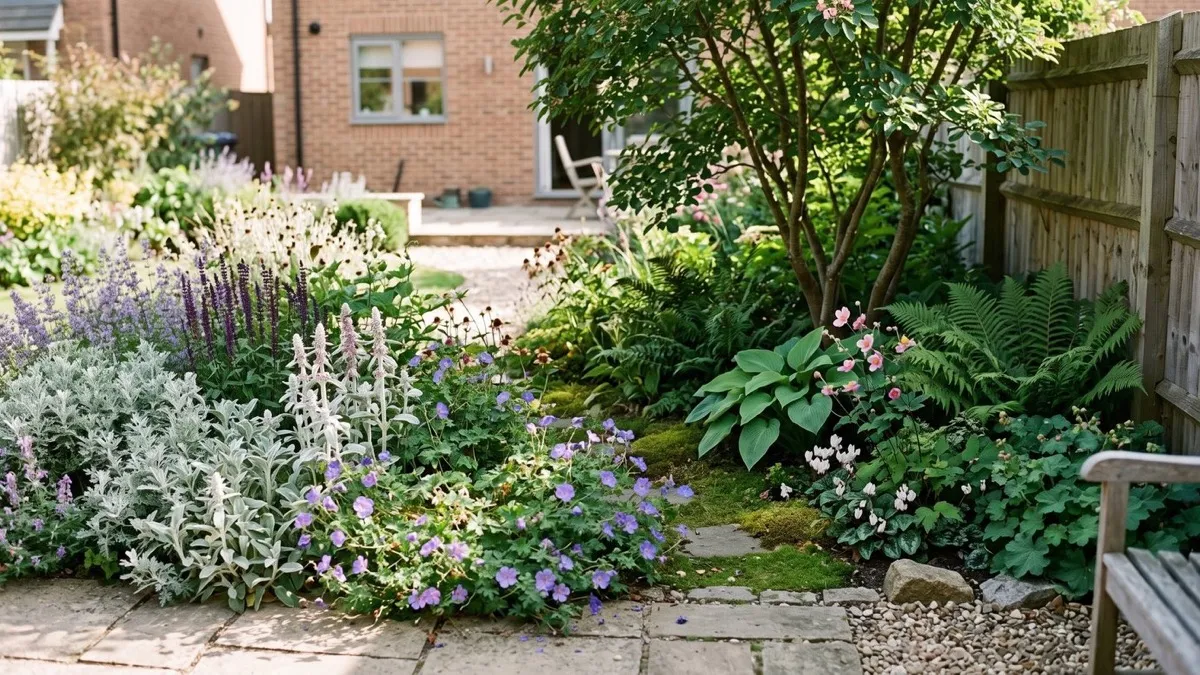 Illustration: sun-lovers fill the open side, with ferns and spring plants in the light shade.
Lesson 7: let the garden change, but stay in charge
A relaxed garden needs a simple rule: keep changes that make the path, the seasons or the plants better.
Take a photo from the same spot four times a year: late winter, late spring, late summer and late autumn. Together they show bare soil, spring crowding, summer height and winter shape.
Spot one problem in each photo. A path might be lost under floppy stems. A self-seeder might be blocking a slower plant. A gap might need bulbs rather than another summer flower.
Change one area at a time. Split a clump that’s doing well and repeat it elsewhere. Before removing a poor plant, check its light, drainage and neighbours.
This way the garden can grow up, while the path and rooms that hold it together stay clear.
 Illustration: careful thinning keeps the best seedheads and clears the path edge.
A 3m x 5m plan inspired by Margery Fish
This simple example has one path, one seat and about 8 square metres of planting. It’s our own small-garden take, not a plan of East Lambrook.
The plot is 3m x 5m. An 80cm-wide curving path runs through it, with a 1.5m square sitting spot off to one side. That leaves roughly 8 square metres for plants.
You’ll need around 20 to 24 perennials or biennials, plus 30 to 40 small bulbs tucked in between. Check each plant label for spacing and adjust to your bed shape.
| Area | Size or number | What it does | Plant ideas |
|---|---|---|---|
| Curved path | About 80cm wide | Reveals the garden bit by bit | Gravel or another firm surface |
| Sitting spot | 1.5m x 1.5m | Your cosy room | A simple bench with low screening |
| Ground layer | 10 to 12 plants | Covers soil, links areas | Hardy geranium, lady’s mantle, ferns |
| Middle layer | 6 to 8 plants | Spring and summer interest | Astrantia, pulmonaria or similar |
| Tall accents | 3 to 4 plants | Break up the low layers | Foxglove or allium where they’re happy |
| Bulbs | 30 to 40 bulbs | Early colour | Snowdrops and daffodils in small groups |
Repeat the ground cover on both sides of the path. Leave the sitting spot open on one side so it doesn’t feel hemmed in. Put taller plants near the bends, not in a straight line at the back.
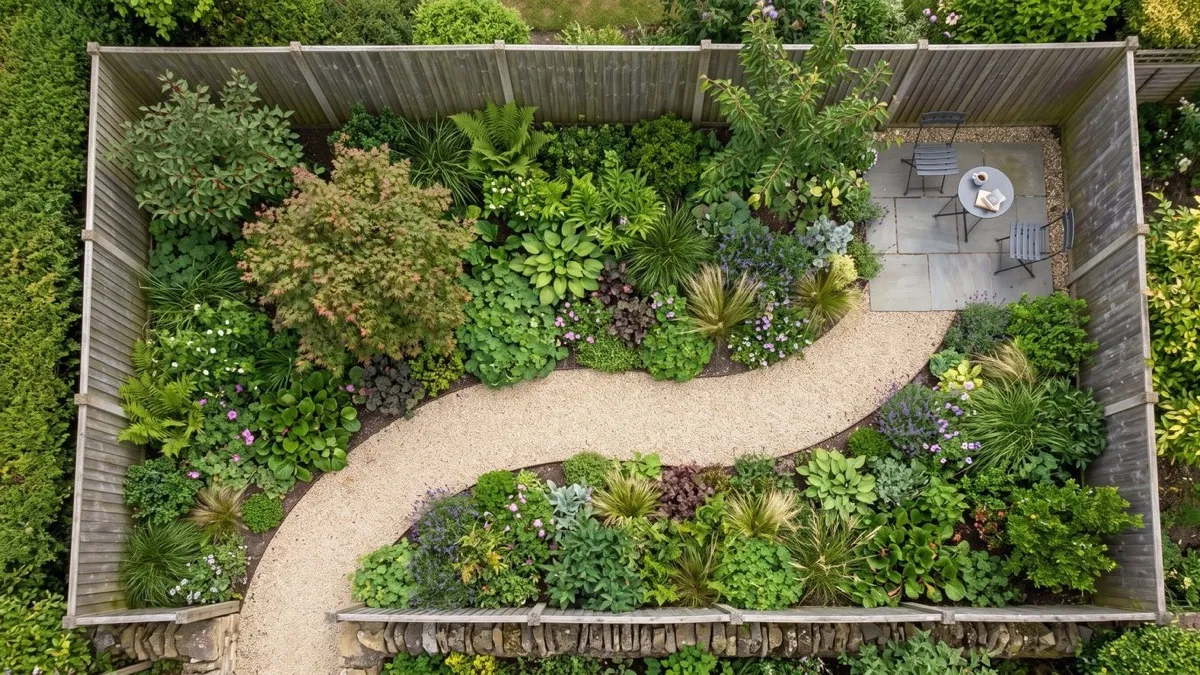 Illustration: the 3m x 5m plan, with one curved path, one seat and linked planting.
An easy year of editing
Most of the work happens in two tidy-ups, with a few quick checks in between. The exact timing will depend on the weather and your plants.
| Month | Main job | Ask yourself |
|---|---|---|
| February | Take a photo and clear collapsed growth | Which stems still look good? |
| March | Divide crowded perennials | Where could you repeat a good plant? |
| May | Thin self-seeders and neaten path edges | Which seedlings look right? |
| June | Check the light and support floppy stems | Has new shade changed things? |
| August | Take a photo at full height | What’s hiding the path or its neighbours? |
| September | Remove seedheads you don’t want | Where would you like seedlings next year? |
| November | Take a winter photo | Does the path still look good without flowers? |
Keep a simple note of each plant’s name, flowering month, height and whether it needs support. After a couple of years you’ll see your own garden’s rhythm.
Common mistakes
Most mistakes copy the relaxed look but skip the editing. A cottage garden still needs you to make choices.
Too many curves
One bend with a purpose is lovely. Lots of tight curves waste space and make edging a chore. Try the full path width before you dig.
Thinking self-seeders look after themselves
Seedlings pop up where they like, not where you want them. Thin them twice a year and pull out any blocking paths.
A theme in every corner
Too many mini themes make a small garden feel bitty. Stick to one or two rooms and repeat plants between them.
Copying a historic plant list
East Lambrook has its own soil, light and long history. Pick plants for your garden, and borrow the thinking behind hers.
Filling every gap at once
Young plants need time to fill out. Use bulbs or a light mulch while they grow, and resist those impulse buys.
Ready to plan your plants? Our modern mixed-border design guide helps turn these layers into a shopping list and spacing plan.
Frequently asked questions
What was Margery Fish’s garden style?
Relaxed, generous planting held together by a clear layout. Winding paths, themed areas, ground cover and self-seeders gave lots of variety without it looking messy.
Where is Margery Fish’s garden?
East Lambrook Manor Garden is in Somerset. It’s a nationally important historic garden, though the planting has changed as the garden has grown up.
Which plants suit a Margery Fish-inspired garden?
Start with plants that suit your soil and light. Hardy geraniums, lady’s mantle, ferns, astrantia, foxgloves and spring bulbs all fit the style nicely.
Are self-seeding plants low maintenance?
They save on replanting, but they still need a tidy. Thin crowded seedlings in May and remove seedheads you don’t want before they scatter.
Can Margery Fish’s ideas work in a small garden?
Yes, her ideas shrink down well. Use one curving path, one cosy seat and a short plant list repeated around the plot.
Our team produces practical UK gardening guidance from source research, contributor records and established horticultural practice. Editorial standards are overseen by Matt W.