Key takeaways
- A matrix of one low grass or ground cover makes up most of the planting and knits the border together
- Repeat a few bold structural plants along the bed to give it rhythm
- Plant closely, around 9 plants per square metre, so no bare soil is left for weeds
- Match the matrix plant to your site, as there are good options for sun, shade, clay and dry soil
- Leave seedheads standing and cut everything back in one go in late winter
- Clear perennial weeds such as bindweed fully before you plant
A modern mixed border works like a plant community rather than a row of plants. One low grass or ground cover forms a matrix across most of the bed. Bold perennials are repeated through it, and bulbs fill the spring. Everything is planted close together, so there’s no bare soil and far less weeding.
This guide shows you how to design one for your own site, sun or shade. For the big, sunny, late-summer version full of grasses and daisies, see the guide to prairie planting. For a classic border of shrubs, perennials and bulbs, see how to plan a mixed border.
What is matrix planting?
Matrix planting builds a border in layers by job, not by height. The idea comes from how plants grow together in the wild, in meadows and woodland edges. Designers such as Piet Oudolf made it popular in Britain, and it’s now a common sight at garden shows.
The matrix is the key. It’s usually one clump-forming grass or ground cover, sometimes two, planted across the whole bed. It covers the soil, ties the border together and smothers weed seedlings. Other plants pop up through it.
The style suits UK gardens because established plants cope well with dry summers, and the border needs one big cut a year rather than constant tidying.

A low grass matrix covers the ground, with echinacea, eupatorium and verbena rising through it. There’s no bare soil for weeds.
The four layers of a matrix border
1. The matrix (most of the plants)
Pick a plant that is clump-forming, not running, and looks decent in winter. Good matrix plants for sun:
- Sesleria autumnalis (autumn moor grass): low, neat, lime-green. Copes with clay and dry spells.
- Deschampsia cespitosa (tufted hair grass): clouds of fine flower heads. Suits damper soil.
- Molinia caerulea (purple moor grass): upright and airy. Suits moist, acid ground.
- Sporobolus heterolepis (prairie dropseed): fine leaves and autumn colour. Slow to get going, but good on dry soil.
Don’t use Stipa tenuissima as the matrix. It self-seeds heavily and takes over. Use it in small groups instead.

Salvia and astrantia with soft clumps of Stipa tenuissima, used here in small groups rather than as the matrix.
2. Scatter perennials
Scatter plants are dotted singly or in pairs through the matrix. They give the border its relaxed, natural look. Try Knautia macedonica, Echinacea pallida, Dianthus carthusianorum, Verbena bonariensis and Sanguisorba ‘Red Thunder’. The guide to growing sanguisorba covers the best varieties.
3. Structural perennials
Structural plants are the taller, bolder anchors. Repeat them in groups of three or five along the bed to give it rhythm. Good choices include Calamagrostis ‘Karl Foerster’, Eupatorium maculatum, Eryngium yuccifolium, Phlomis russeliana and Veronicastrum virginicum. The guide to growing veronicastrum covers its spire-shaped forms.

Eryngium and sanguisorba rise through upright Calamagrostis. Repeating these bold plants gives the border its rhythm.
4. Seasonal bulbs and extras
Bulbs fill the months when the rest is quiet. Plant Narcissus ‘Thalia’ and camassias for spring, and Allium sphaerocephalon for July and August. Monkshood, Aconitum carmichaelii ‘Arendsii’, adds late blue spires in autumn. All parts of monkshood are very poisonous, so wear gloves and skip it where children play.
Matrix planting for shade
The same method works in shade with different plants. Use a shade-loving matrix such as Luzula nivea (snowy woodrush), Geranium macrorrhizum or Hakonechloa macra. Dot hellebores, epimediums and Japanese anemones through it, and use ferns or Solomon’s seal as the repeated structure. Snowdrops and wood anemones add spring bulbs. Hellebores and Solomon’s seal are toxic if eaten, so keep an eye on pets that chew plants.
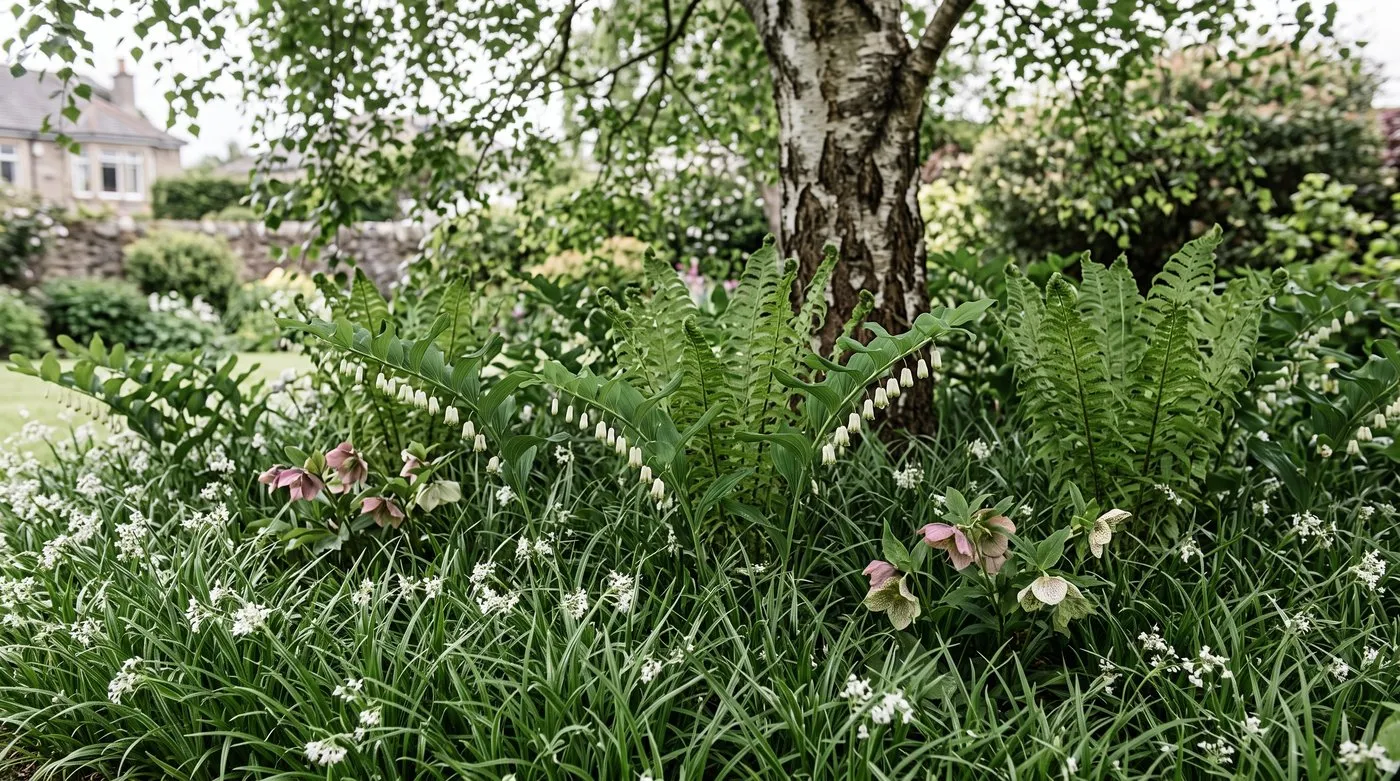
The same idea works in shade: a low woodrush covers the ground, with ferns and Solomon’s seal repeated through it.
How many plants do you need?
Matrix borders are planted much more closely than nursery labels suggest. Aim for roughly 9 plants per square metre in total.
| Plant role | Rough spacing | Share of plants |
|---|---|---|
| Matrix grass or ground cover | About 35cm apart | Around two-thirds |
| Scatter perennials | Dotted singly or in pairs | About a fifth |
| Structural perennials | Groups of 3-5, repeated | A small handful |
| Bulbs | Between everything | Added on top |
So a 10 square metre bed needs about 90 plants. That sounds a lot, but small 9cm pots keep costs down, and close planting is what keeps weeds out. On a tight budget, plant the matrix first and add the rest next year.
How to plant a modern mixed border
- Clear all perennial weeds. Dig out bindweed, couch grass and ground elder, or cover the bed with cardboard for a season. Leftover roots will come back through. The guide to getting rid of bindweed helps.
- Keep the soil lean. Don’t add rich manure. Rich soil makes plants lush and floppy.
- Lay out the matrix first on a rough grid. Stand back and look.
- Place the structural plants in repeated groups along the bed.
- Dot in the scatter plants between the matrix. Aim for irregular, not regimented.
- Plant bulbs between the clumps at the same time, if planting in autumn.
- Water in well, and keep watering in dry spells through the first summer.
Plant in October or March to April. The first few months look gappy. Be patient: by the second summer the matrix closes over.

Geranium and persicaria spread to cover the soil between plants. Close planting does the weeding for you.
Winter structure and wildlife
Leave everything standing over winter. Grass plumes, Phlomis whorls, echinacea and rudbeckia cones look wonderful in frost. Seedheads feed birds such as goldfinches, and hollow stems shelter insects. The guide to plants with winter seedheads has more ideas.

Left standing, grasses and seedheads give the border structure right through winter, especially on a frosty morning.
Matrix border calendar
| Month | What to do |
|---|---|
| January | Enjoy the seedheads. Note gaps to fill |
| February | Cut everything back in late February or early March, before bulbs come through |
| March | Pull weeds while the matrix fills in. Plant new perennials |
| April | Replace any losses with the same plant |
| May | Thin self-seeded Verbena or Knautia where too crowded |
| June | Walk the border and note gaps. No deadheading needed |
| July | Enjoy the peak. Water new plantings in dry spells |
| August | Little to do |
| September | Order bulbs and any new plants |
| October | Plant bulbs and new perennials |
| November | Don’t cut back. Leave the seedheads standing |
| December | Rest |
Common mistakes with modern mixed borders
- Planting too sparsely. Gaps fill with weeds and the matrix never knits. Plant closely, or build the border in two stages.
- Using Stipa tenuissima as the matrix. It self-seeds everywhere and crowds out other plants.
- Cutting back in autumn. You lose the winter structure and the food and shelter for wildlife. Wait until late winter.
- Rich soil. Manure makes plants grow soft and flop. Lean soil gives sturdier plants.
- Leaving perennial weeds. Bindweed in year one can ruin the whole scheme. Clear it first.
- Too many single plants. One of everything looks bitty. Repeat a few plants along the bed.
Want to pick plants that look great together? Read the guide to best plant combinations for borders next, or browse more garden design guides.
Frequently asked questions
What is matrix planting?
Matrix planting uses one low plant as a base across most of the border. It’s usually a clump-forming grass or ground cover. Taller perennials and bulbs are dotted and repeated through it. The matrix covers the soil, ties the look together and leaves little room for weeds.
How is a modern mixed border different from a traditional one?
It’s planted by role, not in strict rows by height. A traditional border puts tall plants at the back and short ones at the front, with bare soil mulched between them. A modern border weaves plants together closely, so the ground is covered. It’s usually cut back once a year instead of tidied all season.
Can I create a matrix planting border on heavy clay?
Yes, many matrix plants grow well on clay. Sesleria, Deschampsia and Molinia all cope with heavy soil, along with perennials such as Sanguisorba, Persicaria and Eupatorium. Don’t add rich manure, which makes plants floppy. Just clear the weeds thoroughly and plant into firm ground.
Which grass is best for a UK matrix planting?
Sesleria autumnalis is a reliable matrix grass for most sunny UK borders. It’s low, neat and copes with clay and dry spells. Deschampsia cespitosa suits damper ground and Molinia caerulea suits moist, acid soil. Avoid Stipa tenuissima as the matrix, as it self-seeds heavily.
How many plants do I need for a matrix planting border?
Plan on roughly 9 plants per square metre. A 10 square metre bed needs about 90 plants. Around two-thirds can be the matrix plant, with the rest split between scattered perennials and structural plants. Add bulbs on top. Close planting is what stops weeds getting in.
When should I cut back a matrix planting border?
Cut it all back in late February or early March. Leave the seedheads standing through winter for birds and frosty structure. Use shears or a hedge trimmer, and cut before new shoots and bulbs come through. Evergreen grasses such as Sesleria just need combing through by hand.
Do I need to weed a matrix planting border?
Yes in the first year or two, then much less. Until the plants knit together, pull weed seedlings and any bindweed or ground elder that reappears. Once the matrix closes over, there’s little bare soil for weeds to germinate in. Never let perennial weeds flower or spread in year one.
Can I add bulbs to a matrix planting border?
Yes, bulbs are a big part of it. Plant them between the matrix plants in autumn. Narcissus ‘Thalia’, camassias and alliums flower in spring and early summer, before the perennials take over. Their dying leaves are hidden as the grasses and perennials grow up around them.
Our team produces practical UK gardening guidance from source research, contributor records and established horticultural practice. Editorial standards are overseen by Matt W.