Key takeaways
- Give about 70% of the space to lasting shapes and 30% to loose cottage flowers
- Clipped evergreens and grasses keep the border looking good from November to April
- Stick to two or three colours plus white for the calm, modern look
- Repeat each plant in groups of three or five rather than one of everything
- Leave seedheads standing in autumn so cosmos, foxgloves and verbena can self-sow
A contemporary cottage garden keeps the soft, romantic flowers of a cottage border but adds a frame that lasts all year. Clipped evergreens, grasses and tidy shrubs do the work in winter. Cosmos, foxgloves and verbena float through them in summer. The result looks generous in July and still has shape in January.
The traditional cottage border can look a bit tired by late summer. Tall flowers flop, early ones go over and the bed loses its shape. This modern take fixes that with more structure, fewer plant types and a calmer colour palette. If you love the full, old-fashioned look, the traditional cottage garden planting plan is the one to follow instead.
How the 70/30 split works in a cottage garden
Give roughly 70% of the border to lasting structure and 30% to loose cottage flowers. Judge it by the space each group fills, not by counting plants.
The structure is everything that holds its shape for most of the year: evergreen balls and domes, grasses, and long-lived perennials with good leaves. The cottage flowers are the airy, short-lived or self-sowing plants that bring the summer froth.
In winter the flowers are gone, but the frame is still there. From May they pop up among the shapes, and the border is at its fullest from June to September. The 70-30 planting rule guide explains how to measure and apply the ratio in any style of border.

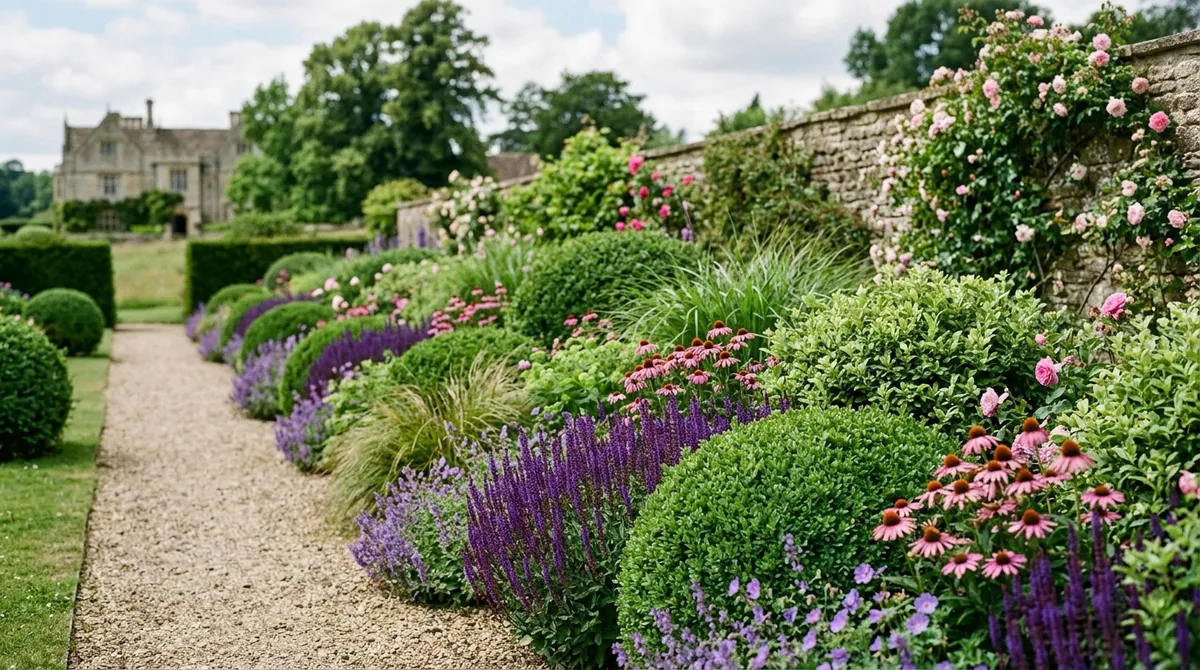
Clipped balls and soft grasses hold the shape, so the pink cosmos can be as loose as it likes.
Best structural plants for a contemporary cottage garden
Pick two or three evergreen shapes and one or two grasses, then repeat them along the border. These are reliable choices for UK gardens.
| Plant | Shape | Height | When to trim |
|---|---|---|---|
| Yew (Taxus baccata) | Clipped ball, cone or block | Kept to 60cm-1.5m | Late summer |
| Ilex crenata | Small clipped ball | Kept to 40-90cm | Early summer |
| Hebe rakaiensis | Natural dome | About 1m | Lightly after flowering |
| Pittosporum ‘Tom Thumb’ | Dark purple mound | About 1m | Lightly in spring |
| Stipa tenuissima | Soft, wispy grass | About 60cm | Comb out dead leaves in spring |
| Calamagrostis ‘Karl Foerster’ | Upright grass | About 1.5m | Cut back in February |
Box is the classic choice, but box blight and box tree caterpillar now cause real problems in many areas. Yew and Ilex crenata give a similar clipped look with less worry. The guide to growing pittosporum covers ‘Tom Thumb’ and its taller cousins.
Repeat each shape in threes or fives at uneven spacing. A row of six identical balls reads as a hedge. Three balls, two hebes and a grass read as a planting.
Mid-height plants that knit it all together
Between the shapes, use reliable perennials at knee to hip height. They fill the gaps, smother weeds and flower for weeks.
- Lavandula angustifolia ‘Hidcote’: grey evergreen leaves and purple summer flowers
- Alchemilla mollis (lady’s mantle): soft leaves and lime-green froth in early summer
- Geranium ‘Rozanne’: blue flowers from early summer into autumn
- Salvia ‘Caradonna’: dark purple spikes in early summer
- Nepeta ‘Walker’s Low’ (catmint): a soft blue haze loved by bees
- Hylotelephium ‘Matrona’ (sedum): pink late-summer flowers and seedheads that stand into winter
Plant these in groups of three to five too. The guide to growing lavender covers pruning so the plants stay compact rather than woody.
Pet note: Lavender and catmint are not pet-safe if eaten in quantity, and foxgloves are poisonous to people and pets. Skip foxgloves if you have a dog that chews plants.
Loose cottage flowers for the summer froth
This is the cottage layer, the fun bit. Choose airy plants you can see through, so the structure behind still shows.
| Plant | Type | Height | Flowers |
|---|---|---|---|
| Cosmos bipinnatus ‘Purity’ | Half-hardy annual | 90-120cm | July to October |
| Verbena bonariensis | Short-lived perennial, self-sows | 1.5m | July to October |
| Foxglove (Digitalis purpurea) | Biennial, self-sows | 1-1.5m | June to July |
| Ammi majus | Hardy annual | 90cm | June to August |
| Nigella damascena | Hardy annual, self-sows | 45cm | June to August |
| Sweet pea | Hardy annual climber | Up to 2m | June to September |
Space them more widely than the structure, about 40-60cm apart. Many of these self-sow, so after a year or two you’ll be pulling out spares rather than buying more. The guide to self-seeding plants lists others that suit this style.

Cosmos, verbena and ammi are tall but see-through. They float above the planting without hiding what’s behind.
Choosing a colour palette
Keep to two or three colours plus white. That restraint is what makes the garden look contemporary rather than busy.
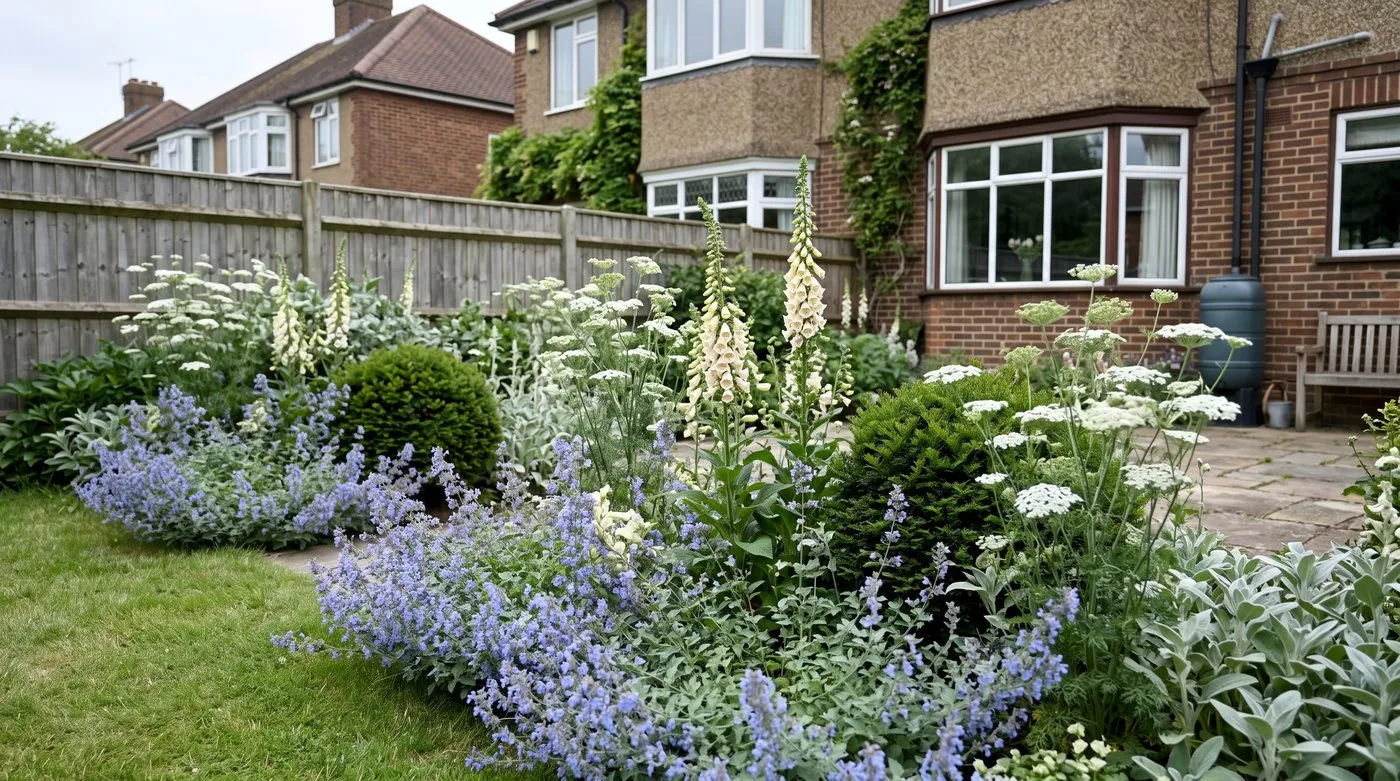
Blue, white and cream with plenty of green looks fresh and calm. One tight palette does more than a rainbow ever could.
| Palette | Colours | Plants to try |
|---|---|---|
| Soft romantic | Pink, white, dusky purple | Cosmos ‘Purity’, Verbena bonariensis, Salvia ‘Caradonna’ |
| Cool and fresh | Blue, white, cream | Nepeta, Ammi majus, foxglove ‘Camelot Cream’ |
| Smoky purple | Plum, lavender, soft pink | Salvia ‘Caradonna’, Stipa tenuissima, sedum ‘Matrona’ |
| Warm and sunny | Apricot, gold, brick red | Achillea ‘Terracotta’, heleniums, Stipa tenuissima |
Pick one palette and stick to it. The evergreen and grass foliage acts as the calm background. The guide to using colour in garden design explains how to put a scheme together from scratch.
Getting the heights right
Step the planting from low at the front to tall at the back, then break the rule in a few places.
- Back (1.5-2m): taller clipped yew, Verbena bonariensis, foxgloves, sweet pea wigwams, Calamagrostis
- Middle (60-90cm): lavender, hebe, salvia, catmint, hardy geranium, Stipa tenuissima
- Front (20-40cm): low evergreen balls, sedum, Hakonechloa, alchemilla
Now pull a few see-through plants forward. A stem of verbena in the middle row, or a drift of alchemilla among the foxgloves, makes it feel relaxed rather than regimented.

Tall and airy at the back, soft mounds in the middle, neat shapes at the front. Your eye drifts right through the border.
Repeating plants for a designed look
Repetition is the single biggest difference between a contemporary cottage garden and a jumble. Choose eight to twelve kinds of plant and repeat each in groups of three, five or seven along the border.
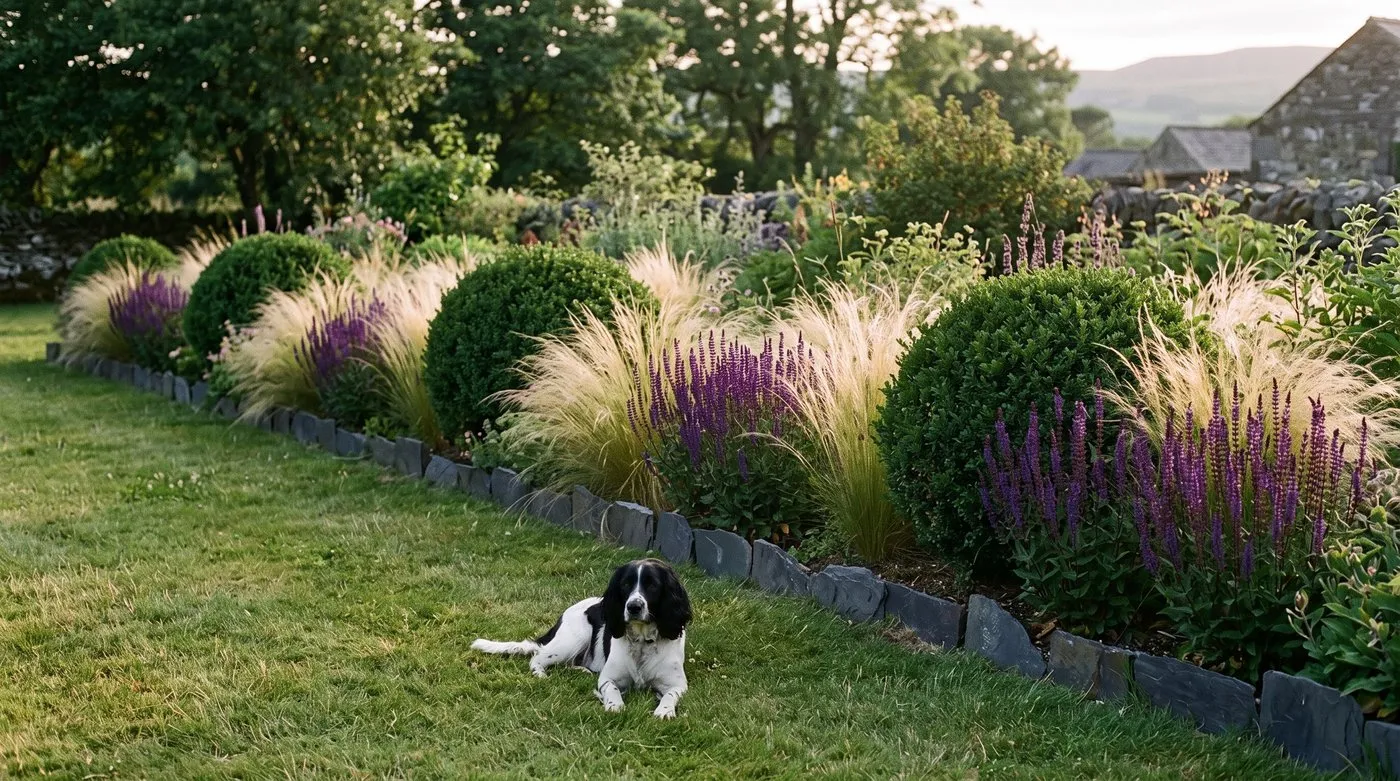
The same three plants repeated down the border make it look planned. Your eye follows the rhythm without even trying.
Let neighbouring groups overlap at the edges rather than meeting in a hard line. That gives a woven look rather than a row of separate clumps. This drift style is borrowed from naturalistic planting, which the guide to modern mixed border design covers in more depth.
For ideas, visit a garden known for this blend of structure and loose planting. Great Dixter in East Sussex and Sissinghurst in Kent are both open to visitors in summer. Check opening times before you go.
Year-round care calendar
The work is light, but timing matters. Here’s what to do and when.
| Month | Job |
|---|---|
| January | Plan, order seeds, enjoy the frosty seedheads |
| February | Cut back Calamagrostis and deciduous grasses |
| March | Mulch with about 5cm of compost. Sow cosmos and ammi under cover |
| April | Comb dead leaves out of Stipa. Thin self-sown seedlings |
| May | Plant out cosmos after frosts. Plant sweet peas at their supports |
| June | Trim Ilex crenata. Cut back alchemilla after its first flush |
| July | Deadhead cosmos and sweet peas. Water new plants in dry spells |
| August | Trim yew and box. Lightly trim hebe and lavender after flowering |
| September | Leave some foxglove and ammi seedheads to drop seed |
| October | Sow hardy annuals for next year. Divide crowded perennials |
| November | Plant tulip bulbs among the perennials. Leave grasses standing |
| December | Leave sedum and grass seedheads for birds and winter frost |

A quick trim keeps the evergreen balls crisp. Those neat shapes are what stop the loose flowers looking messy.
Common contemporary cottage garden mistakes
Buying one of everything. Lots of single plants look restless. Choose fewer kinds and repeat them.
Too little winter structure. If the border vanishes in November, add more evergreen shapes or grasses.
Letting the colours creep. A bright yellow here and an orange there soon undoes a calm palette. Stick to your chosen colours.
Tidying too early. Cutting everything down in autumn removes the seedheads that self-sow and feed birds. Wait until late winter.
Planting cottage flowers too close. Crowded annuals hide the structure and flop. Give them room to wave about.
Frequently asked questions
What is a contemporary cottage garden?
It’s a cottage garden with a firm frame of evergreens and grasses. The loose cottage flowers grow in between, so the garden still looks good in winter. A tight colour palette keeps it calm rather than busy.
How is it different from a traditional cottage garden?
It uses fewer kinds of plant, more repetition and more evergreen structure. A traditional cottage garden packs in everything. The contemporary version edits hard so the border doesn’t collapse into a tangle by August.
What are the best structural plants for a contemporary cottage garden?
Yew, Ilex crenata, hebe, lavender and pittosporum make good evergreen shapes. Add grasses such as Stipa tenuissima, Calamagrostis ‘Karl Foerster’ and Hakonechloa for movement. Box works but suffers from blight and box tree caterpillar.
Which flowers suit a contemporary cottage border?
Airy flowers that float through the structure work best. Cosmos, foxgloves, Verbena bonariensis, Ammi majus, nigella and sweet peas are all good choices. Many self-sow, so the border fills in for free over time.
How many different plants should I use?
Around eight to twelve kinds is plenty for a small border. Repeat each in groups of three or five. One of everything looks busy, while repeats make the planting look designed.
Does a contemporary cottage garden need much maintenance?
It needs less work than a traditional cottage garden. The main jobs are a late summer trim of evergreens, cutting back grasses in February and a spring mulch. Self-sown seedlings may need thinning in spring.
Ready to put your border on paper? Our guide on how to write a planting plan takes you through it step by step. For more border ideas, browse the garden design hub.
Our team produces practical UK gardening guidance from source research, contributor records and established horticultural practice. Editorial standards are overseen by Matt W.