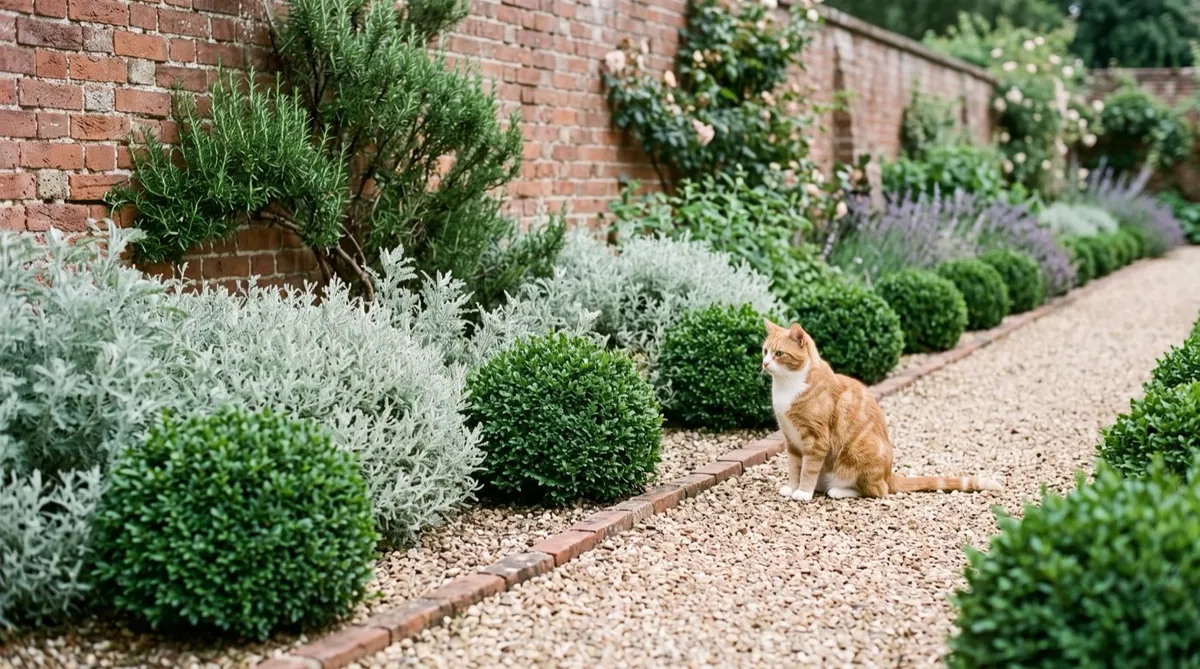
Key takeaways
- Evergreens like yew, holly and sweet box are the backbone, so buy them first
- Red and yellow dogwood stems brighten the garden from November to March
- Plant spring bulbs in autumn for colour from February to May
- Grasses like Calamagrostis and Miscanthus look great through winter, so cut them back in late February
- Aim for at least a few plants looking good in every month of the year
A border that looks good all year comes down to three layers: evergreens for shape, seasonal colour, and winter features like bright stems and bark. This guide walks you through each layer and the plants that do the job best. Whether you have a small cottage border or a big country garden, the same ideas work.
What does year-round interest mean in a UK garden?
It means that whatever the month, a few plants in your border are looking their best. That might be flowers, leaves, bark, stems, seed heads or berries. The aim is simple: walk past on any day of the year and find something worth stopping for.
Most gardens look after themselves from May to September. The tricky bit is October to April, when many borders go bare. Fill that gap and you’ve cracked it.
The three layers:
- Evergreen structure. Yew, holly, sweet box and evergreen grasses that keep their shape all year.
- Seasonal colour. Bulbs, perennials and bedding that flower from February to October.
- Winter features. Coloured stems, bark, seed heads and winter-flowering shrubs for November to March.
Gertrude Jekyll was a master of seasonal flow. Our Gertrude Jekyll border design guide shows how bulbs, summer flowers and autumn seed heads can share one compact bed.
Which evergreens give the best shape all year?
Evergreens are the bones of the garden. Without them, borders go flat and empty between November and March.
Box (Buxus sempervirens) is the classic for clipped balls, cones and low hedges. Clip it in early summer and again in late summer. Box blight is now common in the UK, so check the RHS advice on box blight and consider an alternative like yew, or buy from a trusted nursery.
Yew (Taxus baccata) copes with deep shade, poor soil and hard pruning. A clipped yew cone anchors the back of a border beautifully. It’s slow-growing, but lives for centuries. Yew is poisonous, so keep it away from where pets or children might nibble.
Holly (Ilex aquifolium) adds winter berries. ‘J.C. van Tol’ gives plenty of red berries without needing a male plant nearby. Its glossy dark leaves make a great backdrop for paler plants. For more ideas, see our guide to the best evergreen trees for UK gardens.
Sweet box (Sarcococca confusa) grows to about 1m with glossy leaves and tiny, very fragrant white flowers in January and February. Plant it by a path or door so you catch the scent. It’s happy in deep shade.
For lots more choices, see our guide to evergreen shrubs for year-round interest.
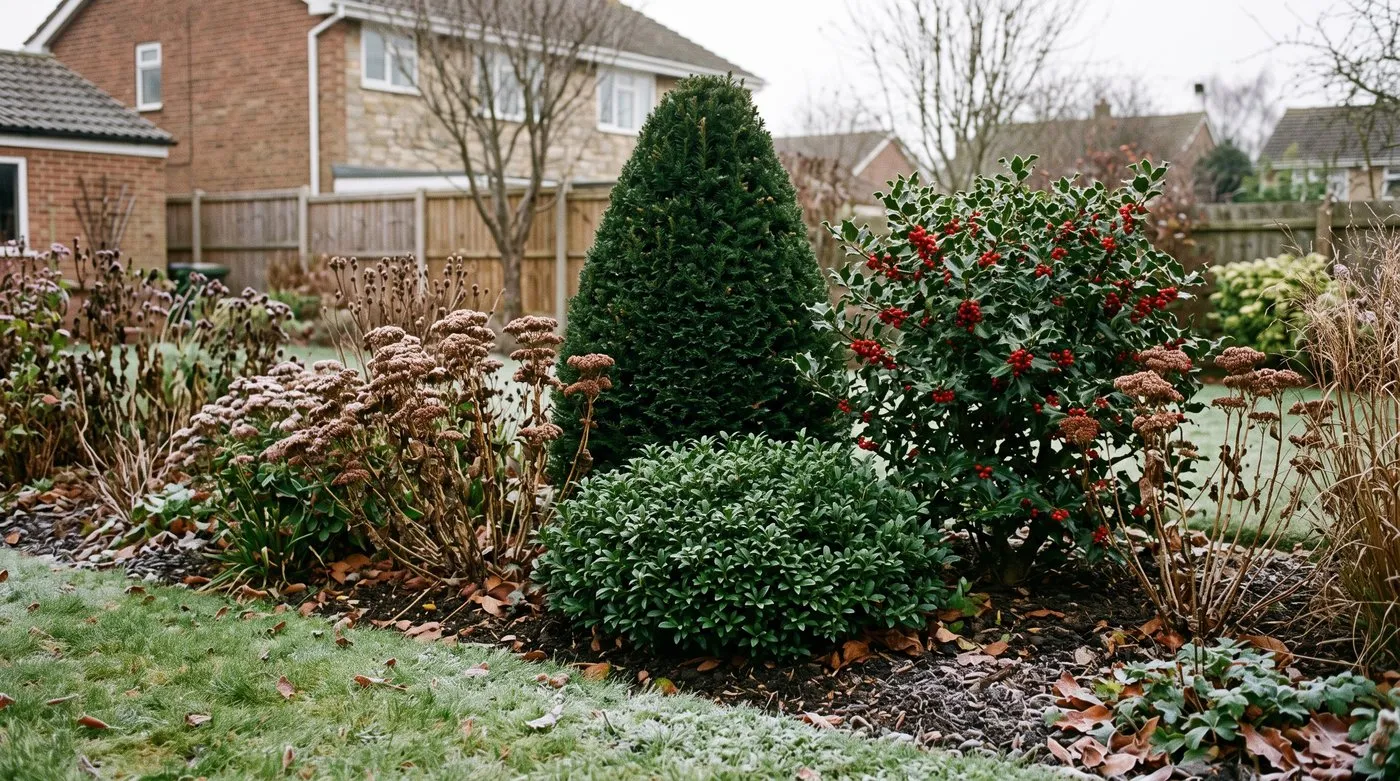
Evergreens like yew, holly and sweet box keep the border’s shape when everything else has died back. They’re the bones you build around.
What gives the best winter interest?
Winter is when most borders fall flat. With the right plants, December to February can be as exciting as June. Your best friends are coloured stems, good bark, winter flowers and seed heads.
 Red dogwood and golden willow stems against white birch bark, glowing from November to March.
Coloured stems give the biggest winter wow.
| Plant | Stem colour | Height | Pruning |
|---|---|---|---|
| Cornus alba ‘Sibirica’ | Bright red | 2.5m | Cut hard in March |
| Cornus sericea ‘Flaviramea’ | Lime-green | 2m | Cut hard in March |
| Cornus sanguinea ‘Midwinter Fire’ | Orange to flame red | 2.5m | Cut hard in March |
| Salix alba ‘Britzensis’ | Bright orange | 3m+ | Cut hard in March |
| Rubus cockburnianus | White-washed purple | 2.5m | Cut to the ground in March |
Cut these back hard in March, every year or every other year. The fresh young stems that follow have the brightest colour the next winter.
Himalayan birch (Betula utilis var. jacquemontii) has dazzling white bark. It looks amazing against a dark hedge, especially where low winter sun catches it. A multi-stemmed tree gives you several white trunks. Our guide on how to grow silver birch covers planting and care.
Winter-flowering shrubs bring actual flowers to the dark months. Witch hazel ‘Jelena’ has coppery spider-like flowers on bare branches in January. Viburnum ‘Dawn’ carries pink clusters from November to March. Mahonia ‘Charity’ has scented yellow spikes from late autumn. For more, see our best winter flowering plants.
How do spring bulbs fill the early gap?
Spring bulbs are the cheapest, easiest way to bridge winter and summer. Plant them in autumn and most come back year after year.
 Snowdrops, crocus and little daffodils pushing up through ajuga for weeks of spring colour.
A simple bulb sequence:
| Bulb | Flowers | Height | Plant this deep |
|---|---|---|---|
| Snowdrop | February | 10-15cm | 10cm |
| Crocus tommasinianus | February to March | 8-10cm | 8cm |
| Narcissus ‘Tete-a-Tete’ | March | 15-20cm | 10cm |
| Grape hyacinth (Muscari) | March to April | 15cm | 8cm |
| Tulip ‘Ballerina’ | April to May | 45cm | 15cm |
| Camassia leichtlinii | May | 60-80cm | 15cm |
Scatter bulbs in loose, natural drifts rather than straight rows. Put snowdrops and crocus at the front, with tulips and camassia further back. Snowdrops establish best when planted “in the green” just after flowering.
Bulb lasagne planting works in borders too. Layer bulbs in one hole, with the biggest at the bottom and the smallest on top. Each layer flowers in turn.
Top tip: pick bulbs that come back reliably. Daffodils, crocus and species tulips (such as Tulipa sylvestris) settle in and spread. Big hybrid tulips often fade after a couple of years. The RHS bulb growing guide covers planting depths for all the common bulbs.
Which perennials give the longest summer show?
Summer perennials fill the gaps between evergreens and grasses. Choose ones that flower for weeks on end, so there’s never a week with nothing out.
Spread out the flowering times. Geranium ‘Rozanne’ and catmint carry early summer. Echinacea and rudbeckia cover August, when many gardens dip. Sedum then takes you into autumn.
Hardy geraniums are real workhorses. Geranium ‘Rozanne’ flowers from early summer right up to the first hard frost. Plant it at the front of a sunny border. It spreads to around 60cm and smothers weeds under its leaves.
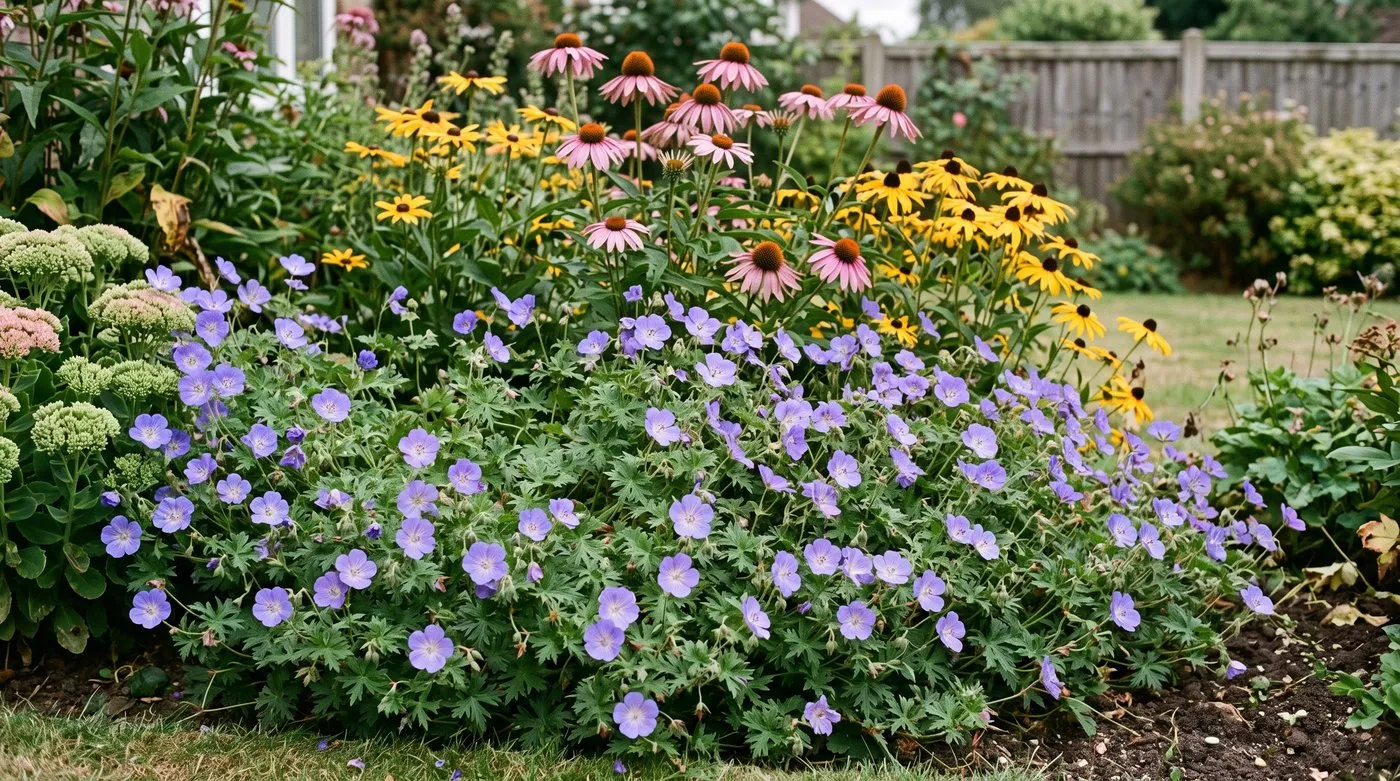
Geranium ‘Rozanne’ flowers from early summer to the first hard frost. With echinacea and rudbeckia behind, August never looks thin.
How do grasses carry autumn into winter?
Ornamental grasses are the bridge from summer to winter. Their seed heads and dry leaves last through the darkest months, catching frost and low sunshine beautifully.
 Miscanthus and Calamagrostis glowing gold in autumn sun, with rich foliage colour behind.
The best grasses for all-year borders:
Calamagrostis ‘Karl Foerster’ is the most reliable upright grass. It makes a narrow column around 1.8m tall that stays standing through wind and rain. Golden seed heads appear in early summer and last until you cut them in late winter. Plant about 60cm apart for a see-through screen.
Miscanthus sinensis ‘Morning Light’ has fine, silver-edged leaves that shimmer in a breeze. It reaches about 1.5m with feathery plumes in autumn, then turns tawny-gold and keeps its shape all winter. Give it full sun.
Stipa gigantea (golden oats) keeps its leafy base all year. Its tall, airy flower stems appear in early summer and last for months. Plant it where low sun shines through the seed heads.
Panicum ‘Shenandoah’ turns deep wine-red in autumn, just as other grasses fade to brown. It grows to about 1.2m.
Leave deciduous grasses standing all winter. Cut them back to about 10cm in late February, before new growth starts. You get months more to enjoy, and the old leaves protect the plant through frosts.
To pair grasses with trees that colour up in autumn, see our best trees for autumn colour.
What is the best planting plan for 12-month interest?
The simple test: every month in this calendar should have a few plants looking good. If a month looks thin, add something that peaks then. August and November are the months most borders struggle, so plan for those.
| Month | Looking good |
|---|---|
| January | Witch hazel, sweet box, dogwood stems, birch bark |
| February | Snowdrops, crocus, hellebores, dogwood stems |
| March | Daffodils, grape hyacinths, winter heather |
| April | Tulips, grape hyacinths, fresh evergreens |
| May | Tulips, camassia, early perennials |
| June | Geranium ‘Rozanne’, catmint, Calamagrostis heads |
| July | Geraniums, salvias, Stipa gigantea |
| August | Echinacea, rudbeckia, geraniums |
| September | Sedum, Miscanthus plumes, rudbeckia |
| October | Grasses, Panicum, autumn leaves |
| November | Grasses, holly berries, Viburnum ‘Dawn’, dogwood stems |
| December | Mahonia, holly berries, dogwood stems, seed heads |
How do I create year-round interest in a small garden?
Small gardens need height and layers rather than spread. Stack plants at different heights with different flowering times.
For a small sunny border, about 3m by 1.5m, try:
- Back (1-2m tall): 1 multi-stemmed birch or 1 Cornus alba ‘Sibirica’, with 3 Calamagrostis ‘Karl Foerster’
- Middle (50cm-1m): 2 Geranium ‘Rozanne’, 1 Salvia ‘Caradonna’, 1 sedum, 1 echinacea
- Front (under 50cm): 50 crocus, 30 Narcissus ‘Tete-a-Tete’, 20 snowdrops, 3 Heuchera ‘Palace Purple’, 1 Carex ‘Evergold’
- Structure: 2 clipped evergreen balls at the front corners
That gives you something to enjoy every month in a small space. Buying in autumn and winter, when bare-root plants are available, keeps costs down.
Gardening in pots? Our guide to the best plants for pots year-round shows how to do it in containers.
What mistakes should I avoid?
Only planting for summer. The biggest mistake. Most of us shop for plants between April and July, so we buy what looks good then. The result is a border that shines for four months and sits bare for eight. Buy winter plants first, ideally bare-root in the dormant season (November to March), when they’re cheaper.
Leaving bare soil. Bare earth from October to March looks bleak and invites weeds. Fill gaps with evergreen ground cover like bugle (Ajuga), periwinkle (Vinca minor) or epimedium.
Cutting back too early. Seed heads and grass stems look lovely in winter and cost nothing. Resist the November tidy-up. Cut back in late February or early March.
Forgetting stems and bark. A dogwood is cheap to buy, and after a few years of yearly cutting it makes a thicket of bright stems that lights up the whole garden in winter.
Planting too close. Give each plant room to reach full size. Crowded plants fight for light and water, and the weaker ones fade away.
Related reading: Aubrieta fills the April gap in many borders, so see our guide to growing aubrieta.
Frequently asked questions
What plants give year-round interest in a UK garden?
Mix evergreens, bulbs, perennials, grasses and winter-stemmed shrubs. Box, yew and holly give shape all year. Dogwood stems and birch bark carry winter. Snowdrops, crocus and daffodils cover early spring. Hardy geraniums, salvias and astrantias fill summer, and grasses and seed heads take you through autumn into winter.
How do I plan a four-season garden border?
Start with a month-by-month list of what looks good when. Put evergreens and tall shrubs at the back, medium perennials in the middle, and bulbs and ground cover at the front. Then check every month has a few plants looking their best. Fill any thin months with something that peaks then.
What are the best winter interest plants for UK gardens?
Red dogwood, white-barked birch and witch hazel are top choices. Cornus alba ‘Sibirica’ has bright red stems from November to March. Himalayan birch has white bark that shines in winter. Witch hazel flowers on bare branches in January. Hellebores, winter heather and Mahonia ‘Charity’ add winter flowers too.
Which evergreen shrubs give the best structure year-round?
Box, yew, holly and sweet box are the best all-rounders. Box clips into neat shapes, though box blight is a common problem. Yew is just as versatile and copes with deep shade. Holly adds glossy leaves and winter berries. Sweet box gives winter scent at about 1m tall.
How many plants do I need for a year-round interest border?
More than you think, because plants look best in groups. Plant perennials 30-45cm apart and evergreen shrubs 1-1.5m apart, depending on their size. Add plenty of spring bulbs underneath. Make sure you have a few evergreens and winter-interest shrubs, not just summer flowers.
Do ornamental grasses stay looking good in winter?
Yes, most hold their seed heads until late February. Miscanthus, Calamagrostis ‘Karl Foerster’ and Panicum all stand well into early spring. Evergreen grasses like Carex ‘Evergold’ keep their leaves all year. Leave dead stems standing until spring to protect the plant from frost.
What is the cheapest way to create a year-round garden?
Spring bulbs are the cheapest way to add seasonal colour. Buy bare-root shrubs between November and March, as they cost less than potted plants. Take hardwood cuttings of dogwood and willow in late autumn for free plants. Divide established perennials in autumn to fill gaps for nothing.
Our team produces practical UK gardening guidance from source research, contributor records and established horticultural practice. Editorial standards are overseen by Matt W.