
Key takeaways
- Walk round the garden every month for a year and note which months look empty
- Evergreens such as yew, Viburnum tinus and Sarcococca hold the garden together in winter
- Multi-season plants like Amelanchier and Cornus alba give more for the space they take
- Plant bulbs from September to November for colour from February to May
- Leave seedheads and grasses standing until March for winter shape
- Plan for at least two things looking good in every month
A four-season garden is one that still looks good in January, not just in June. The trick is to pick plants that do more than one job, then fill the quiet months on purpose.
Most gardens peak in early summer and fall flat from November to March. This guide helps you find your garden’s dull months. Then it shows you plants that work across several seasons, and how to plan the hand-over. If you’d rather start with a single border planting plan, our guide to year-round interest garden planting walks through one bed in detail.
How do you find the gaps in your garden?
Look at the garden once a month for a year and note what is actually looking good. Photos from the same spot each month work well.

Look from the spot you see most, like the back door. A bare view in November shows exactly where the gaps are.
Stand where you look out most, usually the kitchen window or back door. In each photo, ask whether there is a flower, a bright stem, good bark, a berry or a strong evergreen shape in view. Months with nothing are your gaps.
For most UK gardens, the gaps are the same:
- November to February: leaves gone, perennials cut down, nothing in flower.
- Late March to April: bulbs going over before perennials get going.
- Late August to September: summer flowers fading before autumn colour starts.
Write the gap months down. Every new plant should then fill at least one of them.
Which evergreens give a garden its year-round shape?
Evergreens are the backbone. They keep shape and colour in view when everything else has died back.
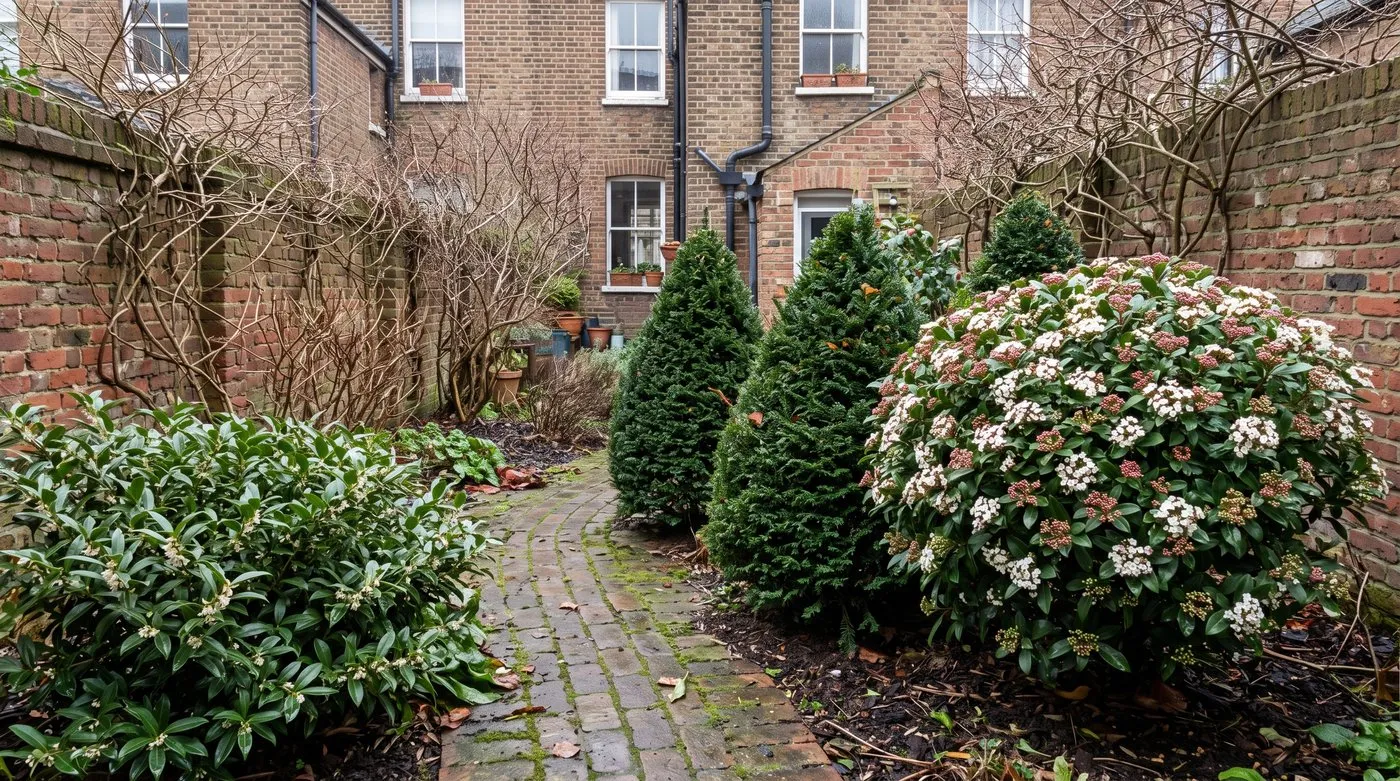
A few evergreen shapes keep a small garden looking planted, even when everything else has died back.
Yew clips to any shape and grows on most soils, including clay. Holly gives glossy leaves and winter berries, though only female plants berry. Viburnum tinus flowers white from late autumn to spring. Sarcococca, or Christmas box, is small, happy in shade and has a sweet scent in winter. Plant it near a path or door.
Box is still popular, but box blight and box tree caterpillar can strip it. Ilex crenata gives a similar look. Our guide to box hedge alternatives has more options.
Place evergreens at corners, along boundaries and at the end of a view. From your main window in winter, you should see at least three green shapes. If the garden looks flat and empty in December, it needs more. Our list of the best evergreen shrubs helps you choose by size and soil.
What are the best multi-season plants?
Multi-season plants earn their space by looking good for more than one season. They are the quickest way to a four-season garden, especially in a small plot.
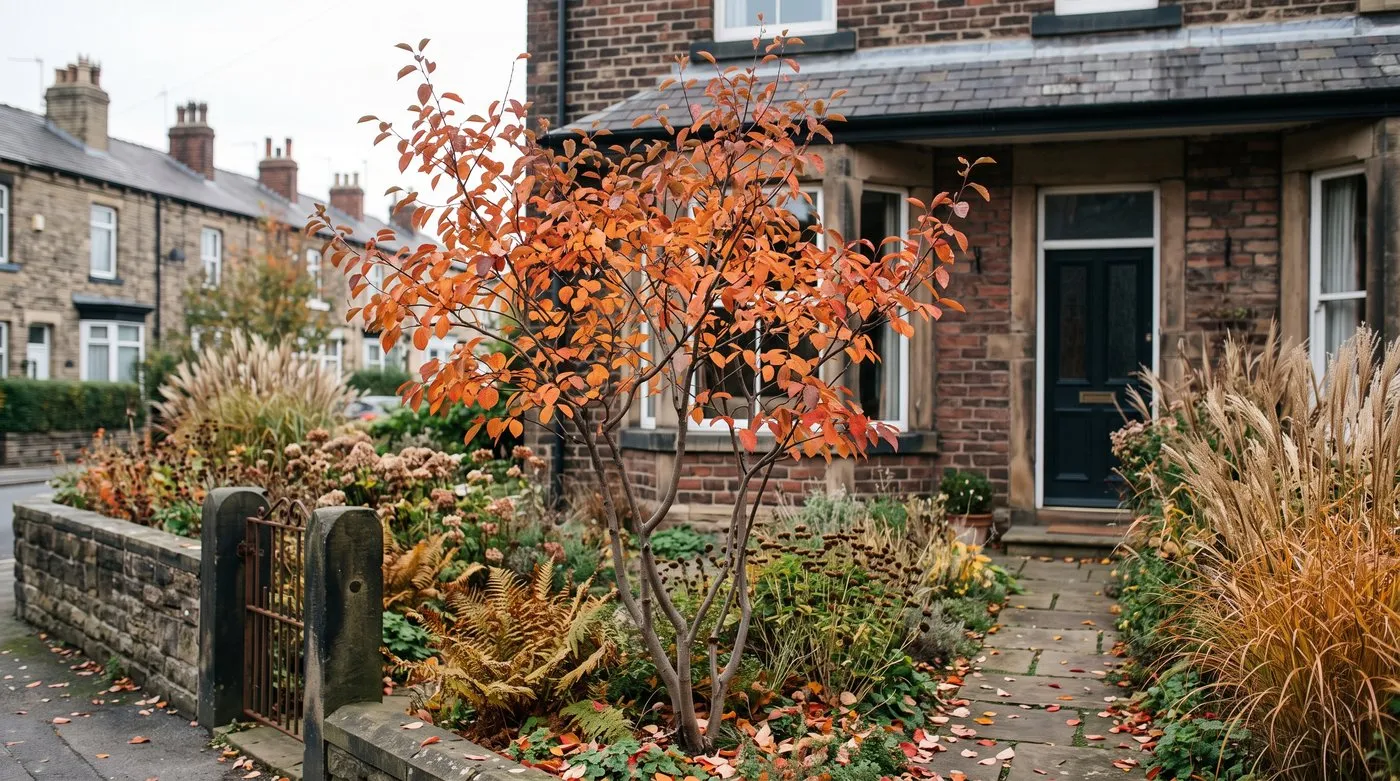
Amelanchier gives spring blossom, summer berries and this autumn colour, which is why it suits small gardens so well.
| Plant | Spring | Summer | Autumn | Winter |
|---|---|---|---|---|
| Amelanchier lamarckii | White blossom, bronze new leaves | Small berries | Orange-red leaves | Neat branch shape |
| Cornus alba ‘Sibirica’ | Fresh green leaves | Green leaves | Red-purple leaves | Bright red stems |
| Hydrangea paniculata ‘Limelight’ | Fresh leaves | Lime-green flowers | Flowers fade pink | Dried flower heads |
| Rosa rugosa | Fresh leaves | Scented flowers through summer | Large red hips | Hips stay on |
| Hakonechloa macra ‘Aureola’ | Golden leaves appear | Golden mounds | Turns russet | Dry buff leaves |
| Viburnum tinus | Last flowers | Evergreen leaves | Buds form | White flowers |
Amelanchier is one of the best small trees for year-round interest. Cornus alba ‘Sibirica’ gives its best stems if you cut it hard back in March every year or two. Leave Hydrangea paniculata heads on until spring, then prune.
How do you fill winter with bark, stems and flowers?
Winter interest comes from bark, coloured stems, evergreen leaves and a handful of plants that flower in the cold. Put them where low winter sun hits them and where you can see them from indoors.
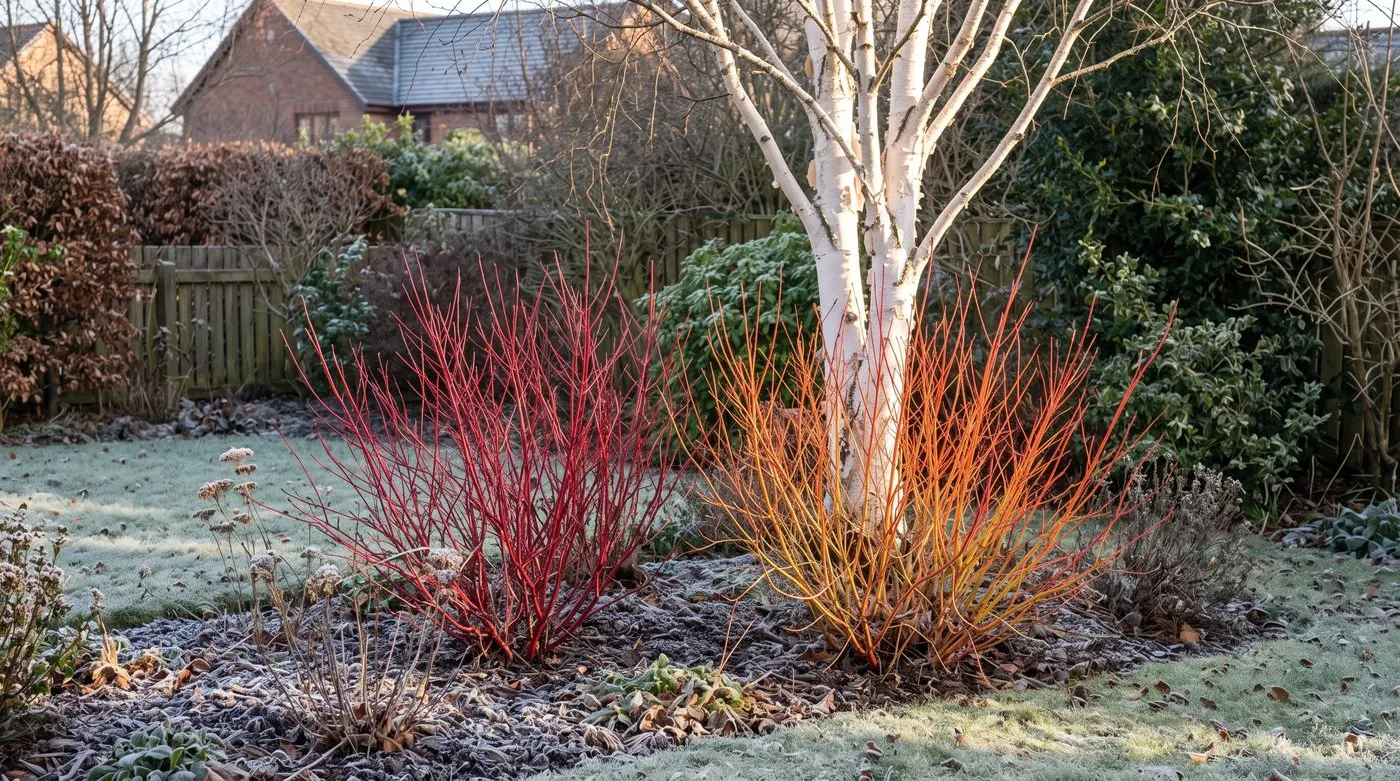
Coloured stems and pale bark glow in low winter sun. Plant them where you can see them from the house.
Bark: Himalayan birch (Betula utilis var. jacquemontii) has white bark. Prunus serrula has shiny copper bark, and Acer griseum has peeling cinnamon bark.
Stems: Cornus alba ‘Sibirica’ has red stems, and Cornus sanguinea ‘Midwinter Fire’ glows orange and red. Willow Salix alba ‘Britzensis’ gives orange-red stems.
Flowers and scent: Mahonia ‘Charity’ bears yellow sprays from late autumn into winter. Viburnum x bodnantense ‘Dawn’ has pink flowers on bare stems. Wintersweet (Chimonanthus praecox) is wonderfully scented. Hellebores flower from late winter into spring.
The guide to winter flowering shrubs has more choices for cold-month colour.
How do bulbs bridge winter and spring?
Bulbs fill February to May for very little space, because they grow up through perennials that are still dormant. Plant them from September to November, tulips last in November.

Tuck bulbs in between perennials in autumn. They flower in spring before their neighbours need the space.
Spread them across the months rather than buying lots of one kind:
- February: snowdrops, winter aconites, Crocus tommasinianus.
- March: early daffodils such as ‘February Gold’ and ‘Tête-à-Tête’, Chionodoxa and Scilla.
- April: tulips, grape hyacinths, late daffodils and snake’s head fritillaries.
- May: late tulips, Allium ‘Purple Sensation’ and Camassia.
Fifty daffodils give a short burst. Fifty bulbs of five kinds give colour for months. On a patio, layer bulbs in one deep pot; our bulb lasagne guide shows how. Pots are also a handy way to plug a gap near the house.
How do you stretch summer into autumn?
Choose long-flowering perennials, then add asters, berries and leaf colour for September to November. Summer is easy to fill, so don’t spend all your space on July.
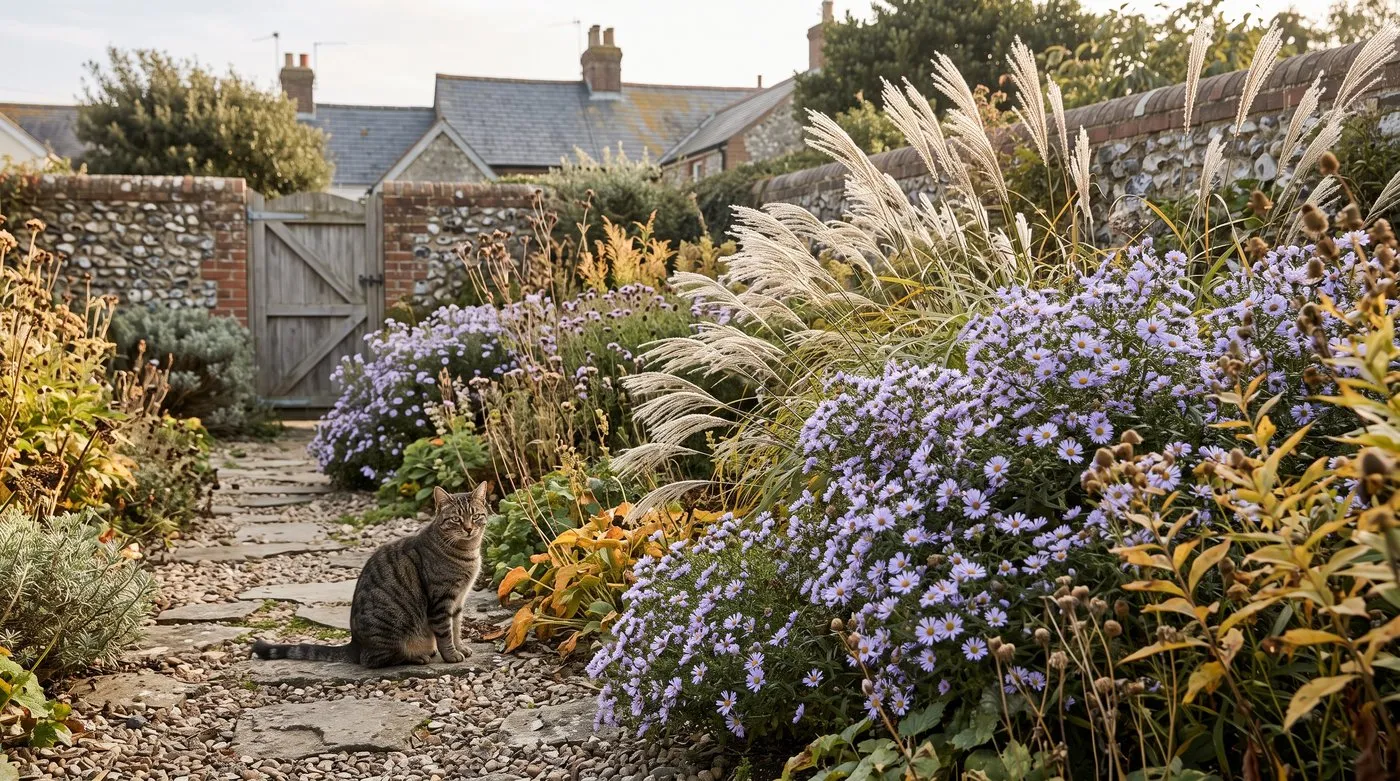
Asters and grasses pick up just as summer flowers fade, carrying colour well into autumn.
Long flowerers include Geranium ‘Rozanne’ (June to October), Salvia ‘Caradonna’ and Nepeta ‘Walker’s Low’. Cut the last two back after their first flush for a second show. Heleniums, echinaceas and Japanese anemones take over from late summer.
For autumn, asters such as ‘Little Carlow’ and ‘Monte Cassino’ flower into October. Berries from pyracantha, cotoneaster and crab apples feed birds and add colour. For leaf colour, Acer palmatum and Euonymus alatus suit smaller gardens. Our guide to trees for autumn colour covers larger choices.
Don’t cut everything down in autumn. Ornamental grasses like Miscanthus and seedheads of echinacea and sedum stand all winter and look great with frost on them. The guide to plants for winter seedheads lists the best. Cut them back in March.
Month-by-month four-season planting calendar
Use this calendar to check you have at least two things looking good in every month.
| Month | What looks good | Job to do |
|---|---|---|
| January | Snowdrops, hellebores, birch bark, dogwood stems | Order bulbs and plants to fill gaps |
| February | Crocuses, winter aconites, Viburnum ‘Dawn’, Sarcococca | Plant bare-root shrubs and trees |
| March | Daffodils, pulmonaria, Magnolia stellata | Cut back grasses, seedheads and dogwoods |
| April | Tulips, Amelanchier blossom, fresh leaves | Note any gap as bulbs fade |
| May | Alliums, aquilegia, euphorbia, late tulips | Plant summer perennials |
| June | Roses, Geranium ‘Rozanne’, nepeta, foxgloves | Cut nepeta back after first flush |
| July | Crocosmia, echinops, Hydrangea paniculata | Note any gap for late summer |
| August | Rudbeckia, echinacea, phlox, heleniums | Deadhead to keep perennials flowering |
| September | Asters, Japanese anemones, grass plumes | Plant spring bulbs and new shrubs |
| October | Acer and Amelanchier leaves, berries, nerines | Plant tulips. Leave seedheads standing |
| November | Late asters, cotoneaster berries, Mahonia | Plant bare-root trees and hedging |
| December | Mahonia, holly berries, Sarcococca, birch bark | Take photos to spot winter gaps |
Common four-season garden mistakes
Planting for June only. Garden centres are full of summer flowers in early summer, so it’s easy to fill up then. Shop in other months too, and you’ll buy what looks good then.
Cutting everything down in autumn. Grasses and seedheads give winter shape and shelter for insects. Leave them until March.
Too few evergreens. Without them the garden vanishes in winter. Aim for a few strong green shapes in view from the house.
One big burst of bulbs. Lots of one daffodil gives two good weeks. Mix early, mid and late bulbs.
Winter plants out of sight. Dogwood stems and scented shrubs are wasted at the far end of the garden. Put them near paths, doors and windows.
Frequently asked questions
What plants give year-round interest in UK gardens?
Evergreens and plants that look good in several seasons do the most work. Amelanchier gives blossom, berries and autumn colour. Cornus alba ‘Sibirica’ has bright red winter stems. Mahonia flowers in winter on evergreen leaves. Add bulbs, long-flowering perennials and asters to fill the warmer months.
How many plants do I need for a four-season garden?
Fewer than you think if you pick multi-season plants. Aim for at least two things looking good in every month. A few evergreens, two or three shrubs with winter stems or bark, plenty of bulbs and some long-flowering perennials will cover most gardens.
What provides winter interest in a garden?
Bark, coloured stems, evergreens and winter flowers carry the garden through winter. Himalayan birch has white bark and Cornus alba ‘Sibirica’ has red stems. Mahonia ‘Charity’ and Viburnum tinus flower in the cold months. Sarcococca adds scent near a door.
When should I plant for autumn colour?
Plant trees and shrubs for autumn colour between October and March. That’s when bare-root and pot-grown plants settle in most easily. Amelanchier, Acer palmatum and Euonymus alatus all colour well. Asters and grasses can go in during spring or autumn.
What are the best evergreen shrubs for garden structure?
Yew, holly, Viburnum tinus and Sarcococca are reliable choices. Yew clips into any shape and grows on most soils. Holly gives glossy leaves and berries. Viburnum tinus flowers through winter. If box blight is a worry, Ilex crenata is a good small-leaved alternative.
Can I create a four-season garden in shade?
Yes, with shade-tolerant plants and more focus on leaves. Hellebores and snowdrops flower in late winter. Ferns and hostas carry the summer. Skimmia, Fatsia japonica and Sarcococca give evergreen structure. Hydrangea paniculata copes with part shade and keeps its dried flowers into winter.
Now you’ve found your gaps, use our UK flower planting calendar to plan what to sow and plant each month, or browse more plant guides.
Our team produces practical UK gardening guidance from source research, contributor records and established horticultural practice. Editorial standards are overseen by Matt W.


