
Key takeaways
- Raised beds are the easiest start on compacted or rubbly school ground
- Choose crops that are ready before mid-July, or will cope alone over summer
- Use the autumn term for garlic, broad beans, spring bulbs and green manure
- A bug hotel, wildflower strip and covered mini pond give lessons all year
- Keep toxic plants out and cover or fence any pond
- Plan for the summer holidays first, with a watering rota or crops that can be left
A school garden turns a forgotten patch of ground into an outdoor classroom. The trick is to plan around the school year. Grow crops that are ready before the summer holidays, use the autumn term for planting and keep things simple enough for busy staff.
This guide is for teachers, teaching assistants and PTA volunteers setting up a garden at a UK primary school. For ideas at home, see our guide to children’s garden design.
Start with raised beds
Raised beds are the easiest way to start a school garden. Most school grounds sit on compacted clay, rubble or tarmac, and raised beds sidestep all of it.
- Size: About 1.2m wide lets children reach the middle from both sides without stepping on the soil.
- Materials: Use untreated timber or scaffold boards. Avoid old railway sleepers, which may contain creosote.
- Filling: Use a mix of topsoil and peat-free compost.
- Height: Low beds of 20-30cm suit most primary children, who are happy kneeling. For wheelchair users, build some beds about 60cm high with space to pull up alongside.
Our guide to raised bed gardening for beginners covers building and filling them step by step.

A volunteer working alongside pupils keeps a school garden going. Low raised beds let small hands reach every plant.
What to grow to fit school term dates
The summer holidays land right in the middle of the growing season, so plan around them. A crop that ripens in August is likely to be wasted.
| Term | Sow or plant | Harvest |
|---|---|---|
| Spring (January to Easter) | Cress, radish and lettuce on windowsills. Seed potatoes and onion sets outside from March | Cress within a couple of weeks |
| Summer (Easter to July) | Radish, lettuce and carrots outside. Sunflowers. Runner and French beans in May | Radish, lettuce, first early potatoes before term ends |
| Autumn (September to December) | Garlic, broad beans, onion sets, spring bulbs, green manure | Pumpkins and late courgettes if someone watered over summer |
Quick wins: Radishes are ready in about four weeks. Cut-and-come-again lettuce gives leaves in about a month. Cress shows results within days, which is magic for younger classes.
Our list of easy vegetables for kids to grow has more crops that suit small hands and short attention spans.

An autumn harvest is the big reward. Courgettes and pumpkins only make it if someone waters over the summer.
Running a sunflower competition
A sunflower race is the easiest first project for a school new to gardening. It needs little space, almost no kit and gives a dramatic result.
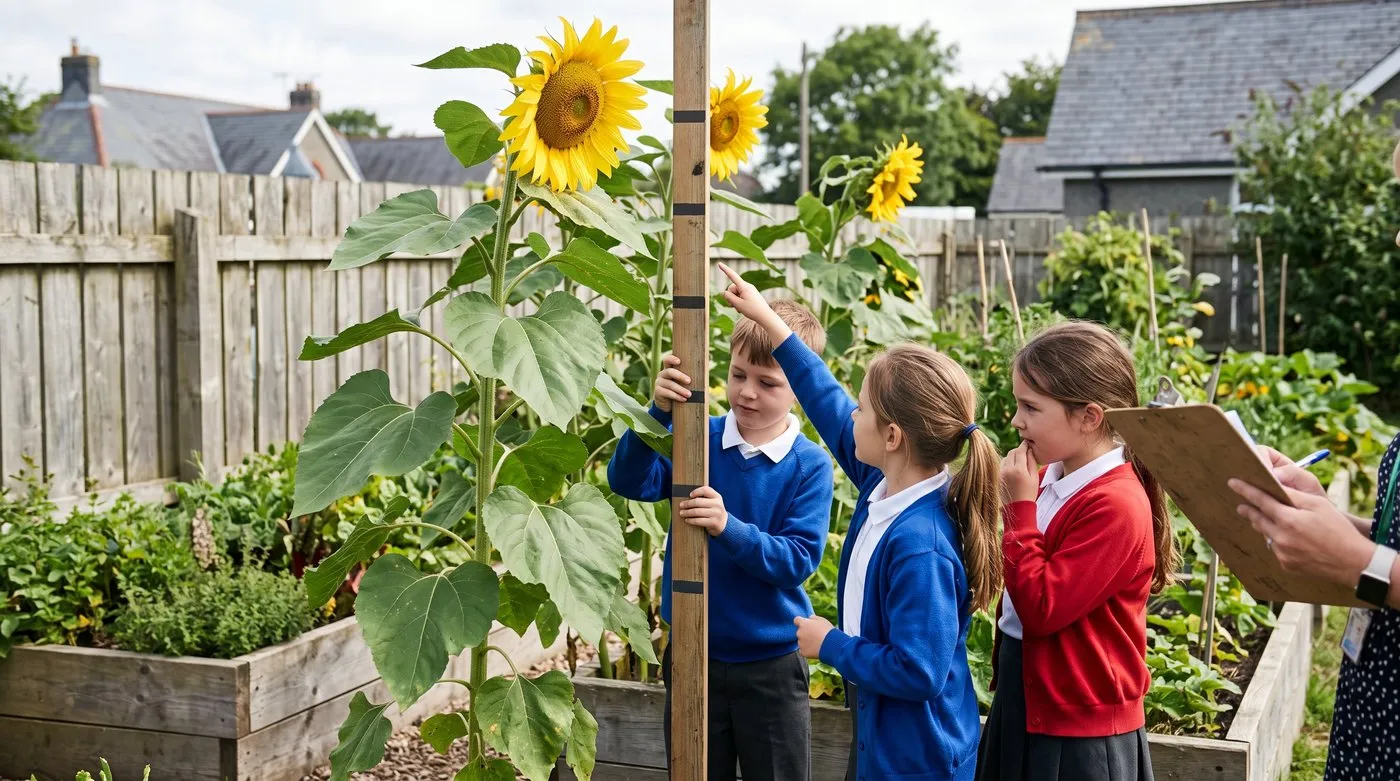
Weekly measuring keeps the whole class hooked, and the numbers make a handy maths lesson.
- Give each class or pupil a seed and a small pot in April.
- Grow the seedlings on a classroom windowsill for three to four weeks.
- Plant them out in May, once frosts are over, against a sunny fence.
- Measure them every week against a height chart.
- Crown the tallest before the end of the summer term.
Pick a tall variety such as ‘Russian Giant’ for the race, and short ones such as ‘Teddy Bear’ for pots. Pupils can plot the heights on a line graph for a maths lesson. Our guide to growing sunflowers with children has more tips.
Making a school wildlife area
A wildlife area needs very little looking after once it’s set up, and it gives lessons all year round.
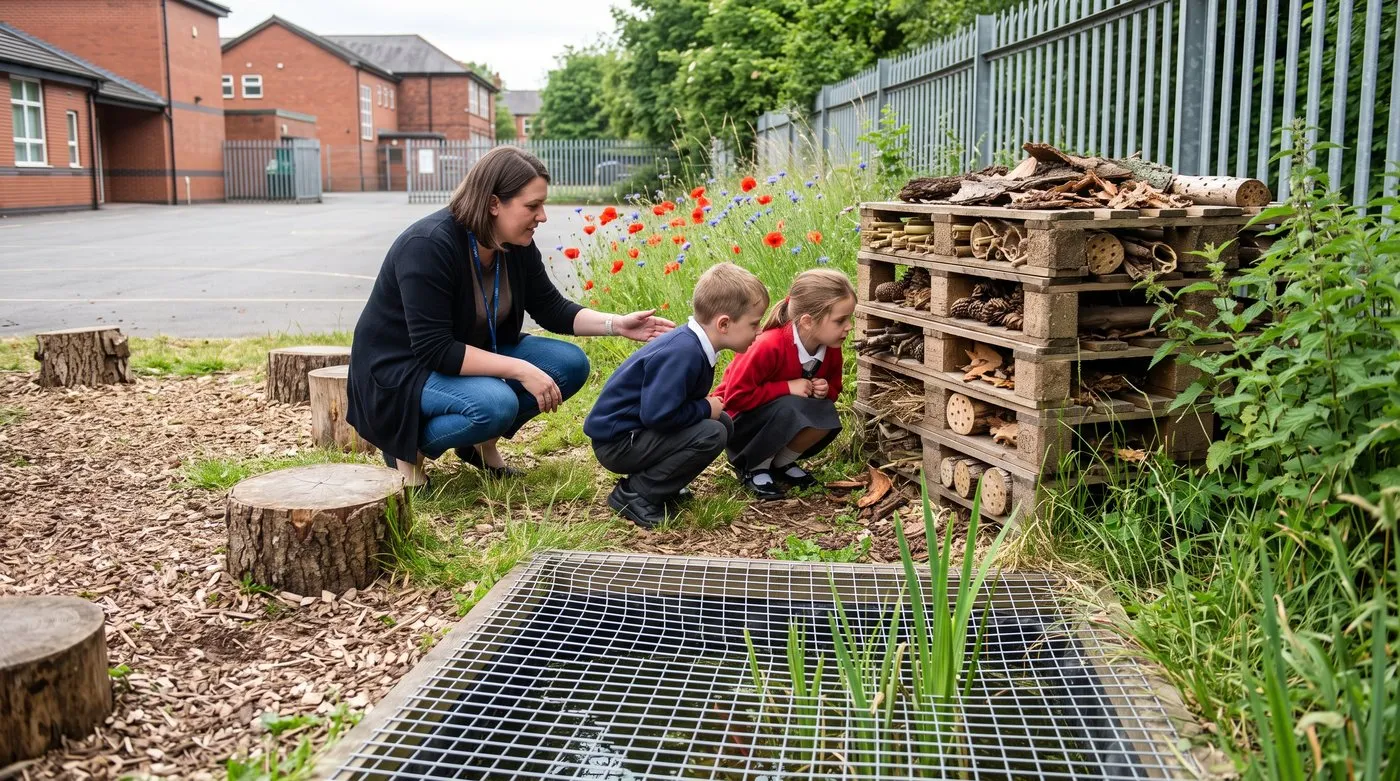
A bug hotel, a strip of wildflowers and a safely covered pond give lessons all year round.
Bug hotel: Stack pallets and fill the gaps with hollow stems, pine cones, bark and straw. Put it somewhere sheltered and sunny. Our guide on how to build a bug hotel shows the method.
Wildflower strip: Clear a strip of turf and sow cornfield annuals such as poppies and cornflowers in spring for flowers that summer. Perennial meadow mixes take longer but come back each year. Cut perennial patches in late summer and rake off the cuttings.
Mini pond: Even a sunken washing-up bowl or half barrel soon attracts insects, and often frogs. Fill it with rainwater and add a few native pond plants. Give it a sloping stone or log so creatures can climb out.
Warning: Any water is a drowning risk for young children. Cover a school pond with a strong, fixed mesh, fence it off, or make a bog garden instead, which is a lined wet patch with no standing water.
Safety, access and sensory corners
Keep the garden safe and open to every pupil.
- No toxic plants. Leave out foxgloves, laburnum, yew, lily of the valley and anything with irritating sap. Our guide to poisonous garden plants lists what to avoid.
- Wide, firm paths. Make them at least 1.2m wide for wheelchairs and walking frames.
- Gloves and handwashing. Gloves for soil work, and wash hands before snack time.
- A sensory corner. Fragrant herbs, soft leaves such as lamb’s ears and a little running water suit pupils who need a calm space. Our sensory garden design guide has planting ideas.
Composting and an outdoor classroom
Composting shows children the whole growing cycle. Use two bins, one filling and one rotting down. Add fruit and veg peelings, garden waste and shredded paper. Leave out meat, dairy and cooked food, which attract rats. A cold heap takes around six months to a year. A wormery is a great alternative for a classroom with no outdoor space.
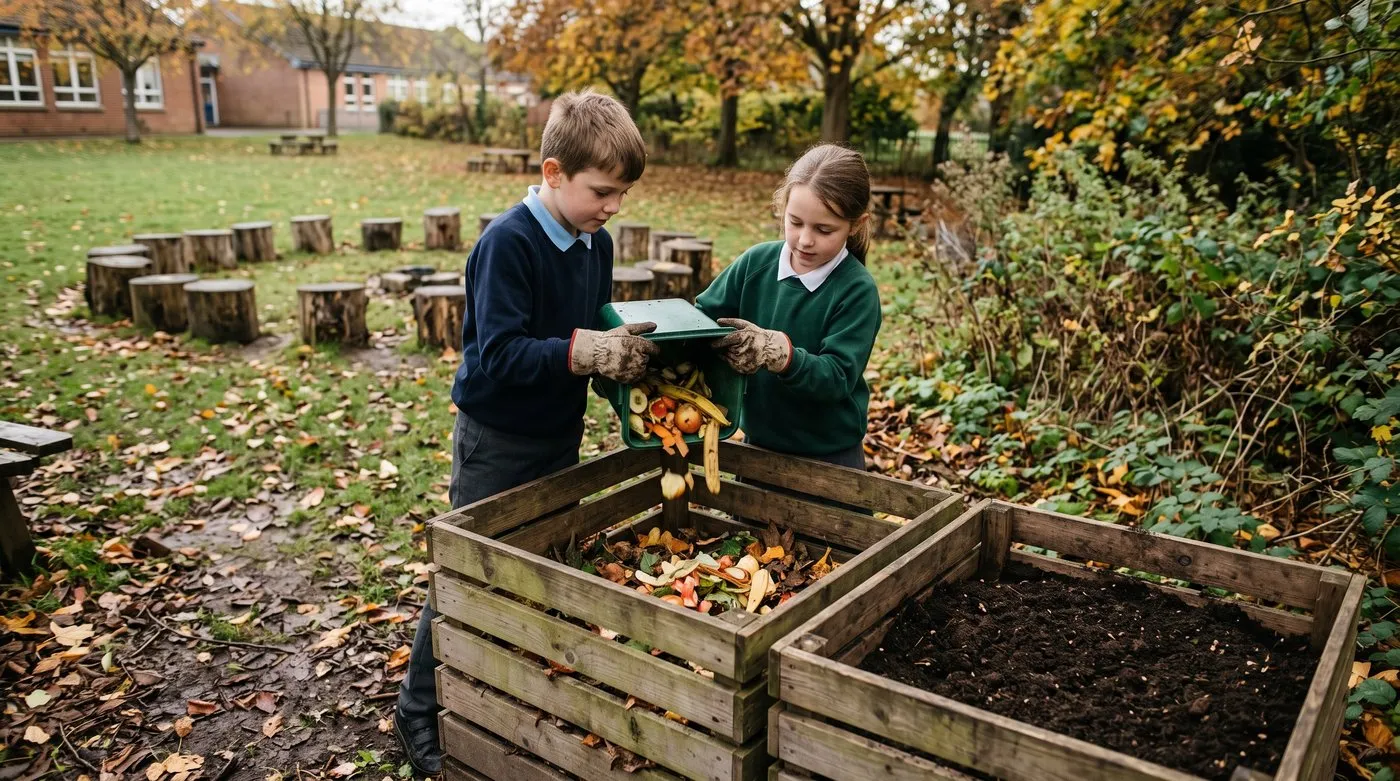
Two bins, one filling and one rotting down, show children how peelings turn back into soil.
An outdoor classroom can be as simple as a circle of log stumps near the beds. Add a chalkboard on a fence, some shade and a lockable box for tools and gloves.
School garden projects compared
| Project | Effort to set up | Best term to start | Ongoing care |
|---|---|---|---|
| Raised vegetable beds | Easy | Spring | Weekly watering in dry spells |
| Sunflower competition | Easy | Summer | Weekly measuring |
| Bug hotel | Easy | Any | Almost none |
| Wildflower strip | Easy | Spring or autumn | One cut a year |
| Mini pond | Moderate | Spring | Top up and check the cover |
| Composting station | Easy | Any | Add waste and turn now and then |
| Fruit bushes | Easy | Autumn or winter | Yearly pruning |
Looking after the garden over the summer holidays
Plan for the holidays from day one, or the garden you built in spring may be gone by September.
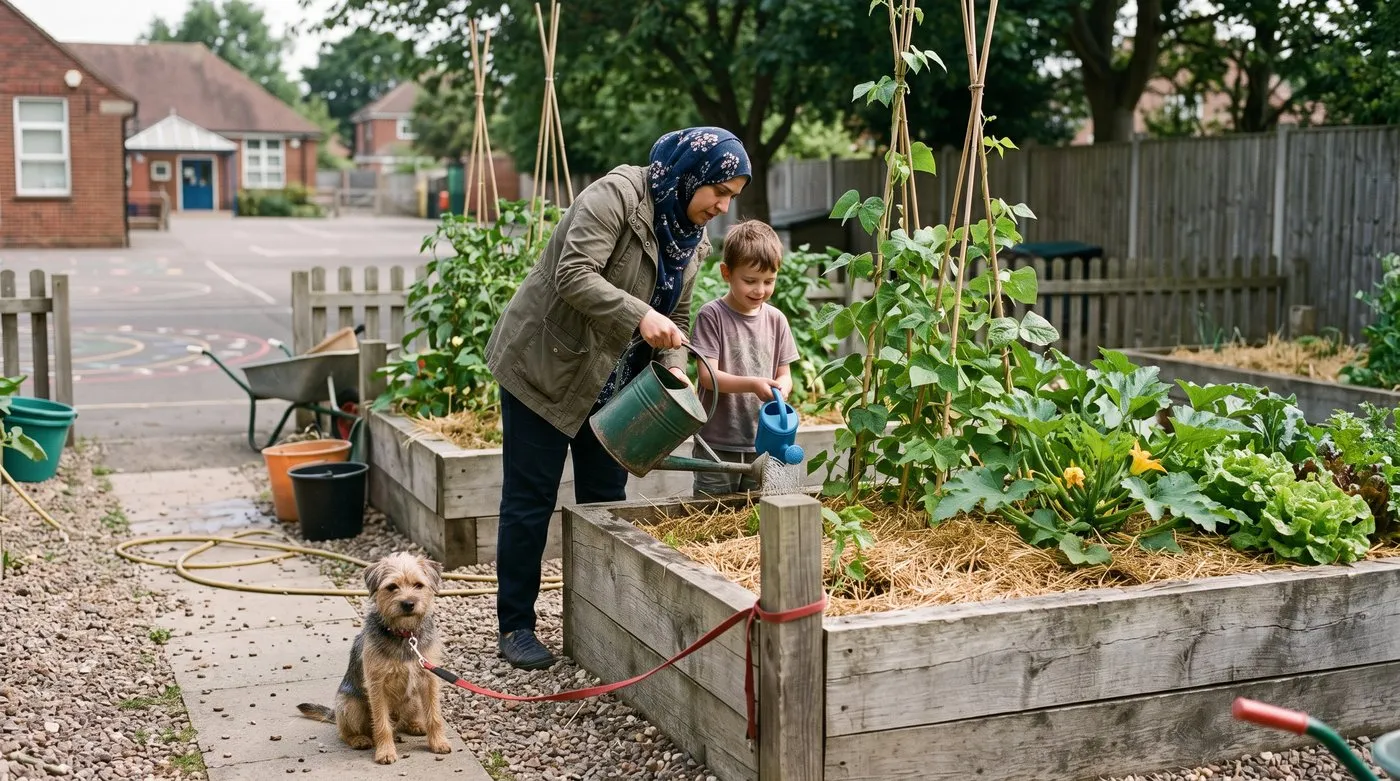
A watering rota of local families keeps crops alive through the long summer break.
- Choose crops that finish early, such as radishes, lettuce and first early potatoes.
- Set up a watering rota with families who live nearby.
- Mulch thickly with bark, straw or compost to hold moisture.
- Fit a timer to an outside tap with a seep hose, if the school has one.
- Rest the beds under a green manure such as phacelia if no one can water.
Funding a school garden
Most school gardens start small and grow over time.
- PTA fundraising: plant sales, cake sales and selling spare produce at the school gate.
- Local businesses: garden centres and builders’ merchants sometimes donate compost, timber or vouchers. A short one-page plan helps.
- The RHS: the RHS Campaign for School Gardening offers free resources and activities for registered schools.
- Community grants: local councils and community foundations sometimes fund growing projects.
- A donation day: parents often have spare tools, pots and timber.
Common school garden mistakes
- Growing crops that ripen in August. Plan around term dates.
- Starting too big. One or two beds done well beat six that run wild.
- No summer plan. Sort out watering before the holidays, not during them.
- Leaving it to one person. Spread the jobs across classes and volunteers.
Frequently asked questions
How much does a school garden cost to set up?
A simple start with one or two raised beds can be very cheap. Seeds cost little, bug hotels can be built from scrap wood, and parents often donate tools and timber. Spend more only when you add sheds, greenhouses or an outdoor classroom.
What vegetables grow best in a school garden?
Radishes, lettuce and first early potatoes fit term dates best. Radishes are ready in about four weeks. Cut-and-come-again lettuce gives leaves in about a month. First earlies planted in late March are usually ready by late June or early July.
When should we start a school garden?
Plan in January and start planting in March. Sow seeds indoors in the spring term and plant out after the last frost. Starting in autumn works too, with garlic, broad beans and bulbs that pupils come back to in spring.
How do we maintain a school garden over summer holidays?
Choose crops that finish before July, or set up a watering rota. Mulch beds thickly to hold moisture. A simple timer on an outside tap helps. Or sow a green manure on empty beds and leave them to rest over summer.
Do we need permission to build a school garden?
Usually only the head teacher’s approval for beds and planters. Talk to your estates team or local authority before putting up sheds, greenhouses or polytunnels, or breaking up tarmac.
How do we make a school garden accessible for SEN pupils?
Use raised beds that can be reached from a seat, with wide, firm paths. A wheelchair user needs beds about 60cm high with space alongside. Fragrant herbs, soft leaves and running water make a sensory corner. Leave out toxic and spiky plants.
What curriculum subjects link to school gardening?
Science, maths, English, art, PSHE and geography all link in easily. Pupils study lifecycles and habitats, measure and graph growth, and write garden diaries. They can also draw from life and learn about healthy eating and the seasons.
Looking for activities to fill your new garden? Read our gardening projects for kids, or browse more garden design ideas.
Our team produces practical UK gardening guidance from source research, contributor records and established horticultural practice. Editorial standards are overseen by Matt W.


