Key takeaways
- Give osteospermum full sun and soil that drains quickly
- Plant out after the last frost, from late May in the south and mid-June in Scotland
- Deadheading every few days keeps the flowers coming until autumn
- Most varieties need a frost-free spot in winter, or take cuttings in August
- Osteospermum jucundum is tough enough to stay outside in mild gardens
- Wet winter soil kills more osteospermum than cold does
Osteospermum is the plant to buy if you want flowers for months rather than weeks. A single pot can stay covered in daisies from late May right through to the first proper frost, in purple, white, pink, buttery yellow or burnt orange. You’ll also see it sold as African daisy or Cape daisy, since it comes from South Africa.
That origin explains both its strengths and its one weakness. It loves sun and copes well with dry spells. What it can’t stand is a cold, soggy British winter. With a bit of planning, though, you can keep the same plants going for years.
What growing conditions do osteospermum need?
Sun and drainage. Get those two right and osteospermum is easy.
Many varieties will shrug off a light frost, but a hard one finishes them. Cold on its own is less of a problem than cold combined with wet. A plant sitting in sodden clay through January is in far more trouble than one on gritty soil that gets a brief, sharp frost.
| What it needs | In plain terms |
|---|---|
| Light | Full sun, at least six hours a day |
| Soil | Free-draining. Sandy soil is ideal. Add grit to clay |
| Planting out | After the last frost, once the soil has warmed |
| Watering | Moderate. Copes with dry spells once settled |
| Feeding | Tomato feed every fortnight for pots, June to September |
| Winter | Frost-free for most varieties |
Which osteospermum varieties grow best in the UK?
For a plant that stays in the ground all year, choose Osteospermum jucundum. Treat almost everything else as a summer plant that you either bring in for winter or replace. When you’re browsing, the RHS Award of Garden Merit logo on a label is a handy sign that a variety performs well in British gardens.
| Variety | Toughness | Size | Best for |
|---|---|---|---|
| O. jucundum | The toughest | Low and spreading | Borders and rockeries, can stay outside |
| ’Serenity’ series | Needs winter protection | Compact | Pots and bedding |
| ’3D’ series | Needs winter protection | Compact | Cloudier gardens |
| ’Soprano’ series | Needs winter protection | Larger, biggest flowers | Big pots and borders |
Osteospermum jucundum, the tough one
This is the one that survives winter outdoors across much of southern and central England, provided the soil drains well. Look for ‘Langtrees’, the form you’re most likely to find. Its soft lilac-pink daisies appear from May to October, and over a few years it spreads into a low mat that smothers weeds at the front of a border.
‘Serenity’ series, neat and reliable
A tidy, compact range that stays in neat mounds rather than flopping about. Colours run from purple and white through pink and rose to a dusky bronze. Good choices for window boxes and pots in patio gardens.
‘3D’ series, good for cloudier gardens
Most osteospermum flowers shut when the sun goes in. The ‘3D’ range is bred to stay open better on dull days, which makes it worth a try in a north-facing garden or anywhere that gets a lot of grey skies. The flowers are semi-double, with a raised, frilly centre a bit like a pompom.
 ‘3D Purple’ has a raised, frilly centre that makes it stand out.
‘Soprano’ series, the showstopper
These have the biggest flowers of the common types. ‘Soprano Purple’ is a deep violet that looks fantastic beside silver foliage. Plants grow taller and wider than the other ranges, so give them a roomy pot or a spot at the front of a sunny border.
How to plant osteospermum
Hold off until the last frost has passed and the soil has warmed up. As a rough guide, that’s late May in southern England, early June in the Midlands and Wales, and mid-June in northern England and Scotland. Plants bought in April are lovely, but they’ll need to stay in a porch or greenhouse until then.
Anything that’s come from a heated greenhouse or garden centre needs hardening off. For a week or so, stand it outside somewhere sheltered during the day and bring it back in at night. Skip this and the plant often sulks for a fortnight after going out.
In a border, dig a hole twice as wide as the pot. On heavy soil, work in a generous handful of grit. Plant at the same depth it sat in the pot, since burying the stem invites rot. Smaller types need 30-40cm between plants, and ‘Soprano’ wants 40-50cm. Water in well and finish with a gravel mulch. Bark holds damp against the stems, which osteospermum doesn’t appreciate.
In pots, use peat-free multipurpose compost with grit or perlite mixed through. One plant suits a pot about 30cm across. Check there are drainage holes, and lose the saucer, because standing in water kills osteospermum faster than any frost. They thrive on sunny balconies, where the warm walls give them extra shelter.
 Osteospermum and trailing geraniums make a cheerful summer balcony display.
Summer care
Deadhead. It’s the one job that really keeps them flowering. Every few days, nip off faded flower stems back to a leaf joint. Left alone, the plant starts making seed and slows right down on new buds.
Feed pots with tomato feed every two weeks from June to September. Border plants in reasonable soil only need a single sprinkle of general fertiliser in late spring. Steer clear of high-nitrogen feeds, which push out leaves at the expense of flowers.
Once settled, osteospermum is fairly drought tolerant. It would rather be a bit dry than permanently damp. Water pots when the top couple of centimetres feel dry to your finger. In a border you’ll only need the hose during long dry spells in the first summer.
Young plants benefit from a pinch. Once they’ve got four or five pairs of leaves, nip out the growing tip. They’ll branch out into a bushier plant with more flowering stems, rather than one tall, leggy one.

Snip faded stems back to a leaf joint and the plant puts its energy into new buds. It’s a quick job that keeps the flowers coming until autumn.
How to overwinter osteospermum
Most UK gardeners need to protect osteospermum from winter wet, winter cold, or both. You have three options.
| Method | How much effort | Best for |
|---|---|---|
| Bring them indoors | Medium | Favourite or large plants |
| Fleece outdoors | Low | O. jucundum in mild, sheltered gardens |
| Take cuttings | Medium | Named varieties and small spaces |
Bringing plants indoors
Move pots, or lift border plants and pot them up, before the first frost. In the south that’s usually mid-October; further north, aim for early October. Cut each plant back by about a third and pull off any yellowing leaves. Then find it a bright, frost-free home: a cool greenhouse, an unheated conservatory or a light porch all work. Water just enough to stop the compost going bone dry. When new growth appears in late March, start watering and feeding properly again.
Fleece outdoors
Realistically this only works for O. jucundum in mild places like Cornwall, the south coast and sheltered town gardens. Trim the plants back in late autumn, spread a thick layer of gravel around the base, and throw two layers of fleece over them when frost is forecast. Take the fleece off again on mild days, or mould sets in underneath. On clay, winter wet will usually kill the roots however well you wrap the top.
Taking cuttings
This is the most reliable method, and the only sure way to keep a named variety you love. Take cuttings in August, while the stems are firm but not yet woody. Our guide to plant propagation from cuttings goes into more detail.
 Taking osteospermum cuttings in late summer. They take up much less room than big plants over winter.
- Choose non-flowering shoot tips 8-10cm long and cut just below a leaf joint with a clean, sharp blade.
- Strip off the lower leaves so only two or three pairs remain at the top, and pinch out any flower buds.
- Push the cuttings into small pots of half peat-free compost, half perlite, then water lightly.
- Stand them on a bright, warm windowsill without a plastic bag over them, as osteospermum cuttings rot in damp air.
- Roots form in a few weeks. Move each cutting into a slightly bigger pot once fresh growth appears.
- Keep them on the windowsill through winter with only a little water, then harden them off and plant out in May.
Always take a few more than you need. A handful usually fail, and spare young plants make good presents for neighbours. If you don’t have a greenhouse or conservatory, cuttings are the obvious answer.
Month-by-month osteospermum calendar
| Month | What to do |
|---|---|
| January | Keep overwintered plants frost-free. Water sparingly. Check for grey mould |
| February | Pick off dead leaves. Water a little more as the days lengthen |
| March | Trim overwintered plants into shape. Start feeding. Pot on rooted cuttings |
| April | Harden off indoor plants. Pinch out tips. Buy new plants |
| May | Plant out in the south after the last frost. Water in well |
| June | Plant out in the Midlands and north. Start fortnightly tomato feed. Deadhead |
| July | Peak flowering. Deadhead often. Water pots when the top dries. Watch for greenfly |
| August | Take cuttings for next year. Keep feeding and deadheading |
| September | Stop feeding. Take any last cuttings. Bring tender plants in before the first frost |
| October | Lift remaining plants before frost and cut back by a third. Fleece O. jucundum outdoors |
| November | Water overwintered plants sparingly and give them some air to prevent mould |
| December | Check stored plants and remove anything dead or rotting |
Common problems and how to fix them
Flowers staying shut during the day. Almost always a lack of sun. Move the pot somewhere brighter. If it’s already in full sun and still sulking, try the ‘3D’ series next year.
Tall, leggy growth. Too little light, too much nitrogen, or both. Move it into full sun, switch to tomato feed and pinch out the tips. You can also cut a leggy plant back by half in early summer. It’ll look sad for a couple of weeks, then reshoot.
Grey mould. A fuzzy grey rot that turns up in cool, damp, still air. It’s most common on plants kept indoors over winter. Open a window or vent when you can, water less and remove any affected bits straight away.
Greenfly. They cluster on soft shoot tips from May onwards. A blast from the hose sorts out small numbers. For a bad attack, use an approved insecticide exactly as the label says rather than a home-made mix. Ladybirds and hoverfly larvae eat greenfly by the hundred, so leave them be.
Root rot. Waterlogged soil kills more osteospermum than anything else, and once the roots go there’s no saving the plant. Grit in heavy soil, drainage holes in pots and no saucers of standing water are your best defence.
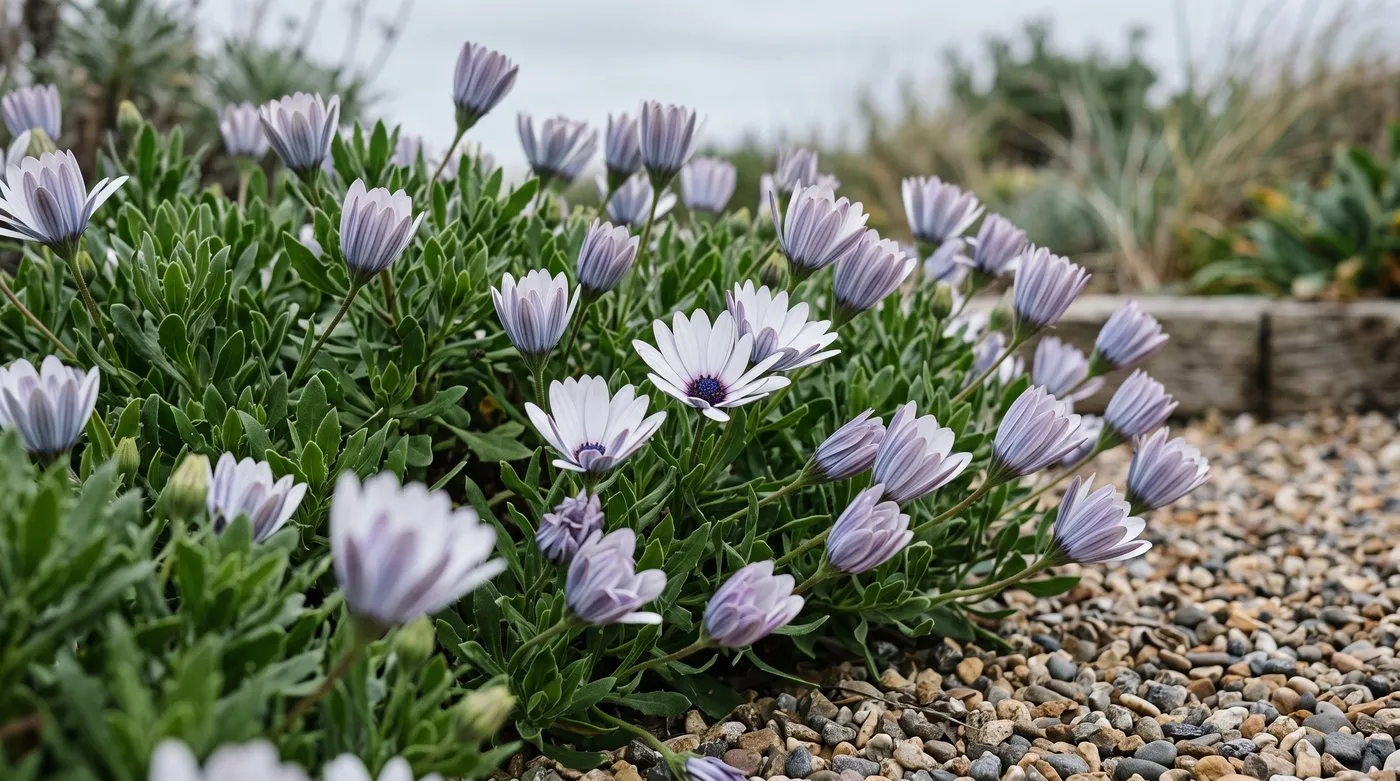
Osteospermum flowers fold up when the sun goes in, so this is normal on a dull day. If they stay shut, the spot probably needs more sun.
Good plant partners
Pair osteospermum with other sun lovers that don’t need much water. In a border, lavender, geraniums, salvias and soft grasses like Stipa tenuissima all work well. The flat, open daisies look good against upright salvia spikes and the movement of grasses.
For pots, try trailing verbena, lobelia or bidens tumbling over the edge. A bit of silver from helichrysum or senecio makes the colours stand out. As a rule of thumb, a 45cm pot holds one osteospermum in the middle with two or three trailers round it.
On a hot, dry bank that you never want to water after year one, try osteospermum with lavender, sedum, eryngium and perovskia.
For another sun-loving pot plant that teams up nicely with African daisies, read our guide on how to grow geraniums in the UK.
Frequently asked questions
Are osteospermum perennial in the UK?
Technically yes, but most can’t take a British winter outside. The hardiest kind, Osteospermum jucundum, can stay in the ground all year in sheltered southern gardens with sharp drainage. Named varieties need a frost-free home over winter, and August cuttings are the easiest way to keep them.
When should I plant osteospermum outside?
After the last frost, once the soil has warmed. That’s usually late May in southern England, early June in the Midlands and Wales, and mid-June in northern England and Scotland. Spend a week hardening plants off first, putting them out by day and bringing them in at night.
Why do osteospermum flowers close at night?
They fold up in dull light and cool air, which protects the flower overnight. It’s completely normal. Some newer ranges, such as the ‘3D’ series, are bred to stay open better on cloudy days.
How do I overwinter osteospermum in the UK?
Move pots in before the first frost, usually by mid-October. Cut them back by a third, keep them somewhere bright and frost-free, and water only enough to stop the compost drying out. Cuttings taken in August are an easier option, as they take up a windowsill rather than a greenhouse.
Can osteospermum grow in pots?
Yes, and they’re brilliant in them. Use peat-free multipurpose compost with some grit mixed in, in a pot at least 30cm wide with drainage holes. Feed every fortnight with tomato feed from June and give them the sunniest spot you have.
Do osteospermum come back every year?
In mild coastal and southern gardens with free-draining soil, often they do. Inland and further north, most gardeners bring them in or start again from cuttings each spring. Osteospermum jucundum is the most likely to come back on its own.
What is the difference between osteospermum and dimorphotheca?
They’re close relatives and both get called African daisies. Dimorphotheca is usually grown from seed as an annual. Osteospermum lives for years if kept frost-free, and it’s what most garden centres sell as plants.
Our team produces practical UK gardening guidance from source research, contributor records and established horticultural practice. Editorial standards are overseen by Matt W.