Key takeaways
- Wire-free mowers find their way by satellite, camera or both, so there's no cable to bury
- Satellite models need a clear view of the sky; cameras help under trees and near buildings
- Cut a little higher, around 40mm, so damp grass doesn't clump
- Steep or wet clay slopes need an all-wheel-drive model
- Only mow in daylight to keep hedgehogs safe
- Sort out moss, thatch and bare patches before the mower starts
Robot mowers have come on a long way, and you can now get wire-free models that cope well with UK lawns. The old boundary wire took ages to lay and snapped whenever you pushed a fork through it. Newer mowers find their way using satellites, cameras or both, and you set them up with a phone app.
Here’s how the different types find their way, a look at three popular models, and tips for slopes, narrow paths and the damp grass we get from autumn to spring. For general lawn jobs alongside your robot, our lawn care calendar covers what to do each month.
How does wire-free navigation work?
Wire-free mowers use satellites, cameras or a mix of both. Which one you pick affects how neatly the mower follows your lawn edge and how well it copes with a fiddly layout.
RTK satellite positioning is very accurate. It uses satellite signals that are corrected live, either by a small aerial in your garden or by an online service. The Segway Navimow pairs this with a camera system. Husqvarna’s NERA range uses its own satellite system, called EPOS.
Camera and AI vision is the newest approach. Cameras on the mower see the lawn and spot obstacles as it goes. The Worx Landroid Vision Cloud uses cameras with satellite help, and Husqvarna has added AI vision cameras to some of its newer NERA models. Cameras help under trees and near buildings, where satellite signals get weaker.
Plain GPS on its own isn’t accurate enough to follow a lawn edge neatly, which is why newer mowers add satellite correction or cameras.
Which robot mower suits British gardens?
Segway Navimow i108E: good for most UK gardens
It’s quick to set up. You walk the edge of the lawn once with your phone, and the mower maps it. It combines satellite positioning with a camera, it’s pleasantly quiet and it suits an average-sized lawn.
Its weak spot is steep, wet clay, where a two-wheel-drive mower can slip. Segway’s all-wheel-drive i2 AWD model is built for steeper ground.
Husqvarna Automower 410VE NERA: good for tricky layouts
This one suits bigger lawns and gardens with lots going on. It combines Husqvarna’s satellite system with AI vision cameras, which helps it spot garden furniture, toys and pets. Its EdgeCut feature trims closer to the lawn edge than most, so there’s less strimming to do.
The catch is the price, which is much higher than the Navimow. It earns its keep in gardens with several lawn areas, beds in the middle of the grass or lots of obstacles. On a simple rectangle of lawn, a cheaper model does the same job.
Worx Landroid Vision Cloud: good camera-led option
The Landroid Vision Cloud uses cameras with satellite help, and there’s no aerial to put up, so it’s simple to install. It comes in sizes for small to very large lawns, and the battery fits other Worx cordless tools, which is handy if you already own some.
There’s a standard model and a 4WD model for steeper slopes. The blade is offset to cut closer to the edges.
Cameras need light. On a gloomy winter day, a camera-led mower may pause until it’s bright enough to see. Set it to mow in the brightest part of the day and it’s rarely a problem.
 A charging dock with a little roof keeps the mower out of the worst weather. Some models need a cover buying separately.
Quick comparison
| Segway Navimow i108E | Husqvarna 410VE NERA | Worx Landroid Vision Cloud | |
|---|---|---|---|
| Price | Mid-range | Premium | Mid-range |
| Finds its way by | Satellite and camera | Satellite and AI vision | Camera with satellite help |
| Best for | Average lawns | Big lawns with lots of obstacles | Simple setup, Worx tool owners |
| Steep slopes | Choose the i2 AWD | Choose a bigger NERA model | Choose the 4WD model |
| Edges | Needs some trimming | Cuts closer with EdgeCut | Offset blade cuts closer |
| Rain sensor | Yes | Yes | Yes |
| App | Navimow app | Automower Connect | Landroid app |
Always check the lawn size and maximum slope on the box against your own garden.
Damp grass: what UK owners need to know
Cut a bit higher. Cut too short and wet grass clumps under the mower. The clippings stick inside and leave lumps on the lawn. Around 40mm gives the clippings room to scatter, even on a dewy morning.
Wet clay slopes are slippery. Two-wheel-drive mowers can lose grip on a steep slope when clay is soggy, which is common from October to March. If you have steep slopes and clay soil, go for an all-wheel-drive model.
Set a rain delay. Ask the mower to wait at least an hour after rain stops. Grass can look dry on top while the soil underneath is still soft, and the wheels can leave ruts.
For more on mowing through the wet months, our guide to when to mow your lawn covers seasonal cutting heights, which apply to robots too.
 A robot mower on a slope. On steep, wet ground, all-wheel-drive models keep their grip better.
How to choose the right one
Measure your lawn first
Pace it out (an adult stride is roughly 75cm) or use a free online map tool. Then pick a mower rated for a bit more than your lawn, so it isn’t working flat out.
| Lawn size | What to look for |
|---|---|
| Small | An entry-level wire-free model |
| Medium | A mid-range model rated for your size |
| Large with lots of obstacles | A model with camera or AI vision |
| Very large | A model built for big lawns, with a large battery |
Check your slopes
Use a spirit-level app on your phone on the steepest bit of lawn. Gentle slopes suit any standard model. For steeper ground, look for an all-wheel-drive version and check its maximum slope.
Count your obstacles
If your lawn wraps round beds, has trees in the middle or links several areas through narrow gaps, a model with camera or AI vision will cope best. For a simple open lawn, a satellite model does the job for less.
Sort out any lawn problems before the mower arrives. Our guides to fixing a patchy lawn and removing moss will help. Robot mowers keep a good lawn looking good, but they won’t fix a poor one.
Keeping hedgehogs, pets and children safe
Robot mowers work on their own, so it’s worth thinking about who else uses the garden.
Hedgehogs: The British Hedgehog Preservation Society advises against running robot mowers at night, when hedgehogs are out and about. Set yours to mow in the middle of the day only. Some mowers have sensors that spot small objects, but don’t rely on them to protect hedgehogs. Daytime mowing is the safe choice.
Pets: Many dogs and cats soon learn to keep clear of the mower. Some models can spot animals and stop. Keep an eye on the first few sessions until your pets are used to it.
Children: Mowers have sensors that stop the blades if the machine is lifted, and PIN codes stop anyone starting it. Even so, keep small children off the lawn while it’s running.
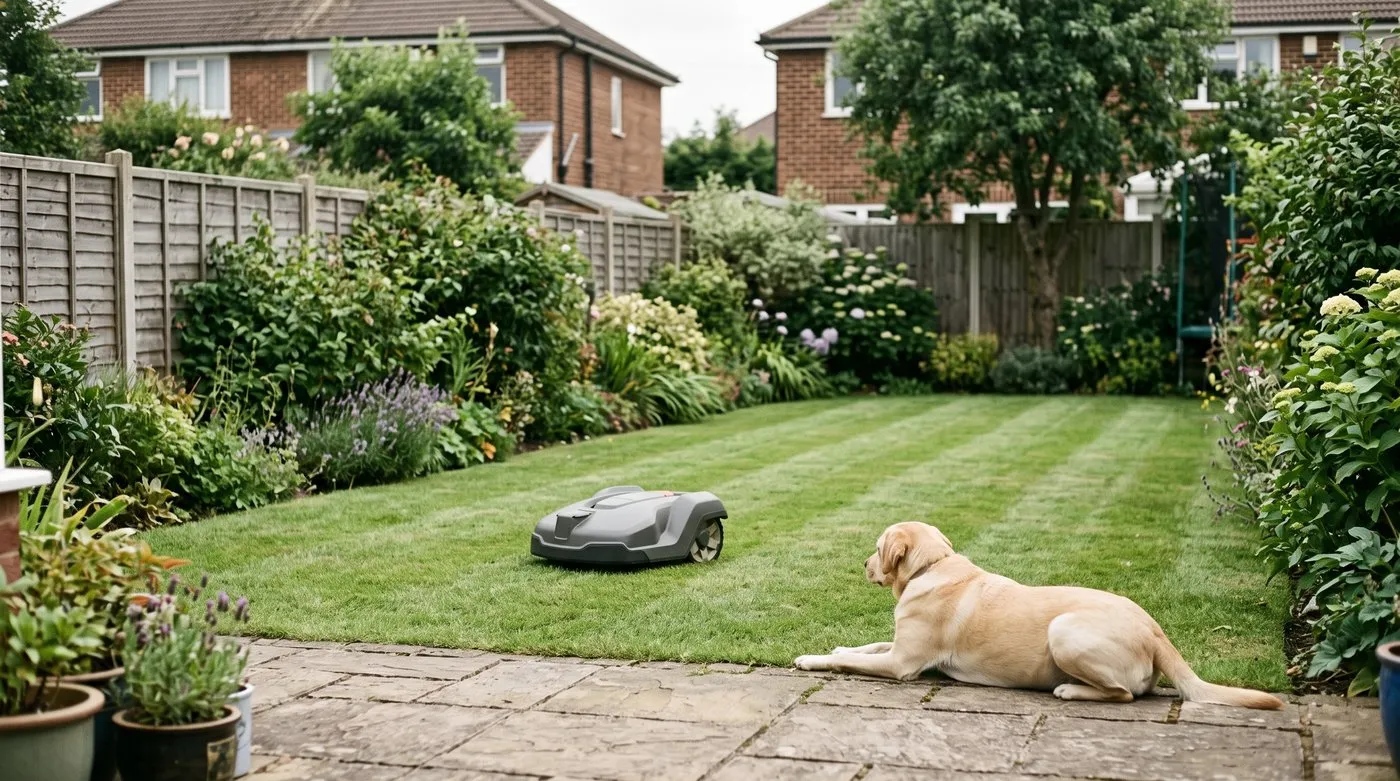
Set the mower to run in the middle of the day so hedgehogs are tucked up. Watch the first few sessions while pets get used to it.
Before your first season
-
Scarify and aerate in early spring. Our guide to scarifying and aerating explains how. Robot mowers struggle with thick thatch.
-
Feed the lawn after scarifying to help it bounce back from winter. Our lawn feeding guide covers when and what to use.
-
Fix bare patches first. Overseed them in spring and give the new grass a few weeks to get going before the mower starts.
-
Clear trip hazards such as low hose reels, flat stepping stones and low edging. The mower will keep bumping into them and waste battery.
-
Put the dock on level ground near an outdoor socket, out of the way of people walking past. Check the cable length that comes with your model.
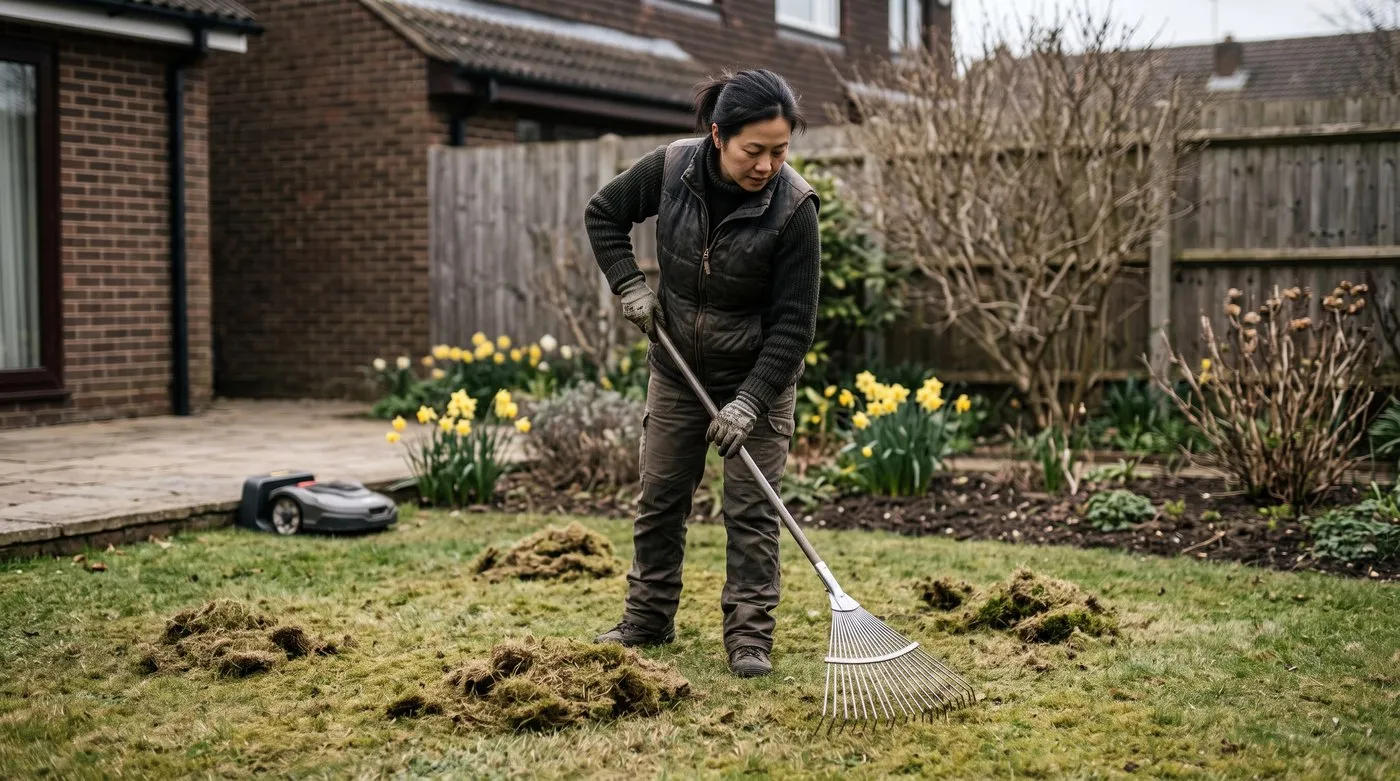
Robot mowers keep a good lawn looking good, but they won’t fix a tired one. Scarify, feed and patch it in spring before the mower takes over.
Frequently asked questions
Do robot mowers work on wet grass in the UK?
Yes, as long as you don’t cut too short. Set the height around 40mm so damp grass doesn’t clump under the deck or make the wheels slip. Set a rain delay so it waits a while after rain. Many models have a rain sensor that pauses mowing automatically.
Which robot mower is best for a sloped UK garden?
It depends how steep the slope is. Most wire-free mowers cope with gentle slopes. For steeper ground, look at all-wheel-drive models such as the Segway Navimow i2 AWD or the Worx 4WD, or Husqvarna’s bigger NERA models. Check the maximum slope on the box, and remember wet clay is harder than dry grass.
How much does a wire-free robot mower cost in the UK?
Prices vary a lot by lawn size and features. Entry-level wire-free models are the cheapest. Mid-range models cost more, and premium models with camera vision for big lawns cost a lot more. Allow a little extra for a cover or garage to keep the mower out of the weather.
Can a robot mower handle narrow passages between buildings?
Often, but check before you buy. Satellite models need a clear view of the sky, which can be blocked between houses or under trees. Models that add cameras or a vision system usually cope better in tight, shady spots.
Do I still need to mow edges with a robot mower?
Yes, usually. Most robot mowers leave a narrow strip along hard edges, though some models cut closer than others. A quick run round with a half-moon edger or battery strimmer every couple of weeks keeps it neat.
How long does a robot mower battery last in UK conditions?
Usually an hour or two per charge, depending on the model. Damp, thick grass uses more power, so expect a bit less than the box says. The mower heads back to its dock to recharge by itself, then carries on.
Is a robot mower worth it for a small UK garden?
It can be, if you value your weekends. You’ll save time every week, and the lawn often looks better because it’s cut little and often. On a very small, simple lawn, a push mower may still be the cheaper choice.
Our team produces practical UK gardening guidance from source research, contributor records and established horticultural practice. Editorial standards are overseen by Matt W.