Key takeaways
- About 30mm suits most UK family lawns, within a 25-40mm range
- Never take off more than a third of the leaf in one cut
- Fine fescue and bent lawns can go to 13-25mm, hard-wearing ryegrass lawns want 25-50mm
- Raise the blade in dry spells, in shade and as growth slows in autumn
- Measure the real cut with a ruler, as mower setting numbers vary by brand
Most UK lawns are happiest cut to about 30mm, somewhere between 25mm and 40mm. Cut lower than that and you start to scalp the grass, which is the quickest way to invite moss and weeds. Plenty of people mow too short, chasing a bowling-green look on grass that was never meant for it.
This guide is all about the height setting: how low to go for your type of grass, when to raise it, how to check what your mower is really doing and how to fix a lawn you’ve scalped. For how often to mow through the year, our lawn care calendar has the timings.
What height should most UK lawns be cut to?
Cut a typical UK family lawn to 25-40mm, with about 30mm as a good everyday height. That covers the usual mix of ryegrass, meadow grass and fescue sold as hard-wearing lawn seed.
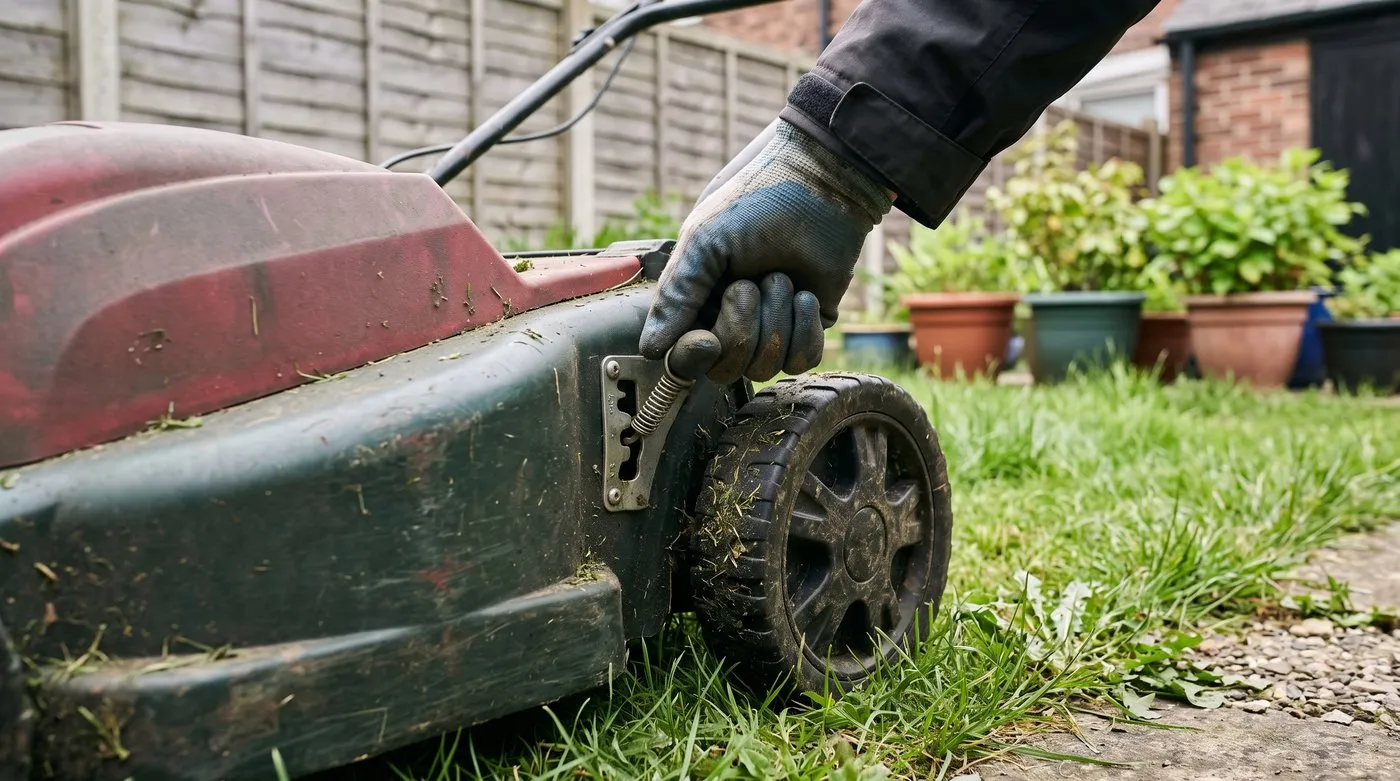
Most mowers change height with a lever or knob by the wheels. Always switch off first.
What matters is staying above the crown, the low growing point at the base of each grass plant. Cut above it and the grass regrows happily. Cut into it and the plant has to rebuild from its reserves, which is slow and leaves it weak.
Go for the higher end if the lawn gets heavy use from children and dogs, or if it sits in shade. The lower end suits a lawn in good condition, in a sunny spot, mown at least weekly.
The one-third rule for mowing height
Never take off more than one third of the leaf in a single cut. If the grass is 60mm tall, cut it no lower than 40mm that day. To get back down to 30mm, mow again a few days later.
Grass feeds its roots from its leaves. Take too much leaf at once and the roots shrink to match, so the lawn dries out faster and struggles. Two gentle cuts are always better than one hard one.
Gardener’s tip: Back from holiday to a meadow? Set the mower to its highest notch for the first cut. Lower it one notch each time you mow over the next week or two.
How your type of grass changes the right height
Different grasses want different heights. Most lawns are a mix, which is why 25-40mm is the safe all-round range.
Fine fescues and bents make the fine, ornamental lawns you see on bowling greens and formal gardens. Their leaves are thin, almost like green needles, and they cope with close mowing at 13-25mm. They need regular feeding, watering and mowing two or three times a week to look that good, and they don’t like being walked on much.
Perennial ryegrass and meadow grasses are the tough, hard-wearing grasses in most family seed mixes. Ryegrass has a wider, flatter leaf that is shiny underneath. It wants 25-50mm and thins out fast if cut too short, but it takes football and dogs in its stride.

Fine fescue (left) has narrow, needle-like leaves that cope with a close cut. Broader ryegrass (right) is happier kept a bit longer.
To check what you’ve got, pull up a few blades and look closely. Fine, rolled, needle-like leaves are fescue. Flat, broader leaves that are glossy underneath are usually ryegrass.
Mowing height by grass type and season
Grass grows fastest in late spring and early summer, so that’s when you can cut at your lowest height. Start high in early spring, raise the blade in dry weather and shade, and raise it again as growth slows in autumn.
| Lawn type | Early spring and late autumn | Late spring and summer (growing well) | Hot, dry spells |
|---|---|---|---|
| Fine fescue and bent lawn | 25mm | 13-25mm | 25-30mm |
| Mixed family lawn | 40mm | 25-35mm | 40-50mm |
| Hard-wearing ryegrass lawn | 40-50mm | 30-40mm | 45-50mm |
| Shady lawn (any mix) | 50mm | 40-50mm | 50mm |
Lower the height in steps rather than all at once. Our guide to the first lawn cut after winter covers that first, high trim in March. In winter, only top the grass if it’s still growing and the ground is firm and dry.
Why you should mow higher in dry weather
Raise the blade to 40-50mm in a hot, dry spell. It feels backwards, but cutting short in summer is one of the most common ways to turn a lawn brown.
Longer grass shades the soil and keeps the roots cooler, so the lawn holds on to its moisture. Short grass leaves the soil baking in the sun and the roots dry out. If a dry spell is forecast, raise the mower a notch before it starts, not once the lawn has turned straw-coloured.

A lawn cut short going into a dry spell browns off fast. Kept longer, it would stay green for much longer.
For timing your cuts in a heatwave, see should you cut grass in hot weather. Brown grass in a drought is usually dormant, not dead, and greens up again after rain.
How to mow a shady lawn
Keep shaded grass at 40-50mm all year. Grass under trees or beside a tall fence gets less light, so it needs more leaf to make its food.
Cut it short and it thins out within weeks, and moss soon fills the gaps. Mow shady areas less often too, as they grow more slowly. Fine fescues cope with shade better than ryegrass. Our guide to growing grass in shade explains which grasses to overseed with.
What scalping is and how to fix it
Scalping means cutting so low that you expose the stems, crowns or bare soil. It shows up as pale yellow or brown patches straight after mowing, usually on bumps and slopes where the mower dips closest to the ground.
A scalped lawn has lost the leaf it needs to feed itself, and the bare soil is open to moss and weed seeds. To help it recover:
- Raise the mower by a notch or two and leave the grass to grow
- Water in dry weather until it greens up
- Overseed any patches that stay bare once the grass is growing again

A scalped lawn (left) browns within days and leaves bare soil for weeds. Kept above the crown (right), the grass stays thick and green.
If the mower scalps the same humps every time, the fix is levelling, not raising the blade for the whole lawn. Our guide to levelling a bumpy lawn shows how to top dress the dips so the mower rides evenly.
How to check your mower’s real cutting height
Mower height numbers aren’t standard. One brand’s setting 3 might cut at 25mm and another’s at 40mm. Some mowers show the height in millimetres, others just use numbers.
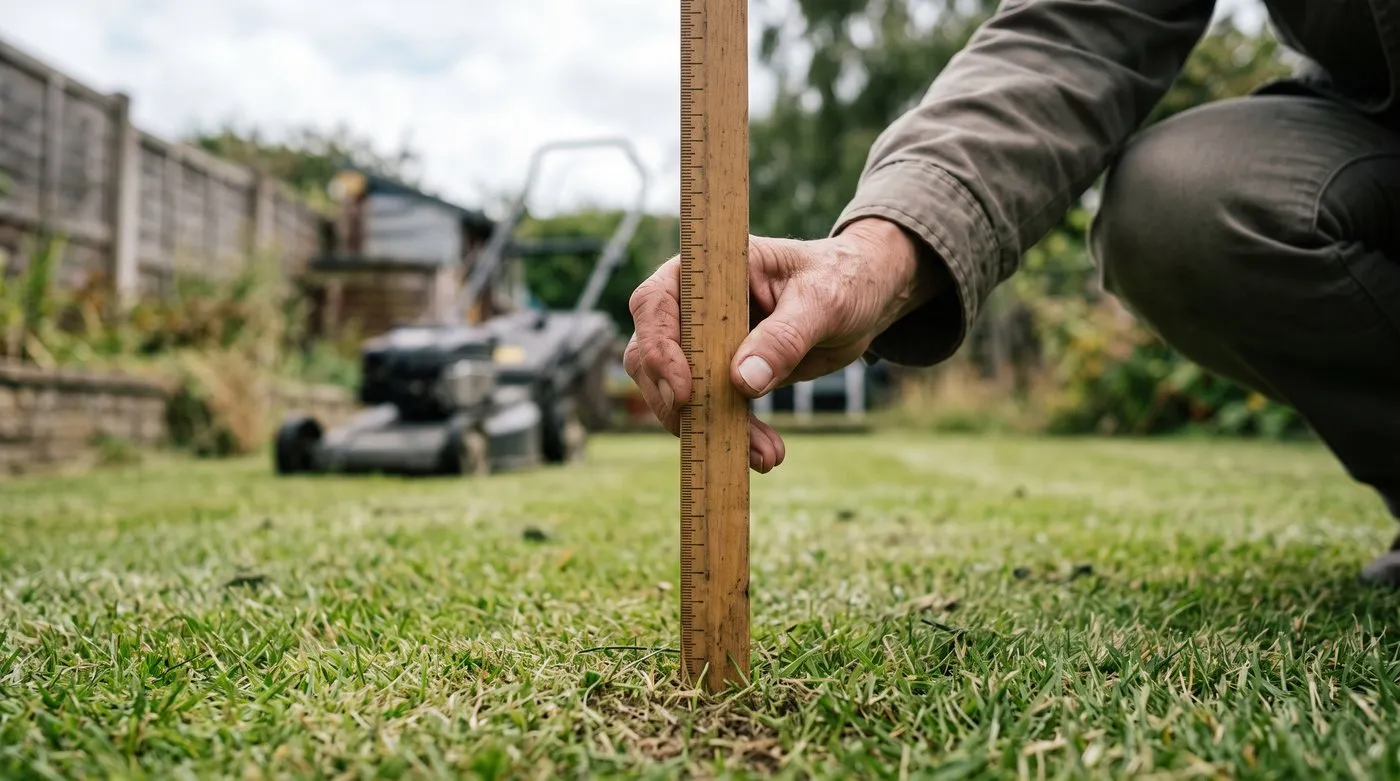
A ruler in the cut grass tells you what your mower setting really means.
The only way to know is to measure:
- Mow a test strip on firm, dry grass
- Stand a ruler upright in the cut grass, with the end resting on the soil
- Read off the height of the leaves, then adjust the setting until it matches what you want
- Note the right setting for each season, so you’re not guessing every week
Always switch the mower off, and unplug it or take the spark plug lead off, before you change the height. A sharp blade matters as much as the right height. A blunt one tears the grass, leaving brown, ragged tips. See when to sharpen a lawn mower blade for the signs to look for.
Common mowing height mistakes
Leaving the mower on its lowest notch. It’s tempting so you can mow less often, but it scalps the lawn and invites moss. Set it to about 30mm and mow a little more often instead.
Cutting short before a dry spell. This strips away the shade the lawn needs to cope. Raise the height before hot weather arrives.
Taking it all off after a holiday. Cutting long grass right down in one go shocks the lawn. Lower the height in stages over a week or two.
Mowing wet grass low. Wet grass folds over and tears, and the wheels sink and scalp. Wait for a dry day, or raise the height. Our guide on whether you can mow a wet lawn has the details.

A lawn kept at 30-40mm and mown regularly still looks smart. You don’t need to scalp it for a neat finish.
Frequently asked questions
What is the lowest you should mow a lawn?
About 25mm for a normal family lawn. Only fine fescue and bent ornamental lawns, which are fed, watered and mown very often, cope with 13-25mm. Go lower on an ordinary lawn and you scalp it, leaving bare patches for moss and weeds.
How low should you cut your grass in summer?
Keep it at about 30mm while it’s growing well, and raise it in dry weather. In a hot, dry spell lift the blade to 40-50mm. Longer grass shades the soil and holds on to moisture. Drop back down once rain returns and growth picks up.
What does the one-third rule mean for mowing?
Never cut off more than a third of the leaf in one go. If the grass is 60mm tall, cut it to no lower than 40mm. To get back to 30mm, mow again a few days later. Taking off more at once weakens the roots.
What height should I cut a new lawn?
Leave new grass until it is about 5-7cm tall, then just trim the top. Keep the blade high, around 40mm, for the first few months. Lower it gradually as the lawn thickens up. Make sure the blade is sharp so it cuts rather than pulls.
Should I mow lower in shade?
No, mow higher in shade, at about 40-50mm. Shaded grass gets less light, so it needs more leaf to keep going. Cutting it short thins it quickly and lets moss take over.
Does mowing height affect weeds and moss?
Yes, cutting too low is a common cause of moss and weeds. Scalped turf leaves bare soil where moss and weed seeds settle. A thick lawn kept at 25-40mm shades out many weed seedlings before they get going.
Now your mower is set to the right height, read our guide on when to mow your lawn to get the timing right, or browse more lawn care guides.
Our team produces practical UK gardening guidance from source research, contributor records and established horticultural practice. Editorial standards are overseen by Matt W.