Key takeaways
- About 20 kinds of bird visit most UK gardens regularly
- House sparrows, starlings and blue tits are among the most common
- Check size, colour, beak shape and song to work out what you're looking at
- Start with the head, as caps, cheeks and bibs give most birds away
- Sunflower hearts, fat balls, mealworms and water bring in the widest mix
- House sparrows and starlings have declined, so nest boxes really help them
Spotting birds from the kitchen window is one of the simple joys of having a garden. You don’t need to know hundreds of species. Around 20 make up most garden visits, as the RSPB Big Garden Birdwatch shows every January. Here’s how to tell them apart.
How to identify garden birds: the four field marks
Look for these four things and you’ll be able to name most garden birds.
Size. Is it sparrow-sized (about 14cm), blackbird-sized (about 25cm) or woodpigeon-sized (about 41cm)? That alone narrows it down fast.
Colour and pattern. Start with the head. A blue cap means blue tit. A black head with white cheeks means great tit. A red breast means robin.
Beak shape. A thin, pointed beak (robin, wren) is for insects. A short, thick beak (finches, sparrows) is for cracking seeds.
Song. A loud “teacher-teacher” is a great tit. A loud, fast trill from a tiny bird is a wren. A rich, lazy tune from a rooftop is a blackbird. Learn five or six songs and you’ll know who’s about even when you can’t see them.
The 20 most common UK garden birds
These are the birds you’re most likely to see, roughly in order of how often they turn up.
1. Robin
 Robin: look for the orange-red breast and face.
Size: 14cm.
Everyone’s favourite. Males and females both have the orange-red breast and face, brown back and pale belly. Young robins are speckled brown with no red. Robins guard their patch all year and sing in every month, even on winter nights under street lights.
Song: A sweet, slightly wistful warble. The alarm call is a sharp “tic-tic-tic”.
Food: Insects, worms, berries and mealworms. They’ll follow you round while you dig, hoping for a worm. They prefer ground trays or low tables to hanging feeders.
2. Blue tit
 Blue tit: bright blue cap, yellow belly, green back.
Size: 12cm.
A tiny acrobat with a blue cap, white face, yellow belly and green back. Blue tits happily hang upside down from feeders. They nest in small holes and love nest boxes. A pair needs huge numbers of caterpillars to feed their chicks.
Song: A high “tsee-tsee-tsee” followed by a trill.
Food: Insects, caterpillars, seeds and sunflower hearts. They’re whizzes on tube feeders and fat ball cages.
Tempt them in: Hang sunflower hearts in a tube feeder. Put up a nest box with a 25mm hole by February. Our seasonal feeding guide has month-by-month food tips.
3. House sparrow
 House sparrow: grey crown, chestnut neck, black bib, thick beak.
Size: 14-15cm. Status: Red List.
Males have a grey crown, chestnut neck, black bib and streaky brown back. Females are plain brown with a pale stripe above the eye. Sparrows live in noisy gangs and stay close to houses. Their cheerful chirping is a classic sound of British towns.
Song: Constant chirping, “cheep-cheep-cheep”. No real song.
Food: Seeds, grain and insects (especially for their chicks). They’re happy on ground feeders and tables.
Tempt them in: Fit a sparrow terrace nest box under the eaves. Sparrows like to nest near each other, so several holes together beat a single box. Leave seedheads standing in autumn and grow a thick hedge for them to roost in.
4. Blackbird
 Blackbird: males are jet black with a bright orange-yellow beak.
Size: 24-27cm.
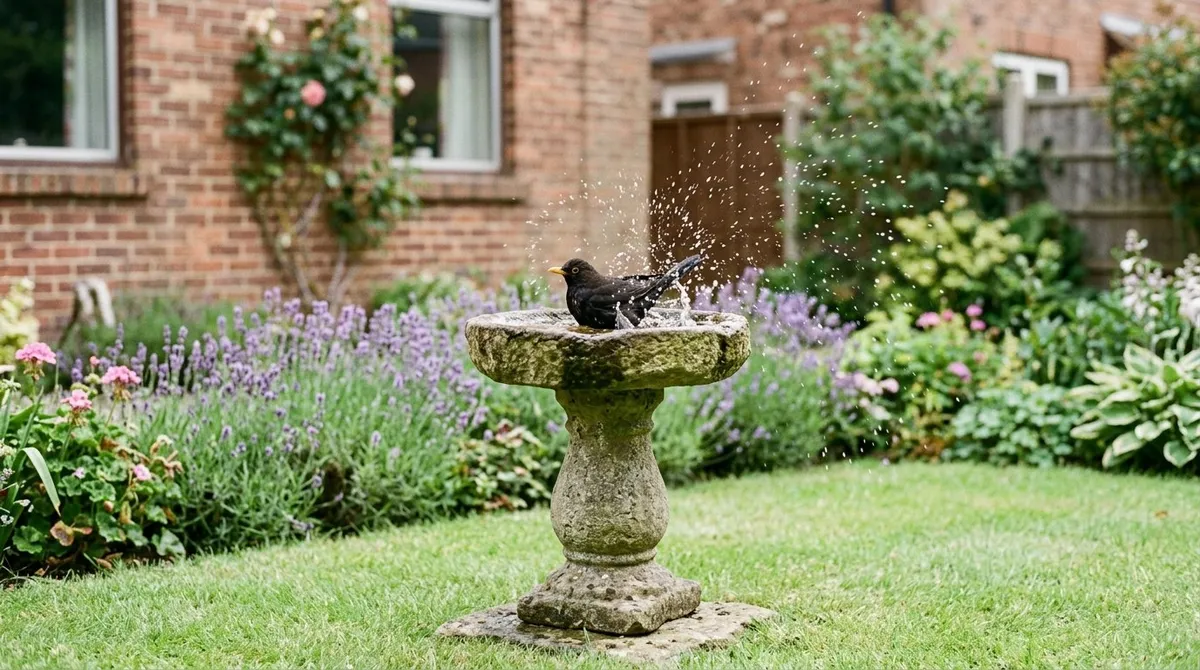
Males are easy: jet black, with a bright orange-yellow beak and eye ring. Females and youngsters are dark brown with a mottled breast. Blackbirds hop across the lawn, then stop and tilt their heads to listen for worms. Their evening song from a rooftop is one of the loveliest sounds in a British garden.
Song: A rich, mellow, made-up-as-it-goes tune. The alarm is a loud “chink-chink-chink”, often when a cat appears.
Food: Worms, insects, berries, windfall apples and raisins on the ground.
5. Woodpigeon
 Woodpigeon: big and grey, with a white neck patch and pinkish breast.
Size: 41cm.
The biggest common garden bird. Grey with a pinkish breast, a white patch on the neck (not on youngsters) and a white wing bar you can see when it flies. Woodpigeons waddle about the lawn and take off with a noisy clatter.
Song: A cooing “hoo-HROO-hoo, hoo-hoo”. Five notes, with the stress on the second.
Food: Seeds, grain, berries and, sadly, your cabbages. They hog ground feeders and bird tables.
Tempt them in (or not): They’ll find you anyway. If they bully smaller birds, use caged feeders that keep big birds out.
6. Starling
 Starling: shiny green and purple feathers with pale spots, yellow beak.
Size: 21cm. Status: Red List.
From a distance starlings look black. Up close they shimmer green and purple, with pale spots in winter. The beak is yellow in summer and dark in winter. Starlings walk rather than hop, and stand up straight. Their winter murmurations, with huge flocks swirling at dusk, are a real treat to see.
Song: A chattering, whistling jumble that copies other birds, car alarms and even phones. The flight call is a harsh “tcheer”.
Food: Insects (they probe lawns for leatherjackets), fruit, fat balls and scraps. They arrive at feeders in noisy, squabbling gangs.
Tempt them in: Put out fat balls and suet. Leave a patch of lawn longer. Put up a nest box with a 45mm hole.
7. Great tit
 Great tit: black head, white cheeks, yellow belly with a bold black stripe.
Size: 14cm.
Our biggest tit. Black head, white cheeks, a yellow belly with a thick black stripe down the middle (wider in males) and a green back. Great tits are bold and often the first to try out a new feeder.
Song: A loud, two-note “teacher-teacher-teacher”. Once you know it, you’ll hear it everywhere.
Food: Insects, seeds, sunflower hearts and peanuts.
Tempt them in: Sunflower hearts and peanuts in tube feeders. A nest box with a 28mm hole, a touch bigger than a blue tit box. They’ll repay you by eating caterpillars on your fruit trees.
8. Goldfinch
 Goldfinch: red face, white cheeks, black crown and gold wing bars.
Size: 12cm.
A real stunner, with a red face, white cheeks, black crown and wide gold wing bars that flash when it flies. Goldfinches travel in little flocks called “charms” and fly in a bouncy, dipping way.
Song: A tinkling, liquid twitter, often given in flight.
Food: Small seeds, especially nyjer, teasel, dandelion and thistle. Their fine beaks are perfect for pulling seeds from seedheads.
9. Long-tailed tit
 Long-tailed tit: a tiny round body with a very long tail.
Size: 14cm, more than half of it tail.
A fluffy little ball with a tail like a lollipop stick. Pink, black and white feathers. Long-tailed tits travel in chatty family groups, flitting through hedges and gardens together. They build beautiful domed nests from moss, lichen and spider silk.
Song: A thin, high “tsee-tsee-tsee”. The flock calls constantly to keep together.
Food: Insects, spiders and fat balls. They pop in to feeders more in winter.
Tempt them in: Fat balls and suet blocks. A thick, mixed native hedge gives them shelter and nesting spots.
10. Magpie
 Magpie: bold black and white, with a long, glossy green-blue tail.
Size: 44-46cm, including the tail.
Hard to mistake: smart black and white, with a long tail that shines green and blue in the sun.
Call: A harsh, rattling “chak-chak-chak-chak”.
Food: Almost anything. Insects, grain, scraps and sometimes eggs or chicks. They’ll use ground feeders and tables.
Tempt them in (or not): Magpies find most gardens on their own. To keep them off feeders, use caged feeders that keep big birds out.
11. Chaffinch
 Chaffinch: blue-grey crown, pinky-orange breast and white wing bars.
Size: 14.5cm.
Males are colourful, with a blue-grey crown, pinky-orange breast and face, chestnut back and white wing bars. Females are olive-brown with the same white wing bars. Chaffinches mostly feed on the ground, picking up seeds dropped from feeders above.
Song: A cheerful, tumbling song that ends with a flourish. The call is a sharp “pink-pink”.
Food: Seeds, and insects in summer. They feed under feeders rather than on them.
Tempt them in: Scatter seed on the ground or a low tray beneath your hanging feeders. Native trees and hedges give them nesting spots.
12. Wren
 Wren: a tiny brown bird with its tail cocked up.
Size: 9-10cm.
One of our smallest birds. Warm brown with darker bars on the wings and tail, which is nearly always cocked straight up. Wrens creep like mice through hedge bottoms, borders and log piles. For something so tiny, they’re amazingly loud.
Song: A loud, fast, rattling trill that fills the garden. The alarm is a sharp “tic”.
Food: Insects and spiders from cracks, bark and leaf litter. Wrens rarely use feeders.
Tempt them in: Leave log piles and twiggy corners alone. Let ivy grow on a wall or fence, and keep some thick planting low down. A bug hotel brings in the insects wrens feed on. In very cold winters, wrens sometimes huddle together in nest boxes to keep warm.
13. Dunnock
 Dunnock: thin pointed beak, grey head, streaky brown back.
Size: 14cm.
Often dismissed as “just a sparrow”, but look closer. The dunnock has a thin, insect-eating beak (sparrows have thick ones), a grey head and breast, and a streaky brown back. Dunnocks shuffle along under hedges, flicking their wings. Their love lives are famously complicated.
Song: A thin, quick warble from a low perch.
Food: Insects, worms and small seeds, picked up from the ground.
Tempt them in: Scatter small seed and mealworms under hedges and shrubs. Low, dense planting gives them the cover they like, and they nest in thick, thorny hedges.
14. Coal tit
 Coal tit: black cap, white cheeks and a white patch on the back of the neck.
Size: 11.5cm.
Like a small great tit, but with a white patch on the back of its neck. That’s the giveaway. It’s grey-buff underneath, with no yellow. Coal tits dash in, grab a seed and zoom off to hide it.
Song: A high, quick “pitchu-pitchu-pitchu”.
Food: Insects, seeds and sunflower hearts. They stash food in bark cracks for later.
Tempt them in: Sunflower hearts in a tube feeder close to a hedge or tree, as they like cover nearby.
15. Collared dove
 Collared dove: pale sandy-brown with a thin black half-collar.
Size: 32cm.
Pale, sandy-brown, with a thin black half-collar on the back of the neck and a pinkish breast. Collared doves only arrived in the UK in the 1950s and are now everywhere. You’ll often see them on aerials and wires.
Song: A “hoo-HOO-hoo”, repeated over and over. It has three notes, while a woodpigeon has five.
Food: Seeds and grain from ground feeders and bird tables.
Tempt them in: Scatter seed on the ground or a flat table. They nest in dense conifers and evergreens.
16. Jackdaw
 Jackdaw: a small crow with a silvery-grey neck and pale eye.
Size: 33-34cm.
A small, neat crow with a silvery-grey neck and a striking pale eye. Jackdaws are clever, sociable birds that pair for life. They nest in chimneys, church towers and tree holes.
Call: A sharp “tchack”. Groups chatter away together.
Food: Insects, grain, scraps and carrion. They visit tables and ground feeders.
Tempt them in: Jackdaws turn up if there’s a colony nearby. Put food on the ground or a sturdy table.
17. Song thrush
 Song thrush: creamy breast with neat, arrow-shaped spots.
Size: 21-23cm.
Brown back and a creamy breast covered in neat, arrow-shaped spots. Song thrushes are famous for smashing snails on a favourite stone. Find a stone surrounded by broken shells and you’ve got a song thrush in residence.
Song: Loud and musical, with each phrase repeated two to four times. “Did he do it, did he do it, YES he DID, YES he DID” is a handy way to remember it.
Food: Snails, slugs, worms, berries and fruit. A true gardener’s friend.
Tempt them in: Skip the slug pellets and let the thrushes do the job. Plant berrying shrubs, leave some leaf litter and keep a thick hedge for nesting. Our guide to composting for wildlife helps create the damp corners thrushes love.
18. Nuthatch
 Nuthatch: blue-grey back, orange underneath and a bold black eye stripe.
Size: 14cm.
Blue-grey on top, orange-buff underneath, with a black stripe through the eye like a bandit’s mask. It’s the only British bird that walks head-first down tree trunks. Nuthatches wedge nuts into bark and hammer them open. They even plaster mud round a nest box hole to make it the right size.
Call: A loud, ringing “tuit-tuit-tuit”.
Food: Insects, hazelnuts, acorns and sunflower hearts.
Tempt them in: Sunflower hearts and peanuts in tube feeders near big trees. You’ll need mature trees nearby. They’re found across England and Wales and are spreading into Scotland.
19. Jay
 Jay: pinky-brown body, black moustache and a blue-and-black wing patch.
Size: 34cm.
A colourful but shy member of the crow family. Pinky-brown body, black “moustache”, white rump that flashes in flight, and a gorgeous blue-and-black striped wing patch. Jays bury lots of acorns in autumn and forget some, which is how many new oak trees get planted.
Call: A harsh scream, “skaak”, that puts every bird on alert.
Food: Acorns, insects, seeds, eggs and chicks. They’ll take peanuts and sunflower hearts from the ground.
Tempt them in: Scatter peanuts on the ground. Jays are wary and prefer gardens with big trees nearby.
20. Green woodpecker
 Green woodpecker: green feathers, red crown and black face.
Size: 31-33cm.
The biggest and most colourful of the woodpeckers you might see in a garden. Green on top, pale yellow-green below, with a red crown and a black face (with red in the middle on males). It spends lots of time on the lawn, licking up ants with a very long tongue.
Call: A loud, laughing “yaffle”. They rarely drum.
Food: Mostly ants, plus beetles and other ground insects. They hardly ever use feeders.
Comparison table: all 20 garden birds at a glance
| Bird | Size | Look for | Uses feeders? |
|---|---|---|---|
| Robin | Small | Orange-red breast | Ground tray |
| Blue tit | Small | Blue cap, yellow belly | Tube, fat balls |
| House sparrow | Small | Grey crown, black bib (male) | Ground, table |
| Blackbird | Medium | Black with orange beak (male) | Ground |
| Woodpigeon | Large | Grey, white neck patch | Ground, table |
| Starling | Medium | Shiny, spotty, walks | Fat balls, ground |
| Great tit | Small | Black head, white cheeks | Tube, fat balls |
| Goldfinch | Small | Red face, gold wing bar | Nyjer feeder |
| Long-tailed tit | Small | Tiny body, long tail | Fat balls |
| Magpie | Large | Black and white, long tail | Ground, table |
| Chaffinch | Small | Pink breast, white wing bars | Ground |
| Wren | Tiny | Cocked tail | Rarely |
| Dunnock | Small | Grey head, thin beak | Ground |
| Coal tit | Small | White patch on neck | Tube |
| Collared dove | Medium | Black half-collar | Ground, table |
| Jackdaw | Medium | Grey neck, pale eye | Ground, table |
| Song thrush | Medium | Spotty breast | Rarely |
| Nuthatch | Small | Black eye stripe, walks down trees | Tube |
| Jay | Medium | Blue wing patch | Ground |
| Green woodpecker | Medium | Green with red crown | Rarely |
Which garden birds are in decline?
Some familiar garden birds have had a hard time, and your garden can really help.
House sparrows have lost many nesting spots as old buildings with gaps under the eaves are repaired or replaced. Paved-over gardens also mean fewer insects for their chicks. A sparrow terrace nest box and some insect-friendly plants make a real difference.
Starlings have fallen a lot too. They need the grubs that live in grassland and lawns. A lawn without pesticides, with a longer patch left uncut, helps feed them.
Song thrushes have also declined since the 1970s. Thick hedges give them nesting spots, and a garden without slug pellets is a safer place for a snail-eater.
How to set up your garden for bird identification
You don’t need fancy kit. A window, a feeder you can see from it and a simple bird chart will get you a long way.
Feeding station placement
Put feeders where you can see them easily from the house. Choose a spot with a bush or hedge nearby, so small birds can dash for cover, but not so close that a cat can hide there and pounce.
Best food for the widest range
| Food | Birds it brings | Feeder |
|---|---|---|
| Sunflower hearts | Tits, finches, sparrows, nuthatches | Tube feeder |
| Fat balls | Tits, starlings, woodpeckers, long-tailed tits | Wire cage |
| Mealworms | Robins, wrens, dunnocks, blackbirds | Ground tray |
| Nyjer seed | Goldfinches, siskins | Nyjer feeder |
| Mixed seed | Chaffinches, dunnocks, sparrows | Ground or table |
Water and shelter
A bird bath brings in birds that skip the feeders. Song thrushes, blackbirds and wrens all love a splash. Put it somewhere open, so birds can see trouble coming. A thick hedge of hawthorn, blackthorn or mixed natives gives shelter and nesting spots. Our wildlife pond guide shows how to add water that helps birds and frogs alike.
Recording what you see
Keep a notebook by the window: date, bird, how many and what it was doing. In a week you’ll know your regulars. In a month you’ll notice who comes and goes. If you enjoy it, join the BTO Garden BirdWatch, where your sightings help track how garden birds are doing.
Seasonal changes in garden bird visitors
Your garden visitors change through the year.
Spring (March to May): Nesting time. Blackbirds and song thrushes sing from high perches. Blue tits and great tits check out nest boxes, and sparrows carry nesting material into roofs. Summer visitors such as swallows, house martins and spotted flycatchers arrive.
Summer (June to August): Scruffy, slightly bewildered youngsters turn up at the feeders. Young robins are speckled brown with no red, and young goldfinches have no red face. Adults moult and go quiet. Swap loose fat for mealworms and seeds in hot weather.
Autumn (September to November): Berry season. Blackbirds and thrushes feast on cotoneaster, pyracantha and rowan. Jays bury acorns. Summer visitors leave and winter visitors arrive. Feeders get busier as wild food runs low. Our seasonal bird feeding guide has month-by-month tips.
Common identification mistakes
Even keen birdwatchers mix these up.
Dunnock or house sparrow? Both are small and brown. The dunnock has a thin, pointed beak and a grey head. The sparrow has a thick, stubby beak and, in males, a grey crown with chestnut sides.
Collared dove or woodpigeon? Count the notes. A collared dove coos three (“hoo-HOO-hoo”). A woodpigeon coos five (“hoo-HROO-hoo, hoo-hoo”).
Blue tit or great tit? Blue tits are smaller with a blue cap. Great tits have a black head, white cheeks and a bold black belly stripe.
Song thrush or mistle thrush? Song thrushes are smaller, with neat arrow-shaped spots. Mistle thrushes are bigger, paler and stand more upright. Song thrushes repeat each phrase two to four times, while mistle thrushes sing wilder phrases, often in wind and rain.
Starling or blackbird? Both look dark from afar. Starlings are smaller, walk with a purposeful strut and have short tails. Blackbirds hop, and males have a bright orange beak you can spot across the garden.
Teaching children to identify garden birds
Birdwatching is a brilliant nature activity for children, and the garden is the easiest classroom there is. The RSPB also runs a Big Schools’ Birdwatch for primary schools.
Start with five easy ones: robin (red breast), magpie (black and white), woodpigeon (big and grey), blue tit (blue cap) and blackbird (orange beak). Even little ones can learn these in a week.
Citizen science: how your records help conservation
Every bird you count can help.
RSPB Big Garden Birdwatch takes place in late January. You spend one hour counting the most of each bird you see in your garden at one time. Huge numbers of people join in, and the results show how garden birds are faring over the years. In 2026, 650,279 people counted 9.4 million birds. Our UK gardening statistics page has the latest results.
BTO Garden BirdWatch runs all year. You note which birds visit each week, which helps show seasonal and regional changes.
So your kitchen-window counting really does matter. It helps experts see which birds need a hand.
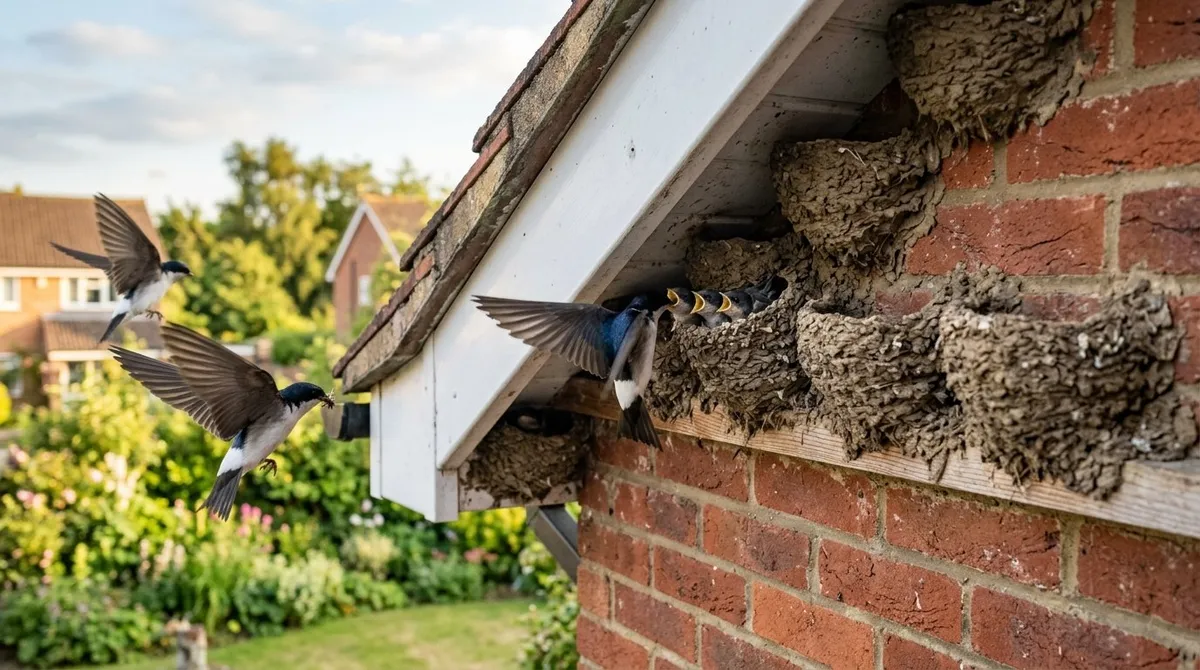
Related reading: for the blue-black birds that nest under the eaves, read how to attract house martins.
Frequently asked questions
What is the most common garden bird in the UK?
The house sparrow tops the RSPB’s garden bird count. Despite that, it’s on the Red List because numbers have fallen a lot since the 1970s. House sparrows live in chatty groups and like to nest in holes and gaps in buildings.
How do I tell a blue tit from a great tit?
Blue tits are smaller and have a blue cap. Great tits have a black head, white cheeks and a bold black stripe down their yellow belly. Great tits sing a loud ‘teacher-teacher’. Blue tits make a high, trilling call.
Why are house sparrows declining in the UK?
Mainly fewer places to nest and less food for their chicks. Modern buildings have fewer gaps under the eaves, and tidy, paved gardens mean fewer insects. You can help by putting up a sparrow terrace nest box and leaving seedheads standing in autumn.
What bird has a red breast in UK gardens?
That’s the robin. Males and females both have the orange-red breast and face. Young robins are speckled brown with no red at all. Robins sing all year round, even on winter nights under street lights.
How do I attract more bird species to my garden?
Offer a mix of foods at different heights. Sunflower hearts in a tube feeder bring tits and finches. Mealworms on the ground suit robins and dunnocks. Fat balls attract starlings and woodpeckers, and a nyjer feeder draws goldfinches. Add a bird bath and some dense hedging for shelter.
What garden bird has a gold wing bar?
The goldfinch. It also has a red face, white cheeks and a pale beak. Goldfinches travel in little flocks called charms. They love nyjer seed, and the seedheads of teasels, dandelions and thistles.
When is the best time to watch garden birds?
Early morning is best. Birds are busiest at the feeders in the first couple of hours after dawn, especially on winter mornings when they need to refuel. The RSPB Big Garden Birdwatch in late January asks you to count birds for just one hour.
Our team produces practical UK gardening guidance from source research, contributor records and established horticultural practice. Editorial standards are overseen by Matt W.