Key takeaways
- Plan four zones: prep, cook, serve and wash
- A roof or pergola turns a summer-only kitchen into one you'll use most of the year
- Fixed gas must be fitted by a Gas Safe registered engineer, never DIY
- Run gas, power and water before the patio goes down, as adding them later costs far more
- Porcelain worktops shrug off frost and stains with no sealing
- Induction hobs need their own dedicated circuit from a registered electrician
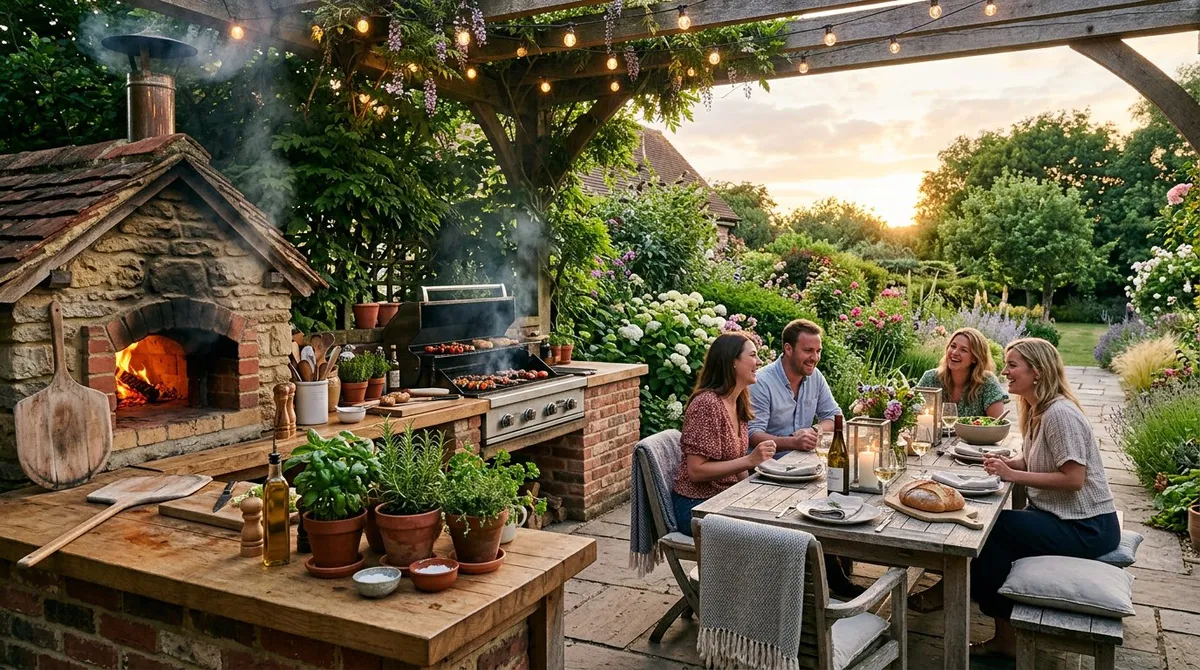
A UK outdoor kitchen has to cope with British weather all year, not just a few sunny weekends. Rain, frost and wind set the rules. The kitchens that last are planned around the weather first and the fun second.
Here’s how to plan one that works: the layout, the gas, power and water, the materials and the roof. For looks and inspiration, our sister guide to outdoor kitchen and BBQ area ideas covers the pretty side.
Why the design-first approach matters in UK gardens
Plan first, buy later. It’s tempting to buy a barbecue, put it on the patio and call it an outdoor kitchen. That works for a summer. A couple of winters later the barbecue is rusty, the cupboard doors have warped and it’s off to the tip.
A planned kitchen works the other way round. Choose the cooking appliances first, because the fuel decides what pipes and cables you need. Lay those before the patio goes down, as adding them to finished paving costs far more. Build the roof at the same time, because cooking in the rain is no fun. And choose materials that will last, so you’re not replacing everything every few years.
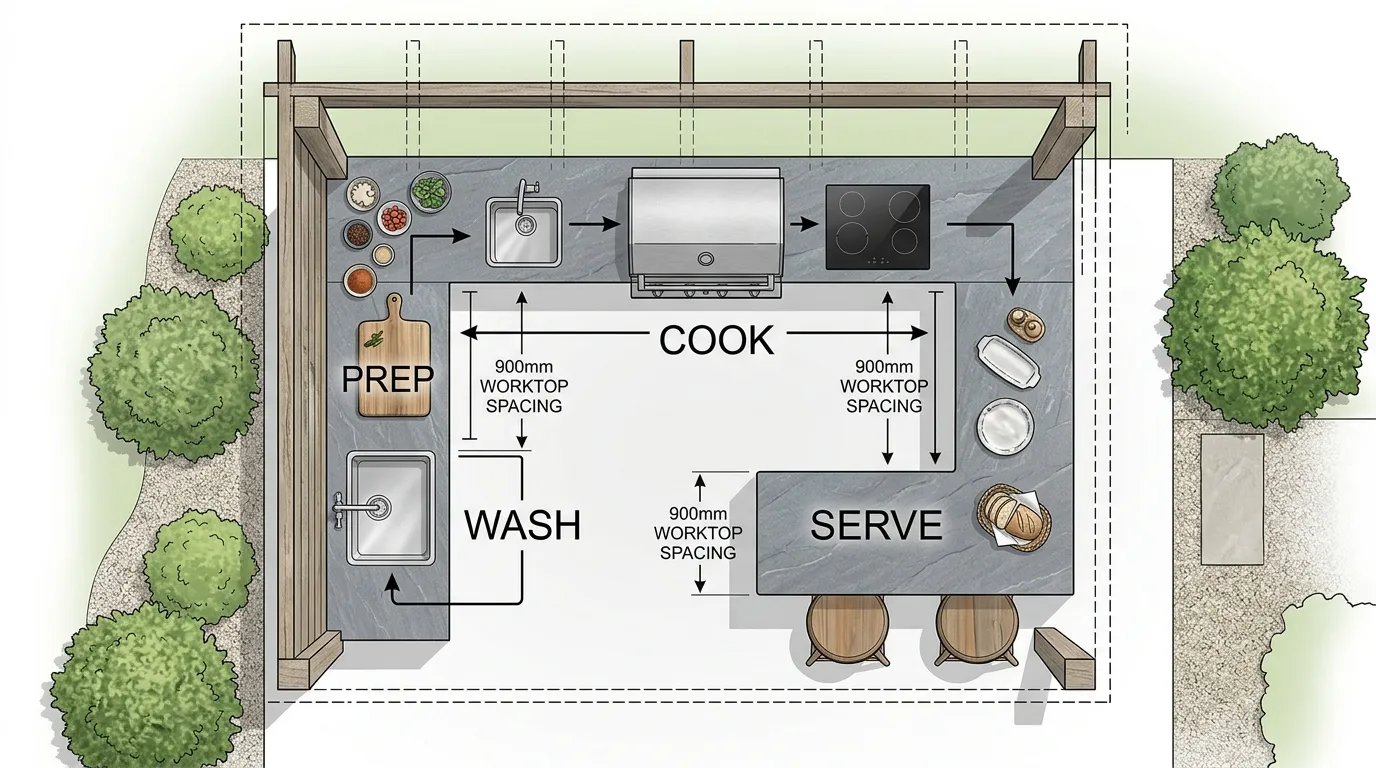
The four zones every UK outdoor kitchen needs
Zone 1: Prep
This is where you chop, marinate and get things ready. Give it a good run of clear worktop, about 90cm, and ideally a small sink.
You can skip the sink and use the indoor kitchen if the outdoor one is just outside the back door. Any further away and the trips back and forth soon get tiresome.
Zone 2: Cook
The cook zone holds the grill, hob, pizza oven or smoker. It needs the most thought, because the fuel you choose affects everything else.
Gas (mains or bottled): A built-in mains gas grill needs a pipe run from the meter, fitted by a Gas Safe registered engineer. Bottled gas is simpler. A big bottle in a ventilated cupboard keeps most grills going for a good while, but you’ll need to buy refills and find somewhere to store them.
Electric and induction: Induction is a great UK choice. It needs its own dedicated circuit from your fuse box, run in outdoor-grade armoured cable to a weatherproof connection. It costs more than a normal socket, so do it at the build stage.
Charcoal and wood: Ceramic kamado-style grills hold their heat in wind and rain much better than open kettle barbecues. If you want charcoal flavour most of the year, a kamado is the one to go for.
Zone 3: Serve
Somewhere to set out plates and dishes. It needs a stretch of worktop, about 60cm, and at least one weatherproof cupboard for boards, bowls and cutlery.
Zone 4: Wash
A small sink with a cold supply and a proper waste connection. A hot tap is nice but not essential, and running hot water outside costs a lot.
Drainage is the bit people most often skip. The waste pipe needs a steady slope down to a drain. Get it wrong and the sink backs up. A plumber will make sure it goes to the right drain.
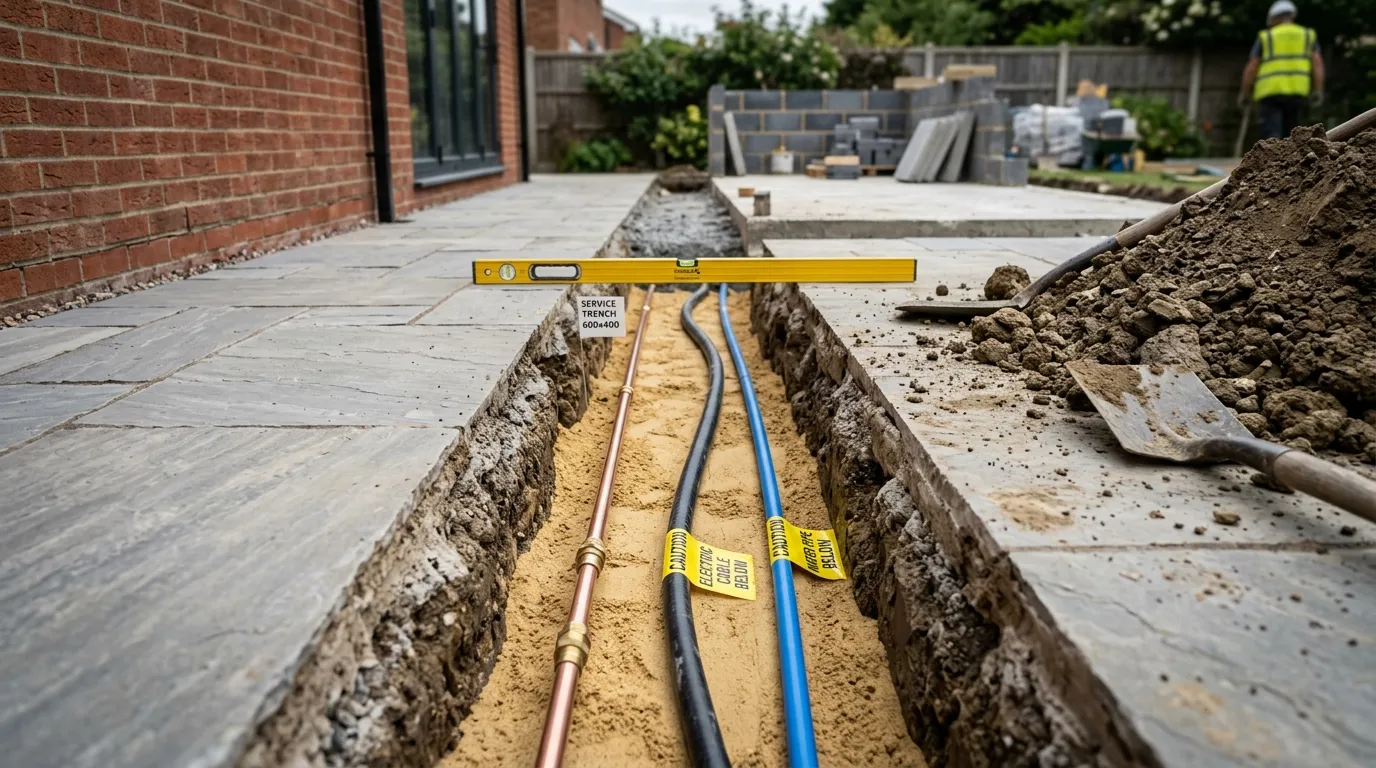
Services planning, the hidden cost that breaks budgets
Get the pipes and cables in before anything else. Adding them to a finished kitchen means digging up the patio, which costs far more.
Gas
Fixed gas is a job for a Gas Safe registered engineer, every time. They’ll run a pipe from the meter, usually buried in a trench with marker tape above it, and fit a shut-off valve inside the kitchen cupboard. Then they’ll test every joint and give you a certificate.
Don’t use anyone who isn’t on the Gas Safe Register. A gas leak is a real danger, and dodgy work can affect your home insurance.
Electrics
Most outdoor kitchens need two circuits:
- A dedicated high-power circuit for an induction hob, electric pizza oven or electric grill.
- A standard circuit for sockets, lights, a fridge and music.
Both should be run in armoured outdoor cable and fitted by a registered electrician, who will certify the work. They’ll fit weatherproof sockets and a small outdoor fuse board with safety cut-outs.
Water and waste
A cold water pipe runs underground from the house, buried deep enough to stay frost-free. It finishes at a shut-off valve and tap inside the sink cupboard.
The waste pipe slopes back to a household drain. If there’s no drain nearby, a soakaway may be an option, but check with your local Building Control first. A plumber can sort out which is right for you.
Materials choices that survive UK weather
Cabinetry
The cupboards take the most weather. Four good options for UK gardens:
| Material | Lasts | Weak spot |
|---|---|---|
| Marine plywood, painted | Fairly well | Needs repainting every few years |
| Powder-coated aluminium | Well | Chips can rust near the sea |
| Stainless steel, grade 304 | Well inland | Brown staining near the coast |
| Stainless steel, grade 316 | The longest | Pricier, but the one to pick by the sea |
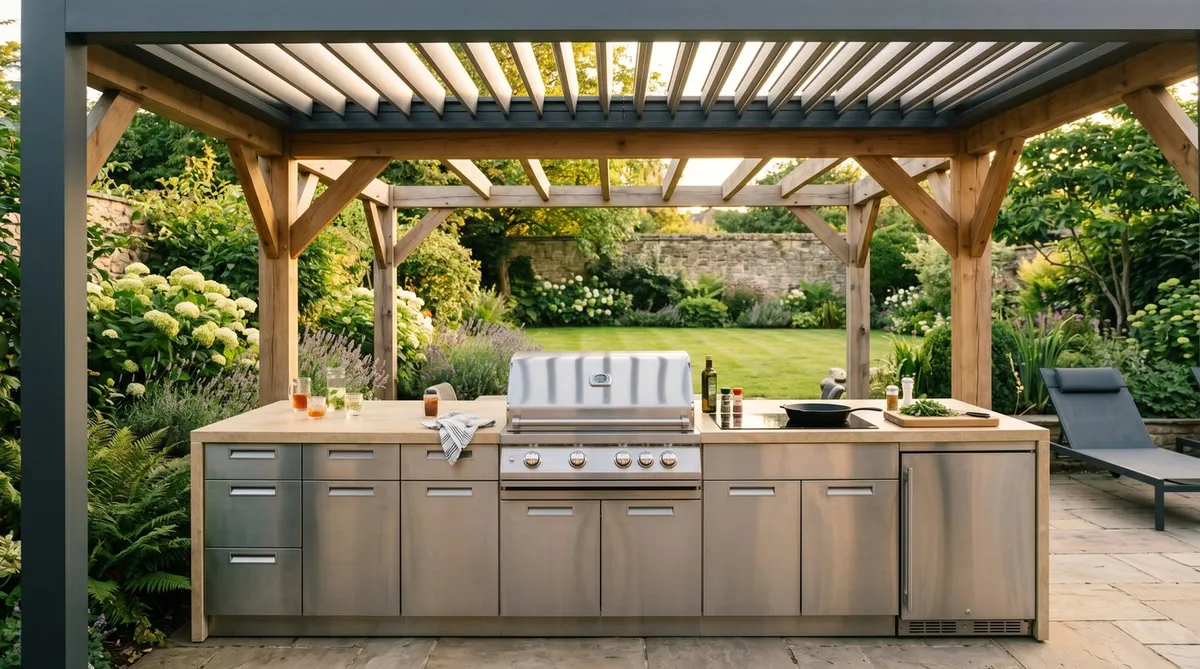
Inland, grade 304 stainless or powder-coated aluminium are both good choices. Near the coast, go for grade 316 stainless, as salty air marks cheaper steel. Avoid timber cupboards unless the kitchen is fully covered, and even then they need yearly care.
Worktops
The worktop puts up with hot pans, knives, marinades and weather. Your main choices:
- Porcelain: the top pick for outdoors. Frost-proof, stain-proof and won’t fade in the sun. No sealing needed. It’s heavy, so it needs a sturdy frame underneath.
- Granite: nearly as good, but heavier still.
- Concrete: looks great but can crack in hard frosts and needs sealing every year. Best kept under a roof.
- Engineered quartz: made for indoors. Sunlight can discolour it, so avoid it outside.
Roof or pergola
A roof is a must for cooking through a British year. Four common choices:
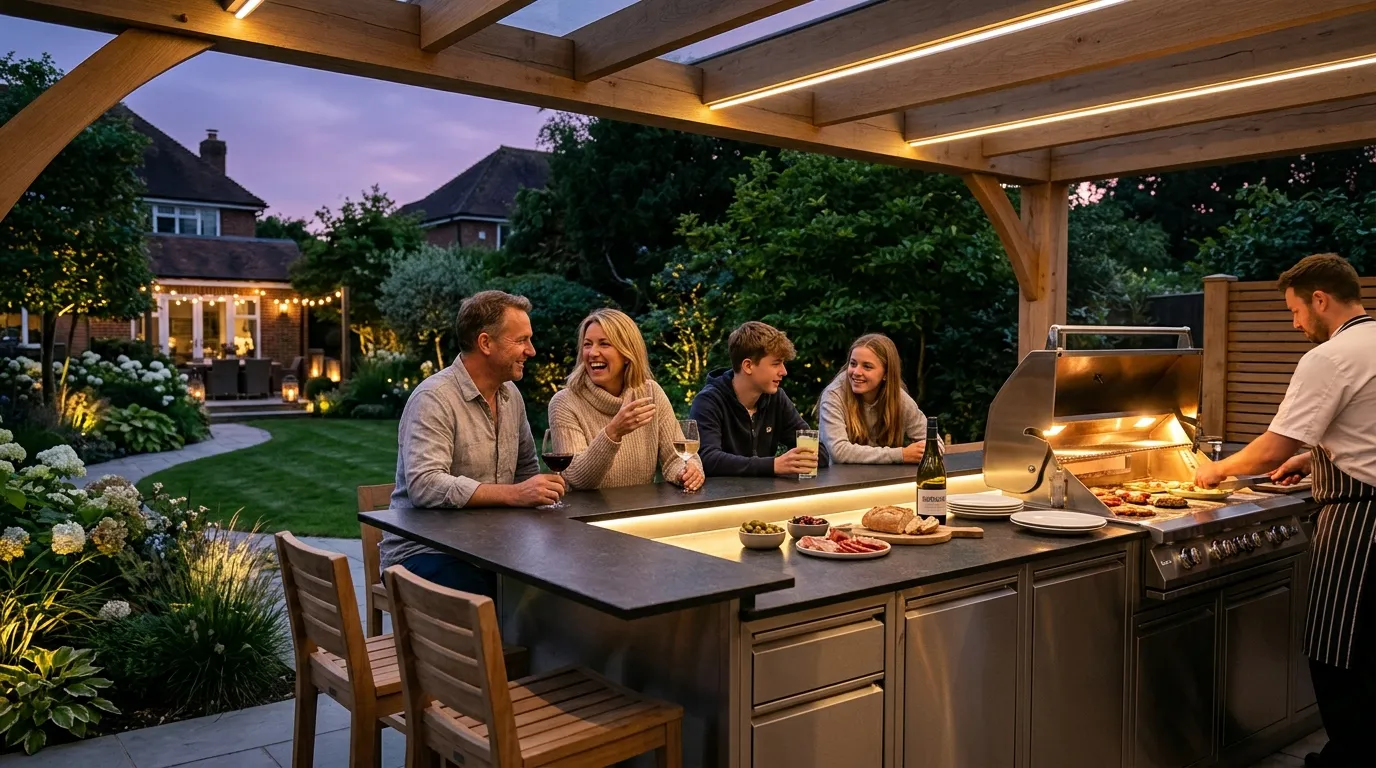
- Pergola with a louvred roof: the luxury option. The slats open in sunshine and close in rain, often with built-in lights and heaters.
- Pergola with a clear polycarbonate roof: a good middle option. Lets light through, keeps rain off, nothing to go wrong.
- Timber pergola with a solid roof: warm and cosy looking, but you lose the view of the sky.
- Lean-to or verandah on the house: uses the house wall as one side. Often the cheapest cover for a kitchen close to the back door.
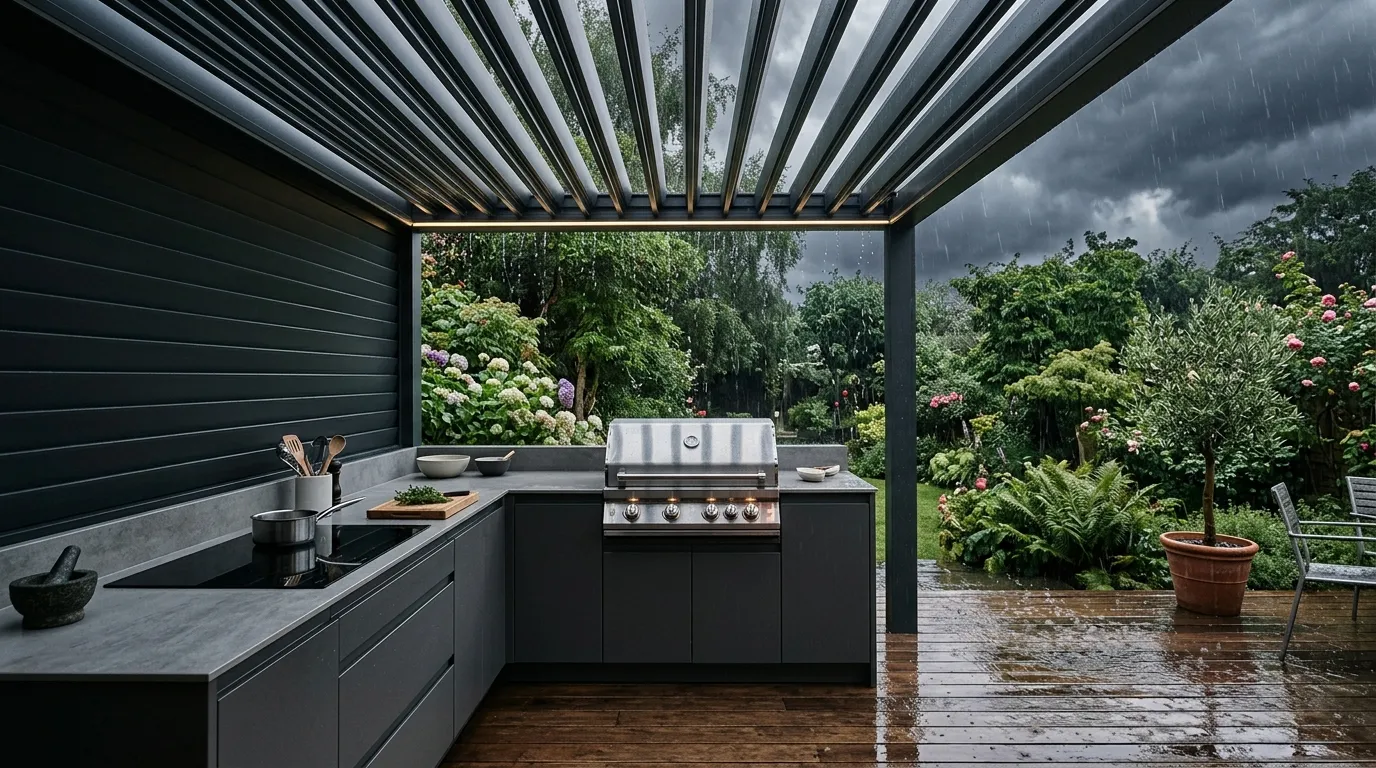
Induction vs charcoal vs gas, what to actually buy
Your fuel choice makes the biggest difference to how often you’ll cook outside.
- Induction: quick and easy, even on a wet evening. Great for families and weekday meals.
- Charcoal: the best flavour, but lighting it and clearing the ash makes it more of a weekend thing.
- Gas: quick to light and easy to use, a happy middle ground.
- Induction plus a kamado: the best of both, with speed on weeknights and smoky flavour at weekends.
An open kettle barbecue is fine for summer, but as your main cooker it struggles in wind and rain.
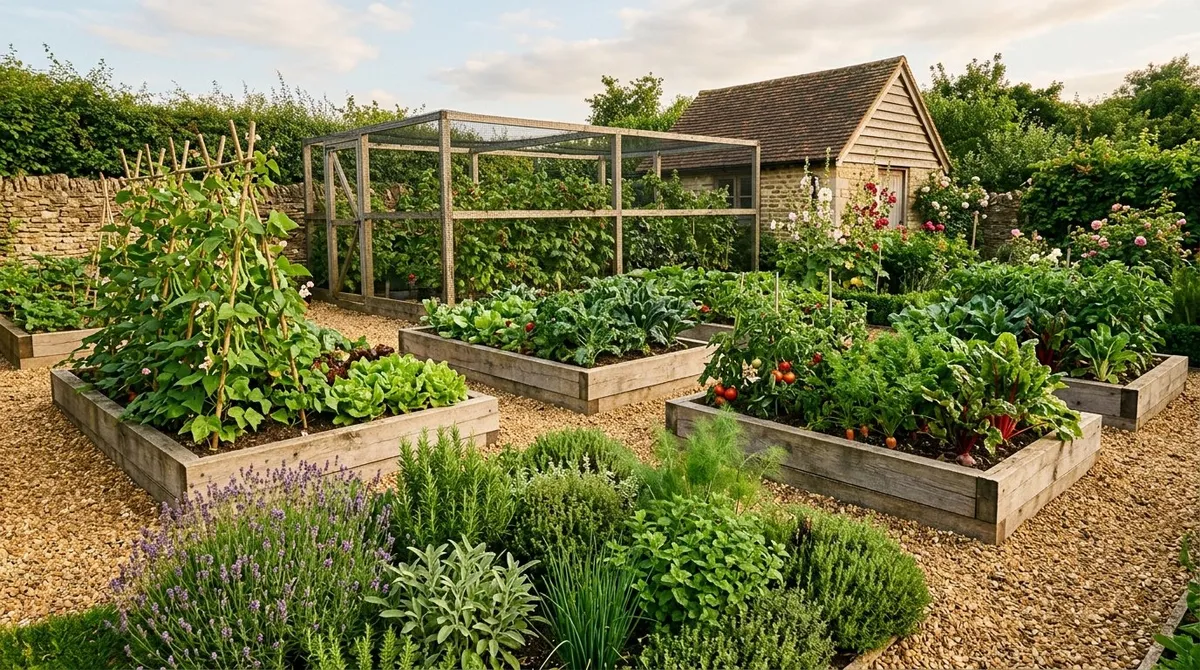
If you’re planning a kitchen garden, put the herb bed close to the cook zone, so you can grab a handful of basil or thyme without leaving the grill.
Lighting, heating and weather protection
Light it like an indoor kitchen, with bright light for cooking, soft light for eating and a little extra for show.
Task lighting: Bright, cool-white LED strips under shelves or in the pergola, aimed at the worktop.
Ambient lighting: Warm-white dimmable lights in the pergola roof or under the eaves to set the mood.
Accent lighting: Uplights into nearby trees and spotlights on planting. Our garden lighting ideas for outdoor spaces covers all of this.
For warmth, infrared electric heaters in the pergola roof work well. They need no fuel, come on instantly and warm the people rather than the air.
A windbreak or side panel makes a big difference on a breezy autumn evening. Plan it in from the start.
Build sequence, what happens when
A simple setup takes a few weeks. A full build can take a few months.
| Stage | What happens |
|---|---|
| Week 1 | Design, choose materials, check planning |
| Week 2 | Dig the trench, lay gas, power, water and waste |
| Week 3 | Pour the base and footings for the pergola and kitchen |
| Week 4 | Put up the pergola or roof |
| Weeks 5-6 | Fit the cupboards and doors, measure for the worktop |
| Week 7 | Fit the worktop, sink and tap, connect the plumbing |
| Week 8 | Fit the appliances, connect the gas, get certificates |
| Weeks 9-12 | Finish any paving and sort out final snags |
Builds most often get held up waiting for the engineer or the worktop, which can take a few weeks to make. Book your gas engineer and electrician well ahead.
For the patio surface under the kitchen, porcelain or natural stone laid on a full mortar bed, sloping gently away from the house, works well. Avoid block paving under the cooker, as grease gets into the joints.
Storage and accessory specification
The little extras add up, so budget for them.
- Fridge: choose one made for outdoors. Indoor fridges don’t last outside.
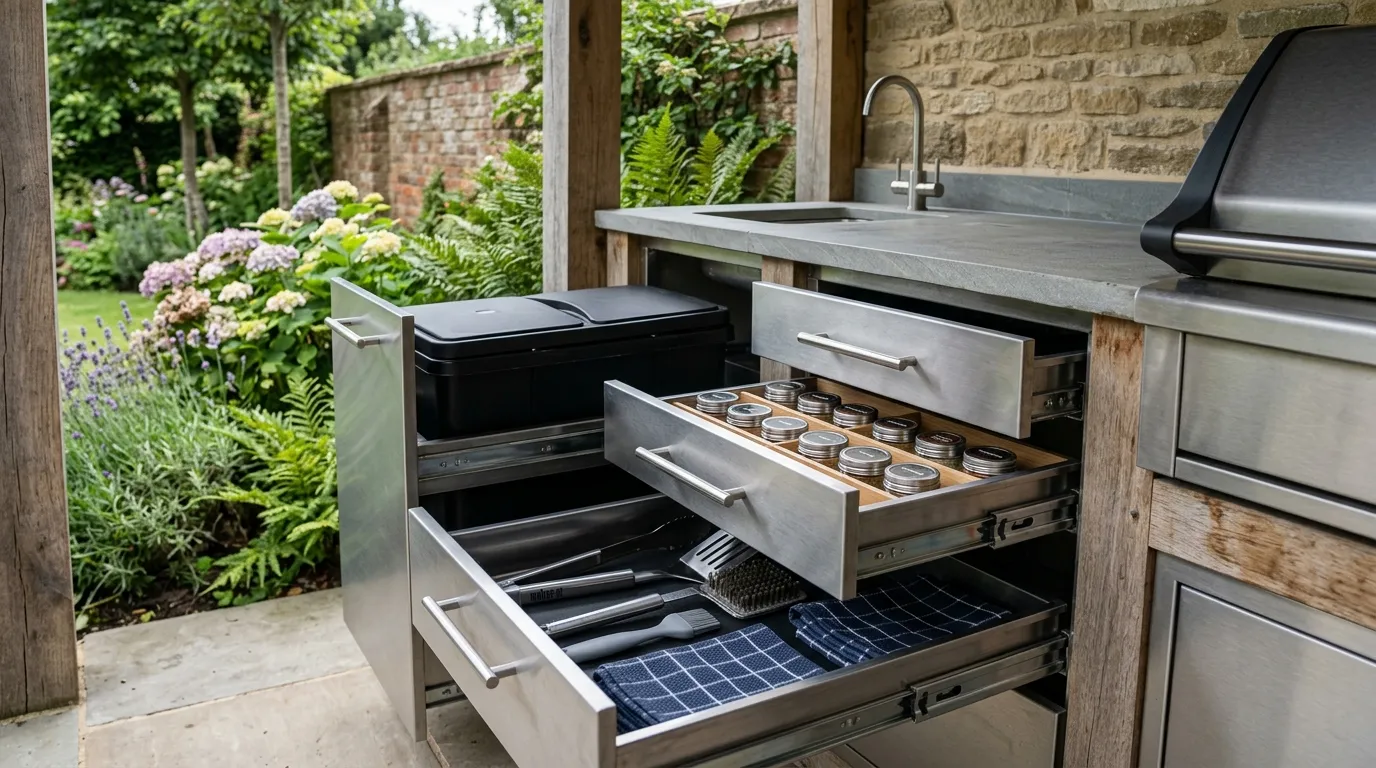
- Cupboards and drawers: weatherproof drawers for boards, tongs, gloves, lighters and kitchen roll.
- Bin: a pull-out bin in its own cupboard stops foxes and birds spreading rubbish overnight.
- Charcoal and wood store: dry and airy, if you cook with charcoal.
- Spice jars: sealed jars with waterproof labels, as damp soon ruins paper ones.
Common mistakes to avoid
- No roof. It looks great in May, but by October it hasn’t been used for weeks.
- The wrong power supply. A normal socket where an induction hob needs its own circuit. Fixing it later means redoing the cabling.
- No slope on the waste pipe. The sink backs up the first time oily water goes down it.
- Cheap stainless steel. Low-grade steel stains quickly and looks tired within a few years.
- Forgetting the services budget. The trenching, plumbing, electrics and certificates can add a big chunk on top of the kitchen itself.
The fix for all five is the same: plan first, spend on the bits you can’t see, and only then choose the finishes.
Integrating the kitchen with the wider garden
An outdoor kitchen looks best as part of the garden, not stranded on a square of paving. Three ideas that help:
- Give the cook a view. Face the cook zone towards a tree, water feature or flower bed rather than a fence. Cooking is sociable, and the view matters.
- Put the seating close by. A pergola with shade and planting over the dining table makes the whole space more inviting.
- Plant right up to the hard surfaces. A bed of herbs, evergreens and ground cover next to the kitchen softens all that steel and stone.
In a bigger garden, make the kitchen the heart of an outdoor living area: a garden room for evenings, a raised deck linking the kitchen to the lawn, and a fire pit area beyond. The kitchen doesn’t have to do everything.
Frequently asked questions
Do I need planning permission for an outdoor kitchen in the UK?
Usually not, as most fall under permitted development. A roofed structure counts towards the rule of covering no more than half the land around the house. Within 2m of a boundary, it must stay under 2.5m high. Listed buildings, conservation areas and structures attached to the house may need consent. Check with your local council if unsure.
How much does a UK outdoor kitchen cost in 2026?
It depends on size, materials and services. A freestanding barbecue station on an existing patio is the cheapest. Built-in units with gas, electrics and water cost much more. A roof, fridge or sink adds more again. Get a few written quotes, and budget separately for groundwork and qualified trades.
What is the best worktop material for a UK outdoor kitchen?
Porcelain is one of the best choices. It copes with frost, resists stains and keeps its colour in the sun. Granite is tough too, but heavier. Engineered quartz isn’t made for outdoors, as sunlight can discolour it. Concrete needs sealing to resist stains and frost.
Can I install a gas BBQ on my own?
A portable bottled-gas barbecue, yes. Set it up following the maker’s instructions. Built-in grills, hobs or pizza ovens running on mains gas or a fixed LPG supply are different. They should be fitted by a Gas Safe registered engineer to keep everyone safe and within the rules.
Is induction better than charcoal for an outdoor kitchen?
For everyday cooking, yes. Induction heats quickly, needs no fuel and has no open flame. It must be rated for outdoor use, kept under cover and wired in properly. Charcoal still wins for smoky flavour, so lots of outdoor kitchens have both.
More outdoor kitchen guides
For the fun, inspiring side, see outdoor kitchen and BBQ area ideas, and our garden room ideas for a covered space to enjoy in the evening. For the patio itself, see how to lay a patio. For cover, see pergola ideas and decking ideas. And garden lighting ideas for outdoor spaces takes care of the after-dark details.
Our team produces practical UK gardening guidance from source research, contributor records and established horticultural practice. Editorial standards are overseen by Matt W.