
Key takeaways
- Choose a sunny, sheltered spot, ideally south-facing, close to a tap
- Keep beds no wider than 1.2m so you never have to step on them
- Make paths at least 60cm wide, and 90cm where you need a wheelbarrow
- A 6x4m plot gives a family salads, courgettes, beans and herbs all summer
- Rotate crop groups round four beds to stop problems building up
- Start with quick, easy crops like salads, radishes and herbs
A good kitchen garden starts with a good layout. Put it in the right spot, make the beds easy to reach and the paths wide enough to use, and growing your own becomes a pleasure. Get those basics wrong and it’ll frustrate you every time you step outside. Here’s how to plan it.
How to choose the right site for a kitchen garden
The site is the one thing you can’t easily change later. Beds, paths and crops can all be swapped around, but a bad spot means starting again.
Go for sun. Veg need 6-8 hours of direct sun a day in the growing season. South-facing is best. East or west-facing still works, with a bit less sun. A shady, north-facing plot is harder, but leafy crops and some fruit can still do well.
Find shelter. Wind batters beans and tomatoes and dries beds out fast. A solid wall or fence can make the wind swirl just behind it, so a hedge or slatted fence that filters the wind is better. Leave at least 1m between a tall structure and your nearest bed to avoid shade.
Keep it level if you can. On a slope, water runs off before it soaks in. On a gentle slope, run beds across it. On steeper ground, terraced raised beds are the answer, though they cost more.
Stay close to water. You’ll be watering a lot from June to August. Aim to have a tap within about 20m. Any further and dragging the hose about soon gets old.
What size kitchen garden do you need?
It depends on how many people you’re feeding and what you want to grow. Starting too big is a classic mistake. A small, well-kept plot gives you more than a big, weedy one.
3x3m: the starter plot. Room for four small beds of about 1m x 1.5m with 60cm paths. It’ll keep one or two people in salad leaves, herbs, radishes, spring onions and a few courgettes from spring to the first frost. It’s a great way to find out if you love growing food before taking on more.
6x4m: the family plot. The most practical size for a family of four. You get four beds of 1.2m x 2.4m, a main path of about 90cm and room for compost at one end. From June to October it’ll give you salads, courgettes, French and climbing beans, tomatoes (in a sheltered corner or greenhouse), spring onions, garlic, herbs and some roots. Expect a noticeably smaller veg bill in summer.
10x6m: the serious plot. Room for four long beds of 1.2m x 4.8m, wide paths, a soft fruit patch, compost bays and storage. Looked after well, it can give a family veg all year, including winter brassicas and stored potatoes, squash and onions.
| Plot | Size | Beds | Best for |
|---|---|---|---|
| Starter | 3x3m | 4 small beds | 1-2 people, salads and herbs |
| Family | 6x4m | 4 standard beds (1.2x2.4m) | Family of 4, summer veg |
| Serious | 10x6m | 4 long beds (1.2x4.8m) plus fruit | Family of 4, veg all year |
| Allotment | 10x10m+ | Lots of beds and rows | Aiming to grow most of your veg |
Kitchen garden layout styles
There are four main ways to lay out a kitchen garden. Each suits different spaces and different amounts of time.
Traditional row layout
The simplest option: rows running north to south, so tall crops only shade their own row, with a path along one side. It suits big plots where you can rotavate between rows. In a back garden it wastes space on paths and makes rotation fiddly.
Best for: Allotments, big plots and anyone who likes to change things around each year.
Raised bed layout
Beds 1.2m wide with permanent paths between them. This is the go-to for most home kitchen gardens. You never walk on the beds, so the soil stays loose and drains well, and each bed can be looked after on its own. Our guide to raised bed garden design ideas covers materials and sizes.
Beds of 1.2m x 2.4m are the handiest size, as they use standard timber lengths with no cutting.
Best for: Families, clay soil, no-dig growing, and anyone who likes a tidy look all year.
Four-bed rotation system
Rotation means grouping crops and moving each group to the next bed every year. A common four-group plan is:
- Bed 1: Potatoes (tomatoes can go here too)
- Bed 2: Legumes and onions (peas, beans, onions, garlic, leeks)
- Bed 3: Brassicas (cabbage, kale, broccoli, Brussels sprouts, kohlrabi)
- Bed 4: Roots (carrots, parsnips, beetroot)
Each group moves on one bed every spring. Brassicas follow peas and beans, which leave the soil a little richer. Roots come after, as very rich soil can make carrots fork. Salads and courgettes are easy-going and can fill any gaps.
Moving crops around helps stop soil pests and diseases, such as onion white rot and potato cyst eelworm, building up in one spot. It also lets you feed each bed for what’s growing in it. Our crop rotation planner for UK gardens has more detail.
Four raised beds, each 1.2m wide, with 60cm gravel paths and a wider cross-path for the wheelbarrow.
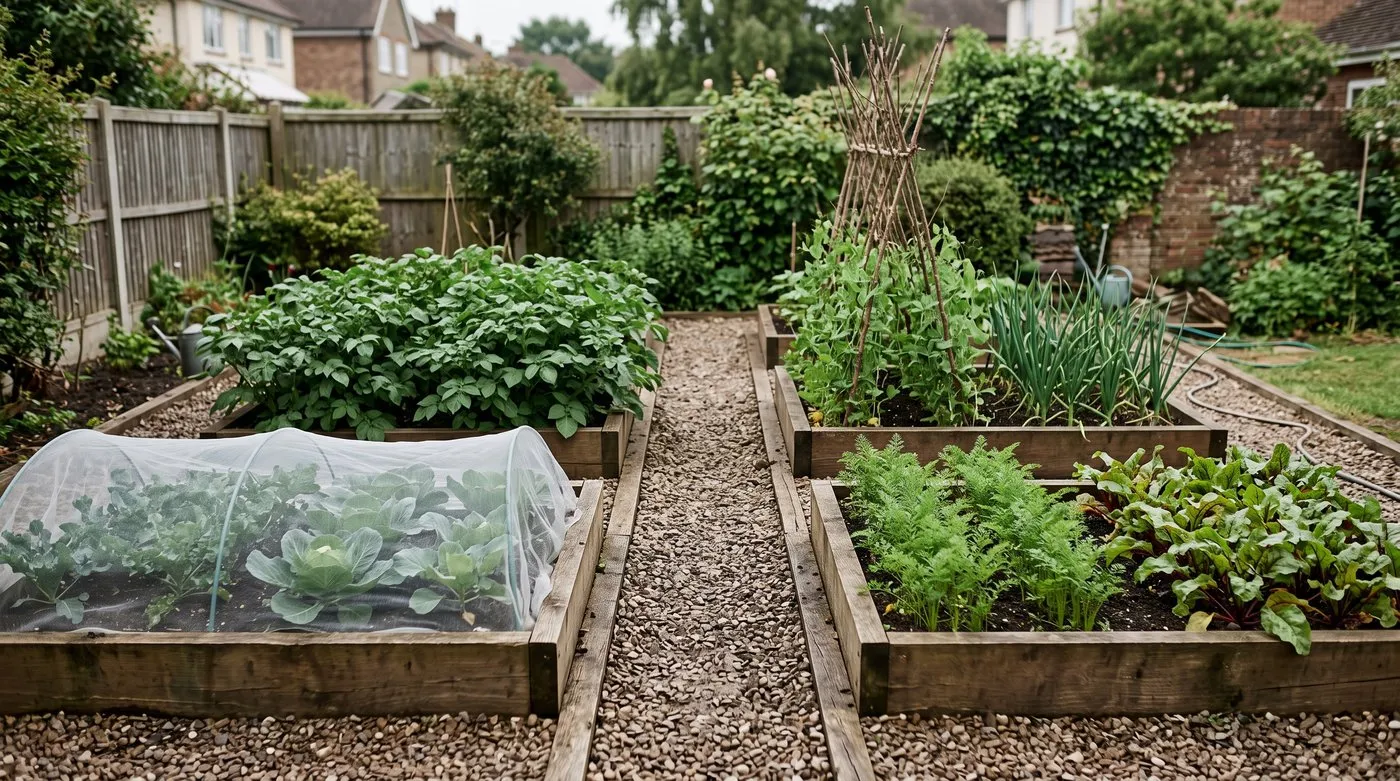
Each crop group moves on one bed every spring. It stops soil pests and diseases building up and lets you feed each bed for what’s in it.
Potager or ornamental kitchen garden
A potager mixes veg, herbs and flowers in a pretty, formal layout. The idea comes from France: a symmetrical plan with a centrepiece (a standard bay, a rose arch or a water feature), beds edged with low hedging or lavender, and crops chosen partly for their colour and texture. Our guide to the potager garden shows how to plan one.

A potager, where vegetables, herbs and flowers grow happily together.
Potagers are lovely in small gardens you can see from the house. Nasturtiums between lettuces, purple basil beside tomatoes and marigolds along the edges look great and can help with pests. Our companion planting guide for UK gardens has more pretty and useful pairings.
The trade-off: A potager gives up a little growing space for good looks. Formal edging needs trimming, and mixing flowers and veg can make rotation trickier. If you’re after the biggest harvest, stick with raised beds. If the veg patch is also a feature, a potager is a joy.
Purple basil, nasturtiums, salad leaves and climbing beans in a formal potager with grass paths.
Getting paths and access right
Paths decide how comfortable your kitchen garden is to work in, and how it looks all year.
At least 60cm wide. That’s enough to kneel or crouch without standing on the beds. Any narrower and you’ll keep stepping on the edges and squashing the soil.
90cm for a wheelbarrow. You’ll be barrowing compost and harvests about, so make the main path wide enough to turn a barrow.
One main path, smaller side paths. Run one wide main path from the entrance through the middle, with 60cm paths between the beds.
Edge your paths. Gravel without edging wanders into the beds and lawn within a season. Timber boards, concrete edging or steel edging keep it in place.
Bed design: width, length and depth
Width: 1.2m at most. That way you can reach the middle from either side. If a bed backs onto a wall or fence and you can only get at it from one side, make it 60cm. You should never need to step on a bed.
Length: whatever’s handy. Timber often comes in 2.4m lengths, which makes that an easy bed length. Keep beds short enough that you walk round them, not across them.
Depth: deeper on clay. Heavy clay often drains badly near the surface. Raising beds with about 30cm of topsoil and compost fixes drainage and gives roots loose soil to grow in. Carrots and parsnips grow straighter in deeper, looser soil. Our guide to raised bed gardening for beginners walks you through building one.
Integrating herbs and flowers into a kitchen garden
Put herbs as close to the kitchen door as you can. A small bed near the house, or the edge of a salad bed, is ideal.
Perennial herbs need a permanent spot. Rosemary, thyme, sage, chives and mint stay put all year, so keep them out of the rotation. A small border near the path or back door works well. Plant mint in a buried pot so it doesn’t take over.
Annual herbs can rotate. Basil, coriander, dill and parsley can move round with everything else. Basil loves being next to tomatoes, and dill and fennel bring in helpful insects.
Flowers earn their keep. French marigolds at the ends of beds and nasturtiums near beans are old favourites for pest control, and nasturtium leaves and flowers are edible too. Sweet peas on a cane wigwam give you flowers to pick. Calendula and phacelia bring in hoverflies, whose larvae eat aphids. Pretty and useful.
Planning a soft fruit and fruit area
Soft fruit gives you a lot for the space it takes. Raspberries, strawberries, redcurrants and gooseberries keep cropping for years with little fuss once they’re settled.
Give fruit its own permanent patch. Soft fruit stays put, so keep it out of the rotation in its own area at one end. A bed 1.2m x 4m holds a row of raspberry canes, a dozen strawberry plants or two or three gooseberry or currant bushes.
A fruit cage is worth it. Netting over a simple frame stops the birds pinching the lot before you get there. Our guide to growing soft fruit in the UK covers raspberry varieties and pruning.
Keep fruit trees small. Full-size apple and pear trees soon shade a veg plot. Go for knee-high step-overs, slanted cordons or fans trained against a wall. Our introduction to growing fruit trees in UK gardens explains how to choose the right rootstock.
Permanent herb borders, gravel paths and a soft fruit bed at the far end of the plot.
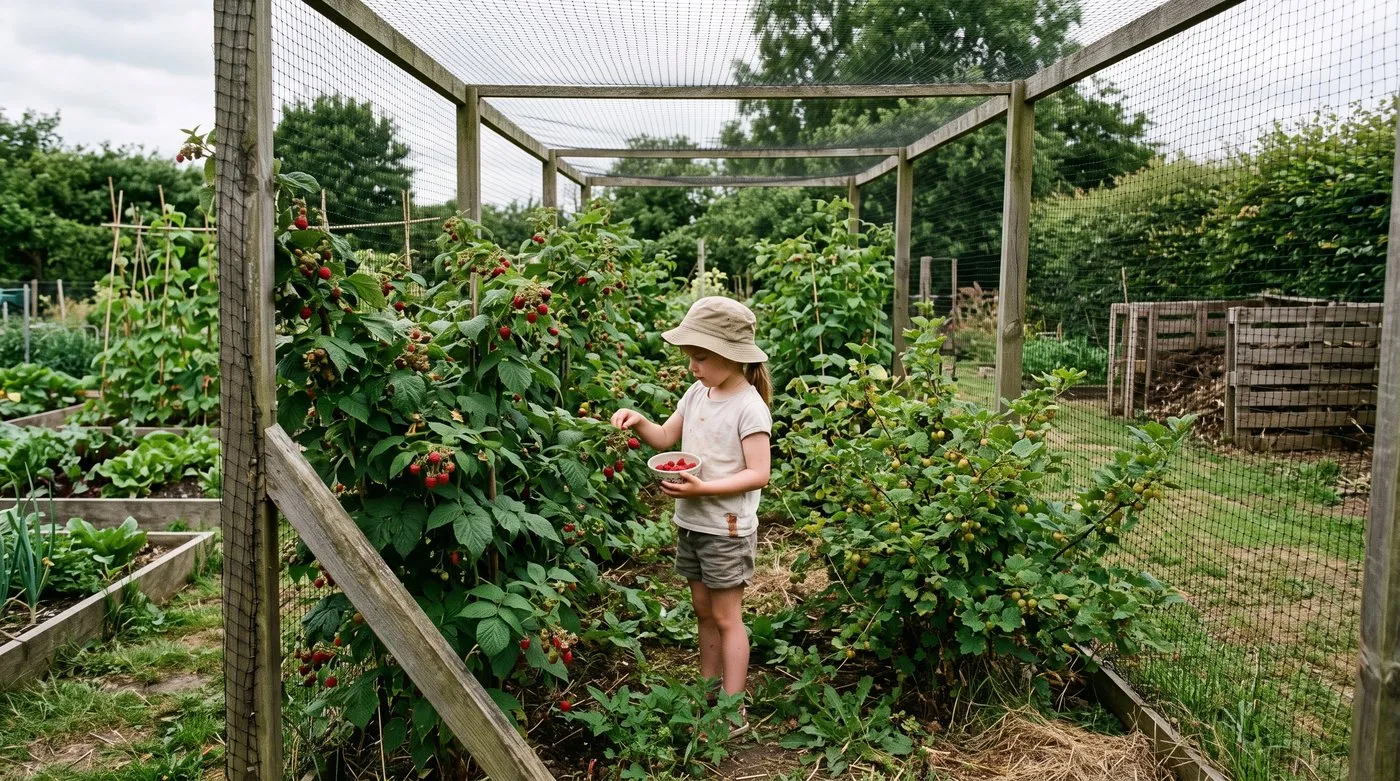
Give soft fruit its own permanent patch outside the rotation. A simple netted cage stops the birds getting there first.
Compost placement and water access
Compost at the far end. Compost bays are bulky and not much to look at, so tuck them at the end furthest from the house. Leave room for two or three bays side by side, at least 1m x 1m each: one filling, one rotting and one ready to use.
A tap inside the plot. A tap or standpipe in the kitchen garden itself beats trailing hoses from the house. If you’re starting from scratch, lay the water pipe before the paths go down. A water butt on a shed or polytunnel gives you free rainwater too.
For how to get going, see our guide to making compost at home, including what to add and what to leave out.
What to grow first in a new kitchen garden
Easy wins keep you keen. In your first year, avoid fussy crops like celeriac, Florence fennel, parsnips and leeks, which like deep, rich, well-worked soil.
Great first-year crops:
| Crop | Ready in about | Spacing | How easy? |
|---|---|---|---|
| Cut-and-come-again salad | 4-6 weeks | 15cm | Easy |
| Radish | 4 weeks | 5cm | Easy |
| Dwarf French beans | 8-10 weeks | 20cm | Easy |
| Courgette | 8-10 weeks | 90cm | Easy |
| Cherry tomatoes | 12-14 weeks | 60cm | Medium |
| Basil | 5 weeks | 20cm | Medium |
| Mint (in a pot) | 4 weeks | One per pot | Easy |
| Spring onion | 8 weeks | 1cm | Easy |
Sow a little salad and radish every three weeks from March to August, rather than one big batch that’s all ready at once. Our succession planting guide explains how, and the UK vegetable planting calendar shows when to sow and plant everything.
Vertical growing for small kitchen gardens
In a small plot, growing up rather than out gives you loads more space.
Wigwams for beans. A tall bamboo wigwam holds several climbing bean plants in a tiny footprint. In a small space, climbing beans give you far more than dwarf ones.
Obelisks and arches for cucumbers and squash. Cucumbers trained up canes stay tidy and airy. Squash on an arch hang at eye level, much easier than hunting under giant leaves.
Peas on netting. Mangetout and sugar snap peas on pea netting crop well from late spring into summer. When they’re done, cut them down and use the space for a late brassica or salad crop.
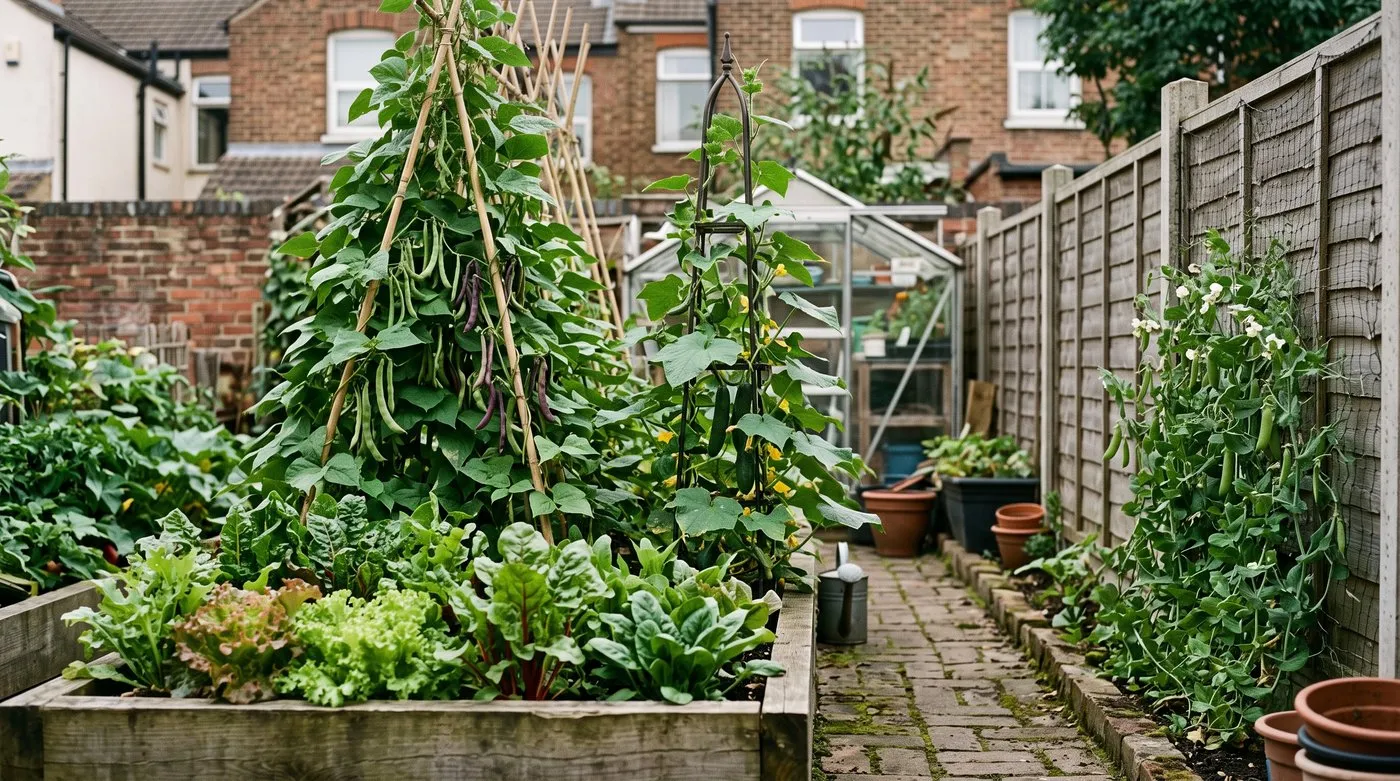
In a small plot, grow up rather than out. A bean wigwam holds several plants in a tiny footprint and crops far more than dwarf beans.
Seasonal planning and year-round productivity
Most kitchen gardens are busy from April to October and quiet in winter. With a bit of planning you can stretch the season at both ends.
Early spring (February-April). A cold frame or cloche over the salad bed gets you picking weeks earlier. Broad beans sown in November give the earliest spring crop, and onion sets planted in autumn are ready to lift by early summer.
Autumn and winter. Kale, chard, leeks, parsnips and Brussels sprouts can all be picked from October to February. Sow them in late spring for autumn and winter harvests. Without them, the plot sits empty for months.
The RHS guide to starting to grow vegetables has lots of crop-by-crop advice to go alongside these layout tips.

Four 1.2m-wide raised beds with 60cm paths. A plot this size suits a family well.

Gravel paths between beds, edged with herbs that pollinators love.
Frequently asked questions
How big should a kitchen garden be for a family?
About 6m by 4m is a good start. That gives a family salads, herbs, courgettes, beans and tomatoes through summer, with room for four beds of about 1.2m by 2.4m plus paths. For potatoes and winter crops too, you’ll need more space. A greenhouse or polytunnel helps stretch the season.
Which direction should a kitchen garden face?
South-facing is best, as it gets the most sun. East or west-facing spots still work, with a bit less direct sun. A shady, north-facing plot is harder, but leafy crops and some fruit can still do well. Put tall crops on the north side of each bed so they don’t shade the rest.
What is the four-bed rotation system?
It means moving crop groups to a new bed every year. The usual groups are potatoes, legumes with onions, brassicas and roots. Moving them round helps stop soil pests and diseases building up in one place, and makes good use of the soil’s goodness. After four years, each group is back where it started.
How wide should paths be in a kitchen garden?
At least 60cm between beds, and about 90cm for main paths. Any narrower and you’ll end up treading on the beds when you kneel or crouch. If you use a wheelbarrow, make main paths wide enough to turn it. Bark or paving keeps paths firm and easy to look after.
What should I grow first in a new kitchen garden?
Quick, easy crops like salad leaves, radishes and herbs. They give you results within weeks. Follow with courgettes, dwarf French beans and cherry tomatoes for summer. Leave fussier crops like parsnips, celeriac and leeks until your soil has improved and you’ve got a bit more experience.
Can you have a kitchen garden on clay soil?
Yes, clay can grow brilliant veg once it’s improved. Add plenty of garden compost or well-rotted manure every year. Raised beds filled with topsoil and compost work well over heavy clay. Clay holds water and nutrients well, so once improved it can be very productive. Just avoid working it when it’s wet.
What is a potager-style kitchen garden?
A pretty kitchen garden mixing veg, herbs and flowers in a formal layout. It often has a centrepiece, such as a standard bay or a rose, with neat geometric beds and low edging. Plants are chosen for looks as well as harvests. It suits small plots that you can see from the house.
Related reading
Our team produces practical UK gardening guidance from source research, contributor records and established horticultural practice. Editorial standards are overseen by Matt W.


