
Key takeaways
- A potager mixes veg, herbs and flowers in neat, symmetrical beds that look as good as they taste
- Keep beds no wider than 1.2m, with gravel paths of 60-90cm between them
- Colourful crops like ruby chard and red cabbage look brilliant next to orange marigolds and calendula
- Flowers such as nasturtiums, calendula and borage bring in helpful insects as well as colour
- Sow salads every three weeks or so to fill gaps as you harvest
- Plan paths, edging and evergreen herbs first, so the garden still looks good in winter
A potager is where growing food meets garden design, and it’s one of the most satisfying things you can make. Every bed gives you something to eat. Every bed looks lovely. You really can have both.
What is a potager garden?
A potager is a French kitchen garden where vegetables, herbs and flowers share the same beds in a neat, symmetrical layout. The name comes from potage, the hearty vegetable soups of French country kitchens. In a normal veg plot, food is the only goal. In a potager, the crops are part of the design too.
The idea goes back to the grand gardens of France, like the king’s kitchen garden at Versailles and the famous potager at Villandry in the Loire Valley. Think symmetrical beds, low clipped edges, gravel paths and veg and flowers planted with colour in mind.
How to lay out a potager
A potager has the same bones as any veg garden: beds, paths and a centrepiece. The difference is that everything is arranged to look good.
Keep beds no wider than 1.2m. This is a practical rule. You need to reach the middle of every bed without stepping on the soil, because squashed soil grows poor crops. A standard raised bed of 1.2m x 2.4m is perfect.
Go symmetrical. Neat shapes are what make a potager. Four beds around a central cross of paths is the classic layout. Eight beds in a wheel around a centrepiece is more ambitious. Even two long beds either side of a path counts, as long as the planting is planned.
Gravel paths of 60-90cm. Gravel over weed fabric is easy to walk on all year, keeps weeds down and looks smart. Make the main path about 90cm wide so a wheelbarrow fits. Paths between beds can be 60cm.
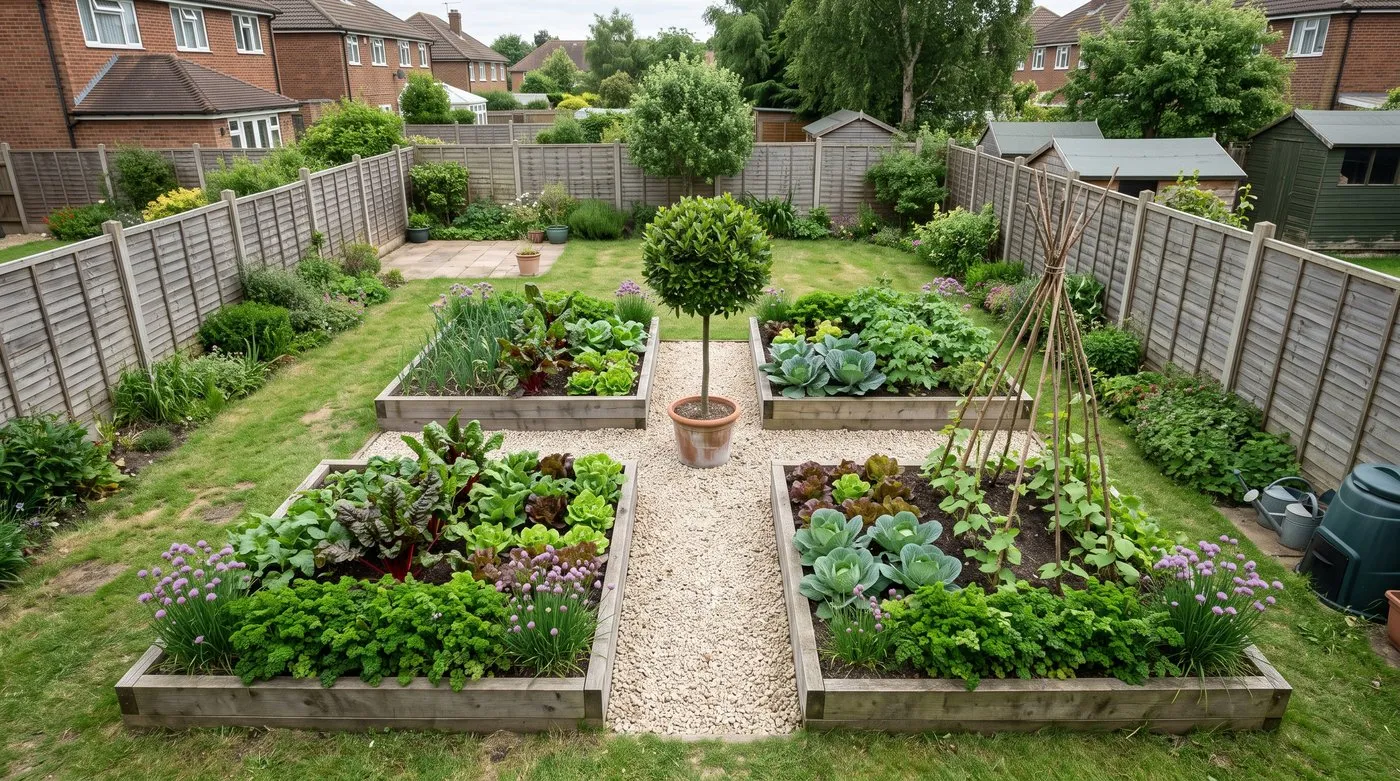
Four beds round a cross of paths is the classic potager shape. Keep each bed narrow enough to reach the middle without stepping on the soil.
Best potager plant pairings

Nasturtiums and calendula earn their place by bringing in helpful insects as well as colour.
Purple and orange: the classic potager colours
Ruby chard with orange marigolds is the pairing everyone loves. The deep red stems make a dramatic backdrop for bright French marigolds. Plant chard about 20cm apart in the middle of the bed, with a row of marigolds 15cm in from the edge.
Red cabbage with calendula. Blue-purple cabbage heads look stunning ringed with orange calendula (pot marigold). Calendula seeds itself around, so one packet goes a long way. It also brings in hoverflies, whose larvae eat aphids.
Purple basil with yellow courgettes. Dark purple basil between yellow courgette plants makes a rich contrast. Both like warmth and shelter, so they’re happy side by side.
Adding height and shape
Runner beans on hazel wigwams give you the height every potager needs. A 1.8m wigwam of six to eight hazel poles covered in scarlet bean flowers is a real centrepiece from July. Plant trailing nasturtiums round the base. Blackfly often go for the nasturtiums first, and the orange flowers echo the beans above. For more on beans and other climbers, see our guide to growing your own vegetables.
Globe artichokes for drama. These grow tall with big silvery, jagged leaves. Pop one at each corner of a four-bed potager. Eat the buds, and any you miss open into purple thistle flowers that bees adore.
Sweet peas for scent. Grown up obelisks or wigwams, sweet peas give you flowers to cut from early summer into September. You can’t eat them, but they bring in pollinators and smell wonderful. Use them at bed corners or either side of the entrance.

A potager is a garden you’ll want to visit every day, picking, replanting and enjoying it up close.
Edible edges
Lettuce edging. Alternate red and green lettuces, such as Lollo Rossa and Little Gem, along the edge of a bed. You get a pretty frilly border you can pick leaf by leaf. Re-sow every three weeks to keep it going. Our lettuce growing guide has variety ideas.
Parsley and chive borders. Flat-leaf parsley planted 15cm apart makes a thick, bright green edge. Chives do the same, with purple pompom flowers in early summer. Both end up in the kitchen most days, which is potager thinking at its best.
| Pairing | Colours | When it looks best | Why it works |
|---|---|---|---|
| Ruby chard + French marigolds | Crimson and orange | May to October | Bold contrast all summer |
| Red cabbage + calendula | Purple and orange | June to November | Calendula brings in hoverflies |
| Purple basil + yellow courgette | Purple and gold | June to September | Both love warmth |
| Runner beans + nasturtiums | Scarlet and orange | July to October | Nasturtiums draw blackfly away |
| Red lettuce + green lettuce | Red and green | March to November | Pretty, pickable edging |
| Globe artichoke + borage | Silver and blue | June to September | Borage brings in bees |
| Cavolo nero + violas | Dark green and purple | September to March | Winter colour |
| Curly kale + purple sprouting broccoli | Blue-green and purple | October to April | Winter food that looks good |
Herbs in the potager
Herbs are the backbone of a potager. They give you edging, ground cover, height and scent, and you’ll use every one in the kitchen.
Perennial herbs need a permanent spot. Rosemary, thyme, sage and oregano stay put all year, so keep them out of your crop rotation. Plant them along the edges or in a herb bed by the entrance. A lollipop-trained rosemary in the middle of a bed makes a year-round centrepiece. Our herb growing guide covers planting and care.
Annual herbs move around. Basil, coriander, dill and chervil are sown fresh each year and can fill any gap. Try basil beside tomatoes, dill among courgettes and coriander as a quick filler between slower crops.

Even a small town garden can be a potager, with raised beds, bright chard and herbs.
Flowers that pull their weight
In a potager, flowers should do a job as well as look pretty: bringing in pollinators, attracting helpful insects or luring pests away. That’s what makes a planned potager different from a random mix.
French marigolds (Tagetes patula) are an old favourite with veg growers. Plant them about 15cm apart along bed edges and between tomatoes for a cheerful edge. They’re a staple of companion planting in edible gardens.
Nasturtiums work as a decoy. Blackfly often head for nasturtiums before beans and brassicas, which keeps your crops cleaner. The leaves, flowers and seed pods are all edible, with a peppery kick that’s great in salads.
Borage is a bee magnet. Its blue starry flowers keep coming all summer. Plant it near courgettes, squash and runner beans, which all need insects to set fruit. The flowers are edible and look lovely frozen in ice cubes. Our guide to edible flowers has lots more ideas.
Keeping it full and colourful all year
The trickiest part of a potager is keeping the beds full through all four seasons. A normal veg patch can sit bare in winter. In a potager, the gaps show.
Spring (March to May)
Sow lettuce, radishes and spring onions straight into the soil in March, under fleece. Add violas and primroses for early colour. By late April, plant out chard, kale and cabbage seedlings raised under cover. Tulips planted between beds the autumn before give colour until the crops fill in.
Summer (June to August)
This is the big show. Beans climb their wigwams, courgettes open golden flowers, and chard, basil and lettuce fill every bed. Marigolds, nasturtiums and calendula are in full bloom. Sow lettuce and radishes every three weeks so gaps fill within days. Keep picking sweet peas so they keep flowering.
Autumn (September to November)
Swap in winter crops as summer ones finish. Replace spent courgettes and beans with cavolo nero, purple sprouting broccoli and winter lettuce. Sow a green manure, such as phacelia or field beans, in any bed that will sit empty until spring. Ornamental kale adds colour. Leave artichoke seedheads standing for shape and for the birds.
Winter (December to February)
Now the bones of the garden do the work. Evergreen herb edges, paths, bed edges and any winter brassicas stop the potager looking forgotten. Purple sprouting broccoli and cavolo nero are handsome and useful in the coldest months. Even bare hazel wigwams still give you some height.
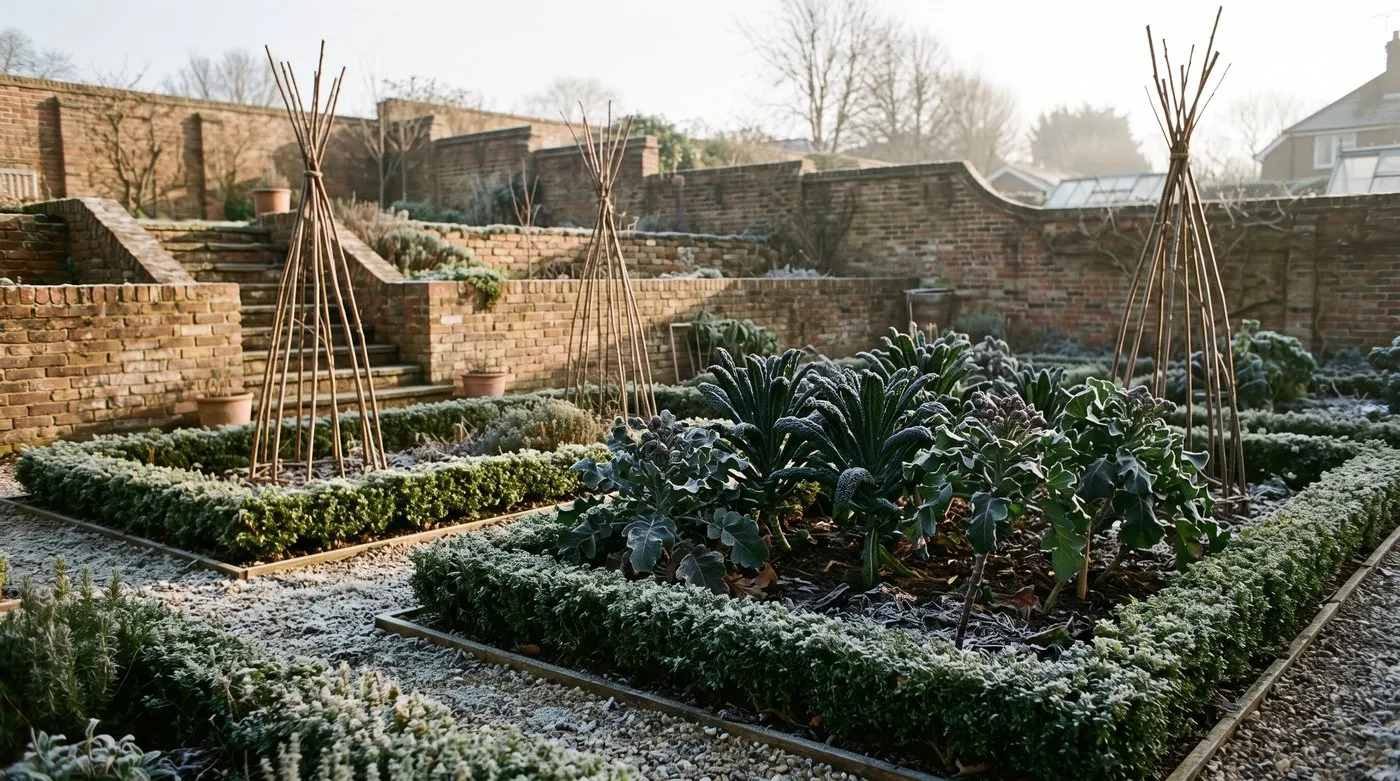
In winter the bones do the work. Evergreen herb edges, tidy paths and a few handsome brassicas keep a potager looking cared for.
Making a potager in a small space
You don’t need a big garden. A single 1.2m x 2.4m raised bed, planted with care, is a mini potager.
The four-bed patio potager. Four 1m x 1m raised beds in a square with 60cm paths fits in a space about 3.2m square. Give each bed a theme: ruby chard and marigolds in one, purple basil and yellow courgettes in another, red and green lettuce in the third and mixed herbs in the last. Pop a small obelisk or a bay tree in the middle where the paths cross.
Pots join in too. Big terracotta pots (40cm or more) with trailing nasturtiums, a lollipop rosemary or mixed herbs carry the look onto the patio. Group them at bed corners and along paths.
Grow upwards. Wall planters, obelisks and bean wigwams add growing space without using more ground. An obelisk of climbing French beans gives you a good crop from a tiny footprint. The RHS has helpful advice on kitchen garden design for smaller spaces.
Common potager mistakes
Cramming plants in. A potager should look full, not squashed. Crowded plants fight for light, crop less and trap damp, which brings disease. Stick to the spacing even if the bed looks sparse at first. It fills in within weeks.
Forgetting to keep sowing. Bare gaps after harvesting are the biggest reason a potager looks scruffy. Keep a sowing plan and a tray of spare seedlings in a cold frame. When you pick a lettuce, pop a new one in the same day.
Choosing plants only for looks. A potager should feed you. Too many purely decorative plants eat into your growing space. Aim for every plant to be edible, a helpful flower or part of the structure.
Ignoring winter. A potager that’s gorgeous in July and sad in January is only half planned. Sort out paths, edging, centrepieces and evergreen herbs before you choose a single vegetable. The bones of the garden need to look good on their own.
Frequently asked questions
What is a potager garden?
It’s a French-style kitchen garden that’s as pretty as it is useful. Vegetables, herbs and flowers grow together in neat, symmetrical beds. Edible plants are treated as part of the design, with colour, texture and height all planned. The name comes from the French potage, a vegetable soup.
How big does a potager garden need to be?
As small or as big as you like. Four raised beds with gravel paths between them, in a space of about 4x4m, gives you plenty of salads, herbs, beans and flowers. A bigger plot leaves room for a centrepiece and a herb bed. Even one raised bed can be planted potager-style.
What vegetables look best in a potager?
Ruby chard, red cabbage, curly kale and red lettuce are the showstoppers. Globe artichokes add height. Runner beans on wigwams give you something tall to look at. Courgettes have big leaves and golden flowers. Cavolo nero and purple sprouting broccoli look great through autumn and winter.
Do potager gardens produce as much food as normal kitchen gardens?
A little less, since flowers and paths take up some room. But the flowers bring in pollinators and helpful insects. And because a potager is a lovely place to be, you tend to pop out daily and pick crops at their best, so less goes to waste.
What flowers should I plant in a potager?
French marigolds, nasturtiums, calendula and borage are the classics. Nasturtiums draw blackfly away from beans. Calendula brings in hoverflies, whose larvae eat aphids. Borage is a magnet for bees. Sweet peas on wigwams add scent and flowers for the vase.
Can I make a potager garden in raised beds?
Yes, and they’re ideal. Their neat edges give you the tidy shape a potager needs. Build four beds in a symmetrical pattern with gravel paths. Edge them with low herbs like thyme or chives instead of box hedging.
How do I keep a potager looking good all year?
Keep sowing little and often. Sow salads every three to four weeks and keep spare seedlings in a cold frame to fill gaps. Grow cavolo nero, purple sprouting broccoli and ornamental kale for winter. Plant bulbs for spring colour, and edge beds with evergreen herbs so there’s always some shape.
Our team produces practical UK gardening guidance from source research, contributor records and established horticultural practice. Editorial standards are overseen by Matt W.


