Key takeaways
- Split a narrow terraced garden into two or three zones instead of one long lawn strip
- Diagonal paving and an off-centre focal point make a 4-5m wide yard feel wider
- A pergola or multi-stem tree blocks views from upstairs windows better than taller fences
- Fences and walls over 2m usually need planning permission in England
- Grow climbers on horizontal wires 30-45cm apart and plant shade-lovers at the base
- Give the side return a job, such as bin and bike storage, so the garden stays clear
A terraced house garden is usually a narrow, walled yard behind the house. It’s often overlooked from upstairs windows and shaded by walls and the house next door. The answer is to split it into small zones, plant upwards and put something leafy between you and the neighbours’ windows.
This guide focuses on the problems terraced gardens share: overlooking, wall shade and where to put the bins. For general tricks on making any plot feel bigger, see our guide to making a small garden look bigger.
Why narrow terraced gardens feel like corridors
A narrow plot feels like a corridor because your eye shoots straight down to the back wall. Two parallel walls make the tunnel stronger. A straight path down the middle with a strip of lawn makes it worse still.
The fix is to break that straight line. Zones, a bending path, diagonal paving and thick planting on the walls all slow the eye down. The garden then feels like a series of spaces rather than a passage.

Dining by the house, a strip of lawn and planting in the middle, and a cosy pergola seat at the end. The curving path means you explore the garden in stages.
How do I make a narrow garden look wider?
Lay your paving on a diagonal. When the slabs run corner to corner, the longest line in the garden crosses the plot instead of running down it. A 4m-wide yard instantly feels roomier.
A few more tricks help:
- Put a focal point off-centre, such as a pot or small tree to one side, so the eye is pulled across.
- Plant the walls thickly so the hard edges blur.
- Hide the far end a little with a screen or planting, so the garden doesn’t reveal itself all at once.
- Use cool colours at the back. Blues, silvers and pale greens seem further away. Keep hot reds and oranges near the house.
A pale colour on the back wall also brightens a dark yard and makes it feel further away.
How do I get privacy in a terraced garden?
Put something leafy overhead. In a terraced garden, most overlooking comes from upstairs windows, so a taller fence rarely helps. A pergola with a climber, a small multi-stem tree or a shade sail over the seat breaks the view from above.
For ground-level privacy, use soft screening rather than solid panels. A slatted screen or a band of tall grasses such as Calamagrostis ‘Karl Foerster’ blocks views while letting light and air through. Solid panels make a narrow yard dark and boxed-in.
Check the rules before building high. In England, fences and walls over 2m usually need planning permission, and next to a road the limit is usually 1m. The GOV.UK planning permission guide explains where to check. Garden buildings and structures close to a boundary have height limits too, so check before building a tall pergola.

A slatted screen and tall grasses give privacy at seat height without blocking the light.
Zoning a narrow plot into outdoor rooms
Zoning turns a corridor into a garden. Split the plot into two or three rooms, each with its own job. Divide them with planting, a screen, an arch or a change of surface. A short yard suits two zones, a longer one three.
A simple three-zone plan:
- By the house: dining and cooking. Paving, a table and the outdoor tap, close to the kitchen door.
- The middle: planting and a small patch of gravel or lawn. This is the green heart of the garden.
- The far end: a quiet seat, screened and placed to catch the evening sun if your aspect allows.
Stagger the zones so the path bends rather than running straight. Mark each entrance with a pair of pots, grasses or an arch.
Greening the walls without losing floor space
In a narrow yard, floor space is precious, so plant upwards. Fix horizontal wires to the wall about 30-45cm apart and grow climbers up them. A narrow bed at the base is all you need.
If the wall is shared with a neighbour, ask before you fix anything to it. Good climbers for shady terrace walls include climbing hydrangea (Hydrangea anomala subsp. petiolaris) and ivy. On sunnier walls, star jasmine and clematis do well.

Climbers trained on wires cover a tall wall from top to bottom, needing only a narrow bed at the base.
A living wall of planted pockets is another way to green a boundary. It needs regular watering, so it suits keen gardeners or one with an automatic watering kit.

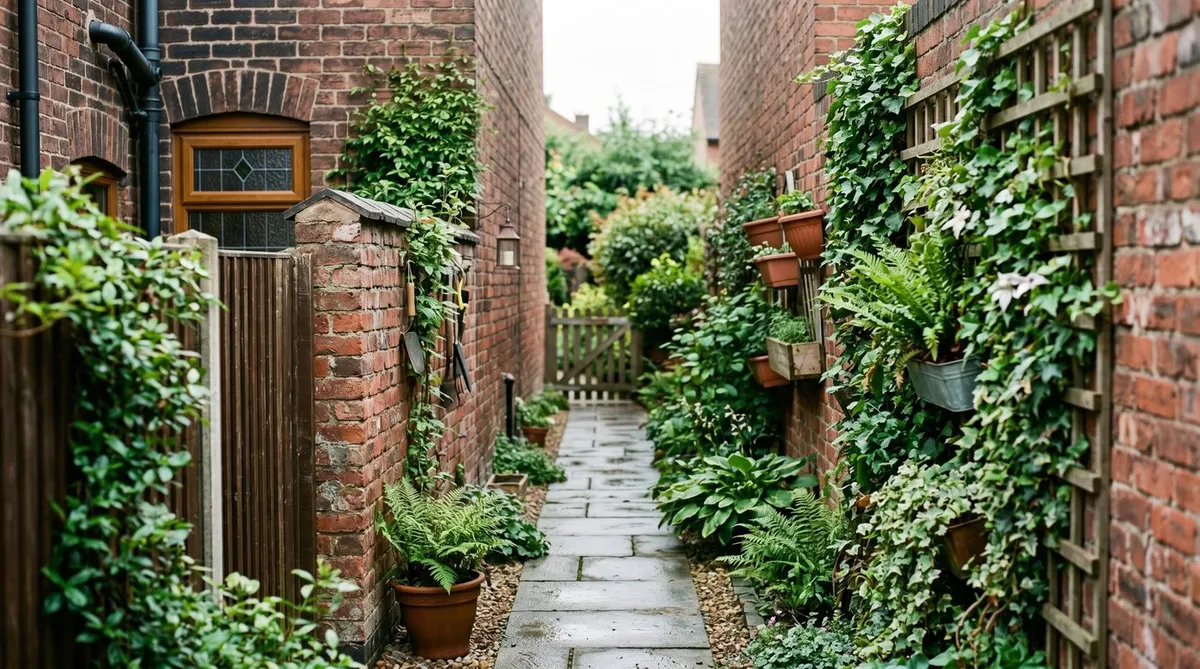
Ferns, heucheras and trailing plants turn a bare stretch of brick into planting, with no floor space lost.
Coping with shade from walls and the house next door
A walled terraced yard is a shade garden, especially if it faces north. Plant for the conditions you have and it will thrive.
Reliable choices for shady town gardens include ferns such as Dryopteris and soft shield fern, hostas (thicker-leaved types like ‘Halcyon’ suffer less from slugs), hardy geraniums, and Brunnera ‘Jack Frost’, whose silver leaves light up a dark corner. Our guide to the best plants for shade has many more.
Make the most of the light you have:
- Paint the back wall a pale colour to bounce light around.
- Choose pale paving, which reflects more light than dark stone.
- Keep bright pots near the seat, where you’ll notice them most.
A mirror on a side wall can reflect light and planting. Angle it so it doesn’t reflect open sky, as birds may fly into it.
Hard landscaping for low maintenance
A small lawn rarely works in a narrow, shady yard. It stays damp, wears thin and needs a mower stored somewhere. Porcelain paving or resin-bound gravel are easier. Both shed water, resist weeds and need only an occasional wash.
Whatever you choose, lay it on a proper sub-base and make sure water runs away from the house. Skipping the sub-base is the main reason paving sinks or lifts after a few winters.
Bins, bikes and the side return
The side return is the narrow passage beside many Victorian terraces. Use it for bins, bikes and recycling, and the rest of the garden stays clear. Slimline bin stores or a bike locker fit along one side, leaving room to walk past.
Shade-loving ferns in pots and a climber on the wall make the passage feel like part of the garden. Our guide to side return garden ideas has plenty more ways to use it.

Pots of ferns and ivy turn a gloomy side passage into a green walkway.
Multi-stem trees and focal points for small yards
A small tree does more work than any other single feature in a terraced garden. A multi-stem tree gives height, light shade and privacy, and its raised canopy screens upstairs windows. The slim stems leave room for planting or a bench underneath.
Good choices include Amelanchier lamarckii for spring blossom and autumn colour, multi-stem birch for white bark and light shade, and Cornus kousa for slow, well-behaved growth. Our list of the best trees for small gardens has more. Plant two or three at the far end and underplant them for a pocket woodland corner.

A multi-stem tree lifts its leaves above head height, screening upstairs windows while leaving room to plant underneath.
A step-by-step plan for reworking a terraced yard
- Measure and observe. Note the width, length, overlooking windows and where the sun falls morning and evening.
- Set the zones. Mark out two or three rooms with canes and string before committing.
- Sort the privacy. Put up screens and the pergola, or plant the tree, early on.
- Lay the hard landscaping. Paving or gravel on a proper sub-base, falling away from the house.
- Wire the walls and plant the borders. Climbers on wires, shade plants at the base.
- Add the finishing touches. Pots, seating and lighting make it feel finished.
Common mistakes in terraced garden design
- A long lawn strip down the middle. It exaggerates the corridor and stays soggy in wall shade. Zone and pave instead.
- Tall solid screens. Boxing a narrow yard in with solid panels makes it dark. Use slatted screens and a leafy canopy.
- Ignoring the side return. Left as a mossy dumping ground, it pushes bins and bikes into the garden. Give it a job.
- Planting sun-lovers in shade. Lavender and roses sulk against a north wall. Choose ferns and woodland plants.
Frequently asked questions
How do I make a narrow terraced garden look wider?
Lay paving on a diagonal so the longest line runs corner to corner. Split the garden into rooms, plant the walls thickly and put a focal point off to one side. Pale colours on the back wall help it feel further away.
How do I get privacy in an overlooked terraced garden?
Put something leafy over your seat, such as a pergola or small tree. Overlooking comes from upstairs windows, so taller fences rarely help. Slatted screens or tall grasses at head height handle ground-level views while still letting light through.
What plants suit a shady walled town garden?
Ferns, hostas, hardy geraniums and climbing hydrangea all cope with wall shade. Brunnera ‘Jack Frost’ lights up dark corners with silver leaves. Choose woodland plants rather than fighting the shade with sun-lovers.
Can I build a high fence around my terraced garden?
Usually up to 2m without planning permission in England. Next to a road used by vehicles, the limit is usually 1m. Check with your council if you’re unsure, and talk to neighbours before changing a shared wall or fence.
What is the best low-maintenance surface for a small city garden?
Porcelain paving or resin-bound gravel are both low-maintenance choices. They shed water, resist weeds and need little more than an occasional wash. A small lawn is hard work in a shady walled yard, as it stays damp and thin.
If your terraced garden is unusually long, our guide to designing a long thin garden covers zoning over a greater length. For more ideas, browse the garden design hub.
Our team produces practical UK gardening guidance from source research, contributor records and established horticultural practice. Editorial standards are overseen by Matt W.