Key takeaways
- UK growers hold world records for the heaviest onion, longest carrot, and longest bean
- Pedigree seed is decisive - giant onion seed from proven breeders costs £15-25 a packet
- Champion pumpkins need a 5m by 5m bed, daily watering, and 5kg of fertiliser per week
- Deep trench beds (1m or more) are standard for stovepipe carrots and prize leeks
- Most championship vegetables start indoors in January and grow under controlled conditions
- The Malvern National Giant Vegetables Championship in September is the UK showcase
- Local village shows accept entries from any grower - not reserved for specialists
A 1,226kg pumpkin. An onion the size of a football. A carrot longer than a London bus is wide. The UK has been competitive in giant vegetables since the 1980s, and 2024 was a record-breaking year for British growers.
This guide explains how the records are set, what methods champions use, where to see them, and what it takes to enter your first village show class. It is not a guide to general vegetable growing - for that, see grow your own vegetables UK. It is about the strange, obsessive corner of horticulture where a single fruit can be heavier than the gardener who grew it.
The current UK records
British giant vegetable growers hold or have held world records in several classes. Here are the headline numbers as of 2026.
| Class | UK record | Holder | Year | World record? |
|---|---|---|---|---|
| Pumpkin | 1,226kg | Stuart Paton | 2024 | Second to USA |
| Onion | 8.97kg | Tony Glover | 2014 | World record |
| Long carrot | 6.245m | Joe Atherton | 2016 | World record |
| Stump-rooted carrot | 10.9kg | Christopher Qualley (USA) | 2017 | UK record stands at 6.7kg |
| Leek (pot) | 11.83kg | Joe Atherton | 2018 | World record |
| Climbing bean (pod) | 1.3m | Hugh Grainger | 2017 | UK record |
| Marrow | 116.4kg | Vincent Sjodin | 2018 | UK / European |
| Cucumber | 12.9kg | Sebastian Suski | 2015 | World record |
| Beetroot | 23.99kg | Ian Neale | 2019 | World record |
Not all categories are formally recognised by Guinness World Records - many UK records are tracked by the National Vegetable Society and the CANNA UK National Giant Vegetables Championship. When a UK record beats an existing world record, growers usually submit to Guinness for ratification, which can take 12-18 months.
The records keep moving. Each year, two or three classes are broken at the September Malvern championship. The trend has been upward since the 1990s, driven by better seed pedigrees and refined growing methods.
What separates champion vegetables from normal vegetables
A 600kg pumpkin is not just a normal pumpkin grown for longer. The plant is a different beast. Champion vegetables of every type share four things in common.
Pedigree seed. Champion seed is documented like racehorses. A 1,000kg pumpkin descends from a chain of weighed parents (e.g. ‘2624 Wallace 2023’, meaning a 2,624 lb fruit grown by Wallace in 2023). Growers swap seeds at auction, paying £50-200 for verified high-pedigree seed. Onion seed from Robinson’s Mammoth strain, leek seed from National Pot Leek Society lines, carrot seed selected over decades from a single grower’s stock.
Deep, fertile beds prepared months in advance. A pumpkin bed is dug out 1m deep, filled with rotted manure, leaf mould, fish blood and bone, and re-mixed. Long carrot beds are vertical bores filled with sieved compost. Pot leek beds are wooden trenches filled with a custom potting mix. The bed gets six months of preparation before the seed goes in.
Controlled growing environment. Most champion plants spend their early life under glass with bottom heat, in dedicated polytunnels with automated misting. Outdoor sites get root-warming cables, cloches, and fleece. The aim is uninterrupted growth from day one - any check (cold, drought, pest) sets the plant back permanently.
Daily attention. Champion growers visit their plants twice a day from May to September. Measurements are recorded. Feed is mixed precisely. Pest checks happen morning and evening. A champion pumpkin grower might spend 25-30 hours per week on a single plant in peak season. This is the part most amateurs underestimate.
The seed and bed get the attention in articles. Daily presence is what wins shows.
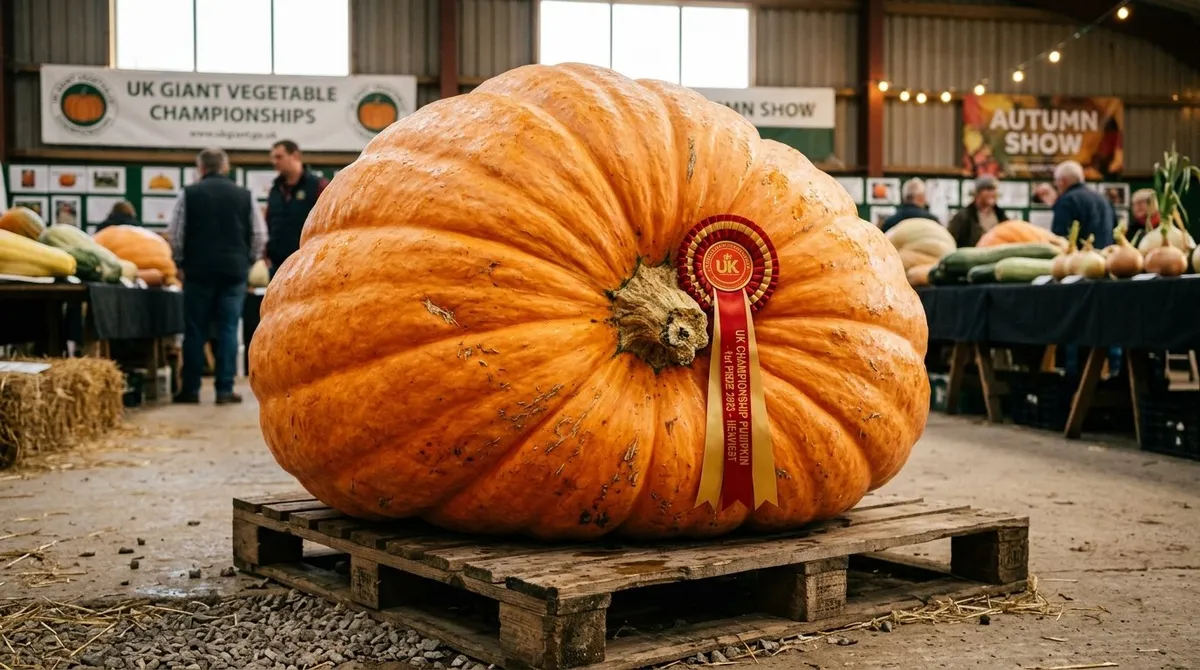
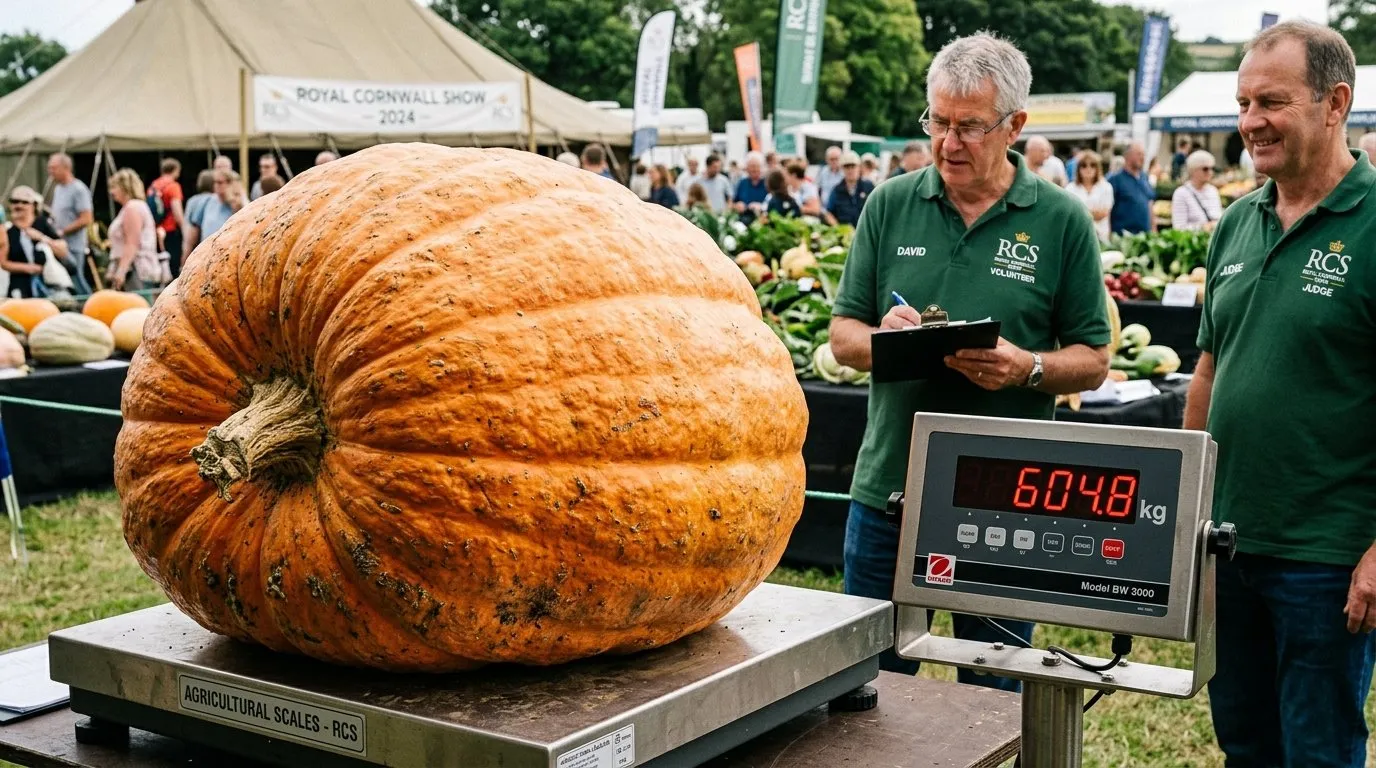 A championship pumpkin is alive, fermenting, and sweating. Champions put on 10kg per day at peak growth and need 100-200 litres of water and 5kg of feed every two days. The plant in this photo weighed 612kg at the 2024 Malvern weigh-in.
Giant pumpkins: the headline event
The Atlantic Giant pumpkin is the most-watched class because the numbers are so absurd. A typical garden pumpkin weighs 5-10kg. A supermarket Halloween pumpkin weighs 4-6kg. A championship pumpkin weighs 600-1,200kg.
The seed is everything. Atlantic Giant pedigrees trace back to Howard Dill’s original 1980s breeding work in Nova Scotia. Modern pedigrees publish parent weights and family lines. A ‘2624 Wallace 2023’ seed is from a 2,624 lb (1,191kg) pumpkin grown by Steve Wallace in 2023. UK growers buy seed from US sources via the Giant Pumpkin Commonwealth seed exchange, paying £30-200 per seed.
Sowing and planting: Late April under heated glass at 28-32°C. Germination in 5-8 days. Pot up to 5L pots within a week. Plant out under cloches in mid-May, only when the bed soil has reached 16°C at depth. One plant per 25 sq m bed.
The vine and fruit selection: A champion vine grows to 18m long with around 30 secondary vines. Growers select a single fruit on the main vine 4-5m from the root, between nodes 12 and 18. All other female flowers are removed. The chosen fruit is shaded with a sun screen, watered through a buried perforated pipe, and turned 5 degrees every few days to prevent flat-sitting.
Feeding: Calcium nitrate (early), then a balanced 5-15-30 NPK feed every 2-3 days through July and August. 5kg of dry feed per week. 100-200 litres of water per day at peak. Daily seaweed foliar feed.
Daily measurement: Champions measure circumference and over-the-top length each morning. Growth charts plot weight gain - a healthy champion pumpkin gains 8-12kg per day in late July. If gain stalls, something is wrong and intervention is needed within 24 hours.
Show day: Pumpkins are lifted onto pallets with custom slings and forklifts. The drive to the show is the most stressful moment - one pothole can crack a 600kg fruit. Most arrive by trailer with foam padding.
In 2024, Stuart Paton’s 1,226kg pumpkin took 8 hours from harvest to weigh-in. The drive from Cornwall to Malvern.
Giant onions: the calmer obsession
Where giant pumpkins are about brute mass, giant onions are about precision. A championship onion is 8-9kg, the size of a small football. The UK has dominated this class for decades.
Seed: Robinson’s Mammoth strain has held UK supremacy since the 1970s. Tony Glover’s 8.97kg world record in 2014 came from this line. Other contenders: Kelsae, Globo. Seed costs £15-25 per packet of 50 seeds.
Sowing: Boxing Day or New Year’s Day. Yes, the seed goes in on December 26th in a heated propagator at 21°C. Champion onions need 270 days from sowing to weigh-in.
Growing on: Pricked out into 9cm pots in February, then 13cm pots in March, then planted into soil in late March or early April under glass. Champion onions live their entire lives in a controlled environment - typically a dedicated greenhouse or polytunnel section, with the bed prepared like a giant pumpkin bed in miniature.
Feeding: Weekly Maxicrop seaweed feed from April. Calcium nitrate fortnightly through May and June. High-potash tomato feed in July and August as the bulb swells.
Bulb support: As the onion approaches 5kg, the leaves cannot support the bulb shape. Growers fashion soft slings from old nylon tights or muslin to prevent the bulb collapsing or rolling. Bulbs are gently rotated every few days for even shape.
Show day: Onions are dressed - outer skins removed, ribbon tied around the neck, presented on green felt. Judges score on weight (primary), shape (secondary), and condition. Damaged or split bulbs are disqualified.
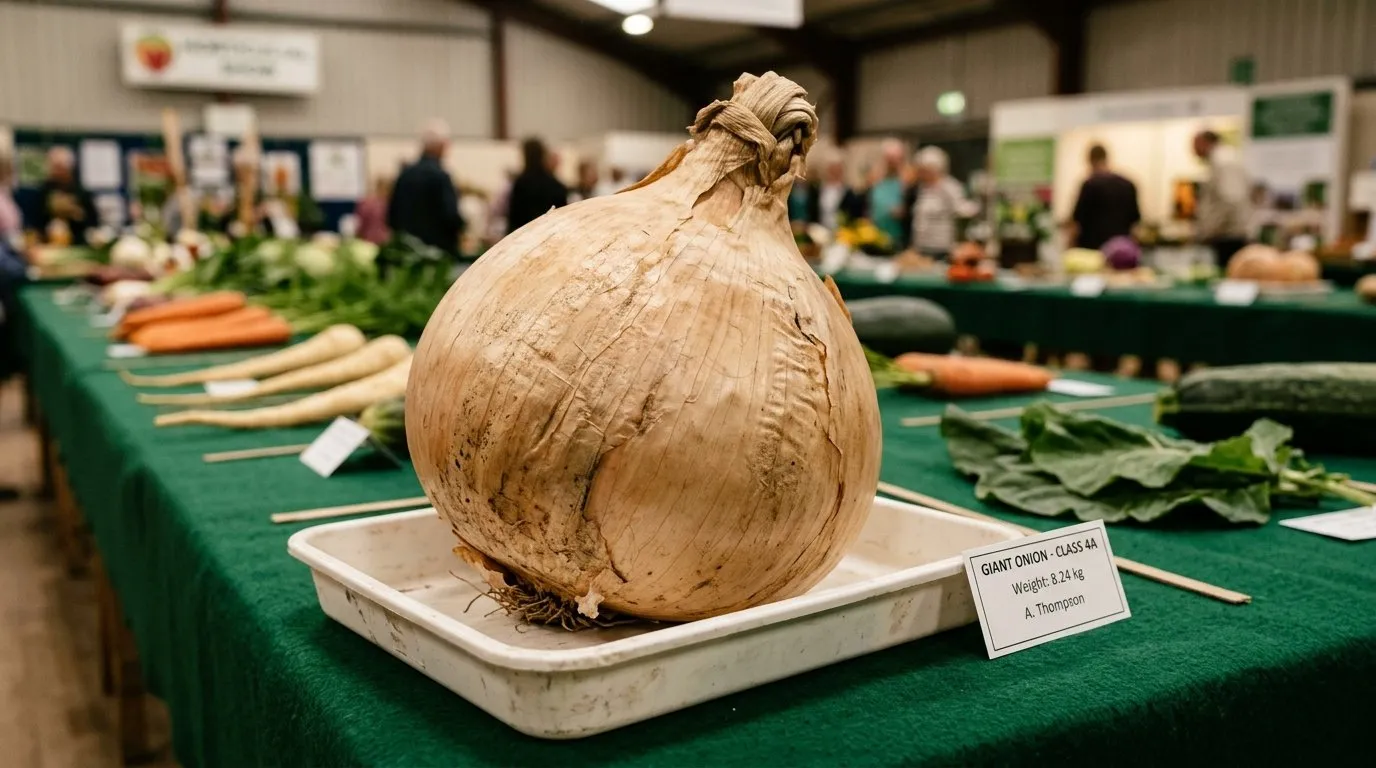 A championship onion is around 8kg. The current UK world record (8.97kg, Tony Glover, 2014) was grown from Robinson’s Mammoth seed sown on Boxing Day. Show judges score primarily on weight, with shape and condition as secondary factors.
Giant leeks: the Northern English specialty
Pot leeks are leeks grown in deep wooden trench beds, judged on volume of the blanched white stem. The class is a North-East England tradition - working men’s clubs and miners’ welfare halls have hosted leek shows since the early 1900s. The National Pot Leek Society tracks records and runs the championship in September.
Seed: Pot leek seed is rarely sold openly. It is exchanged within the society and between trusted growers. A pedigree pot leek seed line is closely guarded - some have been kept in single families for 50+ years. New growers earn a place in the network by attending shows, asking questions, and proving their commitment.
Trench bed: A wooden frame 60cm wide, 60cm deep, and 4m long. Filled with a mix of well-rotted cow manure, sieved leaf mould, soft sand, and a starter base of bone meal. Beds are emptied and refilled annually.
Pip system: Pot leeks are propagated from “pips” - small offsets that grow at the base of show leeks. A grower keeps a single mother plant and divides it each year for the next season’s pips. New genetic material rarely enters a serious grower’s stock - it is all clonal from established lines.
Blanching: The white stem is what counts. Growers wrap the developing stem in heavy black paper or pipe sleeves, gradually adding height through summer to encourage long blanched white sections.
Show day: Three leeks per exhibit, scored on cubic capacity of the blanched stem (length x average circumference). Top exhibits exceed 11kg.
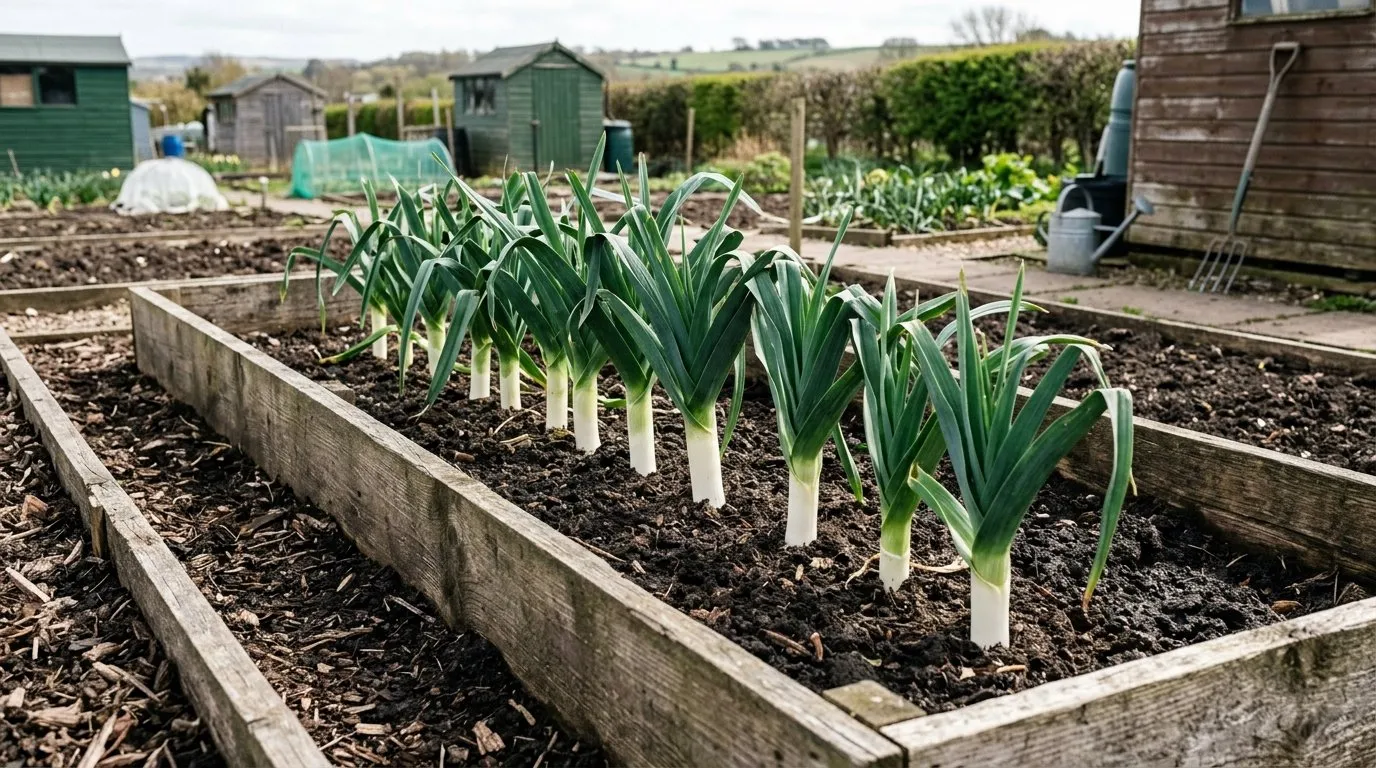 Pot leeks grow in deep trench beds packed with rotted manure and sieved compost. Champion exhibits exceed 11kg per leek, with white stems over 60cm long. The class is dominated by North-East England growers, often from former mining communities.
Long carrots and stump-rooted carrots: vertical engineering
Joe Atherton’s 6.245m long carrot from 2016 is one of the most photographed champion vegetables in UK history. It looks like a piece of orange string. It is.
The growing tube: A 6m vertical PVC pipe, set into a frame in a polytunnel. The pipe is filled with sieved compost - the finer the better, because any stone causes the carrot to fork. Bone meal is added to the base. The tube is the entire growing medium.
Sowing: Three or four seeds at the top of the tube in February. Thinned to one seedling.
Growing on: Root wants down. Compost packing matters more than feeding - any inconsistency in the column causes the root to bend or fork. Watering is from the top, daily, in small amounts.
Show preparation: The most stressful part of the entire process. The carrot is unfurled by gently tipping the tube horizontally and supporting the full length on a long board. The carrot must be presented intact - any breakage disqualifies the entry.
Stump-rooted carrots are different - chunky cylinders 25-30cm wide and 10kg+. These grow in shallower, wider raised beds, fed for mass rather than length. Christopher Qualley’s 10.9kg world record (USA) is the target for UK growers.
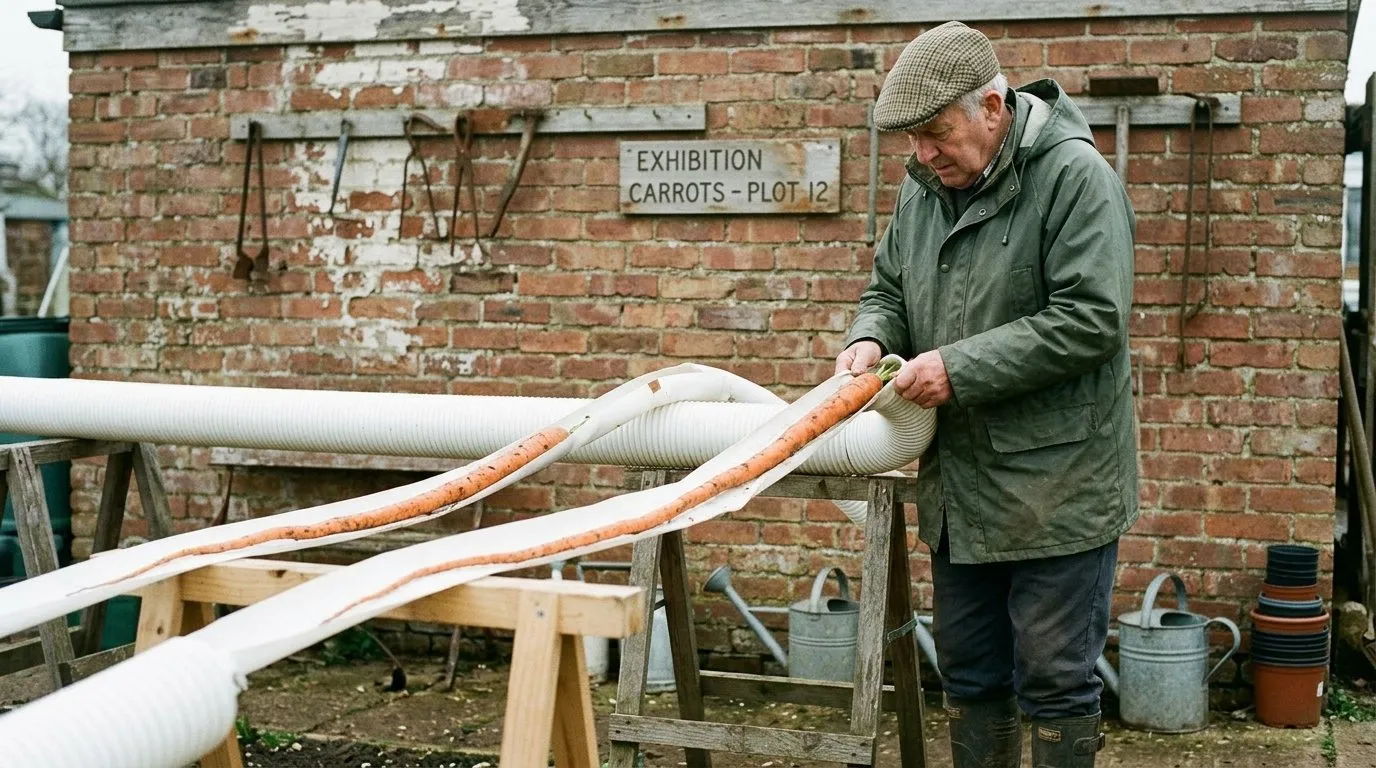 Long carrots grow in 6m PVC pipes filled with sieved compost. Joe Atherton’s 6.245m world record (2016) was unfurled from a tube taller than his Lancashire allotment polytunnel. Any stone in the compost causes the root to fork - sieving is the difference between a 5m carrot and a 50cm one.
Where to see giant vegetables in 2026
If you are not ready to grow them but want to see them, these are the key UK events in 2026.
| Event | Location | Dates 2026 | Notable classes |
|---|---|---|---|
| CANNA UK National Giant Vegetables | Malvern, Worcs | 25-27 September | All major classes - the headline event |
| Harrogate Autumn Flower Show | Harrogate, North Yorks | 18-20 September | Strong long carrot, leek, onion |
| Royal Cornwall Show | Wadebridge | 4-6 June | Early-season giant veg, summer marrows |
| Great Yorkshire Show | Harrogate | 14-16 July | Show veg, traditional classes |
| Shrewsbury Flower Show | Shrewsbury | 14-15 August | Onion, leek, carrot |
| Local agricultural shows | Various | August-October | Open to amateurs - check society websites |
The Malvern Championship is the day to attend if you only go to one. Weigh-in starts at 09:00 on the Friday and runs until early afternoon. Top fruits and vegetables are then displayed all weekend. Entry is around £20 for adults. Champion growers are often happy to talk to visitors - the community is small and welcoming.
For a wider show-grower view, our vegetable show growing UK guide covers the broader exhibition scene including non-giant classes.
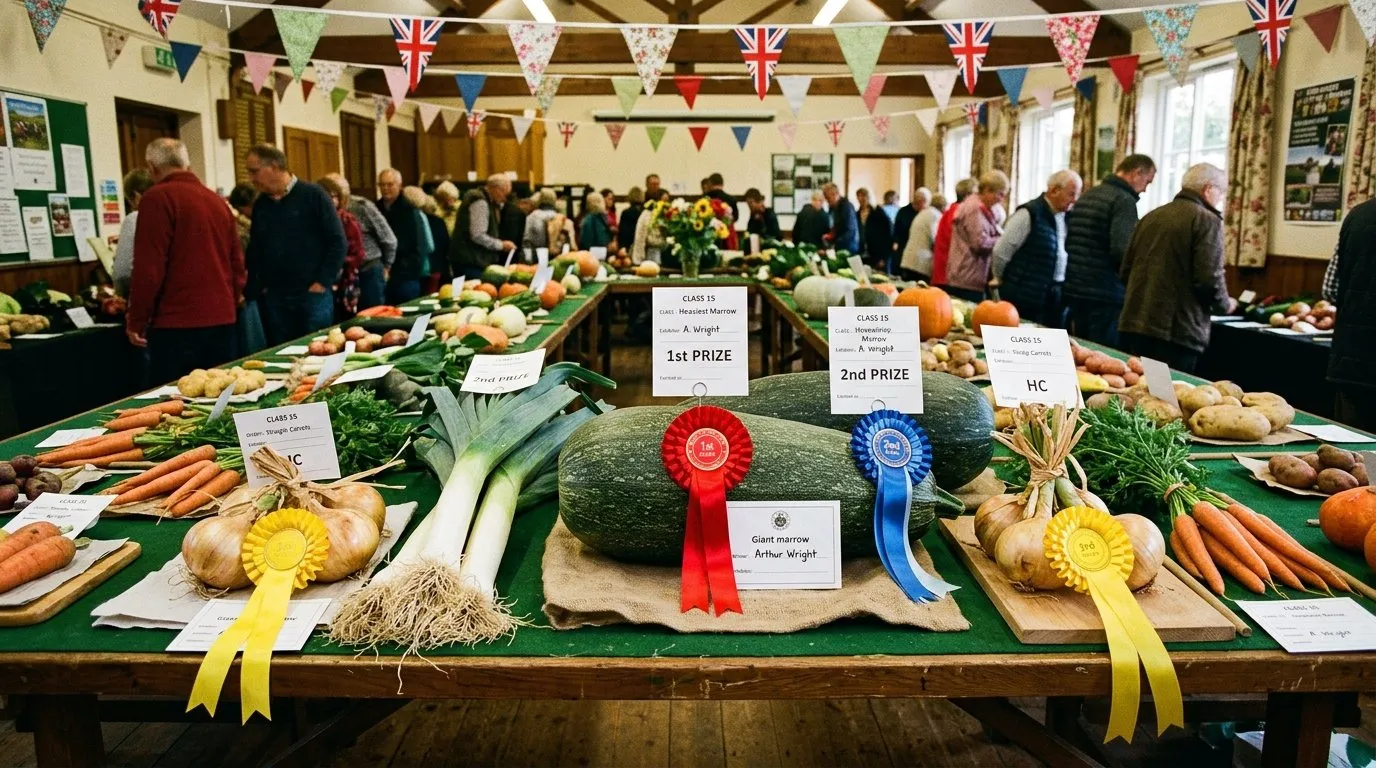 Local village shows accept entries from any grower - you do not need to be a specialist. Most rural agricultural societies hold an autumn show with giant veg classes. Entry is usually free or under £5 per class. Start small with a single onion or marrow.
How to enter your first show
Find a show with classes open to amateurs. Check your local agricultural society or village show. Most have classes for “heaviest marrow,” “longest runner bean,” or “biggest onion.” Entry is usually free or £1-5 per class.
Read the show schedule. Schedules are exact: “three runner beans, average length to be measured.” If you turn up with two or four, the entry is disqualified. Schedules are usually published 8-12 weeks before the show.
Grow with a single class in mind. Pick one class. Grow three or four candidates in good conditions on a normal allotment. The largest one goes to the show.
Enter early in the season’s calendar. Village shows start in August. Pick one and aim for it. The first show you enter is the hardest - by the second show you know the system.
Stage the entry properly. Bring the vegetable in a clean container, present it on the show bench at the right time (most shows stage between 08:00 and 10:30 on show day). Wash off soil, but do not over-handle. Trim leaves and roots according to the schedule.
Stay for the prize-giving. Shows announce winners around 14:00-15:00. Even if you do not win, talking to other entrants and the judge teaches you more in an hour than reading guides for a year.
A first rosette - even a third place at a small village show - is one of the best feelings in growing. The community is welcoming. Champion growers started somewhere.
What does and does not work for an amateur
After three seasons trying to grow giant vegetables on a normal allotment, here is what is realistic and what is not.
Realistic on a normal plot:
- A 30-50kg pumpkin (still a giant by any normal standard)
- A 1-2kg onion (twice the size of a supermarket onion)
- A 50cm-1m long carrot
- A 3-5kg marrow
- A 30-40cm runner bean
Not realistic on a normal plot:
- A 600kg+ pumpkin (needs a 25 sq m bed and daily presence)
- A 8kg+ onion (needs heated glass from Boxing Day)
- A 4m+ carrot (needs a 6m vertical tube)
- A 10kg+ leek (needs a custom trench and decades of pedigree seed)
- World records (need everything above plus 30 hours per week per plant)
The compromise: pick one realistic class. Build skill. Maybe in 5-10 years scale up. Most champion growers started with a single class and one good seed.
What it teaches
Giant vegetable growing looks ridiculous from outside. Why grow a 600kg pumpkin you cannot eat? But the methods - bed preparation, seed selection, daily monitoring, controlled feeding - apply to all serious vegetable growing. The growers who win at the Malvern championship also produce the best ordinary tomatoes, the most reliable runner beans, and the most consistent allotment harvests of anyone you will meet.
The discipline is the lesson. The 600kg pumpkin is just the trophy.
For a different angle on competitive growing, see our vegetable show growing UK guide. For the growing methods that translate to everyday vegetables, grow your own vegetables UK covers practical applications.
Related articles
Our team produces practical UK gardening guidance from source research, contributor records and established horticultural practice. Editorial standards are overseen by Matt W.