
Key takeaways
- A standard grow bag takes two or three tomatoes, two peppers or four to six lettuces
- Put grow bags anywhere sunny, such as a patio, balcony, drive or greenhouse floor
- Water daily in summer, and twice a day in hot weather
- Start a weekly tomato feed once the first fruits begin to set
- Fresh compost each year means no build-up of soil pests and root diseases
- Bigger, deeper bags are easier to keep watered and give stronger plants
Grow bags are the easiest way to grow vegetables when you don’t have a garden bed. Lay a bag of compost on any sunny spot and you can grow tomatoes, peppers, courgettes, salad, herbs and strawberries through the summer. No digging, no soil to sort out. Just compost, sun and water.
What are grow bags and why use them?
A grow bag is a long plastic bag full of compost. You lay it flat, cut holes in the top and plant straight into it. Bags come in different sizes, from fairly slim to deep premium ones.
Advantages of grow bags
No garden needed. Grow bags sit happily on patios, balconies, drives and greenhouse floors. If you’ve got sun and a tap nearby, you can grow food.
Fresh compost every year. Soil pests and root diseases can build up in beds where the same crops grow year after year. Starting with clean compost avoids that.
Cheap and easy to find. Every garden centre sells them, and they cost a lot less than building a raised bed or buying big pots.
Warm roots. The plastic warms up in the sun, which suits heat-lovers like tomatoes and peppers.
Easy to clear. At the end of the season, tip the old compost onto your borders or compost heap and recycle the bag.
Disadvantages
Drying out. A standard bag only holds a shallow layer of compost, so it dries quickly. In hot weather you may need to water twice a day. This is the big one.
Not much root room. Deep-rooted crops like carrots and parsnips won’t grow well. Hungry crops like tomatoes use up the food in the compost within a few weeks, so you’ll need to feed them.
Wobbly plants. Tall plants in a grow bag can catch the wind like a sail. Give them supports that are fixed to something solid, not just pushed into the bag.
Choosing the right grow bag
Grow bags aren’t all the same. Size and compost quality make a real difference.
Standard vs premium grow bags
| Standard bag | Bigger premium bag | |
|---|---|---|
| Compost depth | Shallow | Deeper |
| Holds water | Dries fast | Lasts longer |
| Plants | 2 tomatoes or 4 lettuces | 3 tomatoes or 6 lettuces |
| Best for | Salad and herbs | Tomatoes, peppers, courgettes |
Bigger bags are worth the extra for tomatoes and peppers. The deeper compost holds more water, so you water less, and the roots have more room. For salad and herbs, a standard bag is fine.
Making your own grow bags
Reusable fabric grow bags are another option. You fill them with your own compost, so you choose what goes in.
A good home mix:
- Mostly peat-free multipurpose compost
- A few handfuls of perlite or vermiculite to help drainage
- A little well-rotted garden compost or worm compost
- Slow-release fertiliser, at the rate on the pack
Fabric bags let air reach the roots and are less likely to get waterlogged.
Setting up grow bags
A good setup prevents most problems later.
Positioning
Put grow bags on a flat spot that gets at least six hours of direct sun. South-facing patios, greenhouse floors and sheltered balconies are ideal. Bags on paving or decking warm up faster than those on soil.
Stand bags on a couple of bricks or a pallet if your patio puddles after rain, so the base doesn’t sit in water.
Drainage
Cut four to six small slits in the underside of the bag before you put it in place. Without them, heavy rain turns the bag into a soggy pool and the roots can rot.
Some people cut planting holes in the top and slits in the base. Others cut the whole top off and fold the edges down to make an open tray. The tray is easier to water and plant but dries out faster.
Planting holes
Cut cross-shaped slits in the top where each plant will go, big enough to slip a plant in. Space them evenly: two or three for tomatoes, two for peppers, four to six for lettuce.
Scoop out a handful of compost from each hole. Plant at the same depth the plant was in its pot, firm it in and water well.
 Getting grow bags ready. Slits underneath for drainage, cross-shaped planting holes on top.
Best crops for grow bags
Some crops love grow bags. Others struggle with the shallow compost. Here’s what works.
Tomatoes
The classic grow bag crop. Plant two or three tall (cordon) tomatoes per standard bag, or three in a bigger one. Cordons need support. Use a grow bag frame that sits over the bag, or tie canes to a wall or fence behind it.
Bush types like Tumbling Tom need no staking and tumble nicely over the edges. They’re less work.
Feed weekly with tomato feed once the first truss has set fruit. Our full tomato guide covers varieties, pinching out and common problems.
Peppers and chillies
Great in grow bags. Plant two per standard bag. Peppers and chillies love warm roots. Compact varieties suit grow bags best.
Start tomato feed once the first flowers have set. Peppers need a little less water than tomatoes, but still check every day.
Courgettes
Plant one or two per bag. Courgettes are hungry and thirsty, so a bigger bag gives better results. Our courgette guide has the full how-to.
Feed regularly once they start fruiting. Pick at 15 to 20cm long. Leave them to turn into marrows and the plant slows down.
Cucumbers
Plant one or two per bag. Outdoor types such as Marketmore and Crystal Lemon do well on a sunny, sheltered patio. Our cucumber guide explains training and picking.
Cucumbers hate drying out. In a grow bag that means watering every single day. Patchy watering gives bitter, misshapen fruit.
Salad and lettuce
Plant four to six per standard bag. Cut-and-come-again types give several pickings. Our lettuce guide helps you choose.
Salad is the easiest grow bag crop. The shallow roots suit the bag and it doesn’t need much feeding. Sow or plant a new bag every few weeks for a steady supply.
Strawberries
Plant six to eight per standard bag. Strawberries have shallow roots that suit grow bags well. Everbearers like Mara des Bois fruit over a long season. Let the fruit hang over the edge so it stays clean.
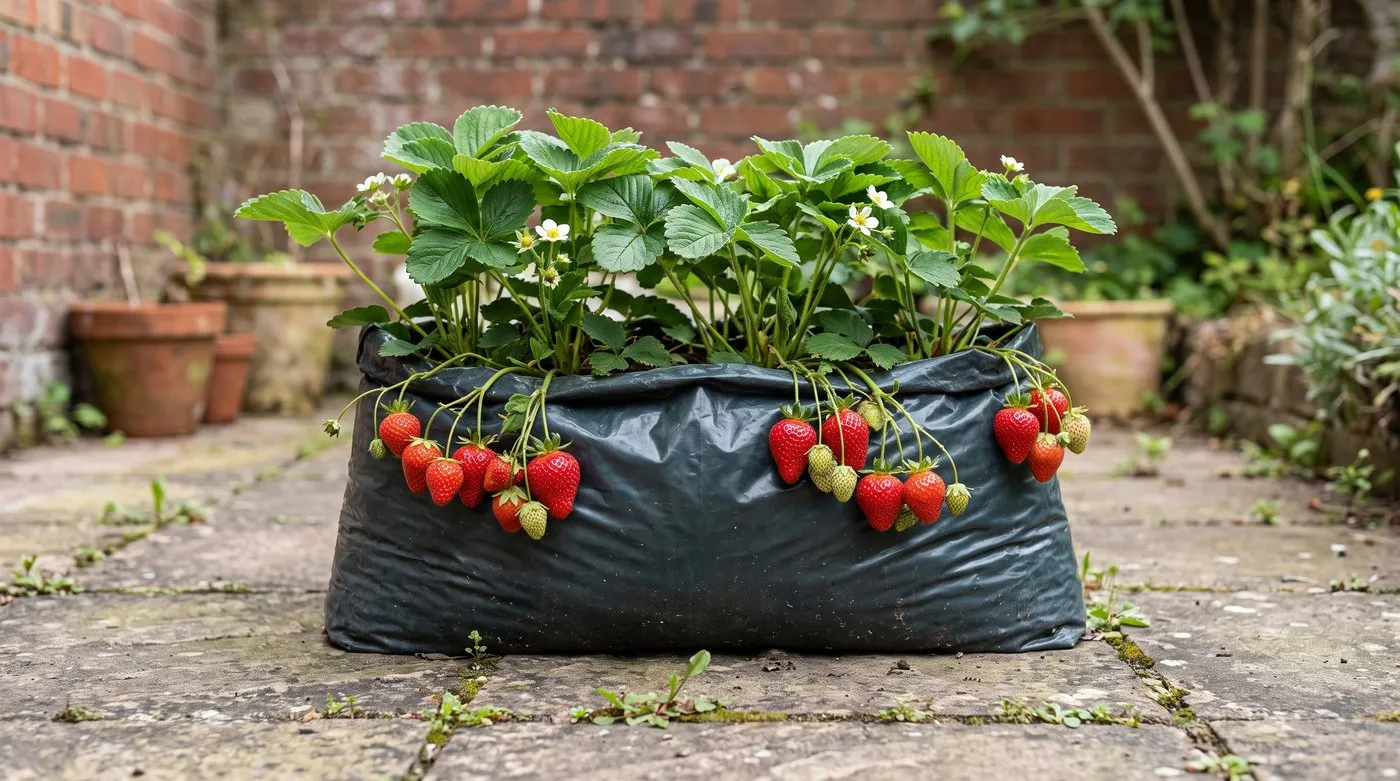
Strawberries have shallow roots that suit a grow bag nicely. Let the fruit hang over the side, where it stays clean and dry and is easy to pick.
Herbs
One bag can hold a little mixed herb garden, such as basil, parsley, coriander and dill. Mediterranean herbs like rosemary, thyme and sage like sharper drainage, so mix in extra perlite for them.
Crops that do NOT suit grow bags
| Crop | Why not |
|---|---|
| Carrots and parsnips | Need deeper soil for their roots |
| Potatoes | Need depth to pile compost up around them |
| Sweetcorn | Too tall and blows over |
| Runner beans | Too big and hungry for a bag |
| Cabbage and broccoli | Need deep roots and a long season |
Watering grow bags
Watering is the most important job with grow bags. Get it right and everything else is easy.
Why grow bags dry out so fast
There’s only a shallow layer of compost, and two or three big leafy plants drinking from it. On a hot, sunny day they can empty it by the afternoon.
Watering schedule
| Weather | How often |
|---|---|
| Cool and cloudy | Once a day, in the morning |
| Warm and sunny | Once or twice a day |
| Hot | Twice a day, morning and evening |
| Greenhouse in summer | At least twice a day |
The best guide is your finger. Push it into the compost. If it feels dry a couple of centimetres down, water.
Watering technique
Water slowly and spread it along the whole bag, not all in one spot. Dry compost can shed water instead of soaking it up, and gentle watering gives it time to sink in.
If water runs straight off, the compost has got too dry. Poke a few holes in the surface with a pencil and water slowly, a little at a time, until it soaks in.
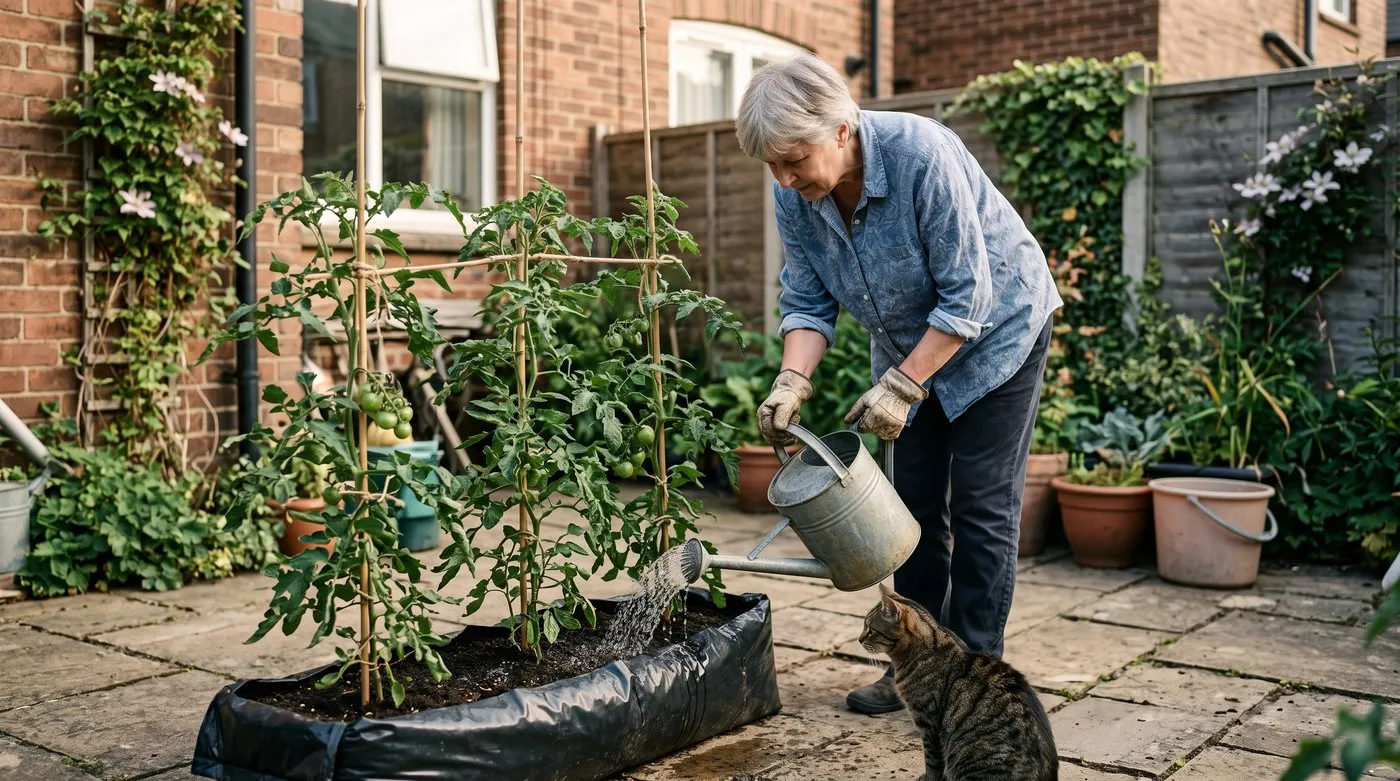
Water gently along the whole bag rather than in one spot, so dry compost has time to soak it up. Evening and morning drinks keep the roots steady in hot spells.
Reducing watering workload
Drip watering: A simple drip kit on a tap timer waters grow bags for you. Put a dripper by each plant.
Grow bag trays: Trays under the bag hold a little water that the compost can soak up, buying you a few extra hours.
Mulch: A thin layer of bark, straw or gravel on the exposed compost keeps it from drying so fast.
Water-retaining granules: Mix them in at planting time. Many premium bags already have them.
Feeding grow bags
A new grow bag only has a few weeks’ worth of food in it. After that, your plants need feeding.
When to start feeding
Tomatoes, peppers, courgettes and cucumbers: Start once the first fruits begin to set. Feeding earlier tends to give lots of leaves and fewer fruits.
Salad and herbs: Feed every two weeks from about three weeks after planting, with a general liquid feed rather than tomato feed.
Strawberries: A high-potash feed (tomato feed is fine) every two weeks from flowering until they finish fruiting.
What to feed
| Feed | Best for | How often |
|---|---|---|
| Liquid tomato feed | Tomatoes, peppers, courgettes, strawberries | Weekly |
| General liquid feed | Salad, herbs, leafy crops | Every two weeks |
| Slow-release granules | Everything, at planting time | Mixed in once |
| Comfrey liquid | Fruiting crops | Weekly, well diluted |
Always follow the dilution on the label for shop-bought feeds.
Gardener’s tip: Comfrey feed is free and great for grow bag crops. Stuff a bucket with comfrey leaves, top up with water, cover and leave for four to six weeks. Dilute the brown liquid with about ten parts water. It smells awful, but plants love it.
 Tomatoes doing well in grow bags on a sunny patio. Tall types need canes, and a weekly feed once the first truss sets fruit.
Ring culture in grow bags
Ring culture is a simple trick that makes tomatoes and peppers in grow bags much easier to look after. You stand a bottomless pot on the bag and plant into that.
How ring culture works
- Put the grow bag in place and cut drainage slits in the base
- Cut holes in the top and stand a bottomless pot (a ring culture pot) over each one
- Plant one seedling in each ring and fill around it with multipurpose compost
- The roots grow down through the ring into the grow bag
- Water and feed into the rings, so it goes straight to the roots
Why it works
The ring gives each plant extra compost. Water poured into the ring goes right down to the roots instead of running off the sides of the bag.
You can buy ring culture pots, or cut the bottom off a 2-litre plastic pot. It works just as well.
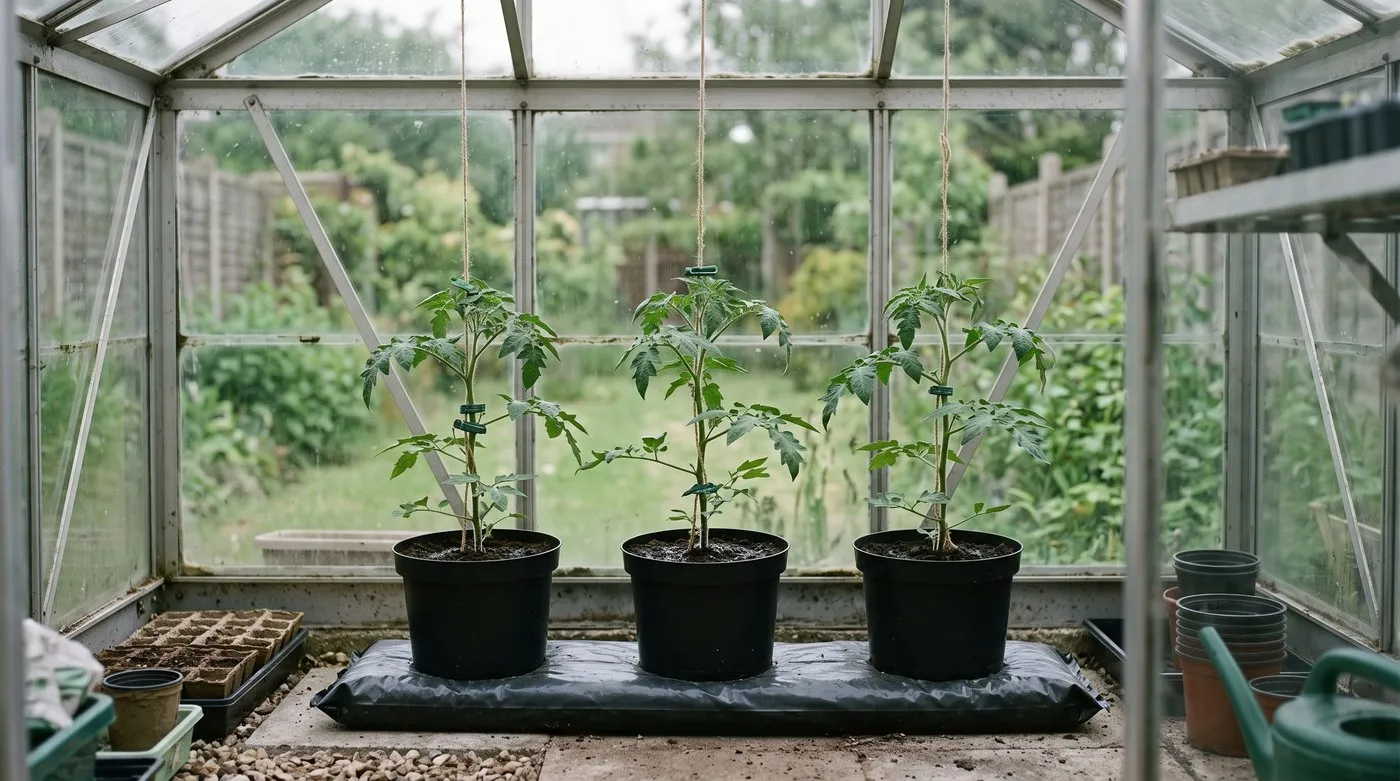
Water and feed into the rings so it goes straight down to the roots. A cut-down plastic pot works just as well as a bought ring.
Grow bags vs pots vs raised beds
Each way of growing has its pros and cons. It depends on your space, budget and what you want to grow.
| Grow bags | Large pots | Raised beds | |
|---|---|---|---|
| Cost | Cheapest | Medium | Most |
| Compost depth | Shallow | Medium | Deep |
| Drying out | Very fast | Medium | Slow |
| Crops | Fruiting crops, salad | Most crops | Everything |
| Move them? | Easily | When empty | No |
| How long they last | One or two seasons | Many years | Many years |
Tomatoes and peppers on a patio: grow bags with ring culture pots are cheap and work well.
A wider range, including root crops: Raised beds give the depth grow bags can’t.
Balconies and small spaces: mix grow bags for tomatoes and salad with pots for herbs and deeper-rooted crops.
Reusing grow bags
A grow bag will do a decent job for a second season if you freshen it up.
How to refresh a grow bag for year two
- Pull out the old plants and roots
- Loosen the compost with a hand fork
- Mix in some fresh multipurpose compost
- Add slow-release fertiliser, at the rate on the pack
- Top up with fresh compost to the original level
Crop rotation in grow bags
Don’t grow the same type of crop in reused compost, as pests and root diseases can build up. If year one was tomatoes, grow salad, herbs or beans in year two.
| Year 1 crop | Year 2 ideas |
|---|---|
| Tomatoes or peppers | Lettuce, herbs, beans |
| Courgettes or cucumbers | Tomatoes, peppers |
| Salad or herbs | Anything |
After two seasons the compost is worn out. Spread it on your borders, add it to the compost heap, or use it as a mulch round shrubs.
 Grow bags on a balcony. Even a tiny space can give you fresh salad, herbs and cherry tomatoes all summer.
Troubleshooting common grow bag problems
Plants wilting in the afternoon
The most common problem, and it means the compost has dried out. Water well morning and evening in hot weather. A tray underneath and a mulch on top both help.
Blossom end rot on tomatoes
A dark, sunken patch on the bottom of the fruit. It’s caused by uneven watering, which stops the plant taking up enough calcium. Water steadily every day. Trays and drip watering help keep things even.
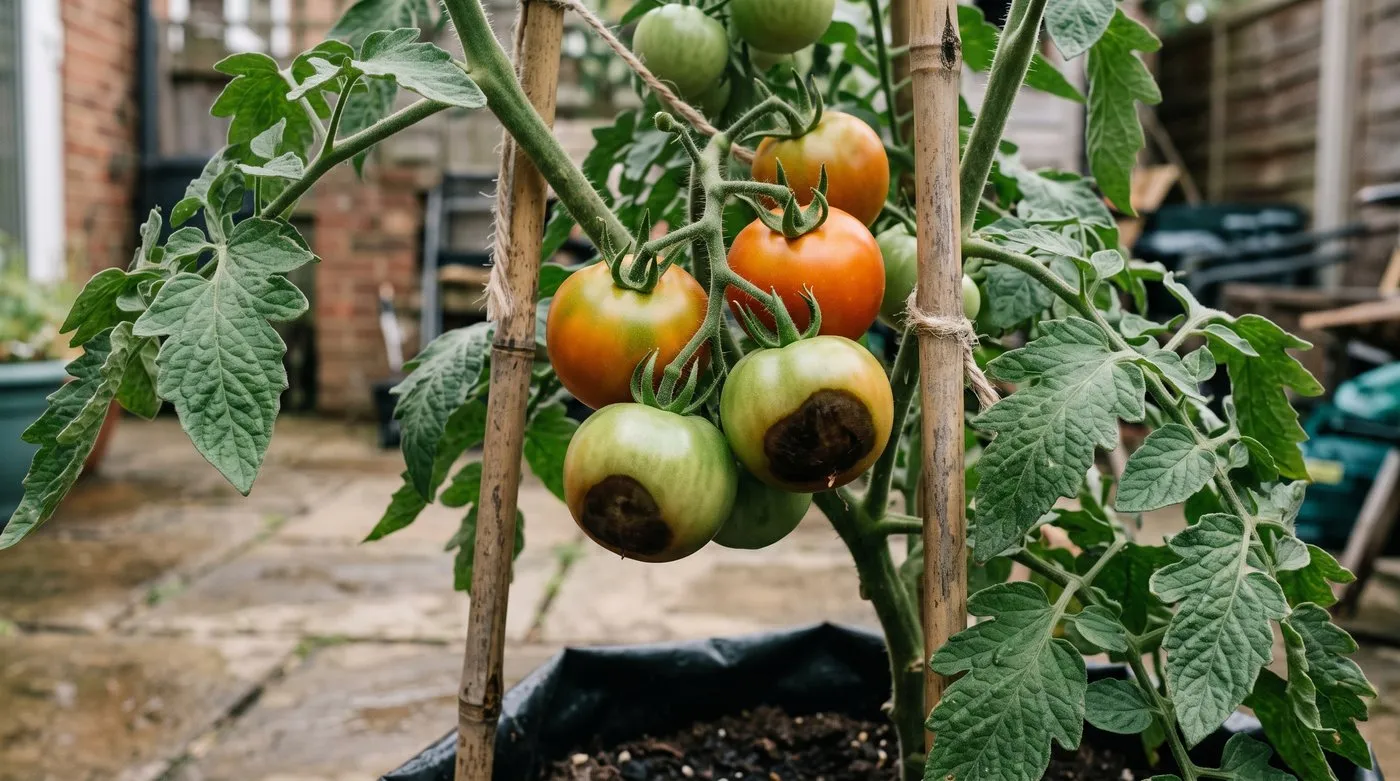
Blossom end rot comes from patchy watering, not a disease, so pick off spoiled fruit and water steadily every day. The next trusses should come through clean.
Yellow lower leaves
Usually the plant is running short of food, especially nitrogen, by midsummer. Give a general liquid feed. If you’ve only been using tomato feed, swap in a general feed every other week.
Fungus gnats (tiny black flies)
Little flies buzzing around the compost. They’re mostly a nuisance and breed in wet compost. Let the top of the compost dry a little between waterings. Yellow sticky traps catch the adults, and a thin layer of grit on top helps.
Root-bound plants
Big plants like tomatoes and courgettes can fill a standard bag with roots by late summer, so it can’t hold much water. Water more often and keep feeding this year. Next year, go for bigger bags.
Month-by-month grow bag calendar
| Month | Jobs |
|---|---|
| April | Buy grow bags. Set them up in the greenhouse to warm |
| May | Plant tomatoes and peppers in greenhouse bags. Wait until after the last frost outdoors |
| Late May | Plant outdoor bags with hardened-off tomatoes, peppers and courgettes |
| June | Start weekly feeding as fruits set. Water daily. Plant salad and herb bags |
| July | The thirstiest month. Water twice a day when hot. Keep feeding |
| August | Pick tomatoes, peppers, courgettes and cucumbers. Keep watering and feeding |
| September | Still picking. Water a bit less as days get cooler. Plant autumn salad in refreshed bags |
| October | Clear finished crops. Compost the old compost or refresh bags for next year |
Grow bags aren’t glamorous, but they’re cheap, reliable and work where nothing else will. For renters, new gardeners and anyone without a bed, they’re the quickest way from seed to supper. Next, read our guide to growing tomatoes in the UK.
Frequently asked questions
How many plants can I put in a grow bag?
Two or three tomato plants fit a standard grow bag. It also takes two peppers or aubergines, one or two courgettes, or four to six lettuces. Don’t overcrowd it. Too many plants fight over water and food and you get smaller harvests.
Do I need to put drainage holes in grow bags?
Yes, cut a few small slits in the base. Without them, the compost can get waterlogged after heavy rain and the roots may rot. Some people cut the whole top off and use the bag as an open tray instead. Both work.
How often do you water grow bags?
Once or twice a day in summer. The compost is shallow, so it dries out faster than a pot or bed. In hot weather, check morning and evening. Steady watering helps prevent blossom end rot on tomatoes. Ring culture pots help direct water to the roots.
What is the best compost for grow bags?
Most ready-made grow bags hold peat-free multipurpose compost. Better bags have extra food and something to help hold water or drain well. You can also fill fabric grow bags with your own good multipurpose compost, which gives you more control.
Can I reuse grow bags?
Yes, for one more season. The compost is tired after the first crop. Top it up with fresh compost and add a slow-release fertiliser. Grow a different type of crop the second time. After two seasons, spread the old compost on your borders or add it to the compost heap.
Are grow bags better than pots?
Each has its good points. Grow bags are cheap, light and start with fresh compost. Pots hold more compost per plant, dry out more slowly and are sturdier. For patio tomatoes and peppers, grow bags with ring culture pots work well. For permanent plants, use pots.
Can I grow strawberries in a grow bag?
Yes, strawberries do well in a grow bag. Their shallow roots suit it. Plant six to eight in a standard bag, in full sun, and keep the compost evenly moist. Feed with a high-potash liquid feed once flowers appear. Replace the plants every three years or so.
Our team produces practical UK gardening guidance from source research, contributor records and established horticultural practice. Editorial standards are overseen by Matt W.


