
Key takeaways
- Sow indoors from February to April and plant out in May or June
- Plant really firmly, as loose plants give loose, open sprouts
- Stake tall plants from August so winter winds don't rock them
- Net against pigeons from the day you plant out
- Pick from the bottom up when sprouts are firm and about 2 to 3cm across
- A few frosts make the sprouts sweeter, so there's no rush
Brussels sprouts are one of the best winter veg you can grow. They stand in the plot through the coldest months and give you fresh pickings from November right through to March. And home-grown sprouts picked after a hard frost taste far better than anything from the shop.
Which Brussels sprout varieties grow best in the UK?
Modern F1 varieties are the easiest, as they make neat, tight sprouts that hold well through winter. Older types offer different colours and flavours but need a bit more care.
Best varieties for UK gardens
- Brigitte F1: a reliable early variety with plenty of tight, medium-sized sprouts from October to December.
- Crispus F1: a mid-season variety picked from November to February. It’s known for its resistance to clubroot, which makes it a great choice if that’s a problem in your soil.
- Trafalgar F1: a late variety picked from December to March. Sweet, dense sprouts that taste great after hard frosts.
- Falstaff: a gorgeous red-purple sprout that keeps its colour if lightly cooked. Milder and nuttier than green ones.
- Flower Sprouts (Kalettes): a cross between sprouts and kale with small, frilly purple-green rosettes. Sweeter and milder, and ready from November.
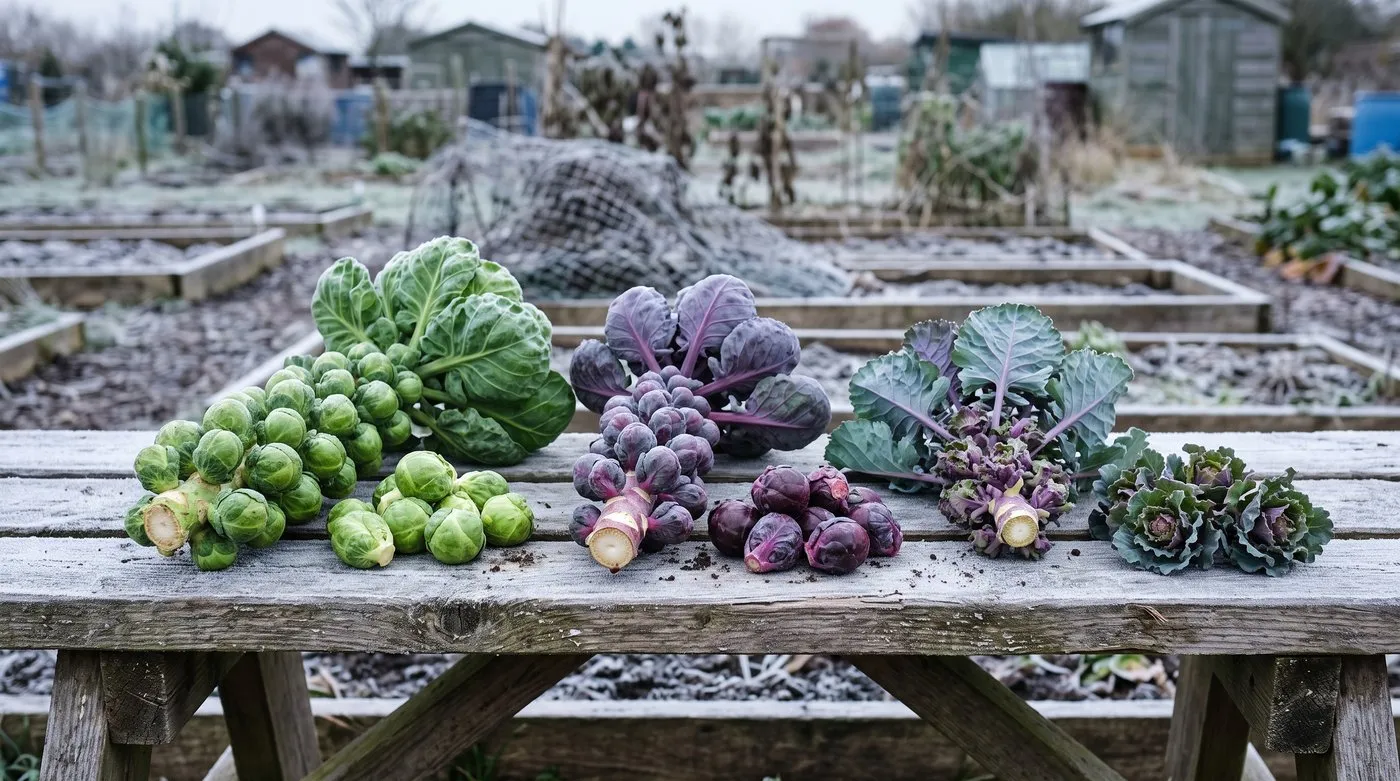
Red Falstaff and frilly flower sprouts make a nice change from green. Lightly cooked, the red ones keep much of their colour.
Variety comparison table
| Variety | Season | Picking | Best for |
|---|---|---|---|
| Brigitte F1 | Early | Oct to Dec | Early, reliable crop |
| Crispus F1 | Mid | Nov to Feb | Long season, clubroot-prone soil |
| Trafalgar F1 | Late | Dec to Mar | Late winter, sweet after frost |
| Falstaff | Mid | Nov to Feb | Colour, mild flavour |
| Flower Sprouts | Mid | Nov to Feb | Mild, kale-like texture |
Handy tip: Grow an early variety like Brigitte alongside a late one like Trafalgar. You’ll be picking from October to March with no gap.
When to sow Brussels sprouts
Sow early in the year, as sprouts need a long season. Our UK vegetable planting calendar shows how they fit in with your other brassicas.
February to March (under cover)
Sow indoors or in an unheated greenhouse from mid-February to late March. Use module trays or 8cm pots of seed compost, one seed per cell, 1.5cm deep. Seedlings appear in a week or two. Our guide to sowing seeds indoors covers the basics.
February sowings give the biggest plants and the earliest sprouts, from October. Plant them out from mid-April under fleece, or in early May.
March sowings are the most popular. They go out in May and crop from November, with less risk from late frosts.
April (direct or under cover)
April is the latest sensible time. You’ll still get a crop, but it starts later, from December. Sow in modules and plant out in June. Sowing straight outside is possible, but pigeons, slugs and flea beetle love young seedlings.
How to plant Brussels sprouts (and why firmness matters)
Plant firmly. It’s the single most important thing for good sprouts. A plant that rocks in the wind gives loose, open sprouts. A plant held tight in the soil gives firm, sweet ones.
Preparing the ground
Sprouts are hungry. Dig in plenty of well-rotted compost or manure several months before planting. By planting time the soil should be settled and firm, not freshly dug and fluffy.
Brassicas like slightly alkaline soil. Acid soil raises the risk of clubroot. Check with a cheap pH kit, and if your soil is acid, add garden lime in autumn.
Pick a sunny spot with shelter from strong wind. A hedge, fence or wall behind them is ideal.
Transplanting
Plant out when seedlings have four to six true leaves and are 10 to 15cm tall, usually six to eight weeks after sowing. Space them 60cm apart in rows 75cm apart. It looks very generous for tiny plants, but they get big.
How to plant them firmly:
- Water the plant well an hour before planting
- Dig a hole a little deeper than the root ball
- Set the plant so the lowest leaves sit just above the soil
- Fill in and press the soil down firmly with your knuckles
- Press again round the stem with your heel
- Tug a leaf gently. The plant shouldn’t move at all
If it shifts, firm it again. For the first few weeks, check after rain or wind and re-firm any that have loosened. This one habit makes all the difference.
Raised beds work if they’re at least 45cm deep and filled with a soil-based mix. Pure compost is too soft for sprouts to root firmly.
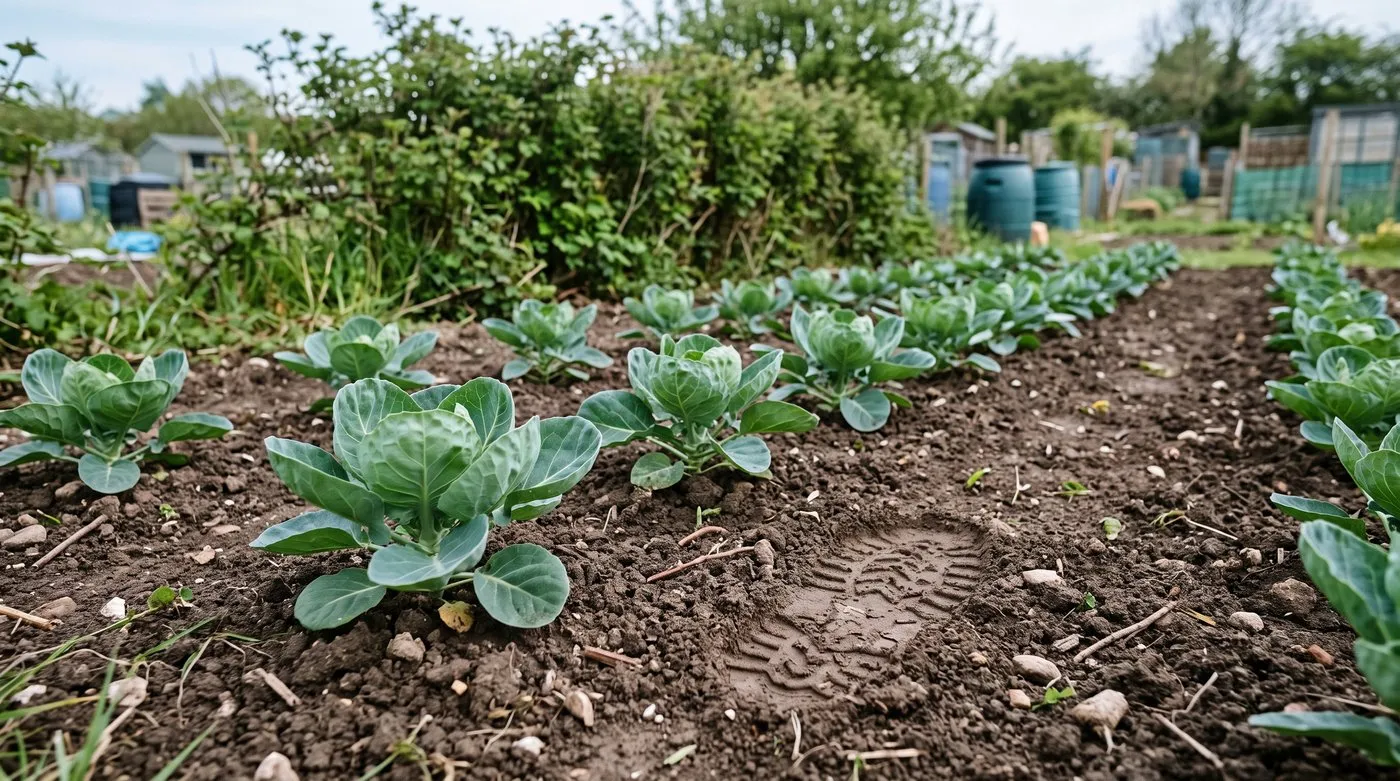
The spacing looks very generous for tiny plants, but they fill it by autumn. Firm, settled soil gives the tight sprouts you’re after.
Earthing up and staking tall plants
Earthing up
Draw soil up round the base of the stem with a hoe. This is called earthing up. It anchors the plant and supports the heavy stem.
Do it twice: once in July or August when plants are 30 to 40cm tall, and again in September or October when the stem is loaded with sprouts.
Staking
Stake each plant from August. Most varieties grow 60 to 90cm tall and get top-heavy by autumn. Winter gales can rock or snap them.
Push a sturdy cane or stake about 30cm into the ground next to the stem. Tie the stem at two points with soft twine, not too tight, as the stem keeps thickening.
On really windy sites, run a strong wire or twine between end posts at about 45cm high, so the whole row has something to lean on.
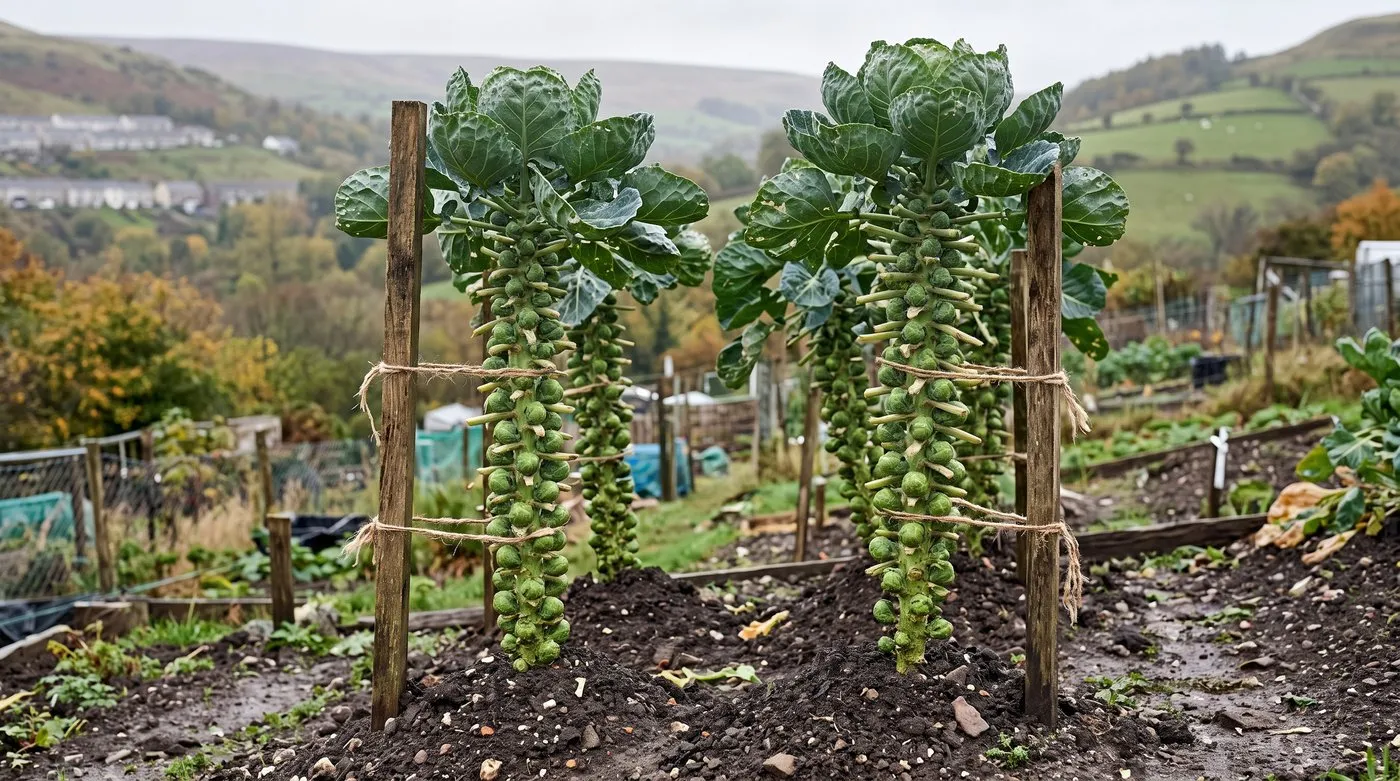
Tie each stem at two points, loosely enough to let it thicken. On windy sites it stops winter gales rocking the plants and loosening the sprouts.
Netting against pigeons and cabbage white butterflies
Net your sprouts. It’s a must. Pigeons and cabbage white butterflies both love them.
Pigeons
Net from the day you plant out. Pigeons remember where the brassicas are and keep coming back. They can strip leaves to bare ribs in hours, and badly damaged plants rarely recover.
Hold the netting up on hoops or canes, not resting on the leaves, or pigeons will peck through it. Peg the edges down well, as they’ll walk in under any gap.
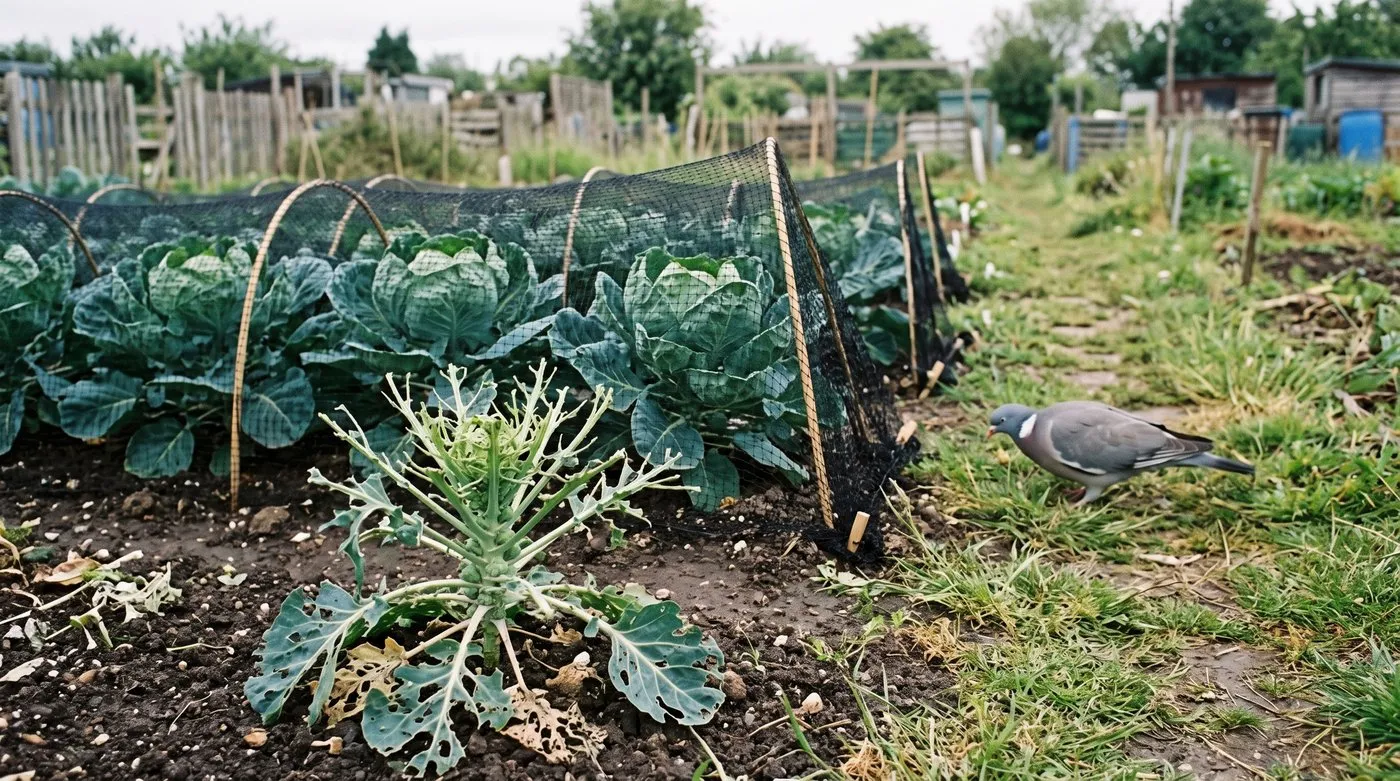
Pigeons can strip a plant to its ribs in hours. Net on planting day, with the netting held up off the leaves so they can’t peck through.
Cabbage white butterflies
Cabbage whites lay eggs on brassica leaves from May to September, and the caterpillars munch holes in the leaves. Fine insect mesh keeps the butterflies out but lets rain and air through.
Check under the leaves every week from May. Small white eggs are yellow and laid one at a time. Large white eggs are yellow and laid in clusters. Pick off eggs and small caterpillars before they do much damage.
Cabbage root fly protection
Cabbage root fly grubs eat the roots, and the plant wilts and can die. The fly lays its eggs at the base of the stem.
Prevention methods
- Brassica collars: cut 15cm squares of felt, carpet underlay or cardboard. Slit to the middle and fit snugly round the stem at soil level on planting day. They stop the fly laying eggs by the stem.
- Fine mesh covering: insect-proof mesh over the whole crop keeps the fly out, and stops butterflies and pigeons too.
- Crop rotation: don’t grow brassicas in the same spot two years running.
Collars are the cheapest and simplest. Fit them on planting day and leave them all season.
Feeding, watering, and ongoing care
Feeding
Sprouts are greedy. After planting, scatter a high-nitrogen feed like pelleted chicken manure round each plant in June and again in August, and water it in.
Don’t overdo the nitrogen after August. Too much late feeding gives soft, leafy growth and loose sprouts.
Watering
Water during dry spells from June to September, especially in the first month after planting. Steady moisture gives bigger, more even sprouts. Water at the base, not over the leaves.
Removing yellowing leaves
As the season goes on, the lower leaves turn yellow. Snap them off with a downward pull. They can harbour pests and disease, and removing them lets air round the sprouts.
Removing the growing tip in September
Taking off the top of the plant helps the sprouts ripen evenly up the stem. Without it, the plant keeps growing upwards and the top sprouts can stay small.
How and when to do it
In early to mid-September, cut off the leafy top of the stem with secateurs. Too early and the plant hasn’t grown enough. Too late and the sprouts don’t have time to respond before the cold slows them down.
The sprouts should swell nicely over the next few weeks, and the whole stem will be ready around the same time.
Handy tip: Leave the tip on if you want a long, slow harvest. Late varieties like Trafalgar are great left alone and picked from the bottom over several months. Only top early varieties you want to pick in one go.
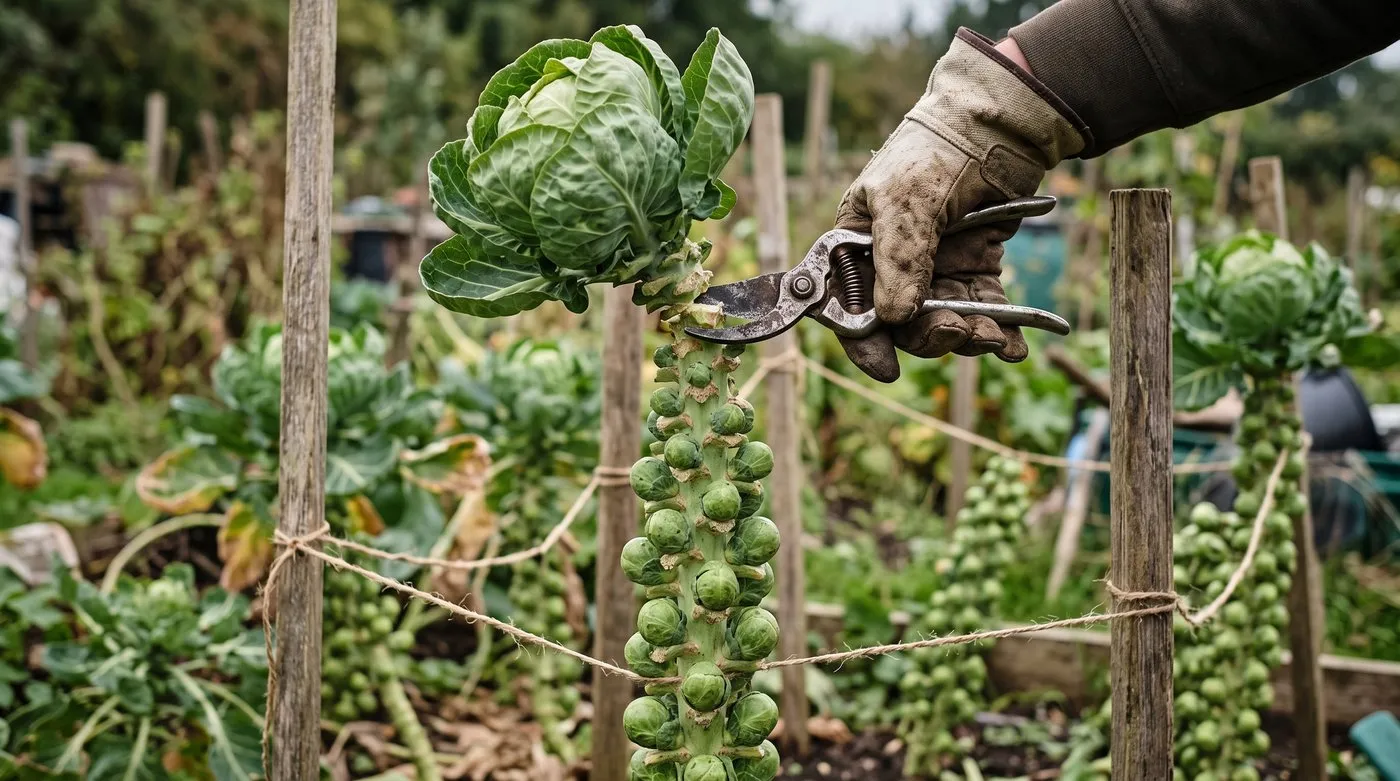
Taking the top off in September helps the whole stem ripen together. The leafy tops are good to eat too, cooked like spring greens.
How to harvest Brussels sprouts
When to pick
Pick sprouts when they’re about 2 to 3cm across and feel firm when you squeeze them. Soft, loose ones are either not ready or have opened up. Picking runs from October for early varieties to March for late ones.
Frost makes them sweeter. Cold weather turns some of the starch into sugar, so sprouts picked after a few frosts taste sweeter and nuttier. The RHS guide to growing Brussels sprouts is a great extra read.
Harvesting technique
Always pick from the bottom of the stem upwards. The lowest sprouts are ready first. Snap each one off with a downward twist, or cut close to the stem with a sharp knife.
Pick what’s ready rather than stripping the whole stem. One plant keeps giving for weeks as the sprouts ripen up the stem.
When the stem is bare, cut it down and chop it up for the compost heap, as the woody stalks are slow to rot. Dig up the roots too, as leaving brassica roots in the ground can let pests and diseases carry on.
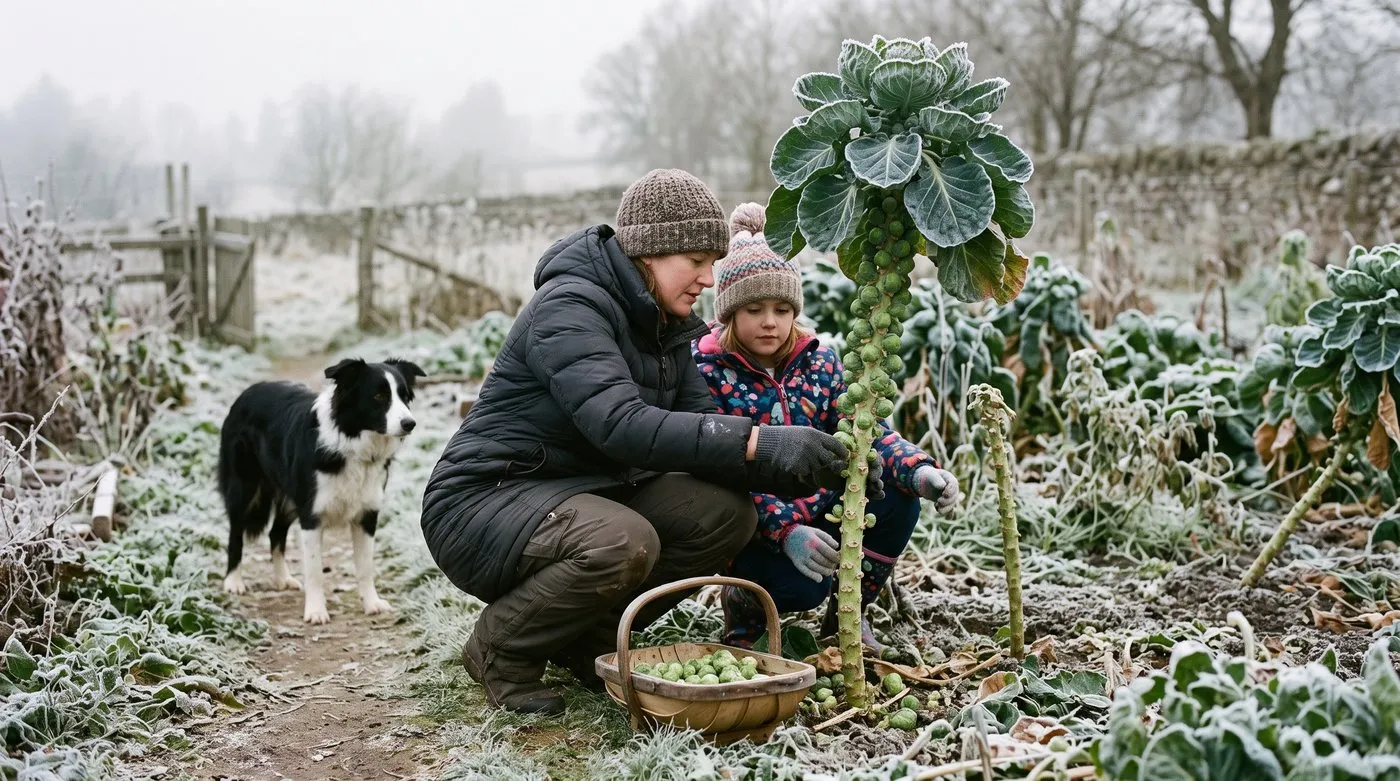
Pick from the bottom up and take only what’s ready. A few frosts turn some of the starch to sugar, so they taste sweeter.
Month-by-month Brussels sprouts calendar
| Month | What to do |
|---|---|
| January | Order seed. Plan where they’ll go |
| February | Sow early varieties indoors in modules |
| March | Keep sowing indoors. Pot on February sowings if needed |
| April | Last sowings. Start hardening off the earliest plants |
| May | Plant out February and March sowings. Firm well. Net straight away |
| June | Plant out April sowings. Fit collars. Water in dry spells. Feed |
| July | Earth up stems. Check for caterpillars weekly |
| August | Stake all plants. Feed again. Earth up again. Watch for whitefly |
| September | Take the tips off early and mid-season varieties |
| October | Start picking early varieties. Remove yellow leaves |
| November | Main picking begins. Pick from the bottom up |
| December | Keep picking. Check stakes after storms. Re-firm loose plants |
Five common mistakes when growing Brussels sprouts
Sprouts have a reputation for being tricky, but most problems come from the same few slip-ups.
1. Planting too loosely
The number one cause of poor sprouts. If the stem rocks, the sprouts open up. Firm with your heel and re-firm after rain or wind. You really can’t plant them too firmly.
2. Forgetting to net against pigeons
Pigeons can flatten a row of young plants in a morning. Net on planting day, not after the first attack.
3. Sowing too late
Sprouts need their full season. Sowing after mid-April leaves too little time for a big, strong plant, and you’ll get fewer, smaller sprouts.
4. Overcrowding
Squeezing plants closer than 60cm gives smaller sprouts and more disease. Give each plant room in every direction.
5. Picking before frost
Patience pays. Sprouts picked before any frost can taste a bit bitter. Wait for a few cold nights and they’ll be much sweeter.
Pests and diseases to watch for
As well as pigeons, cabbage whites and root fly, keep an eye out for these.
Clubroot
Clubroot is a soil disease that swells roots into knobbly clubs, so the plant can’t take up water. Plants wilt on warm days and may die.
It loves acid, wet soil, and it stays in the ground for many years. Prevention is the only answer. Lime the soil so it’s slightly alkaline, improve drainage, rotate your crops and raise plants in pots of fresh compost. Crispus F1 is a good choice where clubroot is a problem.
Whitefly
Tiny white insects that gather under the leaves. They’re more of a nuisance than a real threat. Hose them off and let ladybirds help. Numbers drop after the first frosts.
Mealy aphid
Grey-green aphids that get into the inner leaves and sprouts, which makes them harder to shift. Encourage ladybirds and lacewings, and pick off badly affected leaves. If you need to spray, use a product authorised for edible crops, exactly as the label says.
Downy mildew
Yellow patches on top of leaves with grey-white mould underneath. It’s worse in cool, damp, crowded beds. Remove affected leaves, space plants well and water at the base.
Growing Brussels sprouts in small spaces and containers
Sprouts prefer open ground, but you can still grow a few in a small space.
In containers
Use a pot at least 45cm deep and 45cm wide per plant. Fill with John Innes No. 3 or another heavy, soil-based compost to anchor the plant. Light multipurpose compost on its own lets the plant rock.
Stake from the start and stand the pot against a sheltered wall. Water daily in summer. Feed every two weeks with a balanced liquid feed from June to August, then stop. You’ll get a smaller crop, but they’ll still taste great after frost.
In raised beds
Raised beds at least 45cm deep are great for sprouts. Fill with a heavy soil-based mix, not pure compost, and keep plants 60cm apart.
Companion planting
Low plants like nasturtiums, thyme and marigolds look lovely round the base of sprout plants. Nasturtiums are often grown as a decoy for aphids. Thyme and marigolds are said to put off cabbage whites, though there’s little proof.
Storing and using fresh Brussels sprouts
Fresh sprouts keep in the fridge for up to a week, but they’re best eaten within two or three days.
Freezing works well. Trim them, blanch for three minutes, plunge into iced water, drain well and freeze on a tray before bagging. They keep for months.
On the stalk is a lovely way to store them for a few weeks. Cut the whole stem and stand it in a bucket of water in a cold shed or garage.
In the kitchen, try roasting them. Halve them, toss in olive oil and salt, and roast at 200C for 20 to 25 minutes until golden at the edges. It wins over even the most stubborn sprout-dodger. Shredded raw sprouts also make a great winter slaw with toasted hazelnuts.
Now you’ve got sprouts sorted, read our guide on growing broccoli and calabrese in the UK to round off your winter brassicas.
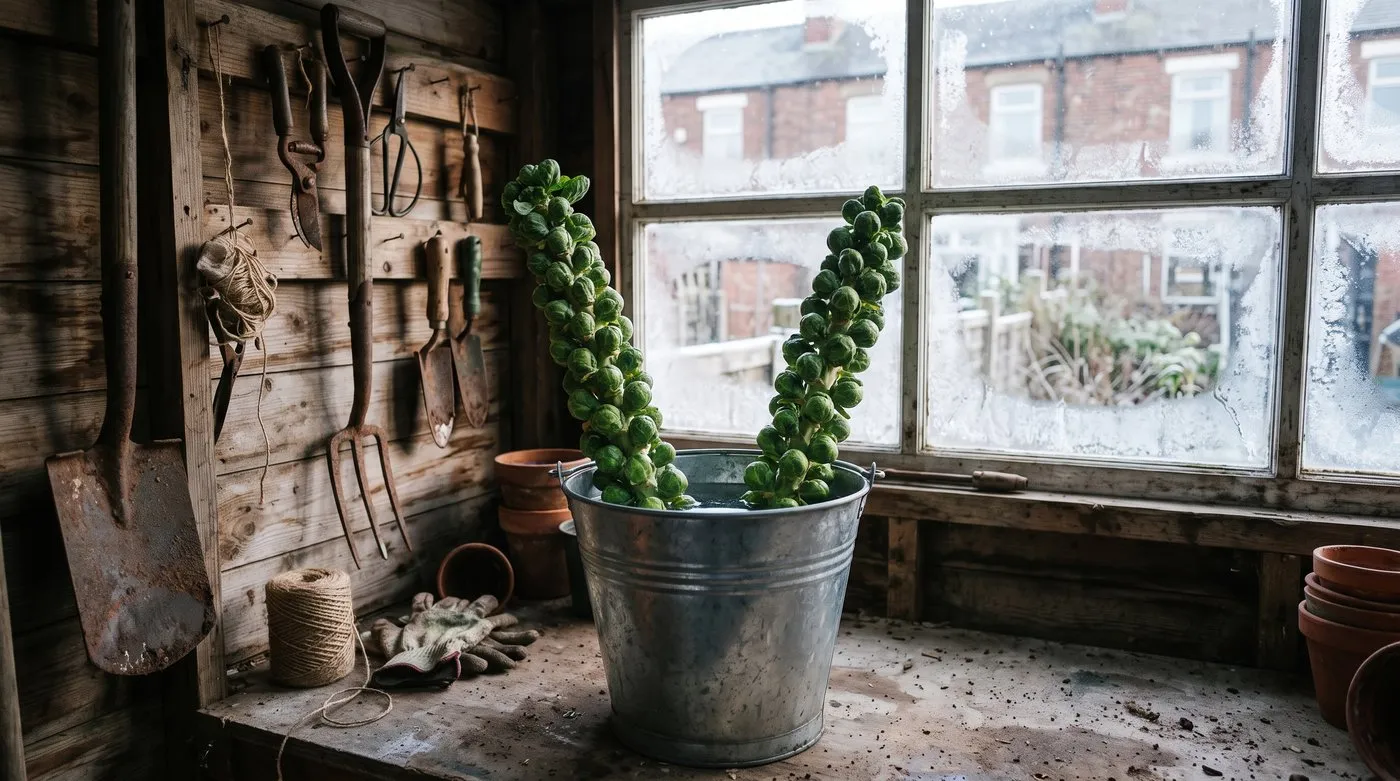
Cutting the whole stalk and standing it in water in a cold shed keeps sprouts fresh for a few weeks. Snap them off as you need them.
Frequently asked questions
When should I sow Brussels sprouts in the UK?
Sow them from February to April. Early sowings under cover give strong plants ready to go out from May. Later sowings can go in a seedbed and be moved in early summer. Earlier sowing gives bigger plants and a longer season. Protect seedlings from slugs, pigeons and flea beetle.
Why are my Brussels sprouts loose and open?
Usually because the plant is loose in the soil. If the stem rocks, it can’t make tight sprouts. Firm the soil well so the plant doesn’t move when you tug a leaf. Too much nitrogen, too little sun, crowding and dry soil can also cause loose sprouts.
Do Brussels sprouts need staking?
Yes, most do, especially on windy sites. Tall, top-heavy plants rock in the wind, which loosens the roots and makes the sprouts open up. Push a sturdy cane in beside each plant and tie the stem loosely with soft twine. Draw soil up round the stems for extra support.
How do I protect Brussels sprouts from pigeons?
Net them from the day you plant them out. Hold the netting up on canes or hoops so it doesn’t touch the leaves. Pigeons can strip plants to bare stalks within days, especially in winter. Netting is the only thing that really works. Bird scarers only help for a short while.
Does frost improve the flavour of Brussels sprouts?
Yes, frost makes them sweeter. Cold weather turns some of the starch into sugar, so the sprouts taste sweeter and nuttier. That’s why the traditional picking season runs through winter. Modern varieties are milder anyway, but lots of gardeners still prefer them after a frost.
When should I remove the growing tip?
In September, if you want the sprouts to ripen together. Pinch or cut off the leafy top of the stem. The plant stops growing taller and puts its energy into the sprouts. It suits early varieties you want to pick in one go. For a long, slow harvest, leave the tip on.
Can I grow Brussels sprouts in containers?
Yes, though they’re happier in the ground. Each plant needs a big pot at least 45cm deep and wide, filled with soil-based compost. The tricky bit is keeping them upright, so stake each plant firmly and stand the pot against a sheltered wall. Expect a smaller crop.
Further reading
Our team produces practical UK gardening guidance from source research, contributor records and established horticultural practice. Editorial standards are overseen by Matt W.


