
Key takeaways
- Sow indoors from mid-April in deep pots and plant out after the last frost
- Plant in a block of at least 4 by 4, 45cm apart, so the wind can pollinate them
- Quick varieties like Swift F1 suit cooler UK summers
- Each plant gives 1-2 cobs, so grow at least 16 plants
- Pick when a pressed kernel gives milky juice, and eat it the same day
Sweetcorn picked fresh from your own plot tastes nothing like the shop-bought stuff. It starts losing its sweetness soon after picking, so a cob cooked straight from the garden is a real treat. Growing it is easy once you know one golden rule: plant in blocks, never in rows.
Best sweetcorn varieties for UK gardens
Choose a quick variety that will ripen in a short, cool summer. There are three main types, and the packet will tell you which you’re buying.
Normal varieties have that classic corn taste and are the most forgiving. Their seeds come up in cooler soil, but the sweetness fades quickly after picking.
Supersweet varieties are much sweeter and stay sweet for longer. They’re fussier, though. The seeds need warmer soil and rot easily in a cold, wet spring. Keep them away from other types, as cross-pollination makes the kernels starchy.
Extra tender varieties sit in between. They’re sweet with tender skins and cope with cooler weather better than supersweet. A good choice for most UK gardens.
Varieties to try
Swift F1 is a quick, reliable variety with good-sized cobs. It’s a great pick for northern and cooler gardens. If you only grow one, grow this.
Lark F1 has very sweet, plump kernels and big cobs. It likes a bit more warmth, so it suits southern and central England.
Incredible F1 gives big cobs with deep yellow kernels and lovely flavour. Grow it in a warm, sheltered spot.
Minipop is grown for baby corn. You pick the tiny cobs at 8-10cm, before pollination, so it doesn’t need block planting. The plants are short, so they suit pots and small gardens.
Variety comparison table
| Variety | Speed | Cobs | Height | Best for |
|---|---|---|---|---|
| Swift F1 | Quick | Medium | 1.5-1.8m | Northern and cooler gardens |
| Lark F1 | Medium | Large | 1.8-2m | Southern and central England |
| Incredible F1 | Medium | Large | About 2m | Warm, sheltered gardens |
| Minipop | Quick | Baby corn | 1-1.2m | Pots and small spaces |
| Earlibird F1 | Medium | Medium | 1.5-1.7m | Cooler areas, allotments |
Handy tip: keep supersweet varieties well away from normal ones, or sow them a couple of weeks apart so they don’t flower at the same time.
Sowing sweetcorn indoors
Sowing indoors in April gives you a few weeks’ head start. That often makes the difference between ripe cobs and unfinished ones in autumn. Our guide to sowing seeds indoors covers the basics.
When to sow
Sow from mid-April to early May. Sweetcorn seedlings grow fast and soon fill their pots, so aim to plant out 3-4 weeks after sowing. Work back from your last frost date: usually mid to late May in the south, and late May to early June in the north and Scotland.
How to sow
Sweetcorn has a long root and hates being disturbed. Use deep modules, root trainers or 8cm pots, not seed trays. Sow one seed per pot, 2.5cm deep, in moist multipurpose compost. Keep them warm, at around 18-21°C, on a heated propagator or warm windowsill.
Shoots usually appear in a week or so. Then move them to the brightest windowsill you have, or an unheated greenhouse, so they don’t go leggy. Turn the pots each day to keep them straight.
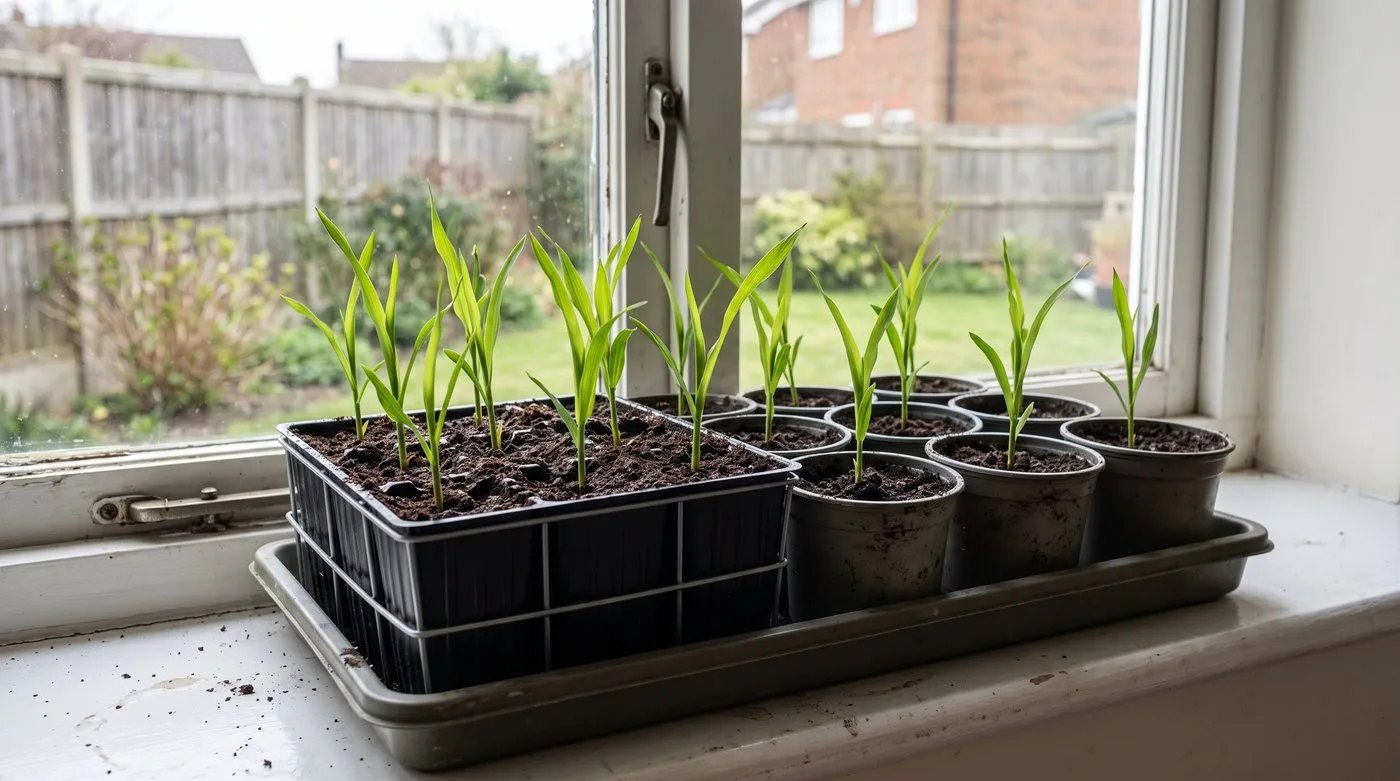
Deep pots or root trainers suit sweetcorn’s long roots. One seed per pot means no root disturbance when you plant out.
Hardening off
Harden off seedlings over 7-10 days before planting out. Put them outside in the day and bring them in at night, slowly giving them more wind and sun. Sweetcorn can’t take frost, so don’t rush.
Planting out and block spacing
Plant out once frosts are over, usually late May to early June. In Scotland and colder areas, wait until mid-June.
Why blocks matter
This is the big one. Plant in a square or rectangle, never a single row. Each plant has tassels (male flowers) at the top and silks (female threads) coming out of the cobs lower down. Pollen has to drift from the tassels onto every silk. Each silk makes one kernel, so a silk that misses out leaves a gap.
In a block, pollen drifts onto the silks from all sides. In a row, it mostly blows away, and you get patchy cobs.
Spacing and layout
Space plants 45cm apart each way. A 4 by 4 block (16 plants) is the minimum, and bigger is better.
| Block | Plants | Space needed | Pollination |
|---|---|---|---|
| 3 by 3 | 9 | About 1.35m square | Poor, expect gaps |
| 4 by 4 | 16 | About 1.8m square | OK |
| 5 by 5 | 25 | About 2.25m square | Good |
| 4 by 6 | 24 | About 1.8m by 2.7m | Good |
| 5 by 6 | 30 | About 2.25m by 2.7m | Very good |
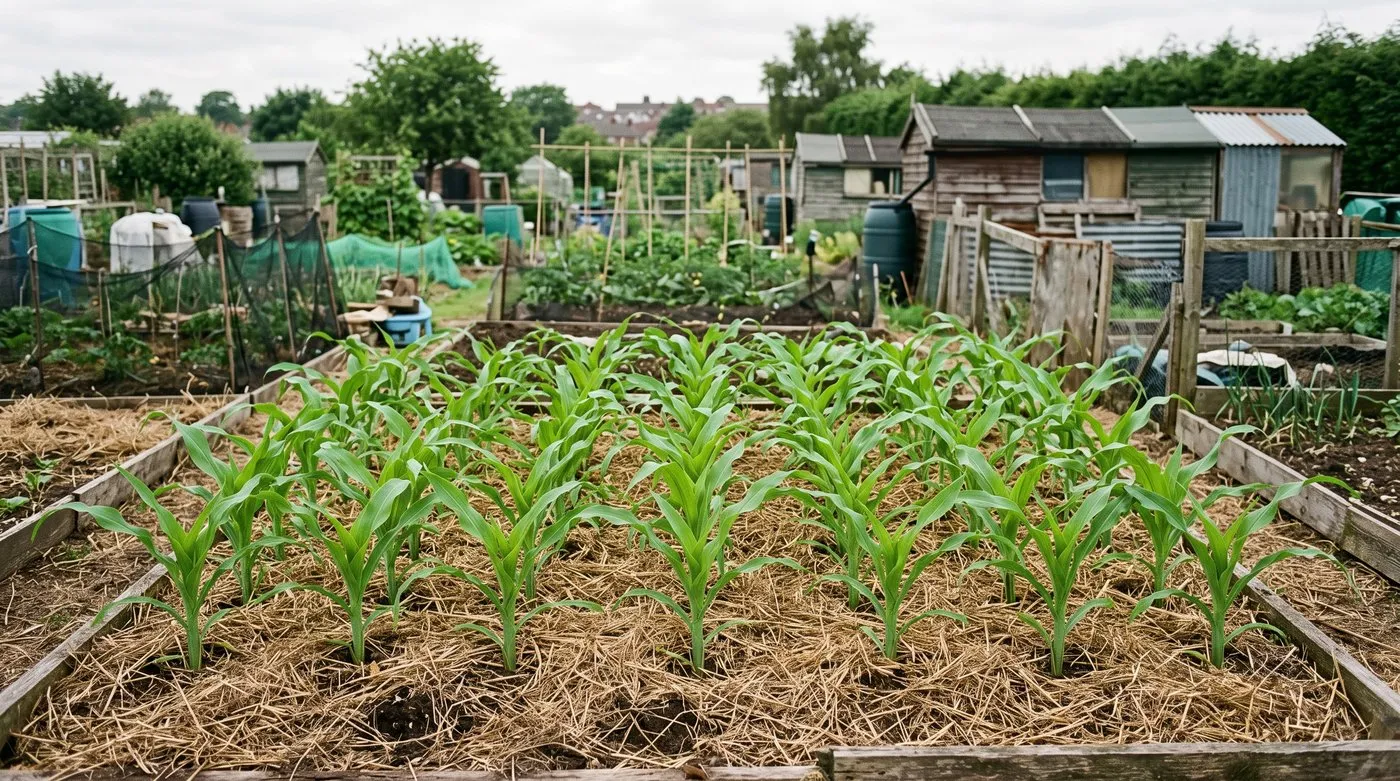
A square block lets pollen drift onto the silks from every side. Five by five gives much fuller cobs than a single long row.
How to plant
Dig a hole a little bigger than the root ball and plant at the same depth it was in the pot. Firm in gently and water well. A handful of garden compost in each hole helps hold moisture in sandy soil.
On windy sites, pull soil up around the base of each stem as the plants grow, to about 10-15cm. This covers the little roots that grow from the base of the stem (brace roots) and keeps the plants steady.
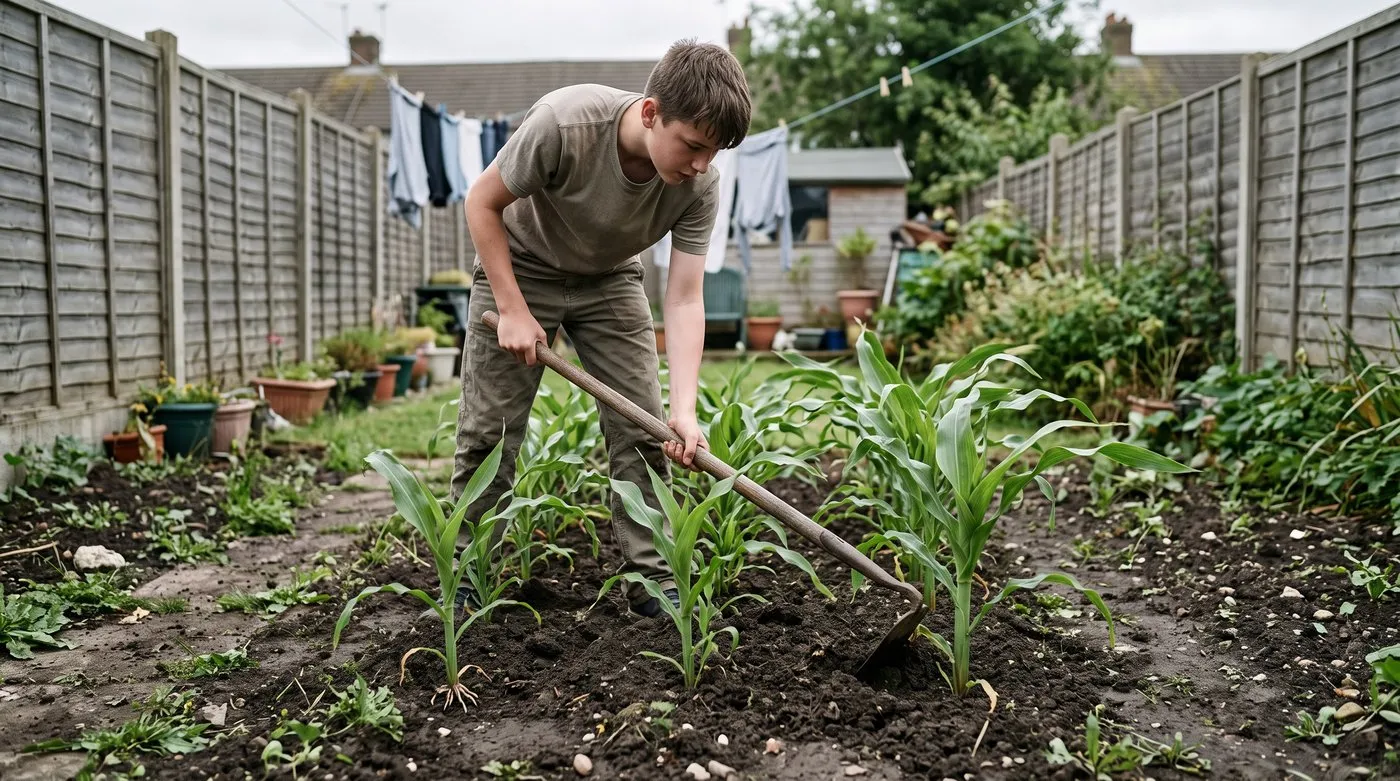
On a windy site, mound soil up around each stem. It covers the brace roots at the base and helps the plants stay upright.
Month-by-month growing calendar
Add 2-3 weeks to these timings in northern England and Scotland.
| Month | What to do |
|---|---|
| March | Get the bed ready. Dig in compost or well-rotted manure. Cover with black plastic to warm the soil |
| April | Sow indoors from mid-April, one seed per deep pot, 2.5cm deep |
| May | Harden off seedlings. Plant out in a block after the last frost. Sow outside in warm areas |
| June | Pull soil up around the stems. Water regularly and mulch. Plant out in colder areas |
| July | Tassels appear. Shake plants gently on calm mornings. Water deeply. Start a high-potash feed |
| August | Silks turn brown as cobs fill. Keep watering. Early varieties may be ready late in the month |
| September | Main harvest. Do the thumbnail test and pick cobs with milky juice. Cook them fast |
| October | Clear old plants. Chop the stems and add them to the compost heap |
Watering and feeding
Sweetcorn is big, hungry and thirsty. Watering matters most at two times: when the tassels appear, and when the silks come out of the cobs.
Watering
Water regularly all season. When the tassels and silks appear, water deeply every 2-3 days in dry weather. Drying out now leads to gappy, shrivelled cobs.
A good soak every few days beats a light sprinkle every day, as it sends roots down deep.
Mulch the block with 5-8cm of compost, straw or grass clippings after planting. It holds in moisture and keeps weeds down. Sweetcorn hates competing with weeds.
Feeding
Before planting, dig in plenty of well-rotted manure or compost. On poor soil, rake in a general fertiliser such as Growmore at the rate on the pack.
When the tassels appear in July, give a high-potash liquid feed such as tomato feed every 10-14 days, until the silks turn brown. This helps the cobs fill out.
Don’t give high-nitrogen feed late in the season. It makes leaves and tall, weak stems instead of cobs.
Pollination and the shake test
Most gappy cobs come from poor pollination. Here’s how to help.
How sweetcorn pollination works
The feathery tassel at the top of each plant sheds pollen for about a week. The wind carries it down to the silks, the threads poking out of each cob. Every silk needs a grain of pollen to make a kernel. In a good block there’s plenty to go round.
The shake test
On calm, still days, pollen may not drift much even in a block. On those mornings, walk through the patch and give each stem a gentle wobble. You’ll see a little cloud of yellow pollen fall onto the silks.
Do this each calm morning while the tassels are shedding pollen. It only takes a couple of minutes and really helps the cobs fill.

On calm mornings, give each stem a gentle wobble while the tassels are shedding. It only takes a couple of minutes.
Signs of poor pollination
About three weeks after the silks appear, peel back a bit of husk on one cob. Gaps with no kernels mean pollination missed those spots. You can’t fix it this year, but next year try more plants, a tighter block and daily shaking.
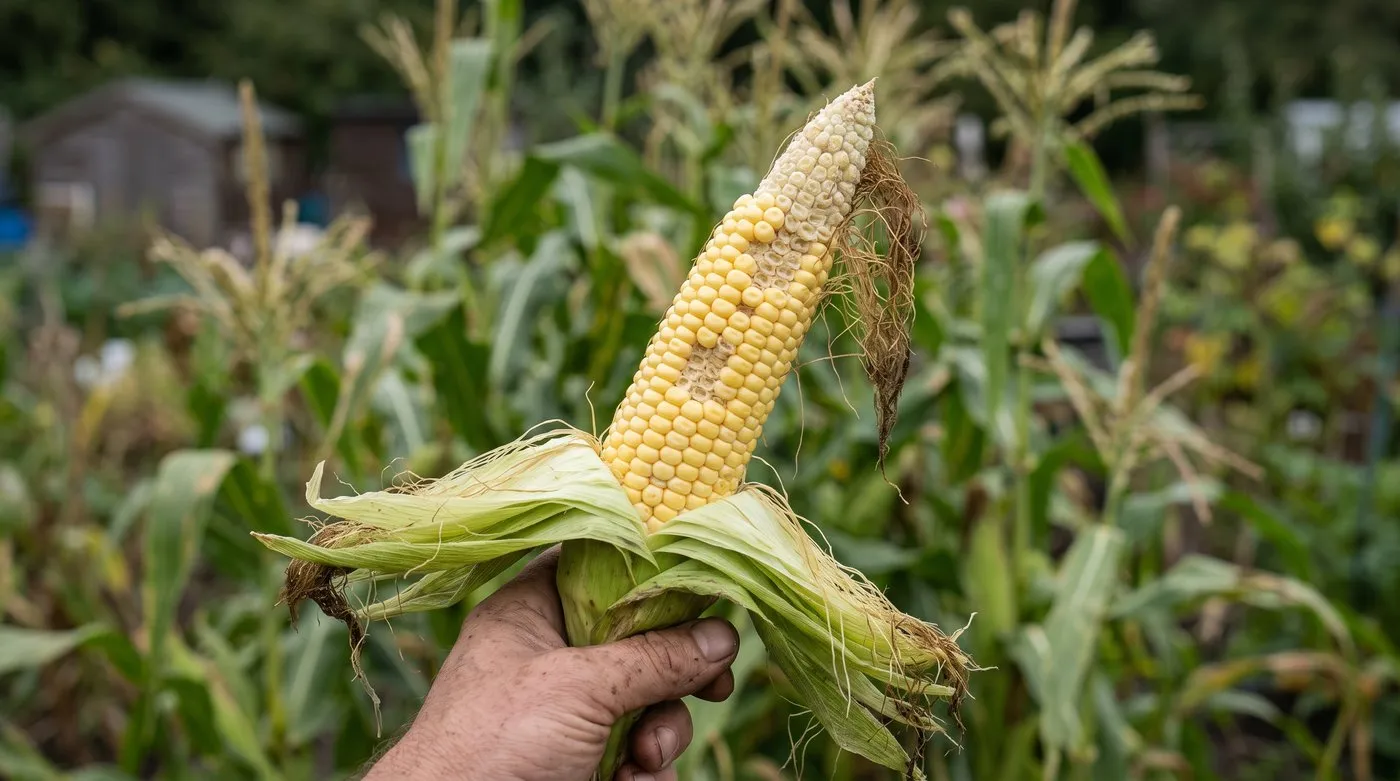
Gaps like these mean some silks missed out on pollen. Next year, plant a tighter block and shake the stems on still mornings.
Harvesting sweetcorn at the right moment
Pick when the juice is milky. Too early and it’s watery, too late and it’s starchy. Each cob is at its best for only a few days.
When to harvest
Cobs are usually ready about 6 weeks after the silks appear, from late August into September. The silks turn from pale to dark brown, and the husk goes slightly paler.
Brown silks are a clue, not a guarantee. Do the thumbnail test to be sure.
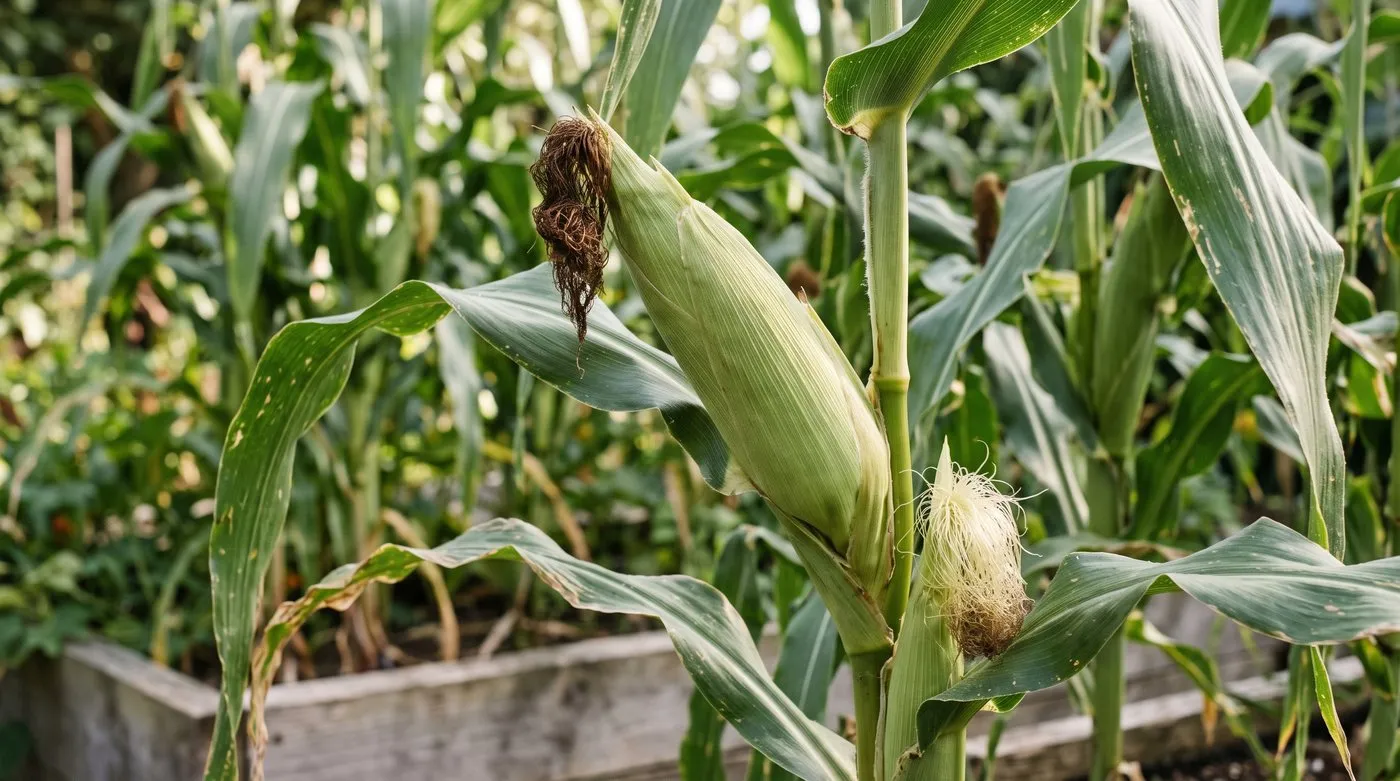
Dark brown silks are a good sign the cob is nearly ready. Check with the thumbnail test before you pick.
The thumbnail test
- Peel back a little husk near the tip to show a few kernels.
- Press your thumbnail into a kernel.
- Check the juice:
- Clear and watery: too early, wait about a week.
- Milky: perfect, pick now.
- Thick paste: past its best, still edible but starchier.
If one cob passes, check the others at a similar stage. Cobs ripen over a week or two.
How to pick
Hold the cob firmly and twist it downwards. It should snap off cleanly. The top cob ripens first, and a second, smaller cob may follow a few days later.
After picking
Cook it as soon as you can. The sugars start turning to starch soon after picking. Boil for a few minutes, steam, or grill on the barbecue.
If you can’t cook it straight away, pop the cobs in the fridge in their husks. Supersweet types stay sweet longer, but fresh is always best.
To freeze, blanch husked cobs in boiling water for 4 minutes, cool in iced water, dry, and freeze whole or cut the kernels off.
Growing sweetcorn in raised beds
Raised beds suit sweetcorn well. The soil warms up faster and drains better. A standard 1.2m by 2.4m raised bed fits a block of 3 by 5 plants at 45cm spacing. That’s fine for pollination, and a second bed alongside makes it even better.
Fill the bed with topsoil, compost and well-rotted manure. Sweetcorn is hungry, so top up with fresh compost each spring. Raised beds dry out faster, so water more often.
Put sweetcorn on the north side of the veg patch. It grows tall and casts shade, so this keeps lettuce, carrots and herbs in the sun.
Companion planting: the three sisters
Grow sweetcorn, climbing beans and squash together. This old Native American method is fun to try. The corn holds up the beans, the beans add goodness to the soil, and the big squash leaves shade out weeds and keep the soil moist.
Plant the sweetcorn first and let it reach 15-20cm tall. Then sow climbing French beans at the foot of every other corn plant. Runner beans are too vigorous. Plant squash or courgettes around the edge of the block.
Choose a sweetcorn with sturdy stems, as thin ones can bend under heavy beans.
Pests and problems
Sweetcorn has fewer pest problems than most veg. Weather is usually the bigger issue.
Slugs and snails nibble young plants at ground level. Use beer traps, or wildlife-friendly slug pellets as the label says, for the first few weeks. Once the stems thicken, slugs lose interest.
Birds, especially pigeons and crows, pull up young plants and peck ripening cobs. Cover new plants with netting or fleece for a couple of weeks. Later, bag or net individual cobs if birds are a problem.
Plants falling over in wind is common on exposed sites. Pull soil up around the stems, plant somewhere sheltered or use a windbreak, and skip late high-nitrogen feeds.
Poor germination hits supersweet seed in cold soil. Sowing indoors avoids the problem.
Five common mistakes to avoid
1. Planting in a single row. This is the classic mistake. It looks tidy, but the cobs come out half empty. Always plant a block of at least 4 by 4.
2. Sowing outside too early. Seeds rot in cold, wet soil. Wait until late May in the south, or early June in the north, or sow indoors.
3. Not watering when the tassels appear. Plants can look fine, but dry weather now means poorly filled cobs. Water deeply every few days in dry spells.
4. Picking too late. Once past the milky stage, they turn starchy fast. Check daily once the silks go brown.
5. Growing supersweet next to normal varieties. Cross-pollination spoils the kernels. Keep them well apart, or sow a couple of weeks apart.
Growing sweetcorn from seed outdoors
Sowing straight outside is simple, but riskier. There’s no transplanting or hardening off, but cold soil can rot the seed.
Wait until the soil has warmed up, usually late May to early June in southern England. Supersweet types need it warmer still.
Mark out the block with string at 45cm spacing. Sow two seeds per spot, 4cm deep, and pull out the weaker one if both come up.
Cover with fleece or cloches for the first few weeks to keep the soil warm. Take the cover off once the plants are about 15cm tall. For more sowing dates, see our UK vegetable planting calendar.
Storing and preserving the harvest
Fresh sweetcorn doesn’t keep well, so freeze any extra.
Freezing works best. Husk the cobs, pull off the silks and blanch in boiling water for 4 minutes. Cool in iced water, drain well and freeze whole, or stand the cob on end and slice the kernels off. Frozen kernels are great in soups, stir-fries and fritters.
For eating fresh, put unhusked cobs in the fridge straight after picking and eat within a couple of days.
Frequently asked questions
The RHS sweetcorn guide has more help if you need it.
When should I sow sweetcorn in the UK?
Sow indoors from mid-April, somewhere warm. Use deep pots or root trainers, as sweetcorn hates having its roots disturbed. Plant out after the last frost, usually late May in the south and early June further north. You can sow straight outside in late May in warmer areas, but you’ll pick later.
Why do I need to plant sweetcorn in a block?
Because the wind does the pollinating, not insects. Pollen drops from the tassels at the top onto the silks on the cobs below. In a block, pollen reaches the silks from every side. In a single row most of it blows away, and you get cobs with gaps.
How much space does sweetcorn need?
Space plants 45cm apart in every direction. A block of 16 plants (four rows of four) fits in about 1.8m by 1.8m. Each plant gives one or two cobs, so a family might want 20-24 plants.
Can I grow sweetcorn in containers?
Yes, though the crop will be smaller. Use pots at least 30cm wide and 40cm deep, and group them tightly into a block. Water daily in summer. Dwarf varieties like Minipop, grown for baby corn, are the easiest in pots.
How do I know when sweetcorn is ready to pick?
Do the thumbnail test on a kernel. Peel back a bit of husk and press a kernel with your nail. Clear, watery juice means wait. Milky juice means pick now. Thick paste means you’re a little late. The silks also go dark brown when cobs are nearly ready.
What is the difference between supersweet and normal sweetcorn?
Supersweet types are sweeter and stay sweet longer after picking. The catch is that their seeds need warmer soil and can rot in a cold, wet spring. Normal types are more forgiving for beginners. Keep supersweet away from other types, or the cobs can turn starchy.
Why does my sweetcorn have missing kernels?
Gaps in the cob mean poor pollination. Planting in a row instead of a block is the usual cause. Dry weather while the tassels and silks are out, too few plants, and still air can also cause it. Shake the plants on calm mornings to help spread pollen.
Our team produces practical UK gardening guidance from source research, contributor records and established horticultural practice. Editorial standards are overseen by Matt W.


