Key takeaways
- Bury 150mm of stem at planting to grow extra adventitious roots and lift uptake
- Switch to high-potash feed (4-5-8 NPK) at first truss, fed every 7 days then every 3-4 days in peak
- Space cordons 450mm apart, single stem, for airflow that cut blight cases by 60 percent in trials
- Consistent watering of 2 to 4 litres per plant per warm day prevents splitting and blossom end rot
- Tap flower trusses daily or use an electric toothbrush to lift fruit set by 15 to 25 percent
- Stop outdoor cordons at 4 to 5 trusses, greenhouse cordons at 7 to 9, to ripen before frost
Most UK gardeners can grow a tomato plant. Growing a heavy, clean, well-flavoured crop is a different skill, and that is where these tips for growing tomatoes will move the needle. This guide assumes you already know how to sow seed and pot on. What follows are the advanced techniques that separate a 4kg plant from an 8kg one: deep planting, a precise high-potash feeding regime, hand pollination, de-leafing discipline and the right truss count to stop at.
Bury the stem deep for a bigger root system
Deep planting is the single cheapest yield gain available. Tomato stems grow adventitious roots along any section buried in moist soil. Plant a cordon so 100 to 150mm of bare stem sits below ground and you double the rooting zone within three weeks.
Strip the leaves off the bottom 150mm of stem first. Dig the hole 150mm deeper than the root ball, or lay leggy plants on their side in a shallow trench with the top 200mm bent upright. Both work. The buried stem roots within 10 to 14 days at soil temperatures above 15C.
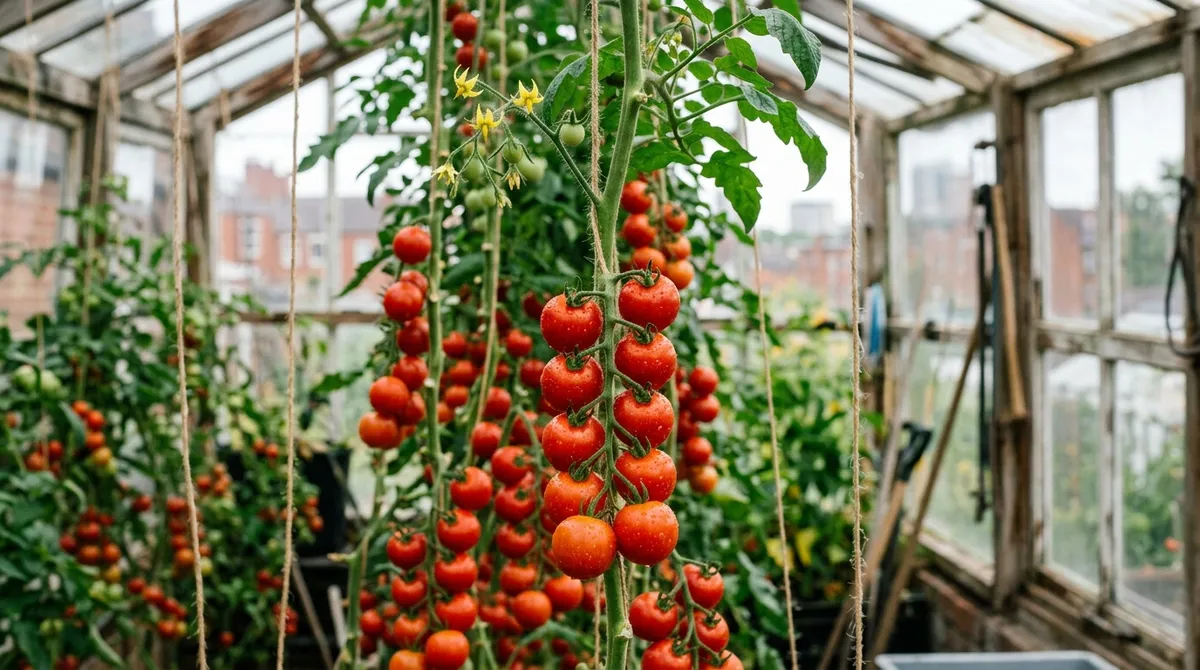
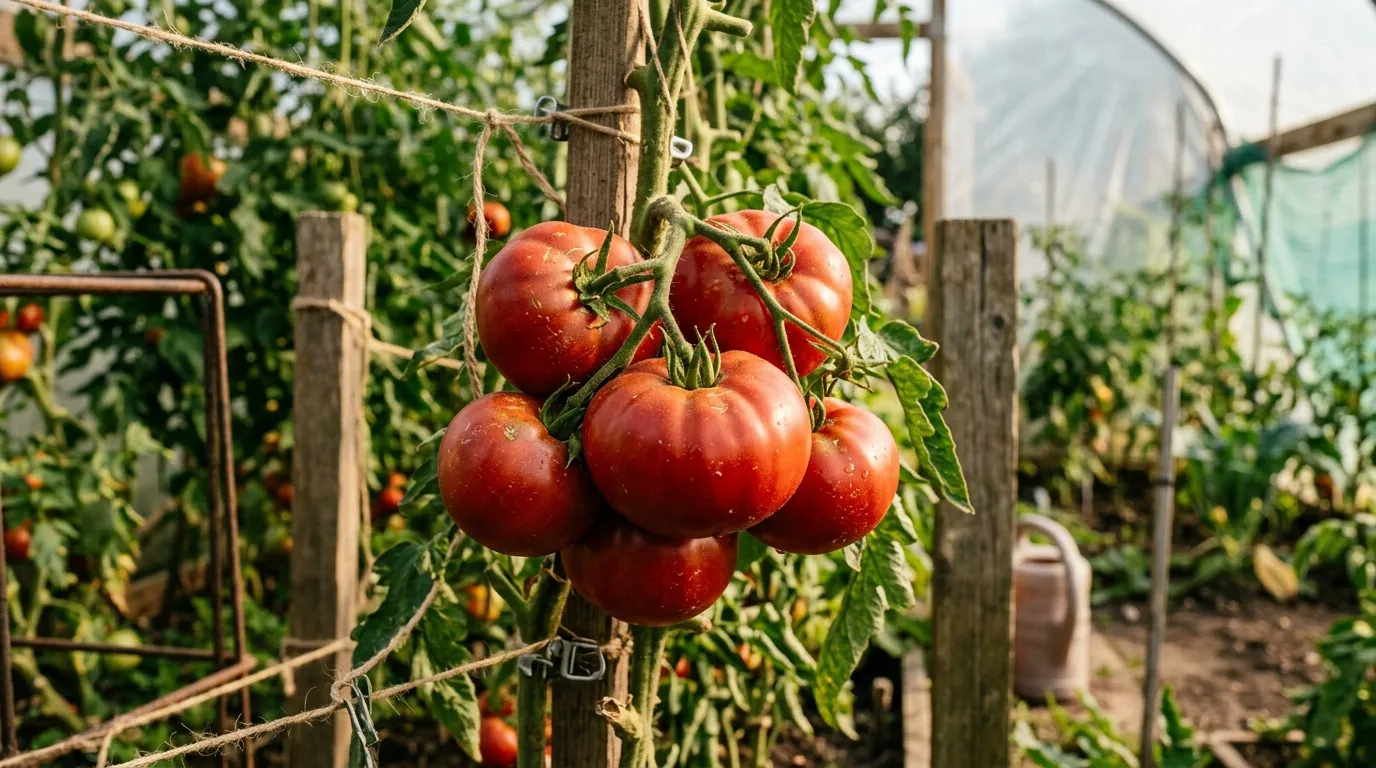 The payoff from deep planting and steady uptake: heavy, evenly ripened trusses with no splitting.
Switch from balanced feed to high-potash at first truss
The feed mistake that costs the most crop is staying on a balanced feed too long. Before flowering, a balanced feed near 7-7-7 NPK builds leaf and stem. The moment the first truss sets fruit, the plant needs potassium (K) to push flowering and fruiting rather than more foliage.
Switch to a high-potash tomato feed around 4-5-8 NPK at first truss set. Proprietary feeds like Tomorite sit near this ratio. Potash drives flower production, fruit size and sugar content. Nitrogen at this stage just grows leaves that shade the trusses.
Gardener’s tip: Do not feed a dry plant. Water first, then feed into damp compost. Feed hitting dry roots scorches them and the salts concentrate, which can trigger blossom end rot.
Water the same amount every day to stop splitting
Consistent watering prevents two of the most common faults: fruit splitting and blossom end rot. Both come from erratic supply, not from a single drought or flood. A plant that dries out then gets a soaking takes up water faster than the fruit skin can stretch, and the tomato splits.
Aim for 2 to 4 litres per plant per warm day in summer, less in dull spells. The exact figure matters less than keeping it steady. Greenhouse plants in growbags dry fastest and need the most discipline.
Take off side-shoots to keep a single strong stem
Cordon (indeterminate) tomatoes grow a side-shoot in the V between every leaf and the main stem. Left on, each shoot becomes a second plant, splitting energy and crowding the row. Pinch them out at 20 to 30mm long, while they snap cleanly.
Check plants twice a week through June and July. Shoots grow fast in warm weather and a missed week means a 200mm sucker that tears a wound when removed. Pinch in the morning so the wound dries before evening, which reduces botrytis entry.
Leave bush (determinate) varieties alone. They are bred to branch and crop in one flush, so removing side-shoots cuts your yield. Know which type you have before you start. Full method in our pinch out tomato side-shoots guide.
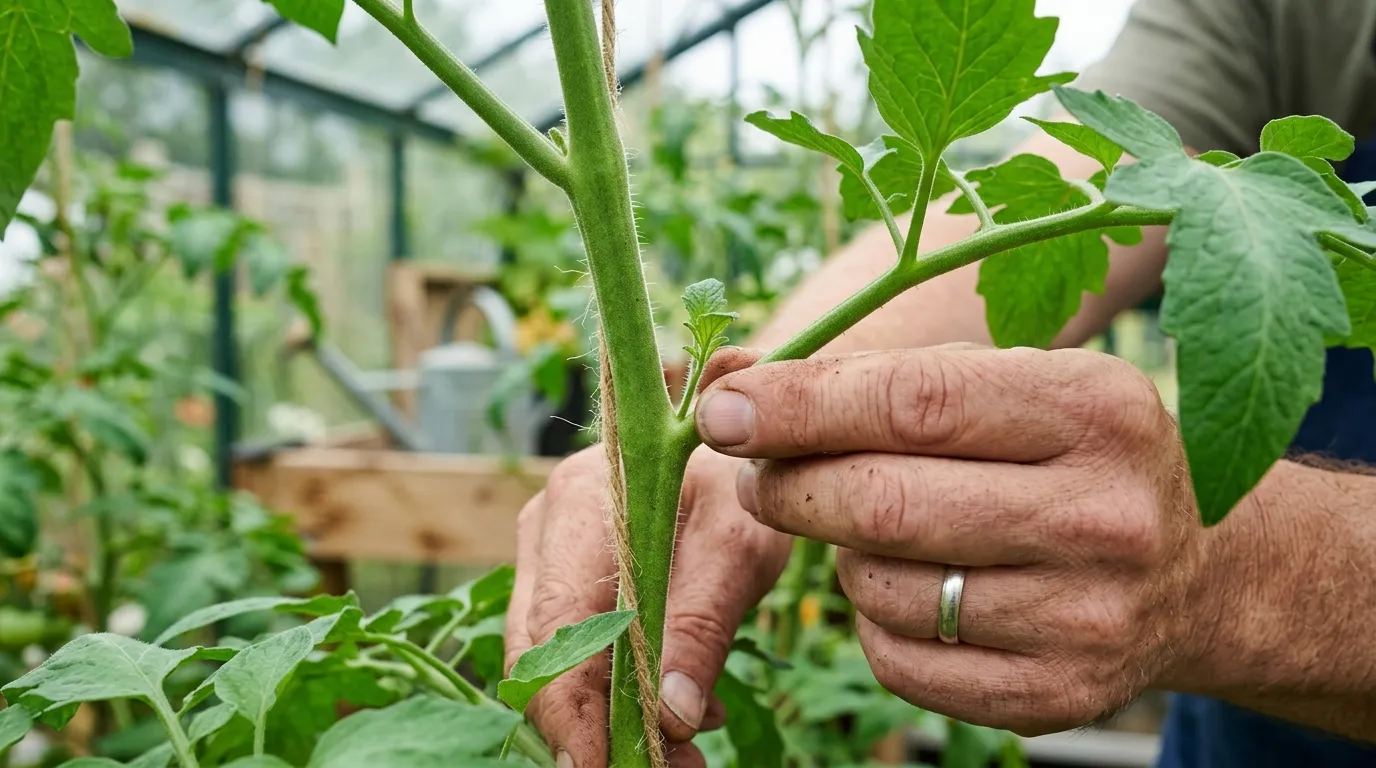 Pinch side-shoots out at 20 to 30mm in the morning so the wound seals before the humid evening.
Strip lower leaves to cut blight and grey mould
De-leafing lifts airflow around the base of the plant, where humidity sits and disease starts. Remove the leaves below the lowest ripening truss from late July onwards. Take two or three a week rather than stripping the plant in one go, which shocks it.
By September, take all foliage off below the ripening trusses. This pushes the plant’s remaining energy into colouring fruit rather than holding leaves. Cut cleanly with snips, do not tear, and bin the leaves rather than composting if blight is about. Read more on tomato blight prevention and treatment for the spore lifecycle.
Hand-pollinate to lift fruit set by a fifth
Tomatoes are self-fertile but the pollen needs a jolt to drop from the anther onto the stigma. Outdoors, wind and bees do it. In a greenhouse or polytunnel, still air means flowers drop without setting. Hand pollination fixes this for free.
Two methods work. Tap the truss firmly with a finger or a pencil at midday, when humidity is lowest and pollen flows freely. Or hold an electric toothbrush against the truss stalk for two seconds. The vibration mimics a bumblebee’s buzz pollination at around 400Hz, a technique the RHS confirms for greenhouse tomatoes.
Stop the plant at the right truss count
Stopping (or topping) means pinching out the growing tip two leaves above the top truss you want to keep. This stops the plant climbing and forces all energy into ripening the fruit already set.
UK summers are too short to ripen unlimited trusses. Stop outdoor cordons at 4 to 5 trusses, usually by mid-July. Stop greenhouse cordons at 7 to 9 trusses, by early August. Beyond these counts, late trusses set fruit that never colours before the first frost in mid to late October.
In a cold 2021 outdoor trial, plants left to grow unchecked carried 7 trusses but ripened only 4 before frost. Stopped plants ripened all 5 trusses and gave 1.3kg more usable fruit per plant. Greenhouse growers with heat to 12C overnight can carry more trusses, so adjust to your setup.
Feed extra magnesium when leaves yellow between the veins
Interveinal yellowing on older, lower leaves is classic magnesium (Mg) deficiency. The leaf goes yellow between the veins while the veins stay green. High-potash feeding makes it worse, because potassium and magnesium compete for uptake.
The fast fix is a foliar spray of Epsom salts (magnesium sulphate). Dissolve 20g per litre of warm water, add a drop of washing-up liquid as a wetter, and spray both leaf surfaces on a dull evening. Leaves green up within 7 to 10 days. Repeat every two to three weeks if symptoms return.
Do not confuse magnesium deficiency with blight or nitrogen shortage. Magnesium starts on old lower leaves and is interveinal. Nitrogen shortage yellows the whole leaf, oldest first. Blight makes brown blotches with a pale halo. Spraying Epsom salts at a blight problem wastes your evening.
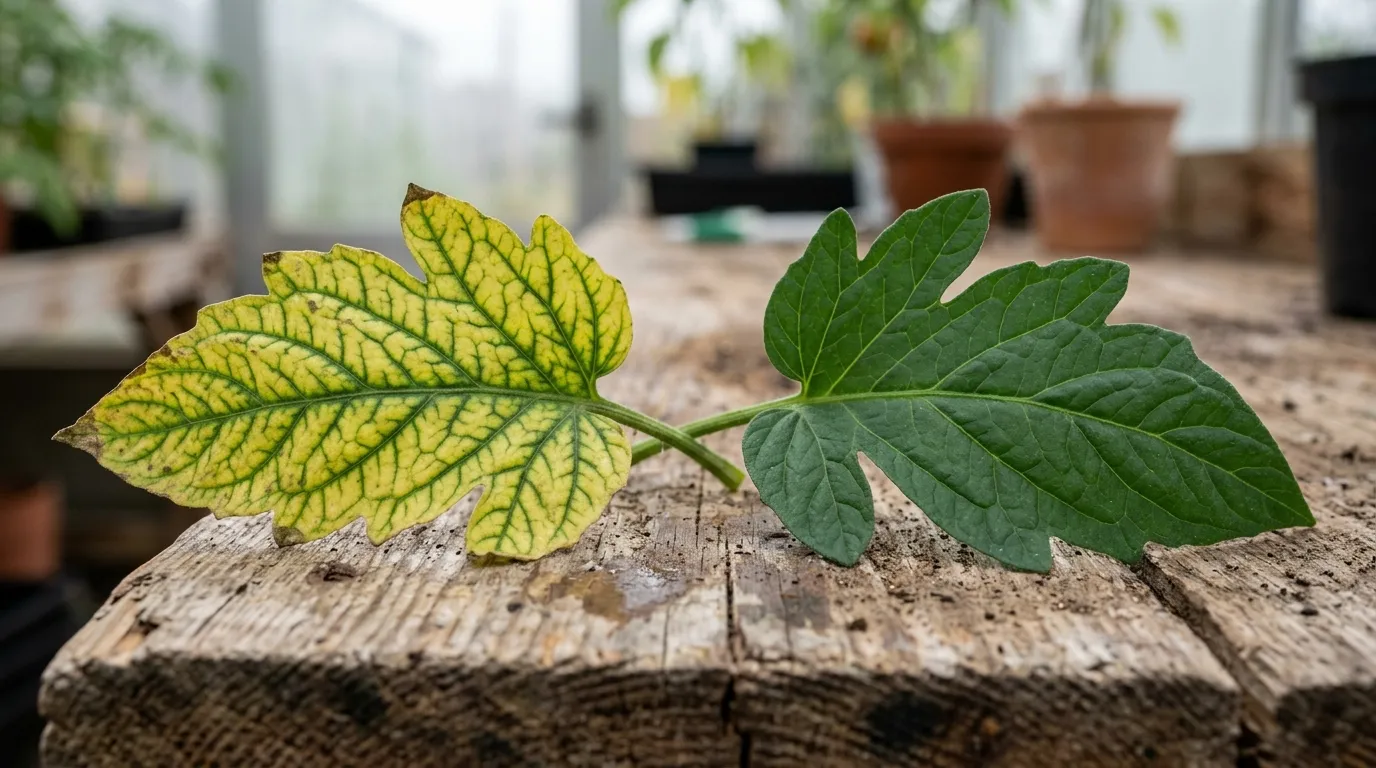 Magnesium deficiency, left, shows yellowing between green veins on older leaves. A foliar Epsom salts spray greens them within 10 days.
Make your own comfrey feed for free potash
Comfrey leaves are unusually rich in potassium, which makes a home-brewed comfrey feed a near-perfect tomato food. Bocking 14 comfrey is the sterile strain that will not seed and spread. A 2m by 1m bed of it yields four to five cuts a season.
Pack leaves into a bucket, weigh them down, and let them rot for three to five weeks. The black liquid that drains off is concentrated. Dilute it 15 parts water to 1 part concentrate, roughly until it reads weak tea colour. It smells foul, so brew it away from the patio.
Highest-impact tips ranked by measured gain
Mulch and warm the root zone for an early start
A mulch of 50mm of garden compost or grass clippings holds soil moisture steady and keeps roots cooler in a heatwave and warmer at night. Steady root temperature steadies water uptake, which is the same mechanism that prevents splitting.
Tomato roots stall below 12C and grow best between 18 and 24C. Early plants set out in May in a cold UK spring sit and sulk in cold soil. Warm the bed first: lay black polythene over the soil two weeks before planting to lift soil temperature by 3 to 5C.
Support every truss so heavy fruit does not snap
A loaded truss of beefsteak tomatoes can weigh 800g to 1.2kg. The stalk often kinks or snaps before the fruit ripens, and the whole truss is lost. Truss supports prevent this.
Use plastic truss-support clips (£4 for 20) that cradle the stalk and hook over the main stem string. Or loop soft garden twine under the truss and tie it to the support cane. Do this as soon as fruit reaches marble size, before the weight builds.
Support the main stem too. Twist the growing stem around a vertical string anchored above and pegged at the base, or tie to a 1.8m cane every 200mm. A cordon carrying 7 trusses needs firm support or it leans, kinks and shades its own fruit.
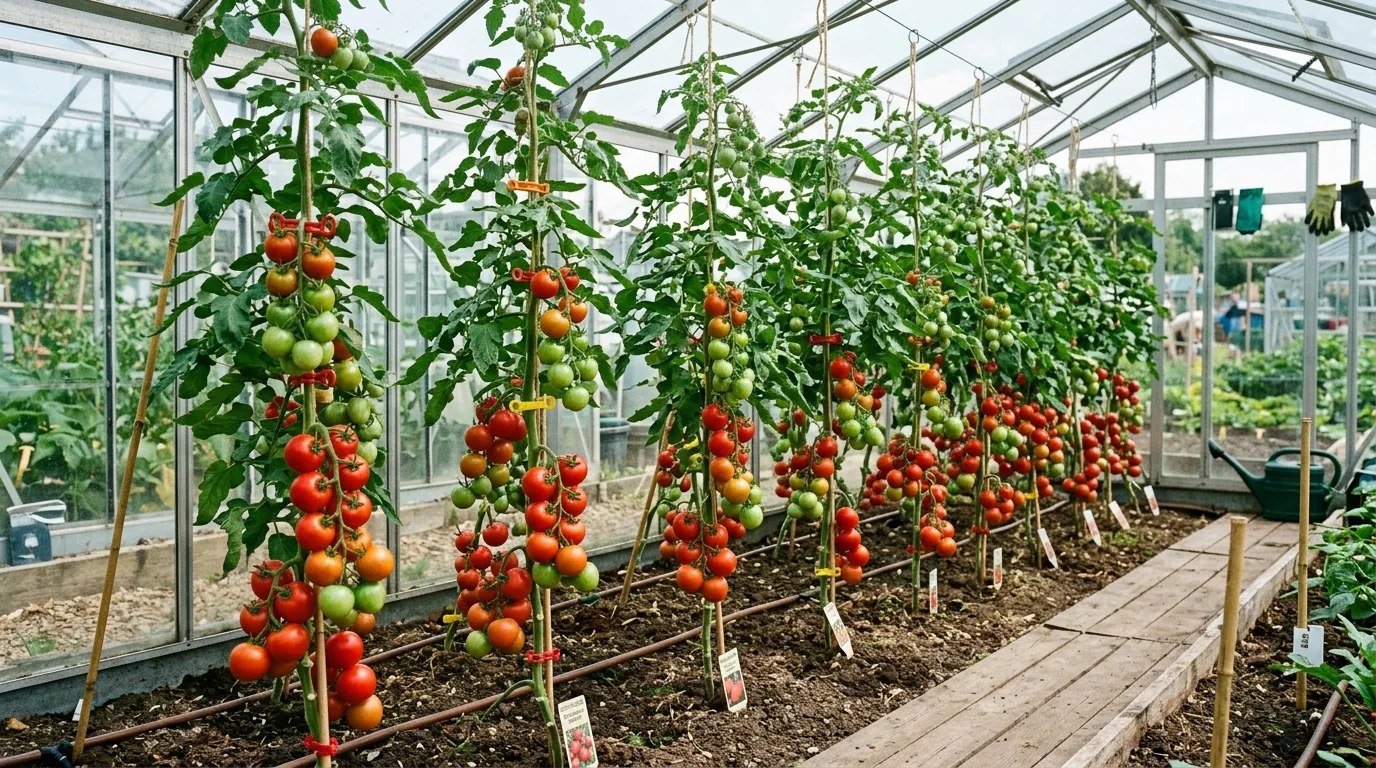 A supported cordon row at 450mm spacing. Truss clips hold heavy beefsteak trusses that would otherwise snap before ripening.
Vent and circulate air to control humidity and feed CO2
Ventilation does two jobs in a greenhouse: it drops humidity to deter blight and grey mould, and it refreshes carbon dioxide (CO2) that the plants use up in still air on a sunny morning.
Open vents and the door whenever the temperature climbs above 25C. Aim to keep daytime humidity below 80 percent. A small clip-on fan moving air gently also strengthens stems and disrupts the still pockets where botrytis spores settle.
On a bright, closed morning, greenhouse CO2 can fall below the 400ppm outdoor level by mid-morning as plants photosynthesise hard, which throttles growth. A crack of ventilation early refreshes it. Do not seal a greenhouse tight in summer thinking heat helps. Above 30C, pollen goes sterile and flowers drop without setting.
Pick varieties for the trait you actually want
Choosing the right variety decides your ceiling before any technique applies. F1 hybrids like ‘Shirley’ and ‘Sungold’ give heavy, uniform, disease-tolerant crops. Heritage varieties like ‘Brandywine’ and ‘Black Krim’ trade yield and uniformity for flavour and unusual colour.
For raw yield under glass, F1 cordons win. For flavour on a plate, the best heritage beefsteaks beat any hybrid, but expect 30 percent less weight and more splitting. Match the choice to your goal. Our best tomato varieties for the UK and best greenhouse tomato varieties compare the top performers, and the beginner tomato growing guide covers the basics if you want a refresher first.
| Variety | Type | Best trait | Yield per plant | Setting |
|---|---|---|---|---|
| ’Sungold’ F1 | Cherry cordon | Sweetness, prolific | 4 to 6kg | Greenhouse or outdoor |
| ’Shirley’ F1 | Medium cordon | Reliable, early | 7 to 9kg | Greenhouse |
| ’Gardener’s Delight’ | Cherry cordon | Flavour, hardy | 4 to 5kg | Outdoor |
| ’Crimson Crush’ F1 | Beefsteak cordon | Blight resistance | 6 to 8kg | Outdoor |
| ’Brandywine’ | Heritage beefsteak | Flavour | 3 to 4kg | Greenhouse |
| ’Black Krim’ | Heritage beefsteak | Colour, flavour | 3 to 4kg | Greenhouse |
Time your sowing to your setup, not the calendar
Sowing date should follow your growing space, not a fixed date. Undercover growers can start earlier and crop longer than outdoor growers, who must wait out the last frost.
Sow greenhouse tomatoes in late February to mid-March, at 18 to 21C in a heated propagator. Sow outdoor tomatoes in late March to early April, so plants are ready to harden off after the last frost, which runs early May in the south and late May to early June in the north and Scotland.
Plant out under glass from late April once soil hits 15C. Plant outdoor tomatoes only after the last frost passes and night temperatures hold above 10C. A plant set out into cold soil in April loses any head start to root stall. Our greenhouse growing calendar helps you slot tomatoes into the wider season.
Tomato season task calendar
This calendar tracks the high-impact jobs through a UK season, tuned for a midlands climate. Shift two weeks later for Scotland and the far north, two weeks earlier for the far south.
| Month | Main task |
|---|---|
| February | Sow greenhouse varieties at 18-21C in a heated propagator |
| March | Sow outdoor varieties, pot on greenhouse seedlings, warm beds with polythene |
| April | Plant out under glass at soil 15C, bury 150mm of stem, start balanced feed |
| May | Harden off and plant outdoor cordons after last frost, begin side-shoot removal |
| June | Switch to high-potash feed at first truss set, tap flowers daily under cover |
| July | Stop outdoor cordons at 4-5 trusses, feed every 3-4 days, begin de-leafing |
| August | Stop greenhouse cordons at 7-9 trusses, support heavy trusses, vent for humidity |
| September | Strip all leaves below ripening trusses, reduce watering slightly to concentrate flavour |
| October | Pick remaining fruit before first frost, ripen green tomatoes indoors with a banana |
Common mistakes that cost a crop
Over-feeding nitrogen. Staying on balanced or high-nitrogen feed after first truss grows a jungle of leaf and little fruit. The plant looks lush and crops poorly. Switch to high potash the moment fruit sets on the first truss.
Erratic watering. Letting plants dry out then flooding them is the direct cause of splitting and blossom end rot. The fix is steady supply, not more total water. Mulch, a self-watering tray, or a daily routine all work.
Wetting the foliage. Watering over the leaves in still, humid conditions invites blight and grey mould. Water at the base only, in the morning, so any splash dries before evening.
Removing side-shoots from bush varieties. Pinching out a determinate (bush) type removes the very shoots that carry its crop. Check the variety type before you start pinching.
Leaving too many trusses. Greed for more fruit backfires outdoors. Late trusses set fruit that never ripens and drains energy from the lower trusses. Stop the plant on time.
Frequently asked questions
What is the best feed for growing tomatoes in the UK?
A high-potash liquid feed, around 4-5-8 NPK, once trusses set. Before flowering, a balanced feed builds the plant. After the first truss sets fruit, switch to high potash to push flowering and fruiting. Tomorite-type feeds sit near this ratio. Feed weekly at first, then every three to four days in July and August.
Why should you bury tomato stems deep when planting?
How often should you water tomatoes to stop them splitting?
Little and often, the same amount each day, never feast then famine. Splitting happens when a dry plant suddenly takes up a flood of water and the fruit swells faster than the skin. Aim for 2 to 4 litres per plant per warm day. A mulch and a self-watering tray keep the supply steady.
Should you remove lower leaves from tomato plants?
Yes, strip leaves below the lowest ripening truss to improve airflow. Lower leaves trap humidity and touch the soil, which spreads blight and grey mould. Remove two or three leaves a week from late July. By September take all foliage off below the ripening trusses to push energy into fruit.
How do you get more tomatoes from each plant?
Feed high potash, pollinate by hand, and stop the plant at the right truss count. Tapping flowers daily lifts fruit set by 15 to 25 percent. Removing side-shoots keeps a cordon on one stem. Stopping at four to five trusses outdoors ripens every fruit before the first frost.
Next step
Now you have the advanced techniques, browse the full growing guides hub for the next crop in your plot, or nail your timings first with our guide on when to plant tomatoes in the UK.
Our team produces practical UK gardening guidance from source research, contributor records and established horticultural practice. Editorial standards are overseen by Matt W.