Key takeaways
- Cress in eggshells is ready to snip and eat in under a week
- Sunflowers and runner beans have big seeds that small hands can manage
- An egg hunt or nature scavenger hunt costs next to nothing
- A bug hotel can be built from free things like sticks, pine cones and bark
- Every activity works on a balcony or windowsill as well as in a garden
Easter garden activities are a lovely way to get children outside over the spring holidays. Gardens are waking up, the evenings are getting lighter, and it’s a great time for sowing, crafts and spotting wildlife.
Here are ten hands-on activities for children aged 2 to 12. Most cost very little and some cost nothing at all. They all work in a garden of any size, and plenty work on a balcony or windowsill too.
 Sowing sunflower seeds gives children something exciting to watch over the holidays.
Quick-growing plants to sow at Easter
Children lose interest if nothing happens. Pick plants that pop up fast, ideally within the holidays.
Cress is the quickest of all. It sprouts within a day or two on damp kitchen paper or cotton wool, and is ready to eat in under a week. No soil, pots or garden needed.
Sunflowers come up in about a week or so when sown 2cm deep in moist compost. Once they get going, children love measuring them. Our guide on how to grow sunflowers covers the rest.
Runner beans are brilliant too. Soak the seeds overnight, then push them 5cm deep into a pot of compost indoors. Shoots appear in a week or two, and children love watching the stems twist up a cane. Keep them indoors until the frosts are over. Our guide on how to grow runner beans takes you from sowing to picking.
Lettuce seeds are tiny but come up in about a week. Sprinkle them thinly on damp compost and cover very lightly. Baby leaves are ready to pick in about a month. See our guide to growing lettuce for varieties that suit pots.
Radishes are the quickest root crop. Sow 1cm deep in rows. Seedlings appear within a week and some varieties are ready in about a month. Pulling them up is half the fun.
| Plant | How deep | Comes up in | Ready in |
|---|---|---|---|
| Cress | On the surface | A day or two | Under a week |
| Sunflowers | 2cm | About a week | Flowers in summer |
| Runner beans | 5cm | One to two weeks | Beans in summer |
| Lettuce | Barely covered | About a week | Baby leaves in about a month |
| Radishes | 1cm | Under a week | About a month |
If it’s cold at Easter, start everything on a sunny windowsill. Our guide on how to sow seeds indoors shows you how. Move tender plants like beans and sunflowers outside once the frosts are over.
Handy tip: Give each child their own labelled pot. They’ll be much keener to water and check “their” plant each morning. Lolly sticks make great labels, and children can decorate them with felt tips.
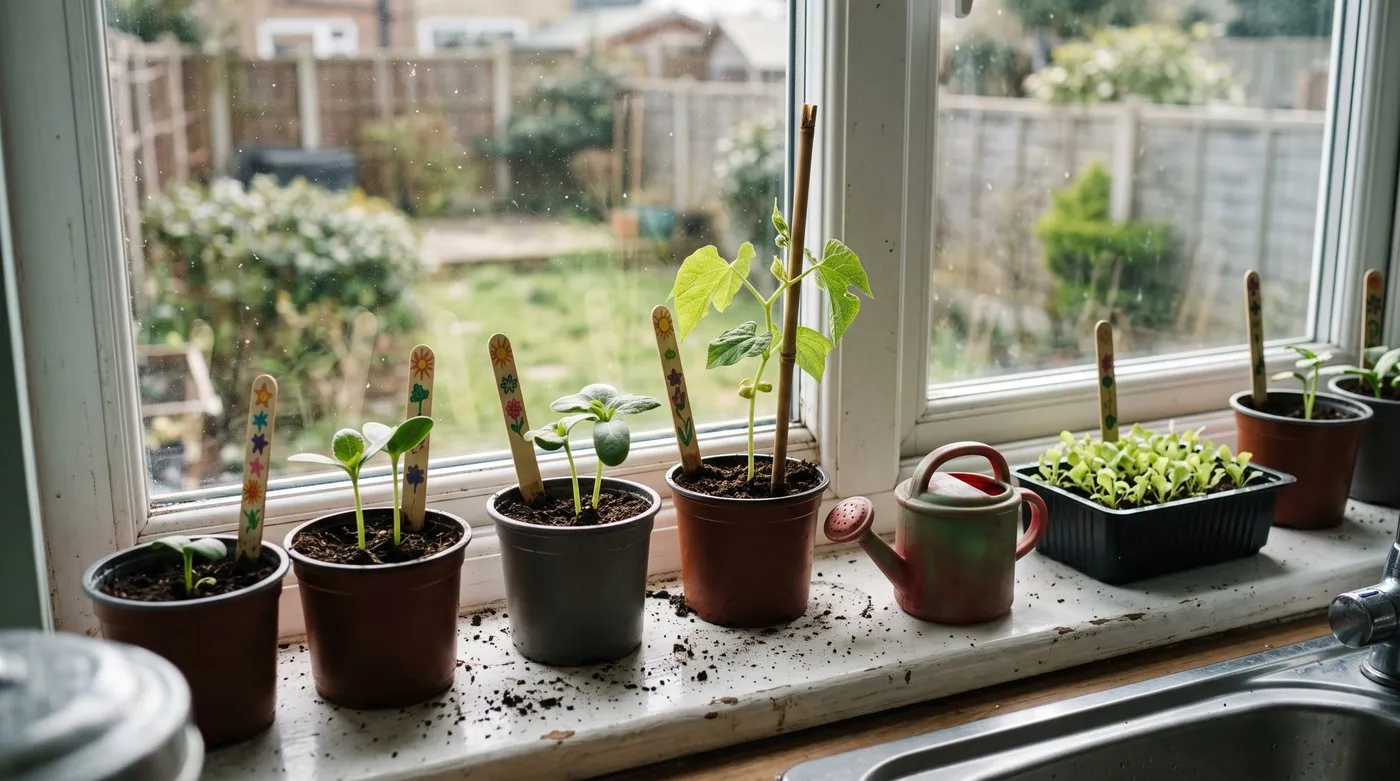
Give each child their own pot so they’ll be keen to check it every morning. Sunflowers and runner beans come up within a week or two, well inside the holidays.
How to grow cress in eggshells
The easiest Easter project of all. It works for children as young as two and takes five minutes to set up.
What you need:
- Empty eggshell halves (save them from breakfast)
- Cotton wool or kitchen paper
- Cress seeds (one packet does lots of shells)
- An egg box to hold the shells upright
- Felt-tip pens
Step by step:
- Wash the eggshell halves gently and let them dry.
- Draw funny faces on the shells with felt tips.
- Put a small wad of damp cotton wool inside each shell.
- Sprinkle cress seeds thickly over the cotton wool.
- Stand the shells in an egg box on a windowsill.
- Keep the cotton wool damp but not soggy, with a little water each day.
- Watch the “hair” grow over the next few days.
- Give each egg head a haircut with scissors, and eat the cress in egg sandwiches.
Children love watching the faces grow hair, and it’s ready to eat in under a week. Start it on the first day of the holidays. Each child can make a few egg heads and see whose grows fastest.
 Cress egg heads: the simplest Easter growing project for any age.
Easter garden egg hunt ideas
A garden egg hunt is the highlight of most family Easters. It costs very little and works in any outdoor space.
Getting set up: Hard-boil and decorate eggs the day before, or use foil-wrapped chocolate eggs. Hide them at heights that suit the youngest child, and give everyone a basket or bowl.
For toddlers (2-3): Hide eggs in plain sight, on walls, in plant pots and beside obvious things. Use big, bright eggs, and just a handful each so they don’t get overwhelmed.
For ages 4-7: Mix easy eggs with sneakier ones. Tuck them under leaves, behind the watering can or inside a welly by the back door. Give them simple picture clues like “Look near something red”.
Team hunts: Split children into two teams with different coloured eggs. The team that finds the most wins. Great for mixed ages, as older ones help the little ones.
Rainy day plan: If it pours, hide the eggs indoors with the same clues. Or hide wrapped eggs under upturned flowerpots on the patio and hunt in wellies and umbrellas.
Nature scavenger hunt for Easter
A nature scavenger hunt gets children looking closely at the garden and spotting spring wildlife.
Write a list of things to find. Children don’t collect them, they just tick them off or take a photo.
Spring scavenger hunt list:
- A yellow flower (daffodil, dandelion or forsythia)
- A bumblebee
- A worm
- A feather
- A bud on a branch
- A spider’s web
- A bird carrying nesting material
- A ladybird
- Something fuzzy (moss, a catkin or lamb’s ears)
- A smooth stone
- Three different leaf shapes
- A flower with five petals
- An insect on a leaf
- A Y-shaped twig
- Something that smells nice
- A snail shell
- A bird singing in a tree
- A patch of clover
- Lichen on wood or stone
- An ant trail
Change the list to suit your garden. In town you might add “a plant growing through a crack”. For little ones, use a shorter list of 8-10 things with pictures.
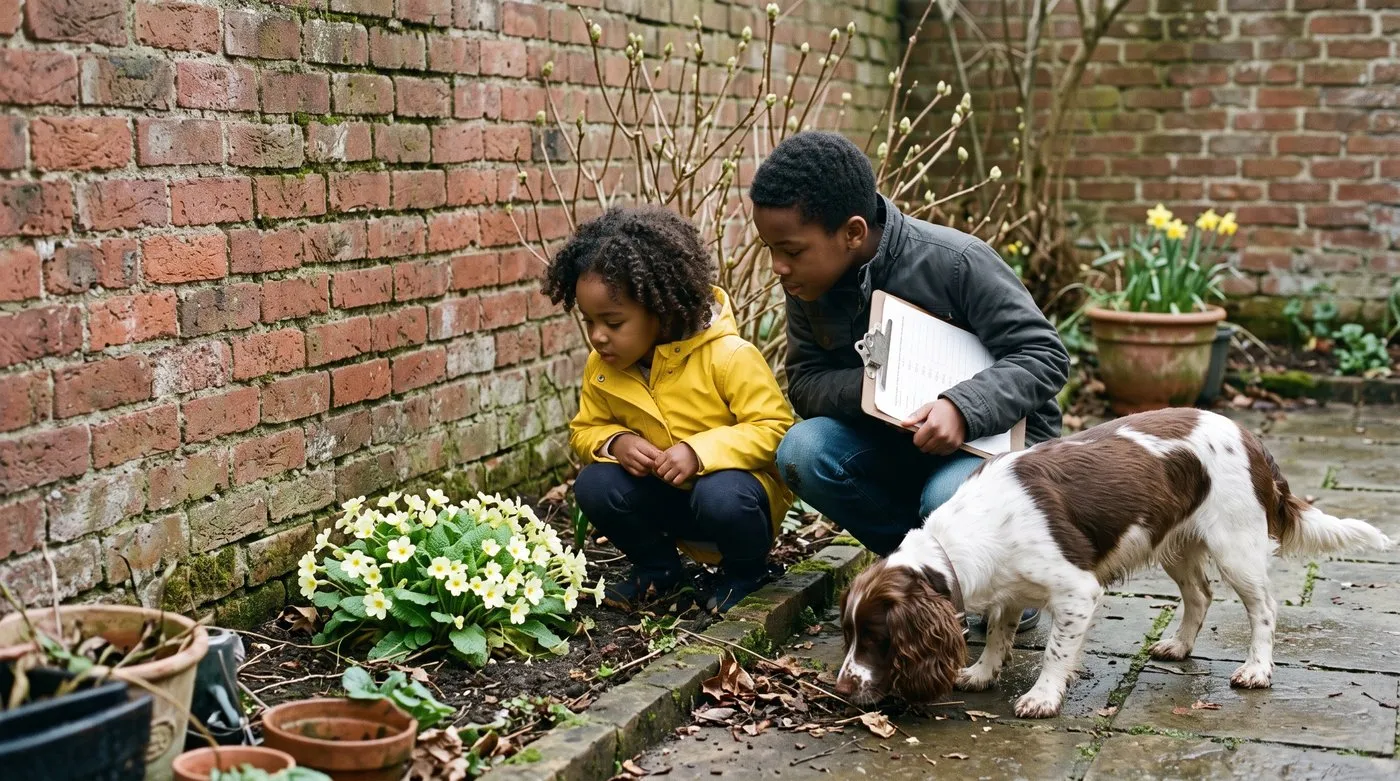
Children don’t collect anything on a scavenger hunt, they just spot it and tick it off. A flower with five petals, like a primrose, is an easy first find.
How to build a bug hotel with kids
A bug hotel is a stack of natural bits that gives helpful insects somewhere to shelter and nest. It’s free to make and really useful for the garden.
What you need (all free from the garden or park):
- A pallet, old wooden crate or big plastic bottle for the frame
- Hollow bamboo canes or dry stems cut to about 15-20cm
- Pine cones
- Dry leaves
- Small logs with holes drilled in the ends
- Bits of bark
- Corrugated cardboard rolled into tubes
- Straw or dry grass
Step by step:
- Pick a sheltered spot, ideally facing south or south-east, at the back of a border or against a fence.
- Set the frame in place. A crate on its side is perfect. Prop it steady with bricks.
- Fill each section with something different: canes in one, pine cones in another, cardboard tubes in another.
- Add a section of dry leaves, held in with a bit of mesh.
- Drill holes of about 6-10mm into small logs and slot them in. Solitary bees love to nest in these. An adult should do the drilling.
- Top it with bark, a tile or slate to keep the rain off.
Who’ll move in? Solitary bees, ladybirds, lacewings, woodlice, earwigs and spiders. Solitary bees are great pollinators, and they’re gentle and very unlikely to sting.
Check the hotel every few weeks through summer to see who’s moved in. Our guide on how to build a bug hotel has more design ideas.
 An egg hunt in the garden: the classic Easter treat.
Easter garden crafts
These crafts use bits from the garden and make something to keep or give away.
Painted plant pots
Get some small, cheap terracotta pots and let children paint them with acrylic or outdoor craft paints. Once dry, fill with compost and sow a sunflower seed or plant a small herb. They make lovely Easter presents for grandparents.
Cost: Just a few pounds for pots, paints and seeds.
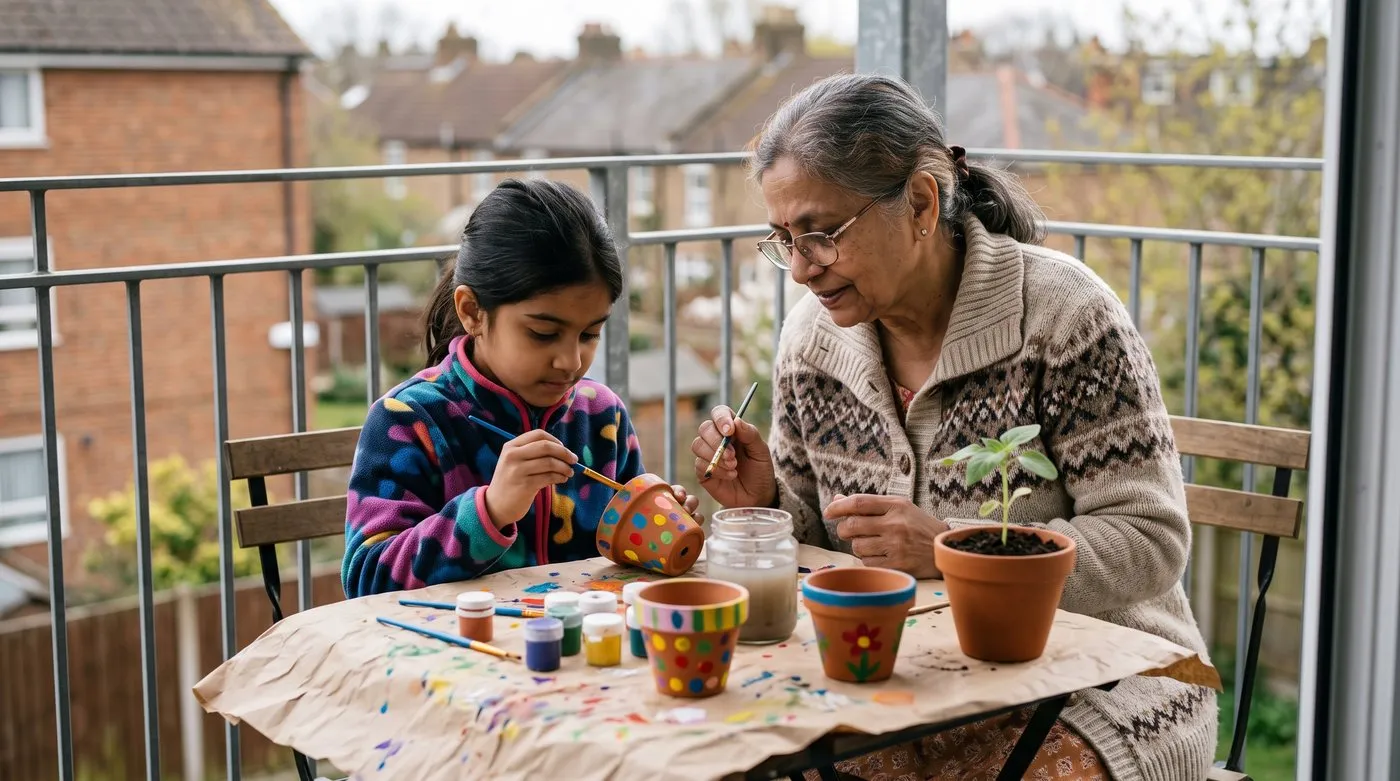
Once the paint is dry, fill each pot with compost and sow a sunflower seed or plant a small herb. They make lovely Easter presents for grandparents.
Seed bombs
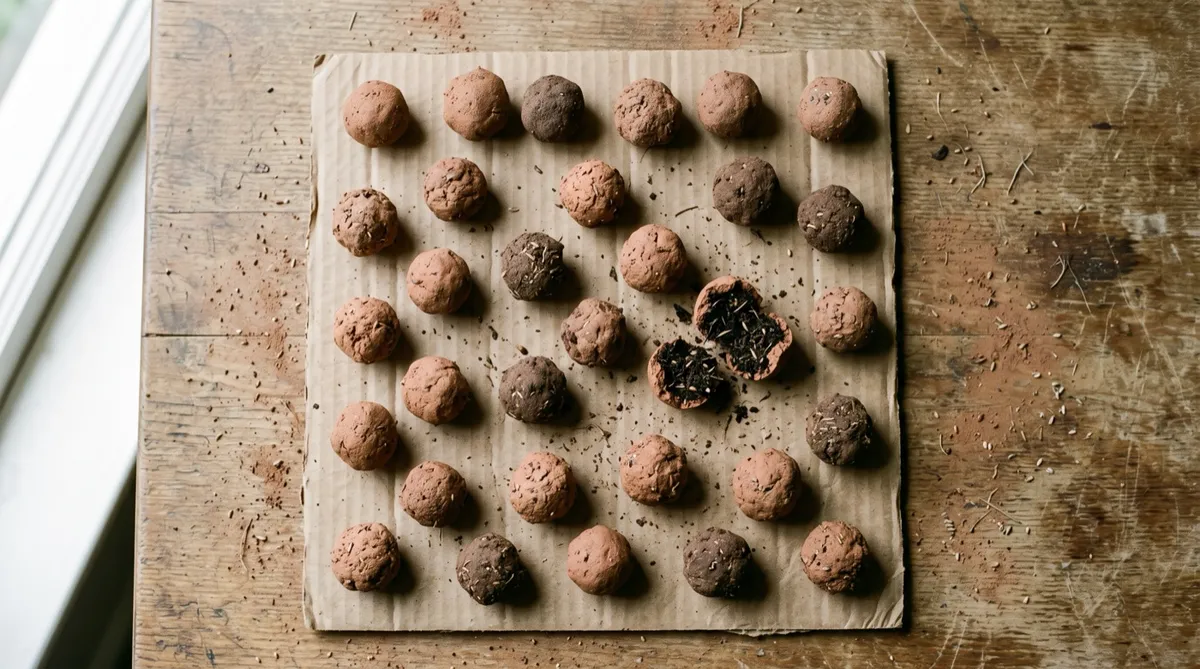
Mix two parts peat-free compost, one part clay powder (from craft shops) and one part wildflower seed. Add water until it holds together, roll into walnut-sized balls and leave on newspaper for a day or two to dry.
Children can throw them into bare patches of the garden. The clay keeps birds off the seeds, then rain softens it and the seeds sprout where they land. A fun way to get bee-friendly plants into forgotten corners.
Cost: A few pounds makes a big batch.
Pressed flower bookmarks
Collect flat flowers and leaves. Lay them between sheets of kitchen paper inside a heavy book for a week or so. Glue the dried flowers onto card bookmarks and cover with clear sticky-back plastic.
Primroses, violas, daisies and single blossom petals press well. Fern leaves and herb leaves work too.
Cost: Free if you’ve got card and glue.
Nature crowns
Cut a strip of card about 5cm wide and long enough to go round a child’s head, and staple the ends. Then wander round the garden sticking on flowers, leaves, feathers and twigs with double-sided tape or glue. Every crown turns out different.
Cost: Free with things from around the house.
Easter activities by age group
A quick guide to which activities suit which ages.
| Activity | Age 2-3 | Age 4-7 | Age 8-12 | Cost | Time |
|---|---|---|---|---|---|
| Cress egg heads | With help | Yes | Yes | Very cheap | 10 minutes |
| Sowing sunflowers | With help | Yes | Yes | Cheap | 15 minutes |
| Sowing runner beans | No | Yes | Yes | Cheap | 15 minutes |
| Egg hunt (simple) | Yes | Yes | Yes | Free or cheap | 30-60 minutes |
| Egg hunt (clue trail) | No | With help | Yes | Free or cheap | Up to 90 minutes |
| Scavenger hunt | With help, short list | Yes | Yes | Free | 30-60 minutes |
| Bug hotel | No | With help | Yes | Free | Up to 90 minutes |
| Painted pots | With help | Yes | Yes | Cheap | 30 minutes |
| Seed bombs | No | Yes | Yes | Cheap | 30 minutes |
| Pressed flowers | No | With help | Yes | Free | 10 minutes, then a week |
| Nature crowns | With help | Yes | Yes | Free | 20 minutes |
For the very young, try cress egg heads, a simple egg hunt and nature crowns. Older children get the most from runner beans, bug hotels and clue trails. For a mix of ages, painted pots and scavenger hunts let everyone join in at their own level.
Tips for gardening with children
A bit of patience and not worrying about perfection go a long way.
Start small. One pot and one packet of seeds is plenty for a first go. Fifteen happy minutes beats an hour of moaning.
Let them get mucky. Mud and compost are half the fun. Pop them in old clothes. Gloves help if they don’t like the feel of soil, though most children dig in happily.
Give them their own patch. A pot, a corner or a raised bed that’s “theirs”. Let them choose what to grow from a shortlist of easy ones.
Make it a habit. A daily watering round takes five minutes. Children who check every day spot all the little changes.
Celebrate everything. A wonky sunflower or a nibbled lettuce still counts. Take a photo of their plants each week and compare.
Use real tools. Toy trowels bend and frustrate. Proper child-sized tools last for years. A small trowel, a watering can and a hand fork cover most jobs. Keep an eye on little ones with anything sharp.
Grow something to eat. Eating a radish they grew themselves changes how children think about food. Even cress on toast counts.
Explore together. Turn over a stone and count the woodlice. Watch a bee on a flower. Follow an ant trail. Those shared moments are what children remember.
The RHS Campaign for School Gardening has free activity sheets and growing calendars for children. They’re just as handy at home as in the classroom.
Frequently asked questions
What can kids plant at Easter time?
Sunflowers, cress, runner beans, lettuce and radishes. They all come up quickly, so children see results within a week or two. Sow indoors if it’s still cold outside. Big seeds like sunflowers and beans are easiest for small hands.
What age can children start gardening?
Toddlers of two can join in. They love watering and digging. From about four, children can sow big seeds like sunflowers and beans by themselves. Older children can follow instructions, use real tools carefully and look after their own little patch.
How do you make an Easter garden egg hunt?
Hide decorated hard-boiled eggs or wrapped chocolate eggs around the garden. Give each child a basket. For little ones, keep eggs low down and easy to see. For older children, write riddle clues that lead from one hiding spot to the next.
What are cheap Easter garden activities?
Cress, bug hotels and scavenger hunts cost next to nothing. Cress seed is very cheap, and a bug hotel uses free bits from the garden. A scavenger hunt just needs a list. One packet of seeds holds plenty for several children, and seed bombs and nature crowns use things you already have.
Can you do Easter garden activities without a garden?
Yes, easily. Cress eggs, sunflower pots and seed trays all grow on a windowsill. Scavenger hunts work in the park or on a woodland walk. A big pot on a balcony can even grow runner beans up a cane.
What is the easiest plant for a child to grow?
Cress is the easiest of all. Sprinkle the seeds on damp cotton wool in an eggshell. It sprouts within a day or two and is ready to snip in under a week. No soil or garden needed. Sunflowers come next, as the big seeds are easy to handle.
Our team produces practical UK gardening guidance from source research, contributor records and established horticultural practice. Editorial standards are overseen by Matt W.