Key takeaways
- Tar spot shows as raised, shiny black spots on maple leaves from mid-summer
- It is cosmetic and does not harm the health of the tree
- Sycamore and Norway maple are the trees most often affected
- Rake up and remove fallen leaves in autumn to cut next year's spots
- No spray is needed, and none is worth using in a garden
Acer tar spot is the reason so many sycamore leaves look as if someone has flicked tar at them by late summer. The big, shiny black spots are made by a fungus called Rhytisma acerinum. It looks dramatic, but it does not harm the tree. A bit of autumn tidying is all the control you need.
This guide helps you identify tar spot and tell it apart from look-alikes. It also explains why there seems to be more of it these days.
How to identify acer tar spot
Tar spot shows as raised, shiny black spots on the upper side of the leaf, a bit like blobs of tar. Look for:
- Black spots roughly 1-2cm across, slightly raised
- A yellow ring around each spot, especially early on
- Several spots on each leaf in a bad year
- Spots showing from mid-summer and staying until the leaves fall
- Mostly on sycamore and Norway maple
Spots start as pale yellow patches in early summer, then the black centres develop.

Classic tar spot on a sycamore leaf. The raised black blobs with yellow rings are hard to mistake for anything else.
What else could the black marks be?
A few other problems darken maple leaves. This table helps you tell them apart.
| Problem | How it differs from tar spot |
|---|---|
| Sooty mould | Flat black film that wipes off, usually on sticky leaves under aphids |
| Leaf scorch | Brown and crispy from the edges inwards, no spots |
| Verticillium wilt | Whole branches wilt and die, no spots |
| Other leaf spots | Smaller brown or grey marks, not raised and shiny |
If it is raised, shiny, black and sits in a yellow ring, it is tar spot. Brown, crispy edges on a Japanese maple are a different story, explained in our guide to acer leaf scorch.
Does tar spot harm the tree?
No. Tar spot is a cosmetic problem. It spoils the look of the leaves, and in a bad year heavily spotted leaves can drop a little early. The tree itself carries on growing normally, and a spotty summer does not weaken it for the next year.
That makes tar spot one to live with, not to fight. If you want to reduce it, autumn leaf clearing is the one job worth doing.
How tar spot spreads from year to year
The fungus has a simple yearly cycle:
- Autumn and winter: spotted leaves fall, and the fungus sits out the winter in them.
- Spring: the dead leaves release spores, which blow onto the fresh new leaves.
- Summer: yellow patches appear, then black spots develop.
- Autumn: the spotted leaves fall and the cycle starts again.
So the fallen leaves are where you can break the cycle.
How to reduce tar spot: rake up the leaves
Rake up the fallen leaves under the tree once they have all dropped, usually in November. Put them in your council green-waste bin, or bury them deep in a compost heap where spores can’t escape in spring.
Do it every autumn. It won’t stop tar spot completely, because spores also blow in from other sycamores nearby. In a garden with one tree, though, it can make a real difference.
There is no need for a fungicide. Spraying a big tree isn’t practical, and the disease doesn’t harm it anyway.

Raking up fallen leaves in November is the best way to cut next year’s tar spot. The green-waste bin is a good home for them.
Why is there more tar spot than there used to be?
Cleaner air is a big part of the answer. The tar spot fungus does not cope with sulphur dioxide, a pollutant from burning coal. When towns were smoky, sycamores there were often spot-free. As the air has cleaned up, tar spot has become common in towns and cities as well as the countryside.
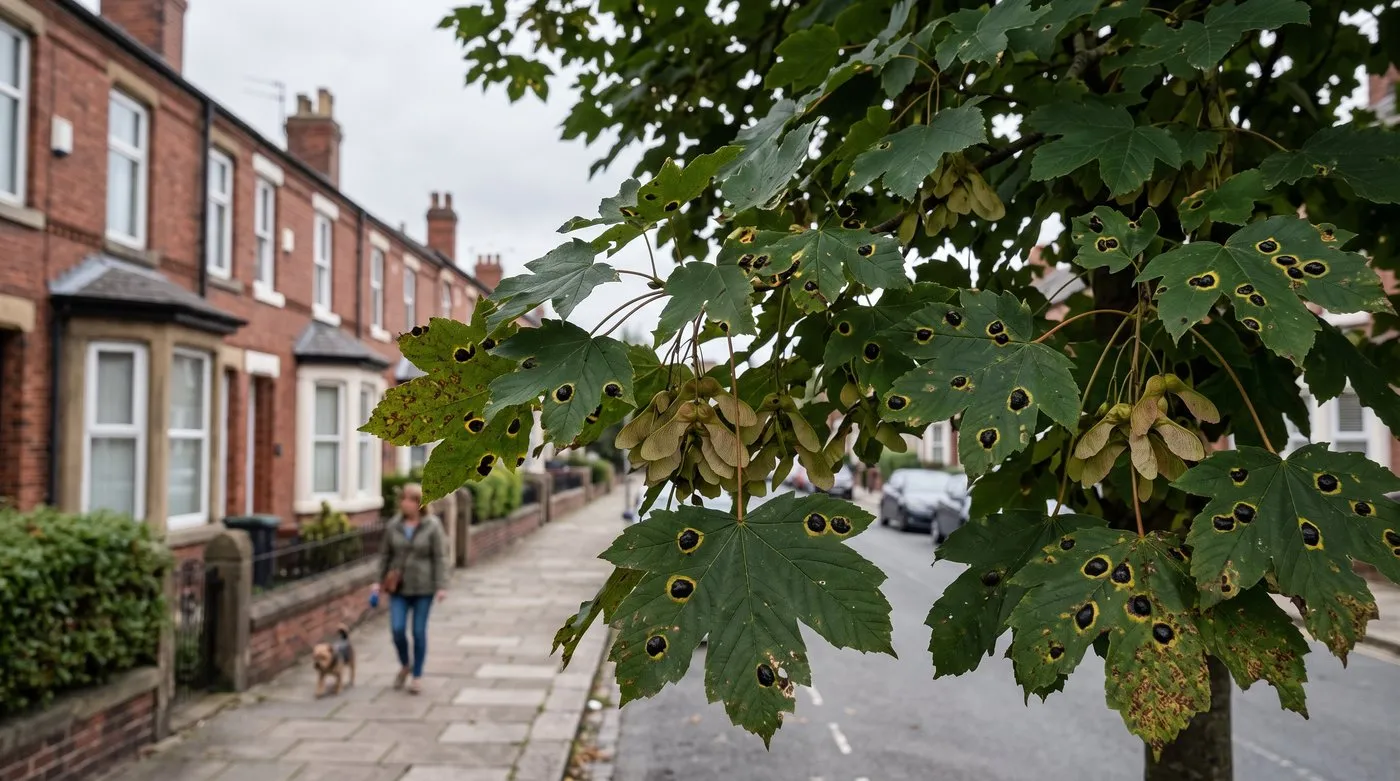
Tar spot is now a common sight on town sycamores, a side effect of cleaner air.
So a spotty sycamore is, in a roundabout way, a sign of cleaner air.
Which maples get tar spot, and which avoid it?
Sycamore (Acer pseudoplatanus) and Norway maple (Acer platanoides) are the trees most often spotted. Japanese maples (Acer palmatum) are rarely troubled.
If you are planting a new tree near the house and the spots would bother you, a Japanese maple is a good choice. Our Japanese maple care guide explains how to keep one happy. For other ideas, see the best trees for small gardens.

A spotty sycamore leaf next to a clean Japanese maple leaf. Japanese maples are rarely troubled by tar spot.
Sycamores also seed freely. If young sycamores keep popping up in your borders, our guide to sycamore seedlings shows how to clear them.

A clean Japanese maple leaf in late summer. These trees give you maple foliage without the black spots.
Common mistakes with tar spot
- Spraying the tree. It isn’t needed, and you can’t cover a big tree properly anyway.
- Pruning off spotted branches. Every leaf can carry spots, so pruning achieves nothing.
- Leaving fallen leaves all winter. They release the spores that start next year’s spots.
- Worrying about the tree. Tar spot is cosmetic. A spotty sycamore is a healthy sycamore.
Tar spot through the year
| Month | What happens and what to do |
|---|---|
| April to May | Spores from old leaves land on new leaves. Nothing to do |
| June to July | Pale yellow patches appear on leaves |
| August to September | Black spots at their most obvious |
| October | Spotted leaves start to fall |
| November | Rake up and remove all fallen leaves |
| December to March | Clear any leaves blown in late. Nothing else needed |
Frequently asked questions
What are the black spots on my sycamore leaves?
They are almost certainly acer tar spot, a common leaf fungus. It makes raised, shiny black spots about 1-2cm across, often ringed with yellow. They appear in summer and stay until the leaves fall.
Will tar spot kill my tree?
No, tar spot does not harm the health of the tree. It spoils the look of the leaves, and badly spotted leaves may fall a little early. The tree carries on growing normally.
How do I get rid of acer tar spot?
Rake up and remove fallen leaves every autumn. The fungus spends winter on dead leaves and infects new leaves in spring. Clearing them reduces spots, although spores can still blow in from trees nearby. No spray is needed.
Why is there so much tar spot on trees nowadays?
Cleaner air is a big part of the reason. The tar spot fungus does not cope with sulphur dioxide pollution, so it used to be scarce in towns. As the air has cleaned up, it has become common in towns and cities too.
Do Japanese maples get tar spot?
Rarely, it mainly affects sycamore and Norway maple. Brown, crispy edges on a Japanese maple are much more likely to be leaf scorch from dry roots, wind or sun.
Find more leaf and tree troubles in our problems hub. If other plants in your garden have spots too, our guide to common garden plant diseases helps you work out what they are.
Our team produces practical UK gardening guidance from source research, contributor records and established horticultural practice. Editorial standards are overseen by Matt W.