Key takeaways
- No flower is truly black; the best 'blacks' are the deepest purples, maroons and browns
- Tulip 'Queen of Night' flowers black-maroon in late April and May, about 60cm tall
- Dark flowers fade into the background, so plant them near a path against a pale foil
- Dahlia 'Karma Choc' and 'Sam Hopkins' flower near-black from July to the first frost
- Black mondo grass keeps the dark theme going all year round
- Chocolate cosmos is tender; lift or protect it over winter
Black flowers give a garden a moody, gothic edge that no other colour can match. The catch is that none of them is truly black. Every dark bloom you can buy is really the deepest purple, maroon, red or brown. Placed well, they look black from a few steps away. Placed badly, they sink into the soil and vanish.
This guide picks the best near-black flowers and foliage for UK gardens, season by season, then shows you how to place them so they actually get noticed.
Why there is no truly black flower
No flower makes true black pigment. The darkest petals are packed with so much deep red-purple pigment that they soak up almost all the light. Your eye reads that as black. Hold a ‘Queen of Night’ tulip up to the sun and the maroon shows straight away.
That hidden colour matters when you plan. Oxblood-red blacks such as Dahlia ‘Karma Choc’ look great beside orange. Purple-blacks such as Viola ‘Bowles’s Black’ sit better with silver and lime. Look at a dark flower in bright light to see its true base colour, then choose its neighbours to suit.
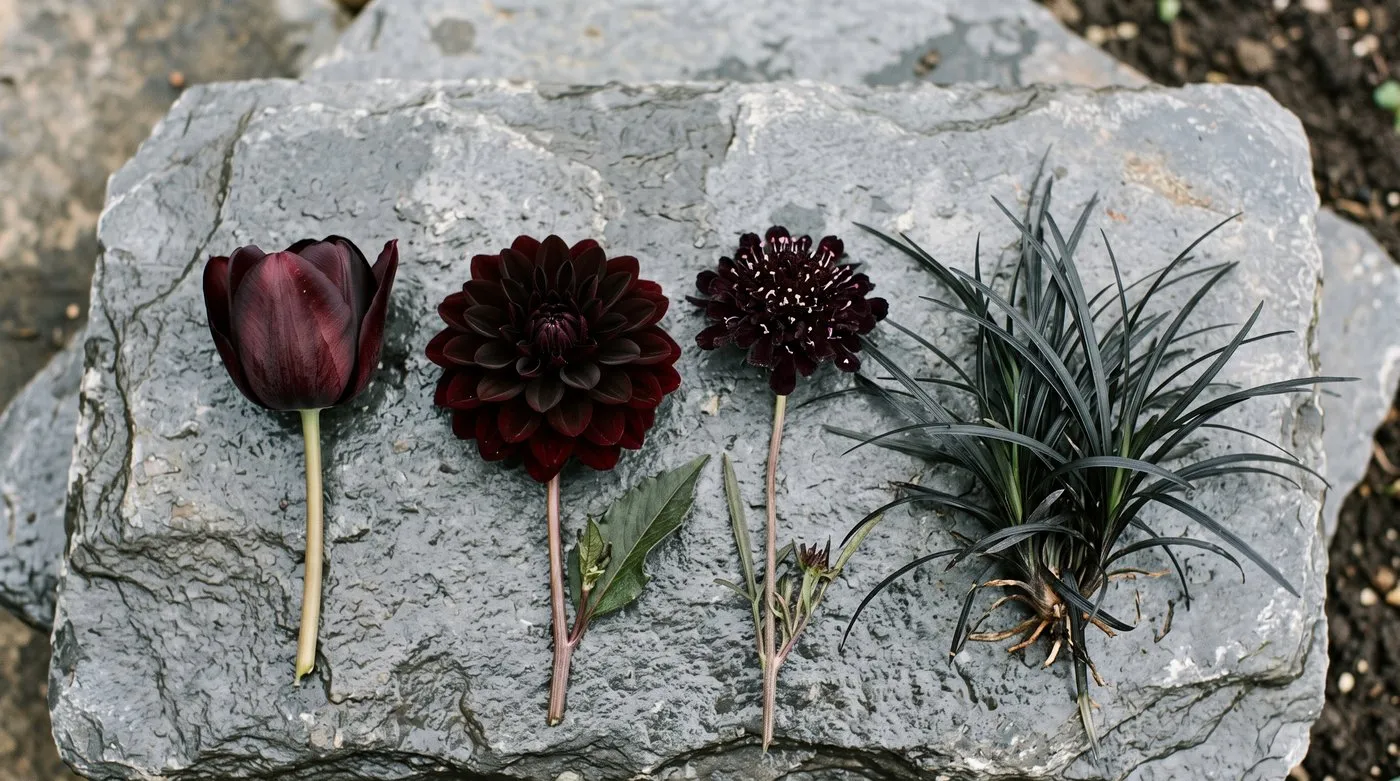
The darkest flowers side by side. The black mondo grass on the right reads blacker than any of the petals beside it.
Black flowers for spring: tulips, fritillaries and aquilegia
Black tulips are the easiest and cheapest way to start a dark scheme.
- Tulip ‘Queen of Night’ is the classic single late tulip in velvety black-maroon. It grows to about 60cm and flowers from late April into May.
- Tulip ‘Black Parrot’ has frilly, twisted purple-black petals and is a little shorter.
Plant both in November, about 15cm deep. On heavy soil they often fade after the first year, so many gardeners treat them as annuals and replant. The guide to growing tulips in the UK covers spacing and lifting.
For height, Fritillaria persica ‘Adiyaman’ sends up a tall spike of plum-black bells in April. It wants full sun and sharp drainage, and looks wonderful rising through lime-green euphorbia. Aquilegia ‘Black Barlow’ follows in May and June with double maroon-black flowers. It self-seeds gently, but seedlings may come out paler. Pull out any that stray from the dark colour.
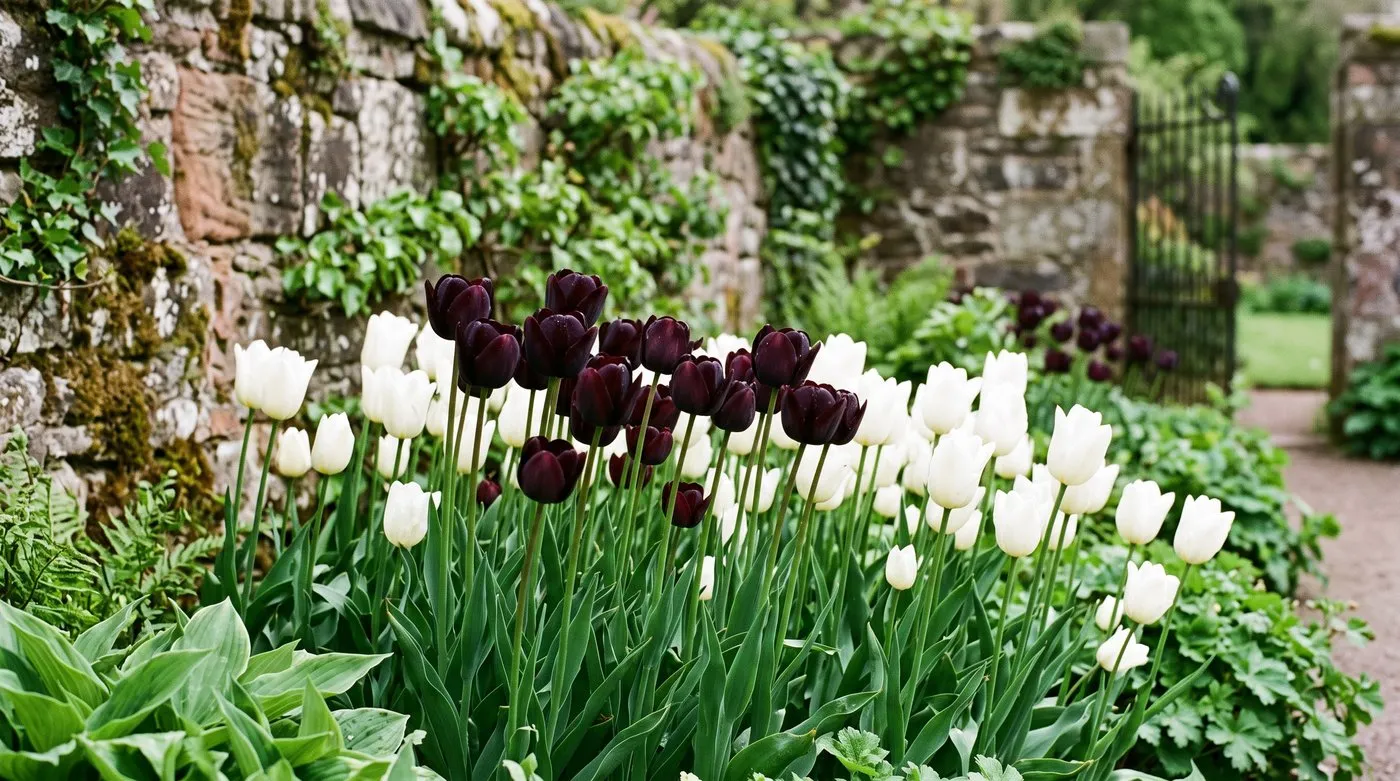
Pairing ‘Queen of Night’ with white tulips makes the dark flowers jump forward instead of fading into the soil.
Early summer blacks: iris, geraniums and hollyhocks
Early summer bridges the gap between the tulips and the dahlias.
Iris chrysographes has near-black, velvety flowers on slim stems in June. It likes moist soil that doesn’t dry out, in sun or light shade.
Geranium phaeum, the mourning widow, has small dusky maroon flowers from May. It is one of the few dark flowers that is happy in shade, so it suits a gloomier corner.
Hollyhock ‘Nigra’ (Alcea rosea ‘Nigra’) adds tall spires of deep maroon-black from July. It looks great against a pale wall. Hollyhocks often get rust on their leaves, so grow them where lower plants hide their legs.
Summer and autumn blacks: dahlias, cosmos and scabious
The dark theme peaks from July until the first frost, and dark dahlias lead the way.
- Dahlia ‘Karma Choc’ has dark red-black flowers on long, strong stems, about a metre tall. It is lovely for cutting.
- Dahlia ‘Sam Hopkins’ has spiky, near-black flowers in a similar oxblood shade.
Both flower from July until frost blackens the leaves. In cold gardens, lift the tubers or mulch them heavily for winter. The guide to growing dahlias in the UK explains both methods. Slugs love the young shoots, so protect them from the day they appear.
Chocolate cosmos (Cosmos atrosanguineus) has maroon-brown flowers that really do smell of chocolate on a warm day. It flowers from July to October. It is tender, so it needs lifting or protecting in winter, as the guide to growing chocolate cosmos explains.
Dark scabious, such as Scabiosa atropurpurea ‘Ace of Spades’, carries maroon-black pincushions on wiry stems all summer. The guide to growing scabious covers sowing. Lower down, Viola ‘Molly Sanderson’ and ‘Bowles’s Black’ give near-black faces at the front of a border, and Petunia ‘Black Velvet’ does the same in pots.
Gardener’s tip: Pick chocolate cosmos and dark scabious for the vase often. Both flower harder the more you cut, and one dark bloom in a jar of silver foliage shows off the colour beautifully.
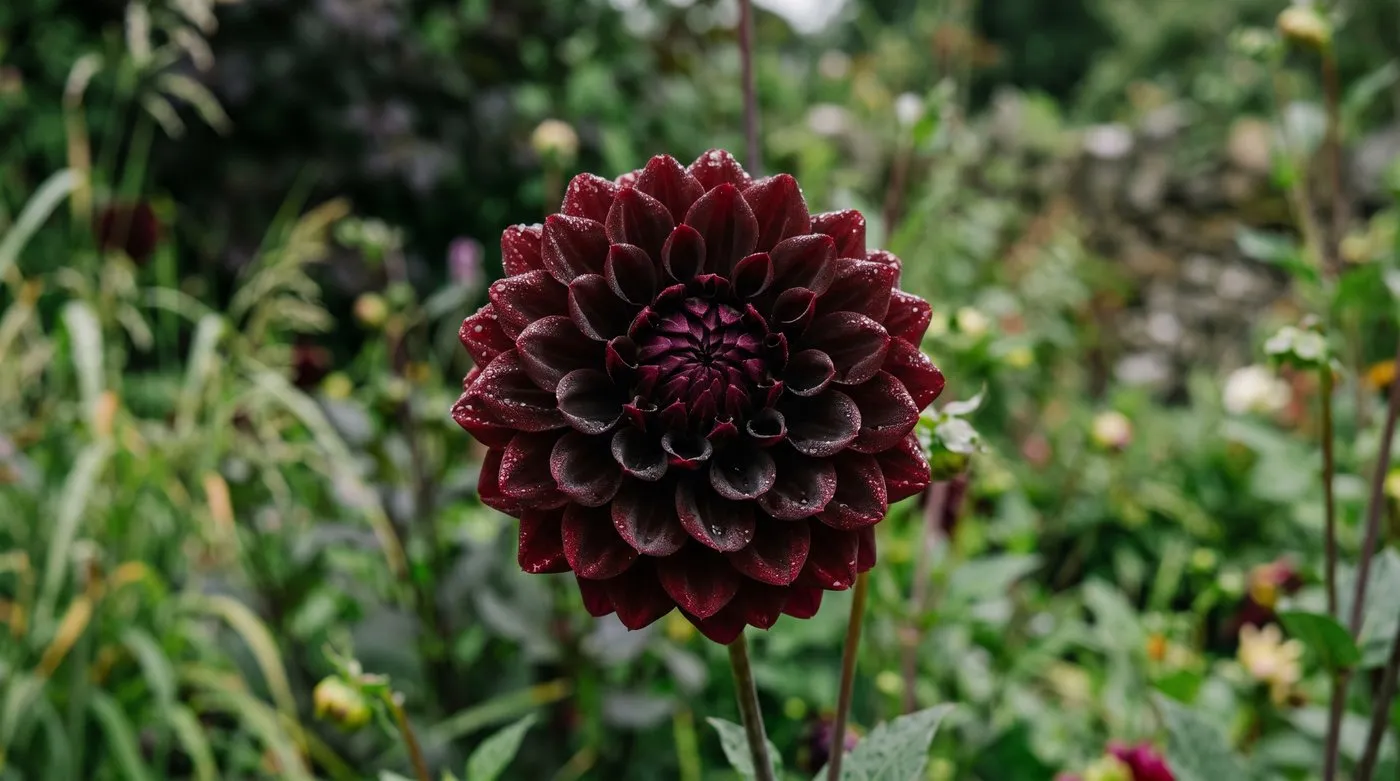
Up close, a dark dahlia shows its oxblood-red base. That warm undertone is why it looks so good next to orange and lime.
Black foliage that holds the theme all year
Flowers come and go. Dark foliage keeps the theme going all season and looks darker than any petal.
Black mondo grass (Ophiopogon planiscapus ‘Nigrescens’) is the star. It makes low tufts of near-black, strappy leaves about 15-20cm tall and stays evergreen. It spreads slowly into a dark mat. Grow it along a path edge or in pots, in sun or part shade.
Sambucus nigra ‘Black Lace’ is a dark-leaved elder with finely cut, black-purple foliage. It grows into a large shrub, but you can cut it back hard in early spring for a smaller plant with bigger, darker leaves. Pale pink flowers in early summer lift the dark canopy.

Black mondo grass looks this dark every day of the year. Against pale gravel it reads as true black.
Dark hellebores for winter drama
The black theme doesn’t have to stop in autumn. Dark hellebores carry it through late winter and early spring.
Helleborus ‘Onyx Odyssey’ has double flowers in slate-black to deep purple from about February to April. Other dark hybrid hellebores, often sold as “black” or “slate”, do a similar job.
Hellebores like rich soil in part shade, which is the opposite of what tulips and dahlias want. Plant them near a door or path you use in winter, as the flowers nod downwards. Cut off old, tatty leaves in midwinter so the flowers show clearly. The guide to growing hellebores covers soil, division and leaf spot.
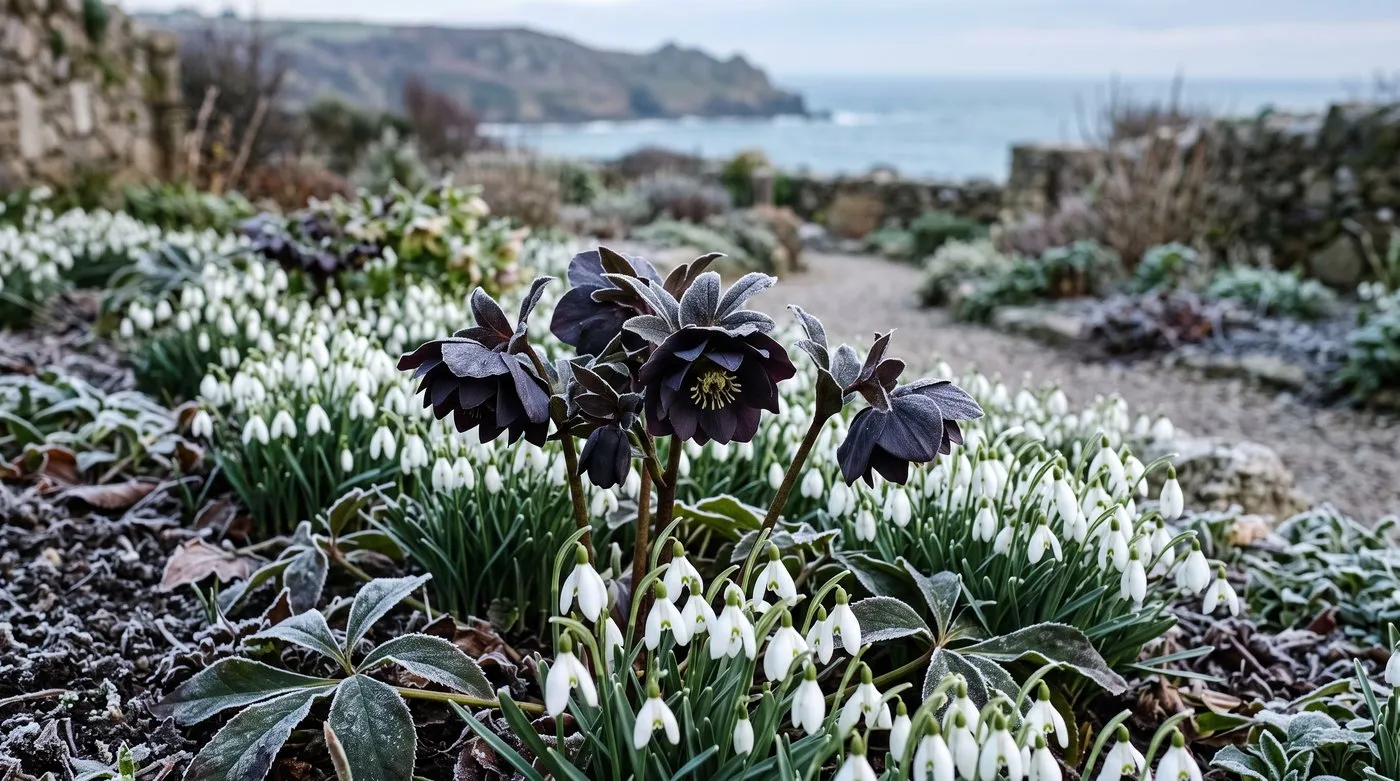
Snowdrops around a dark hellebore give it the pale backdrop it needs. Together they bring drama to the garden in February.
Pet note: Hellebores, tulip bulbs and dahlias can all make cats and dogs ill if chewed. Keep bulbs out of reach while planting, and think twice if you have a pet that chews plants.
How to stop black flowers disappearing in the border
Dark flowers fade into the background. They soak up light instead of reflecting it, so from a distance a black flower can look like a hole. Massed against soil, they simply vanish. This is the main reason gothic schemes disappoint.
Three simple rules fix it:
- Keep them close. Plant dark flowers within about a metre of a path, seat or door. Raised beds, tall pots and wall-top planters lift them closer to eye level.
- Give them a pale foil. Put silver, lime, white or orange plants right behind or beside them. Artemisia, Alchemilla mollis, white cosmos and orange geum all work.
- Use black as an accent. Dot dark flowers through brighter planting rather than filling a whole bed. A bed of nothing but dark flowers looks flat on a grey day.
Black mondo grass makes a handy base. Plant dark tulips through it and they sit against dark leaves rather than bare earth. Add silver or lime nearby and the whole group carries across the garden. For more on balancing colours, see the guide to colour wheel garden design.
Warning: Don’t plant sun-lovers in deep shade to match the mood. Tulips, dahlias and scabious need at least six hours of sun to flower well. Keep the shade for hellebores and mourning widow geranium.
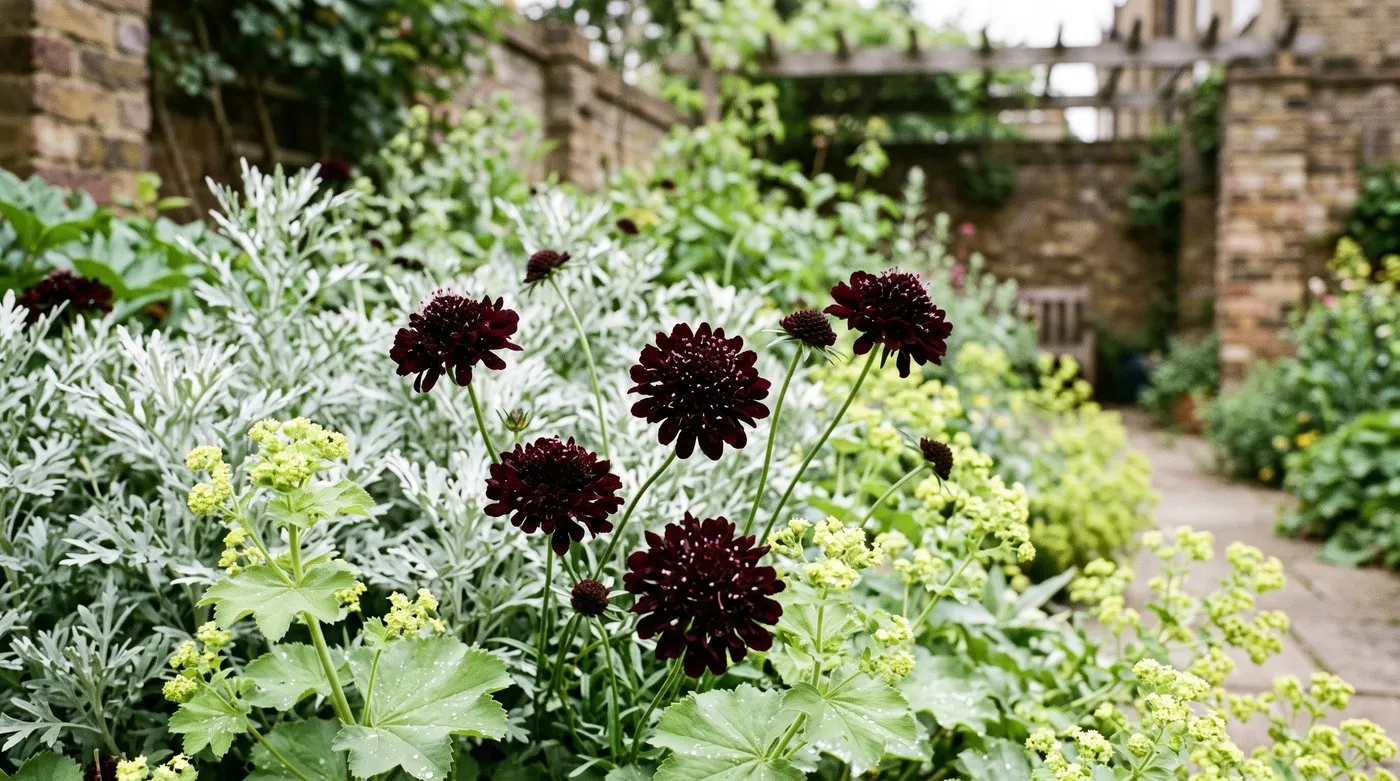
Silver artemisia and lime lady’s mantle make the dark scabious flowers pop. Without them, the same flowers would blend into the shadows.
Month-by-month plan for a gothic border
Plant for a relay, so something dark is always in flower. Black mondo grass holds the theme in every month while the flowers take turns.
| Month | What carries the dark theme | Job to do |
|---|---|---|
| January | Black mondo grass, first hellebore buds | Cut old hellebore leaves; order dark varieties |
| February | Dark hellebores, mondo grass | Start dahlia tubers under cover |
| March | Hellebores, mondo grass | Prune Sambucus ‘Black Lace’ hard if you want it smaller |
| April | Tulip ‘Queen of Night’, ‘Black Parrot’, Fritillaria persica | Stake tall fritillaries |
| May | Aquilegia ‘Black Barlow’, late tulips, Geranium phaeum | Sow scabious under cover |
| June | Iris chrysographes, Geranium phaeum | Plant out dahlias and chocolate cosmos after frosts |
| July | Dahlias, chocolate cosmos, scabious, hollyhock ‘Nigra’ | Deadhead dahlias; support tall stems |
| August | Dahlias, cosmos, scabious, violas | Keep picking to prolong flowering |
| September | Dahlias, scabious, ‘Black Lace’ foliage | Collect seed from violas and scabious |
| October | Late dahlias, chocolate cosmos, mondo grass | Lift chocolate cosmos and dahlias after the first frost |
| November | Black mondo grass | Plant black tulip bulbs 15cm deep |
| December | Black mondo grass, dark seedheads | Leave seedheads standing for winter shape |
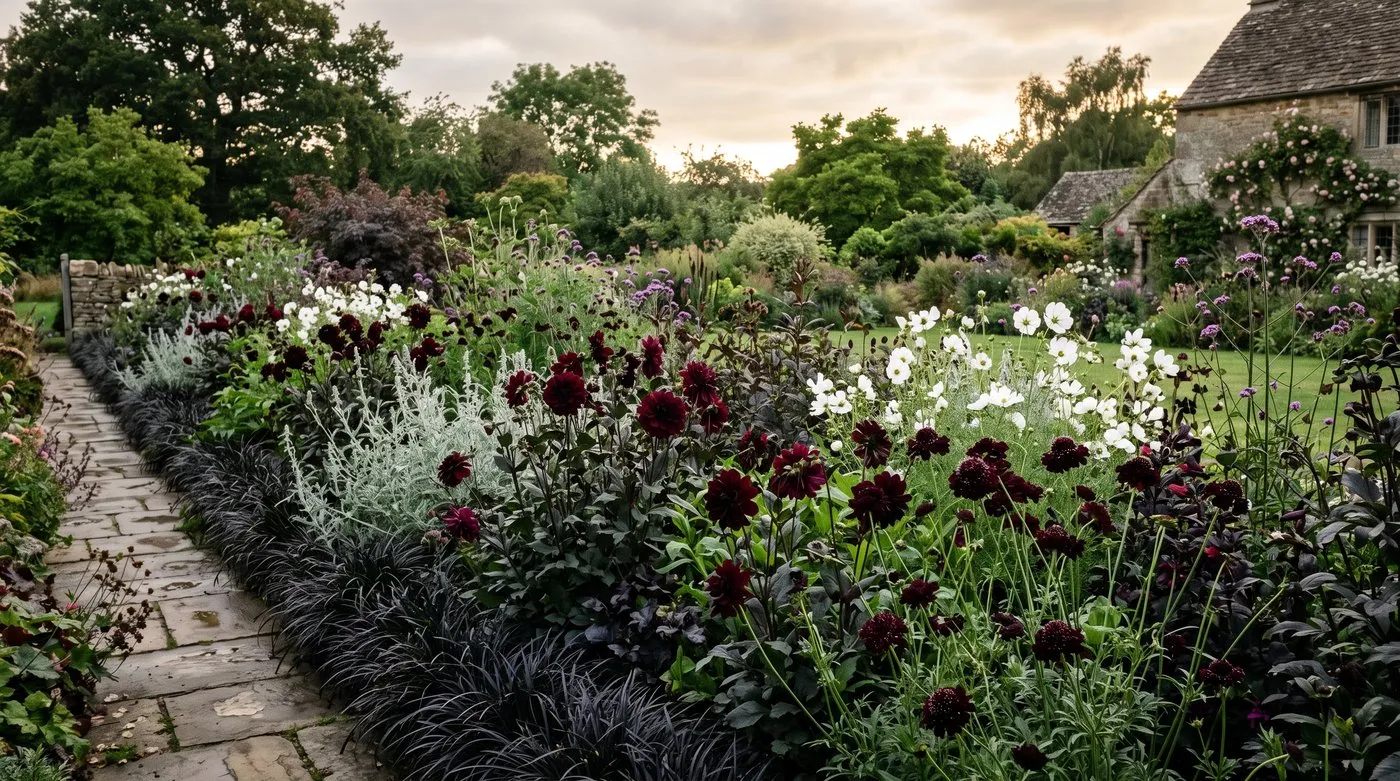
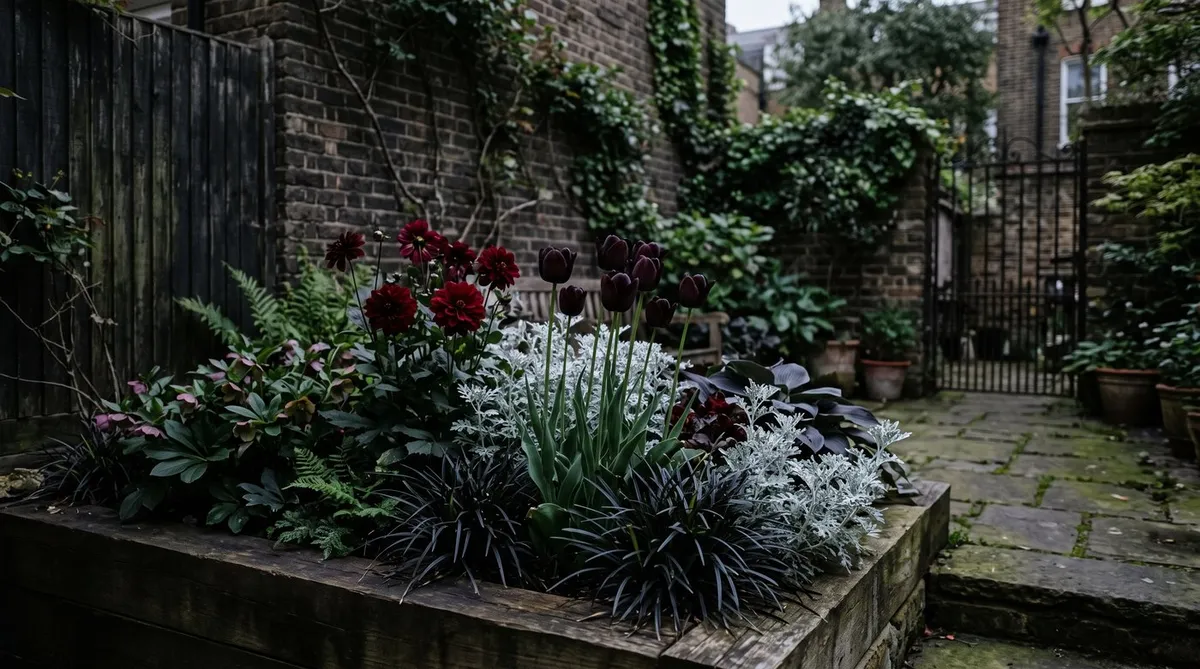
A gothic border in late summer. Dark dahlias rise from black mondo grass, with silver and white lifting the whole scheme.
Common mistakes with black flowers
- Expecting a truly black flower. A “black” tulip opens dark maroon, and that’s normal. Read “black” as “darkest possible purple or red”.
- Massing dark flowers together. A whole bed of black looks like a sooty gap under grey skies. Use dark flowers as accents.
- Skipping the pale partner. Black against bare soil disappears. Always add silver, lime, white or orange nearby.
- Planting them too far away. Dark detail is wasted at the back of a deep border. Keep them close to where you walk or sit.
- Growing sun-lovers in shade. Dark tulips, dahlias and scabious stretch and flower poorly without sun.
For hardiness and growing details on any of these plants, the RHS plant search is a handy check before you buy.
Frequently asked questions
What is the blackest flower you can grow in the UK?
No flower is truly black, and black mondo grass leaves come closest. Among flowers, Iris chrysographes and Tulip ‘Queen of Night’ are two of the darkest reliable choices. Everything sold as black is really very deep purple, maroon or brown.
Are there any true black flowers?
No, true black flowers don’t exist in nature. The darkest petals are packed with so much deep red-purple pigment that they look black. Hold one up to bright sun and you’ll see a maroon, plum or oxblood tint.
What is the best black flower for a gothic garden?
Tulip ‘Queen of Night’ is the most reliable black flower for UK gardens. It flowers black-maroon in late April and May and is cheap and easy. For a longer season, add dark dahlias and black mondo grass to carry the theme to autumn.
Why do my black flowers look invisible in the border?
Dark flowers blend into soil and shade from a distance. They soak up light rather than reflecting it, so they read as a gap. Move them close to a path or seat, lift them to eye level and put silver or lime plants right behind them.
What colours go with black flowers?
Silver, lime green, white and orange make black flowers stand out. White cosmos and orange geum both lift dark tones. Avoid bare soil, deep shade or dark evergreens behind them, where they disappear.
Is chocolate cosmos hardy in the UK?
No, chocolate cosmos is a tender tuber that needs winter protection. In most gardens, lift the tuber in autumn and store it frost-free, like a dahlia. In mild areas with free-draining soil, it may survive outside under a thick, dry mulch.
When do black tulips flower in the UK?
Black tulips flower from mid-April to May in most UK gardens. ‘Queen of Night’ and ‘Black Parrot’ both open in late spring. Plant the bulbs in November, about 15cm deep.
Now you’ve chosen your dark plants, read the guide to when to plant tulip bulbs to get the spring show started, or browse more garden design ideas.
Our team produces practical UK gardening guidance from source research, contributor records and established horticultural practice. Editorial standards are overseen by Matt W.