
Key takeaways
- Plant tulips from late October to late November, later than daffodils and crocuses
- Planting once the soil has cooled lowers the risk of tulip fire
- Plant 15-20cm deep, about three times the bulb's height, and 10-15cm apart
- Darwin Hybrids like Apeldoorn are the most likely to flower again
- Bulb lasagne in pots gives weeks of spring colour from one container
- Give tulips you want to keep a weekly tomato feed from March until the leaves yellow
Tulips are the last spring bulbs to go in each autumn, and that’s on purpose. Planting them after daffodils and crocuses lowers the risk of tulip fire, the worst disease tulips get in British gardens. Get the timing and depth right and you’ll have one of the loveliest spring shows going.
This guide covers when to plant, how deep, the best varieties for UK gardens and how to grow tulips in pots with the lasagne method. Growing daffodils too? See our guide on when to plant daffodil bulbs. For other autumn jobs, our October planting guide has the full list.
When to plant tulip bulbs
Plant tulip bulbs from late October to late November. November is the best month for most UK gardens. The key is to wait until the soil has cooled down, ideally below about 10C.
Why plant tulips late?
Tulip fire is a fungus that loves warm, damp soil. Tulips planted early can sprout in a mild autumn, and those young shoots are easy for the fungus to infect. You end up with scorched brown leaves and twisted, mouldy flowers in spring.
Wait until the soil is cooler and the bulbs make roots without pushing up shoots before winter. That gives the fungus far less of a chance.
The RHS tulip growing guide gives a broad autumn window of September to November. Tulips root and flower perfectly well from a November planting, so waiting costs you nothing.
Regional timing
| Region | Plant from | Plant until |
|---|---|---|
| Scotland and Northern England | Mid-October | Late November |
| Midlands and Wales | Late October | Late November |
| Southern England | Early November | Early December |
| South-west and coastal areas | Mid-November | Mid-December |
These are a rough guide. A cold or mild autumn can shift them by a week or two.
Coastal and south-western gardens stay warm longest. To check, push a soil thermometer 10cm into the ground on two mornings in a row before planting.
Can I plant tulips in December?
Yes, as long as the ground isn’t frozen solid. December-planted bulbs may flower a little later than November ones, but still put on a good show. It’s handy if you’ve picked up bargain bulbs late in the season.
January planting is possible but less reliable. Tulips need a good spell of winter cold to flower well, and planting late cuts that short. You might get leaves but no flowers.
Can you plant tulips in spring?
Yes, but only tulips already growing in pots. Garden centres sell potted tulips in leaf from late winter, and these can go straight in. Tip them out of the pot, plant at the same depth and give them a tomato feed.
Dry bulbs found in the shed in March are a different story. They’ve missed most of the winter chill, so you may get leaves and few or no flowers. Plant them anyway in a spare corner or pot rather than binning them, as some will flower the next spring. For daffodils and snowdrops, see our guide to planting bulbs in the green.
How to plant tulip bulbs

Planting tulips in late autumn: pointy end up, 15-20cm deep, in well-prepared soil.
Plant tulips deep, pointy end up, in soil that drains well and in full sun. Depth and spacing make the difference between tulips that flower once and tulips that come back.
Planting depth
Plant tulip bulbs 15-20cm deep, counting from the bottom of the bulb to the soil surface. That’s about three times the bulb’s height. Deep planting:
- Protects the bulbs from hard frost
- Lowers the risk of tulip fire
- Helps them come back in future years
- Makes it harder for squirrels to dig them up
Planting too shallow, under 10cm, is the most common mistake. You get smaller flowers, weaker stems and few returns after the first year.
Spacing
Space tulips 10-15cm apart in borders. Closer gives a fuller look but more competition and disease. For a formal block of colour, go for 10cm. In a mixed border, 15cm lets air through and leaves room for other plants.
Planting method
- Dig a hole or trench 15-20cm deep
- On heavy clay, add a handful of horticultural grit to the bottom
- Pop the bulb in pointy end up, flat base down
- Fill in with soil and firm gently
- Water once to settle the soil
Do you need to soak or water tulip bulbs before planting?
No, don’t soak them. Plant them dry, straight from the bag. Soaking can make them rot, especially in heavy soils that stay wet all winter.
In borders, autumn rain usually gives them all the water they need. Only water if the soil is dry when you plant, which can happen after a dry October in the south-east. Pots are different: water them well after planting, then keep the compost just moist. Pots under the eaves can dry out even in winter.
For lots of bulbs, a long-handled bulb planter saves your knees and back. Or dig a wide trench to the right depth, set all the bulbs in and fill it back in.
Gardener’s tip: On heavy clay, put a 2cm layer of sharp grit under each bulb. Tulips hate sitting in wet ground over winter, and the grit helps water drain away from the base. Our how to improve clay soil guide has more drainage tips.
Soil and position
Tulips want full sun for the best flowers, so a south or west-facing border is ideal. They’ll put up with part shade, but stems are shorter and flowers smaller.
Soil that drains well is a must, as wet ground rots tulip bulbs over winter. On heavy clay, dig in coarse grit and compost down to planting depth. Raised beds and pots give the best drainage of all.
How do you stop squirrels digging up tulip bulbs?
Lay chicken wire over the planted area until the leaves come up. Grey squirrels love digging up freshly planted tulips, often within days. Peg wire over beds and across the tops of pots, then take it off in late winter as the shoots push through.
A few other tricks help. Clear away the papery bulb skins after planting, as the smell draws squirrels in. Sprigs of holly pushed into the soil put some animals off. Mixing tulips with daffodils may help too, as squirrels leave daffodils alone. Our guide on how to stop squirrels digging up bulbs has more ideas.
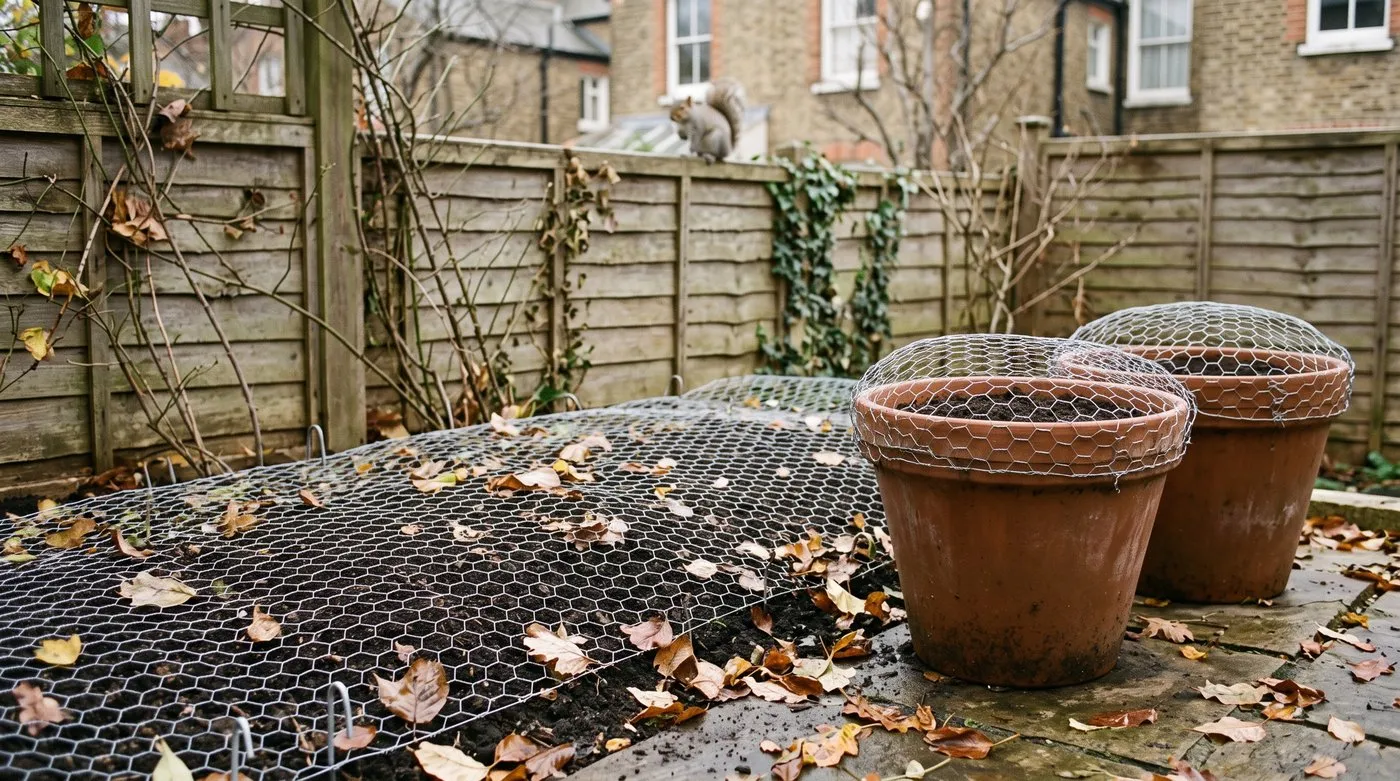
Peg chicken wire over freshly planted tulips until the shoots come up in late winter. Squirrels can dig new bulbs up within days.
Best tulip varieties for UK gardens
These are reliable choices for British gardens, grouped by when they flower. The last column is a rough guide to how well each comes back.
Variety comparison
| Variety | Type | Height | Flowers | Colour | Comes back? |
|---|---|---|---|---|---|
| Queen of Night | Single Late | 55-60cm | May | Deep maroon-purple | Sometimes |
| Apeldoorn | Darwin Hybrid | 55-65cm | April-May | Scarlet red | Often |
| Golden Apeldoorn | Darwin Hybrid | 55-65cm | April-May | Golden yellow | Often |
| Spring Green | Viridiflora | 40-50cm | Late April-May | White with a green stripe | Sometimes |
| Ballerina | Lily-flowered | 50-55cm | Late April | Orange, scented | Sometimes |
| Purple Prince | Single Early | 30-40cm | Late March-April | Rich purple | Not often |
| Black Parrot | Parrot | 45-55cm | May | Deep purple-black, frilly | Rarely |
| Tulipa sylvestris | Species | 25-30cm | April | Yellow, nodding | Spreads |
| Tulipa tarda | Species | 10-15cm | March-April | Yellow and white star | Very reliably |
| Negrita | Triumph | 40-50cm | April | Purple | Sometimes |
Early-flowering tulips
Purple Prince and Apricot Beauty are among the first big tulips to flower, opening in late March in southern England. At 30-40cm, they’re great for pots and the front of borders. Pair them with early daffodils.
Mid-season tulips
Triumph tulips are the backbone of most UK tulip displays. They flower in mid to late April at 35-50cm, bridging the gap between early and late types. Negrita (purple) and Jan Reus (dark red) are stunning.
Darwin Hybrids are the best bet if you want tulips that come back. Apeldoorn, Golden Apeldoorn and Pink Impression are the hybrids most likely to flower again when planted 20cm deep in well-drained soil, though it’s never guaranteed.
Late-flowering tulips
Queen of Night is a classic late tulip with deep maroon-purple flowers in May. Plant it with white forget-me-nots for a gorgeous contrast. Black Parrot has the same dark drama with frilly petals.
Ballerina is one of the few scented tulips. Its orange, lily-shaped flowers have a sweet, musky smell. Plant it by a path or bench so you can enjoy it.
Species tulips for naturalising
Species tulips are small, but they often come back year after year without any lifting. Tulipa sylvestris spreads underground and settles happily in grass and light woodland. T. tarda makes carpets of yellow-and-white stars just 10-15cm tall. T. clusiana ‘Lady Jane’ has pretty pink-and-white striped petals.
They’re perfect for grass, rock gardens and the front of cottage borders, and need no fuss once settled. Our cottage garden planting plan has ideas for mixing them with other cottage plants.
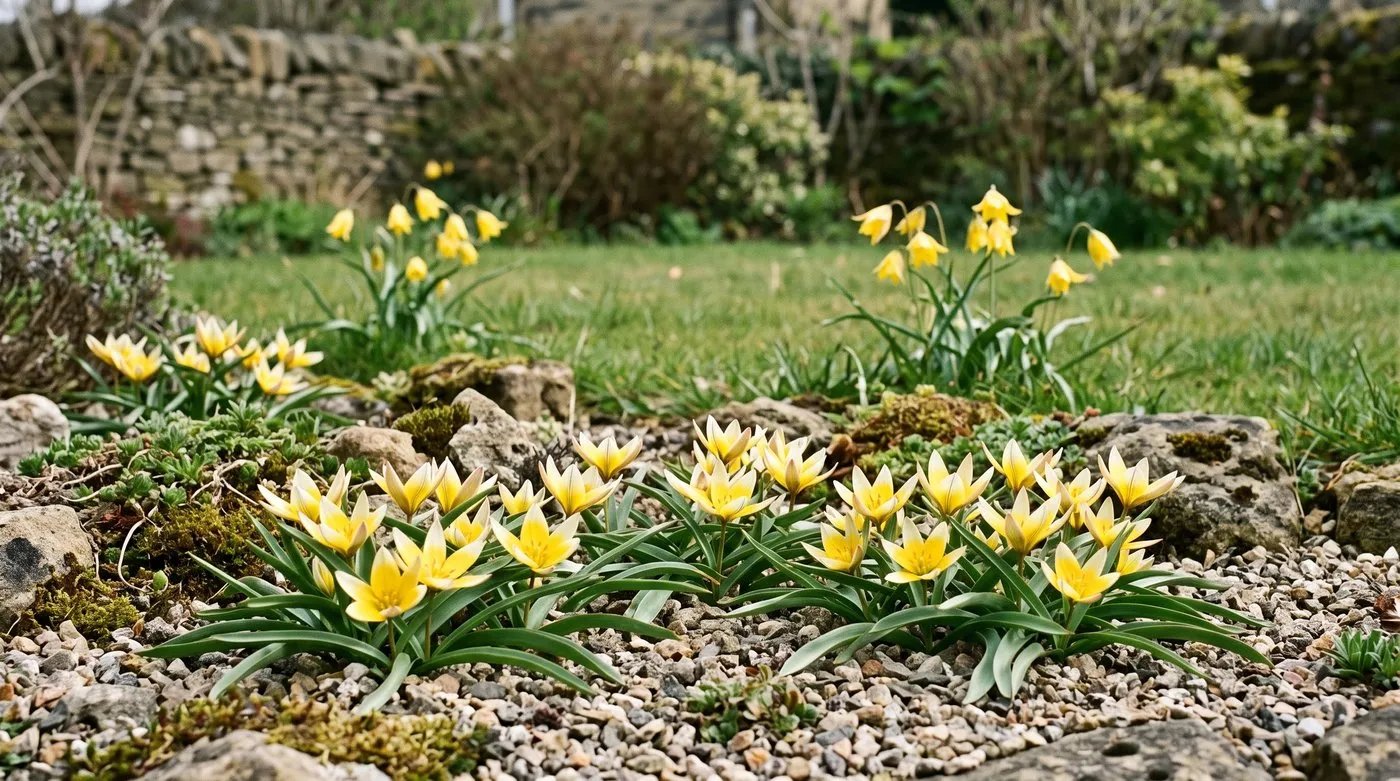
Little species tulips like T. tarda come back year after year without lifting. They’re perfect for gravel, rock gardens and the front of a border.
Month-by-month tulip calendar
Tulip jobs run all year: planting in autumn, feeding in spring, and lifting and storing in summer.
| Month | What to do |
|---|---|
| January | Order bulbs if you haven’t already. Plan your colour schemes |
| February | Check stored bulbs for mould. Throw out any soft ones |
| March | Start a weekly tomato feed as shoots grow. First species tulips flower in mild areas |
| April | Peak tulip season. Snap off dead flowers but leave the stem and leaves |
| May | Late tulips flower. Keep feeding weekly until the leaves yellow |
| June | Leaves die back. Lift hybrid bulbs once the leaves are brown. Store somewhere dry and airy |
| July | Clean and sort stored bulbs. Throw out any damaged ones |
| August | Keep stored bulbs warm, dry and dark. Order new varieties from the catalogues |
| September | Buy bulbs. Pick firm, plump ones with no mould |
| October | Start planting in late October once the soil cools |
| November | Main planting month. Plant borders and pots, and make bulb lasagnes |
| December | Last chance to plant if the ground isn’t frozen. Mulch planted areas |
Growing tulips in containers
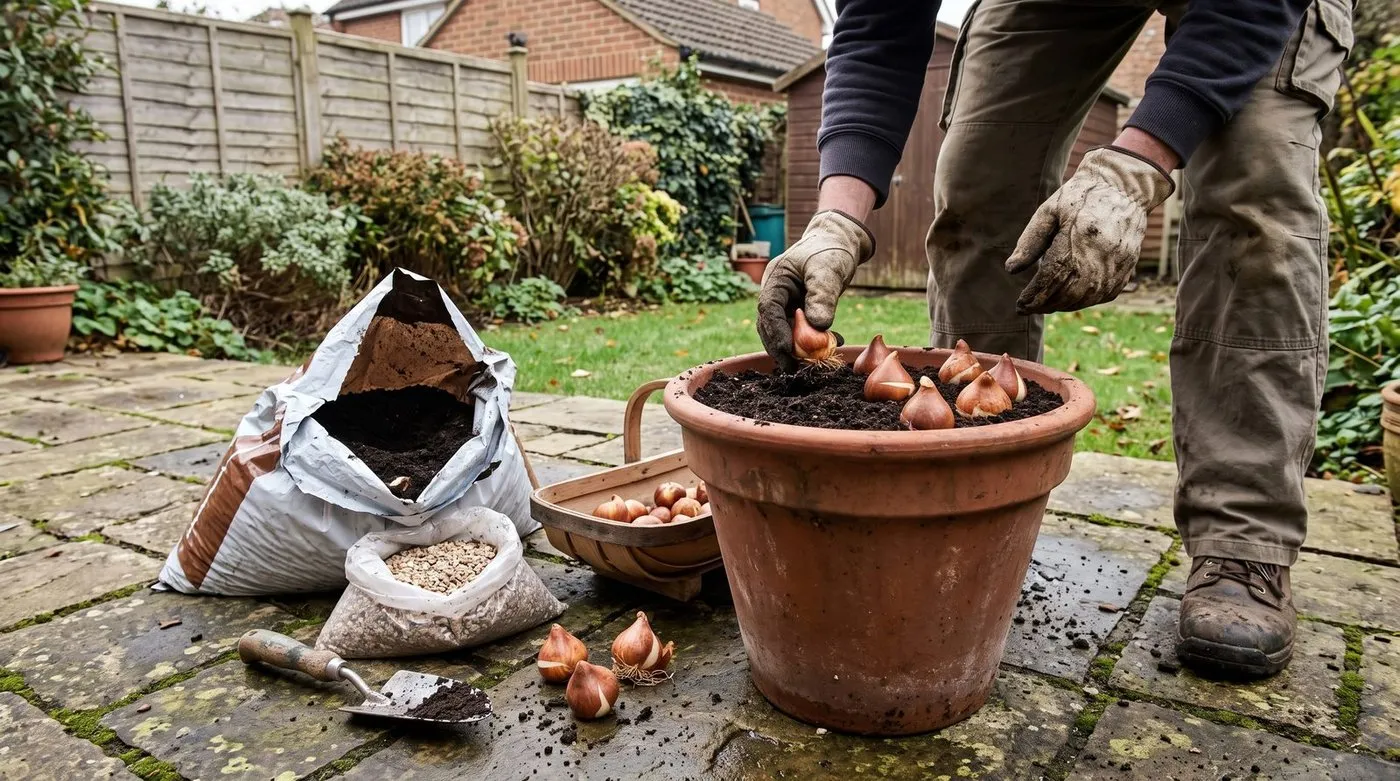
Set tulip bulbs pointy end up. For a bulb lasagne, add more layers at different depths for weeks of spring colour.
Tulips are brilliant in pots. You’re in charge of the drainage, the compost and where they sit. Fresh compost each year also keeps tulip fire away.
Pot selection
Use pots at least 30cm deep with drainage holes. Terracotta, ceramic and plastic all work, though terracotta dries out faster. Stand pots on pot feet or bricks so water drains freely.
Compost mix
Fill pots with 2 parts multipurpose compost to 1 part horticultural grit. It drains well and stops the bulbs sitting wet. Add a little slow-release fertiliser at planting time.
Planting density
In pots, plant tulips 2-3cm apart, much closer than in the ground, for a packed display. A 30cm pot takes 7-9 bulbs comfortably.
Lasagne planting
Lasagne planting means layering different bulbs at different depths in one pot. Each layer flowers in turn, so you get weeks of colour.
Layer 1 (deepest, 15cm): Tulips. A mid-season variety like Negrita or Apeldoorn.
Layer 2 (10cm): Daffodils. A little one like Tete-a-tete works well.
Layer 3 (5cm): Crocuses. A mix of purple, white and yellow gives the first colour in February.
Cover each layer with compost before adding the next. Water once after planting. Keep the pot somewhere sheltered until growth appears in late winter, then move it somewhere you’ll see it as the first crocuses open.
Gardener’s tip: For the longest show, pair an early tulip (Purple Prince, late March) with a late one (Queen of Night, May) in the same pot. One takes over as the other finishes.
After flowering in pots
When the flowers fade, move the pot out of the way and let the leaves die down on their own. Don’t cut them, as they’re feeding next year’s flower. Water now and then. Once the leaves are completely brown, usually by June, tip out the bulbs, clean them and store them somewhere warm and dry until autumn.
Feeding and aftercare
If you want to keep your tulips, feed them weekly in spring, deadhead them and leave the leaves for six weeks. If you’re treating them as one-season bedding, you can skip all this.
Spring feeding
Feed tulips weekly with a tomato feed once they’re growing, from March onwards. Stop when the leaves start to yellow. Tomato feed is high in potash, which helps the flowers and the bulb’s store for next year.
Avoid high-nitrogen feeds. They give lots of leaves but fewer flowers, and the bulbs are less likely to come back.
Deadheading
Snap off the flower heads as soon as the petals drop, but leave the stem and all the leaves. They keep feeding the bulb for about 6 weeks after flowering.
Foliage management
Don’t cut, tie or fold tulip leaves after flowering. Let them yellow and die down on their own over about 6 weeks. It’s the most important thing you can do if you want flowers next year. Plant low perennials or annuals around them to hide the fading leaves.
Lifting and storing
Species tulips and Darwin Hybrids can stay in the ground for good in well-drained soil. Other hybrid tulips do better if you lift them once the leaves have died back in June.
Dig the bulbs up gently with a hand fork and brush off loose soil. Throw out any that are soft, mouldy or damaged. Lay the good ones in a single layer in trays or mesh bags, and keep them somewhere warm, dark and airy, around 18-20C, until you replant in autumn.

Lift hybrid tulips once the leaves are brown, throw out any soft ones and store the rest in a single layer somewhere warm, dark and airy.
Common mistakes
Most tulip troubles come from five mistakes: planting too early, too shallow or in wet soil, leaving short-lived hybrids in the ground, and cutting the leaves too soon.
Planting too early
It’s tempting to plant tulips in September with the daffodils, but it’s risky. Warm September soil makes them sprout early and catch tulip fire. Wait until late October at the earliest. November is better most years.
Planting too shallow
Bulbs planted 8-10cm deep flower the first year but rarely come back. Planting 15-20cm deep protects them from frost and swings in temperature, and gives you a better chance of flowers in later years. Stick to the three-times-the-height rule.
Ignoring drainage
Tulips sitting in wet soil over winter rot. It’s a common problem in clay gardens. Add grit under each bulb, dig in compost, or grow them in pots. Raised beds work brilliantly too.
Leaving hybrid tulips in the ground
Most hybrid tulips (Parrot, Lily-flowered, Fringed and Single Late types) fade after 2-3 years in the ground. The bulbs split into small offsets that don’t have the energy to flower. Lift and store hybrids each year, or treat them as bedding and buy fresh bulbs each autumn. Our November planting guide has other things to plant alongside them.
Cutting foliage too early
Cutting tulip leaves before they’ve died down starves the bulb. Those six weeks of green leaves after flowering really matter. Plant them among perennials to hide the leaves, but don’t cut, tie or fold them.
Companion planting with tulips

Queen of Night and Apeldoorn tulips in bold blocks with blue forget-me-nots.
Great tulip partners are low spring plants like forget-me-nots and wallflowers, plus perennials that hide the fading tulip leaves. Tulips look best in groups of 7-15 of one variety, with blocks of one colour next to another.
Spring partners that work well include forget-me-nots, wallflowers, honesty and polyanthus. They fill the gaps between the tulip stems and give a lovely contrasting backdrop.
For later in the season, plant tulips among perennials that are just coming up, like hardy geraniums, hostas and lady’s mantle. As the tulip leaves die down, the perennial leaves grow over and hide them.
In cottage garden borders, tulips look wonderful with late daffodils, crown imperials (Fritillaria imperialis) and early alliums. Sketch the display on paper first so you know where each group goes.
Tulip fire: identification and prevention
Tulip fire is the most serious tulip disease in UK gardens. It causes twisted leaves, brown scorched patches, grey fuzzy mould in damp weather and spotty, rotting flowers. Tiny black specks on dead leaves and bulbs carry the disease in the soil. The RHS tulip fire guide says it’s worst after a long, wet spring.
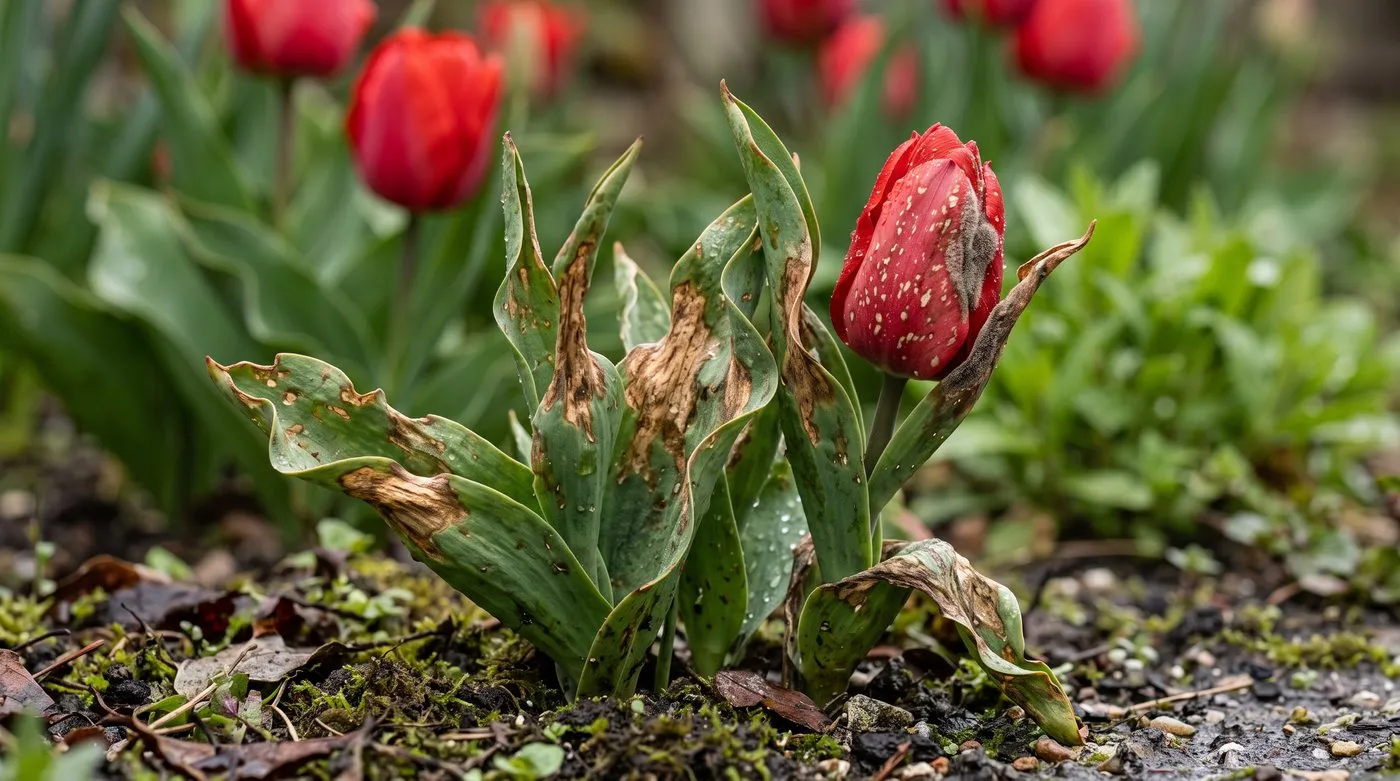
Twisted, scorched leaves and spotty flowers with grey mould point to tulip fire. Dig out and bin affected plants, and don’t replant there for three years.
Prevention
- Plant late, in November, once the soil has cooled
- Move your tulips around, and don’t replant where tulip fire has been for at least 3 years
- Space bulbs 10cm apart so air can move between them
- Remove and bin any infected leaves straight away
- Check bulbs before planting and throw out any with black specks or soft patches
Treatment
There are no sprays available to home gardeners for tulip fire. Dig up infected plants and put them in the bin, not on the compost heap. Don’t plant tulips in that spot for at least 3 years, as the disease lingers in the soil.
Frequently asked questions
When should I plant tulip bulbs in the UK?
From late October to late November. That’s later than daffodils and crocuses, which go in from September. Planting late lowers the risk of tulip fire. In mild southern and coastal gardens, November is usually best.
Can I plant tulip bulbs in December or January?
December is fine if the ground isn’t frozen. December-planted tulips may flower a little later, but they still put on a good show. January is possible but less reliable, as tulips need a good spell of winter cold to flower well.
How deep should I plant tulip bulbs?
15-20cm deep, counting from the bottom of the bulb. That’s about three times the bulb’s height. Deep planting protects them from frost and helps them come back. Bulbs planted shallower than 10cm give weaker flowers and rarely return.
Why did my tulips not come back this year?
Most hybrid tulips fade after 2-3 years. They use up their stored energy making those big flowers. Shallow planting, wet soil and crowding make it worse. For tulips that return, pick Darwin Hybrids or species tulips, plant deep in well-drained soil and feed them in spring.
What is tulip fire and how do I avoid it?
It’s a fungal disease that only affects tulips. It causes brown spots, twisted leaves and grey mould on the flowers. To avoid it, plant late, don’t replant where it’s been for at least 3 years, remove infected leaves straight away and space bulbs at least 10cm apart.
Can I plant tulips in pots?
Yes, they’re brilliant in pots. Use one at least 30cm deep with drainage holes. Fill it with 2 parts multipurpose compost to 1 part grit. Plant the bulbs 15cm deep and just 2-3cm apart for a packed display.
What is lasagne planting?
It’s layering different bulbs at different depths in one pot. Put tulips deepest at 15cm, daffodils at 10cm and crocuses at 5cm. Each layer flowers in turn, giving you weeks of colour from one container.
Which tulip varieties are best for UK gardens?
Queen of Night, Apeldoorn, Spring Green and Ballerina are all reliable favourites. For tulips that come back in grass or borders, try species tulips like Tulipa sylvestris, or Darwin Hybrids planted 20cm deep. Our spring gardening jobs guide covers other spring bulb jobs.
Our team produces practical UK gardening guidance from source research, contributor records and established horticultural practice. Editorial standards are overseen by Matt W.


