
Key takeaways
- Measure the slope first, as it decides what you need
- Gentle slopes can simply be planted with tough ground cover
- Steeper slopes are easier to use as level terraces
- Sleepers are the cheapest DIY way to terrace, but keep walls low
- Plan where the water will go, with a French drain at the base
- Get a professional to design any tall retaining wall
A sloping garden can feel like a headache, but it’s one of the most rewarding spaces to sort out. Whether you have a gentle roll or a steep bank that loses soil every time it rains, there’s a way to make it work.
How do I assess my garden slope?
Measure the slope before you spend a penny. It tells you whether you need plants, terraces or a professional.
The easy way: rest one end of a 2m spirit level on the slope, pointing downhill, and hold it level. Measure the gap between the free end and the ground. That’s how much the ground drops over 2m.
| Drop over 2m | What it’s like | What you need |
|---|---|---|
| About 10cm | Gentle | Planting may be enough |
| About 20cm | Moderate | Ground cover plus some drainage |
| About 33cm | Steep | Terraces |
| About 50cm | Very steep | Proper retaining walls |
| 65cm or more | Severe | Talk to a structural engineer |
Bare soil on a slope washes downhill a little every time it rains, taking your best topsoil with it. The steeper the slope, the faster it goes.
What are the best terracing methods for a sloped garden?
Terracing turns a slope into a series of flat steps held up by walls or planted banks. The best method depends on how steep it is, your budget and the look you like. Retaining walls can also shape a sunken garden on flatter plots.
Terracing methods compared
| Method | Cost | DIY friendly? | How long it lasts | Best for |
|---|---|---|---|---|
| Railway sleepers | Low | Yes, for low walls | Years, then needs replacing | Budget terraces, veg beds |
| Gabion baskets | Medium | Yes, for low walls | A very long time | Modern gardens, steep slopes |
| Dry stone walls | High | Skilled job | A very long time | Cottage and country gardens |
| Timber crib walls | Medium | Mostly professional | Many years | Big slopes, planted walls |
| Planted banks | Lowest | Yes | Permanent | Gentle slopes, wildlife gardens |
Railway sleeper terraces
Sleepers are the most popular DIY choice. Softwood sleepers are the cheapest. Reclaimed oak costs more but looks great from day one.
For a single sleeper, about 20cm high: lay it on a bed of compacted sand. Pin it in place with steel rods driven through drilled holes deep into the ground. No concrete needed.
For taller walls: you’ll need a concrete footing, posts or rods tying the layers together, and gravel and a drain pipe behind the wall. This is where it pays to get advice.
 Sleeper terraces on a clay slope. Gravel behind each wall lets water drain away so the wall stays put.
Don’t stack sleepers more than two high without expert advice. Every extra layer means much more push from the wet soil behind.
Gabion basket walls
Gabions are wire cages filled with stone. They drain freely, are very strong and suit modern gardens.
They flex a little instead of cracking, which is handy on clay that swells and shrinks. The gaps between the stones make homes for insects, frogs and other small creatures.
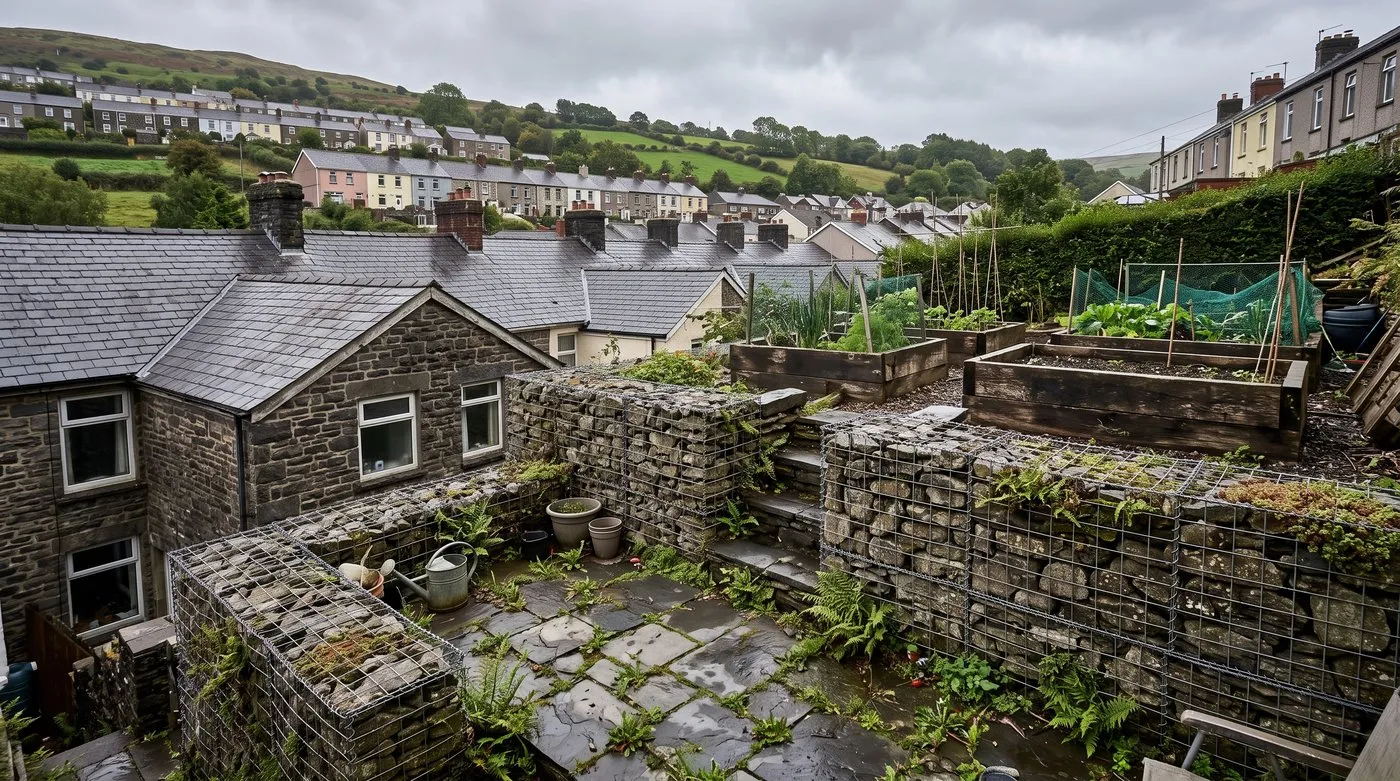
Gabions drain freely and flex a little rather than cracking, which suits wet clay slopes. The gaps between the stones soon fill with life.
Natural stone retaining walls
Dry stone walls have no mortar and drain through the gaps. They look perfect in country and cottage gardens. Building one is a skilled job, so use an experienced waller.
Mortared stone walls need small drainage gaps, called weep holes, along the bottom. Without them, water builds up behind the wall and it can crack and lean.
How do I drain a sloped garden?
Sorting the water is the difference between a slope that works and one that slumps. Every terracing job needs a drainage plan.
French drains
A French drain is a gravel-filled trench with a pipe in it. It catches water moving through the soil and carries it to a soakaway or drain.
How to build one:
- Dig a trench about 450mm deep and 300mm wide across the slope
- Line it with geotextile membrane, which stops soil clogging the gravel
- Add a 10cm layer of clean gravel
- Lay perforated land drain pipe on the gravel, sloping gently downhill
- Fill with gravel to about 10cm below the surface
- Fold the membrane over the top
- Cover with topsoil and turf, or plant it up
A 10m drain is a good day’s digging for one person.
Soakaways
A soakaway is a pit where the drained water can slowly soak into the ground. Dig a hole about 1m across and 1m deep at the lowest point, well away from the house (at least 5m). Fill it with clean rubble or soakaway crates, wrap in membrane and run your drains into it.
Surface water channels
On patios, paths and other hard surfaces, fit channel drains across the slope at each change of level. They catch rain before it picks up speed and washes away the soil below.
What plants stabilise a sloped bank?
Plants are the most natural and cheapest way to hold a slope together. Their roots knit the soil, slow the run-off and look much nicer than bare earth.
On your slope plan, mark changes in light and moisture separately from changes in level. Our three-zone garden design framework draws lessons from Church Gill’s contrasting conditions. Garden UK’s translation also considers the joins between areas, so each transition receives attention before you choose plants.
Best plants for slopes and banks
| Plant | How fast it spreads | Sun or shade | Evergreen? | Good to know |
|---|---|---|---|---|
| Cotoneaster horizontalis | Steady | Sun to part shade | Partly | Red berries for birds |
| Vinca minor | Steady | Part to full shade | Yes | Blue flowers in spring |
| Geranium macrorrhizum | Steady | Sun to part shade | Partly | Scented leaves |
| Hypericum calycinum | Fast | Any | Partly | Yellow summer flowers, can spread too far |
| Pachysandra terminalis | Slow | Shade | Yes | Great for shady banks |
| Ivy (Hedera helix) | Fast | Any | Yes | Needs keeping in check |
| Juniperus horizontalis | Slow | Sun | Yes | Stays low, about 30cm |
How to plant a bank: peg jute or coir matting over the soil, then cut crosses in it and plant through, 30-45cm apart. Mulch around each plant. The matting holds the soil while the plants settle in, then rots away on its own.
 A planted bank in its second year. The cotoneaster and vinca have knitted together to hold the clay in place.
For more ground cover ideas, creeping thyme and ajuga suit sunny, well-drained slopes. On heavy clay, Geranium macrorrhizum and Vinca minor are the most reliable.
How do I build steps and paths on a slope?
Steps and paths on a slope need a little care. A badly built one turns into a mudslide by November.
Steps
Comfortable garden steps have a rise of about 150mm and a tread about 400mm deep. That feels easy to climb without being steep.
Material ideas:
- Sleeper steps: sleepers as the risers, with compacted gravel treads
- Stone slab steps: natural stone treads on a mortar bed
- Brick steps: frost-proof engineering bricks with a non-slip finish
Pin every step into the slope with steel rods. On clay, add a layer of compacted gravel behind and under each riser so water doesn’t pool and frost doesn’t lift it.
Sloped paths
A path that runs across the slope, or zigzags, is easier to walk and washes out less than one that goes straight up.
For paths that run downhill, pick surfaces with grip. Smooth stone and decking get slippery on a slope. Bark chip, gravel with timber edging and textured stone are the safest. If you fancy a raised deck to make a flat spot at the top, remember it’ll need support underneath.
 Stone steps with creeping thyme in the joints. A gravel landing between flights stops water rushing straight down.
Put a channel drain or French drain at the bottom of any path on a slope. In heavy rain a smooth path turns into a stream.
Should I flatten or work with a sloped garden?
This is the big first decision, and it’s easy to get wrong.
Full levelling with a digger is usually the priciest option once you add walls and taking away soil. It works for small slopes where you want a flat lawn or patio. But it makes huge piles of spoil, buries your good topsoil and can cause drainage trouble.
Terracing keeps the character of the slope but gives you flat, usable spaces. It costs less and keeps the topsoil where it is. Picture raised beds at the top, a seating area in the middle and a planted bank at the bottom. Much more fun than a flat rectangle.
Working with the slope is cheapest of all. Plant the bank, add a few informal steps and make the slope a feature. South-facing slopes catch extra sun and drain quickly, which lots of plants love.
Lawn alternatives for slopes
Mowing a steep slope is hard work and can be risky, especially on wet grass.
Swap a steep lawn for ground cover instead. Micro-clover and creeping thyme cope well with slopes and need little or no mowing. Wildflower mixes are happy on thin, poor soil where grass struggles.
If a slope is too steep for plants alone, combine terraces and planting. Make flat terraces for the spaces you use, and plant the banks and wall faces in between.
Cost summary: sloped garden projects
| Project | Rough cost | DIY friendly? |
|---|---|---|
| French drain | Low | Yes, a day’s digging |
| Low sleeper wall | Low | Yes |
| Taller sleeper wall | Medium | With advice |
| Gabion wall | Medium | Low walls, yes |
| Dry stone wall | High | Professional |
| Sleeper steps | Low | Yes |
| Planting a bank with ground cover | Lowest | Yes |
| Full terracing on several levels | High | Big project, often professional |
Prices vary a lot by region, access and materials, so get a few quotes for bigger jobs.
Frequently asked questions
How do I stop soil washing away on a slope?
Cover it with plants and slow the water down. Good spreading plants include Cotoneaster horizontalis, Vinca minor and Geranium macrorrhizum. Mulch bare soil while they settle in. Terraces or planted steps break up long runs of slope, and a drain at the bottom catches the run-off.
What is the cheapest way to terrace a sloped garden?
Timber sleepers are usually the cheapest option. Low sleeper walls are easy to build yourself and need little or no concrete. Taller walls need rods or posts driven firmly into the ground so they don’t bow. Use new sleepers, not old creosoted ones, near food or seating. Get a professional for anything tall.
Do I need planning permission for a retaining wall UK?
Low garden retaining walls usually don’t. Taller walls, or ones that raise the ground level, might. Walls beside a road or footpath, and in conservation areas, have stricter limits. A wall holding back a lot of soil should be designed by a structural engineer. Check with your local council before you start.
How deep should a French drain be on a slope?
Usually around 450-600mm deep and about 300mm wide. Line the trench with geotextile membrane and add a layer of gravel. Lay a perforated pipe on top, sloping gently towards a soakaway or drain. Fill with gravel, fold the membrane over and finish with topsoil or more gravel.
What plants grow best on a bank or slope?
Try Cotoneaster horizontalis, Vinca minor, Geranium macrorrhizum and Pachysandra terminalis. They root well, spread to cover bare soil and cope with the drier top of a bank. Hypericum calycinum covers ground fast but can spread too far. Plant closely and mulch to help them settle.
Can I build a patio on a sloping garden?
Yes, by cutting a level terrace into the slope. A retaining wall holds back the soil uphill or supports the lower edge. Give the patio a slight fall so rain runs away from the house. Have taller retaining walls designed by a professional.
How much does it cost to level a sloped garden UK?
It depends on the slope, the size of the garden and access for machines. Full levelling is usually the priciest choice because of digging, walls and taking soil away. Terracing in stages often costs less and keeps your topsoil. Get a few quotes from experienced landscapers.
Our team produces practical UK gardening guidance from source research, contributor records and established horticultural practice. Editorial standards are overseen by Matt W.


