Key takeaways
- Turn the lawn, patio or path at 45 degrees to the fences
- A circular lawn or patio ignores angled boundaries completely
- Split the plot into two or three zones so you never see the whole triangle
- Give the narrow tip a job: a small tree, an obelisk or a hidden seat
- Borders at least 1.2m deep swallow the sharp corners
- Corner plots get better privacy from layered hedging than a tall fence
Triangle and wedge-shaped gardens have a reputation for being awkward, and fair enough. The fences run away from each other at odd angles, and wherever you stand, your eye ends up at that pinched corner. But a funny shape is also a chance to do something more interesting than a rectangle of lawn with a border down each side.
The trick is to stop fighting the shape. Design across it on the diagonal, give the narrow tip something to do, and let generous planting hide the sharp corners. The seven ideas below show how, and most gardens only need three or four of them.
Why triangular gardens feel awkward
It comes down to where your eye goes. In a rectangular garden it travels straight down the length and stops at the back fence. In a wedge, the side fences close in and funnel your gaze towards one tight corner.
Most people then make it worse without meaning to, laying a straight lawn along the longest fence and running a path down the middle. Now every line in the garden points at the tip.
Triangles turn up on three main kinds of plot:
| Plot type | Where the triangle comes from | The usual mistake |
|---|---|---|
| Corner plot | Two roads meet at an angle | A square lawn squashed against one road |
| Tapering back garden | The plot narrows away from the house | A straight path to the narrow end |
| Front triangle | The pavement cuts across at an angle | Bare gravel and no privacy |
Whichever you have, the fix starts in the same place: stop lining things up with the fences.
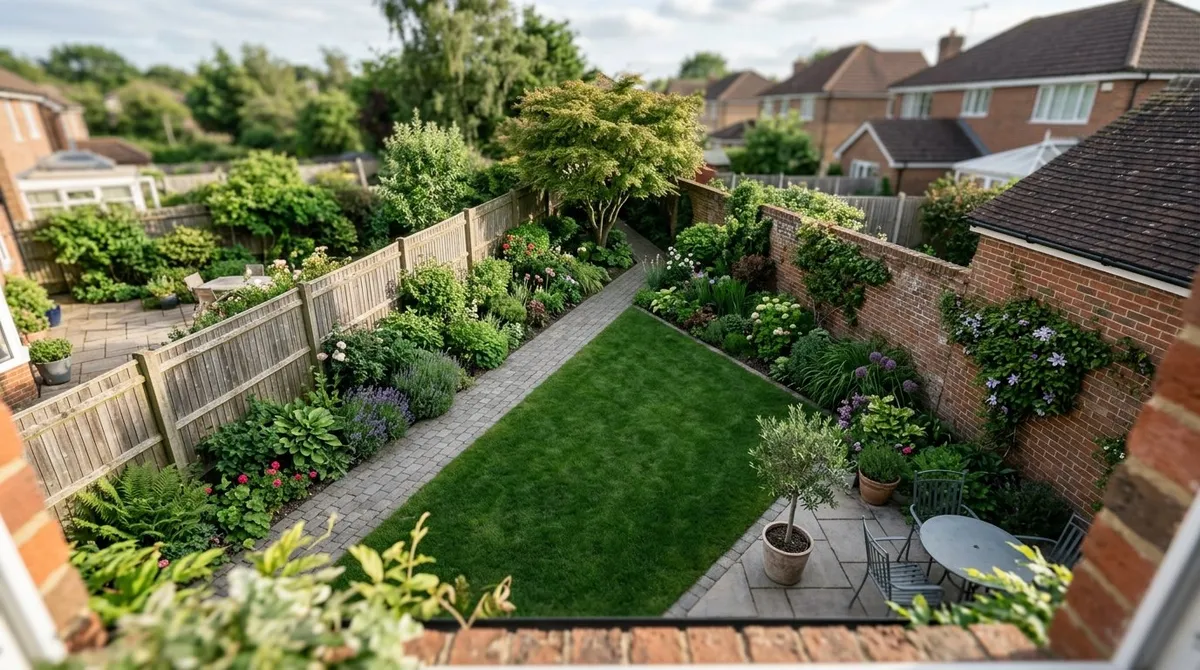
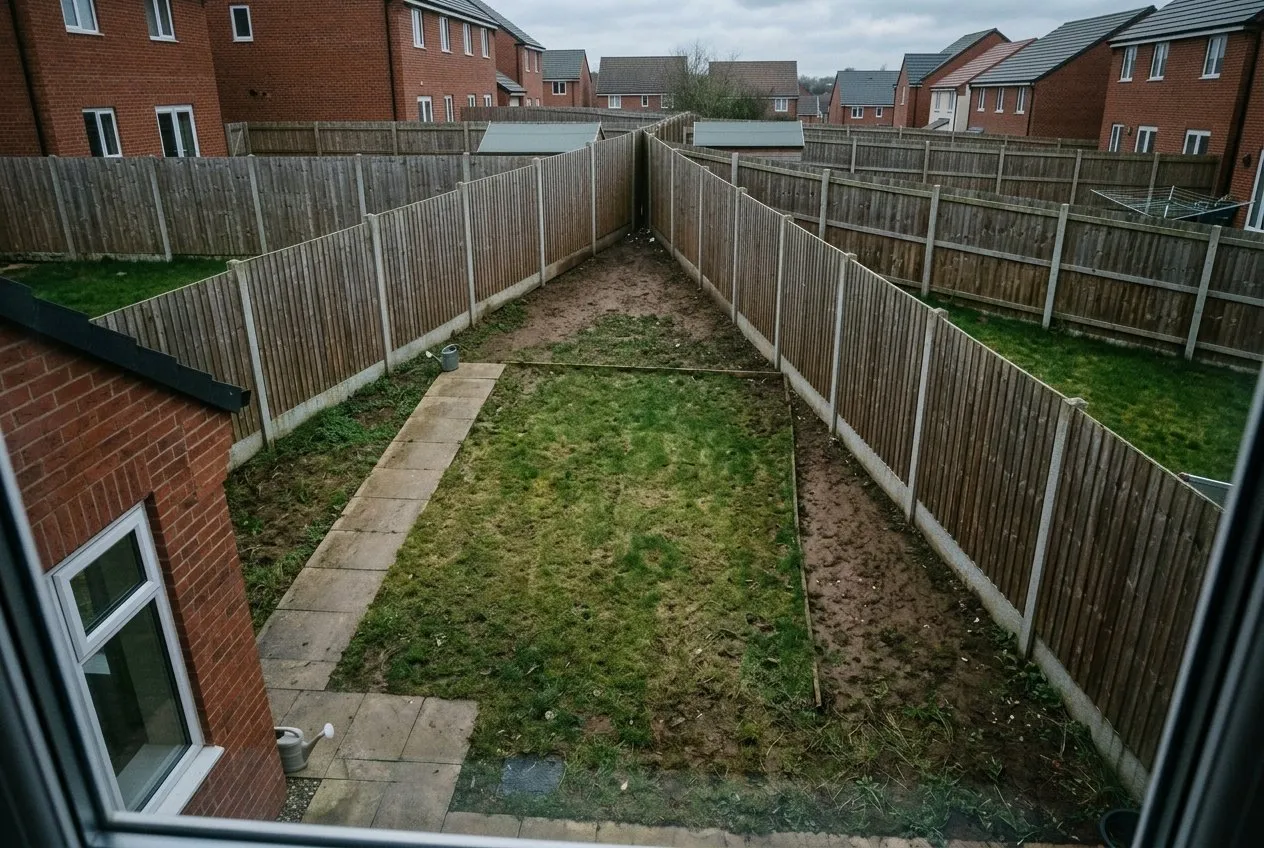 Seen from upstairs, the problem is obvious. The side fences close in and everything points at the far corner.
Idea 1: Work on the diagonal
Turn the whole design 45 degrees to the fences. If you only take one idea from this page, take this one.
The diagonal is the longest line you can draw across a triangle. Set things along it and your eye travels corner to corner across the widest part rather than hurrying to the tip. The fences slip into the background.
In practice:
- Set the lawn or patio at 45 degrees to both side fences
- Run the main path on the diagonal rather than down the middle
- Line up the best view from the back door across the widest part
- Fill the leftover triangles at the edges with deep planting
Don’t think of those leftover corners as wasted. They’re ideal for borders, a shed, a compost bin or a little tree.
A quick way to test it: stand at the back door with a few canes and a ball of string, and peg out the diagonal shape on the lawn before you dig anything.
Idea 2: Use curves and circles
Circles have no straight edges to argue with the fences, which makes them brilliant in a triangle.
Put a circular lawn or a round patio in the middle and it simply ignores the angled boundaries. Your eye follows the curve round and never really registers the fences closing in behind the planting. Fill the spaces around the circle with plants and it looks as if the whole garden was meant to be that way.
Curves help in other places too:
- A path that sweeps round instead of pointing
- Curved border edges to soften sharp corners
- A round pond or gravel seating area at the wide end
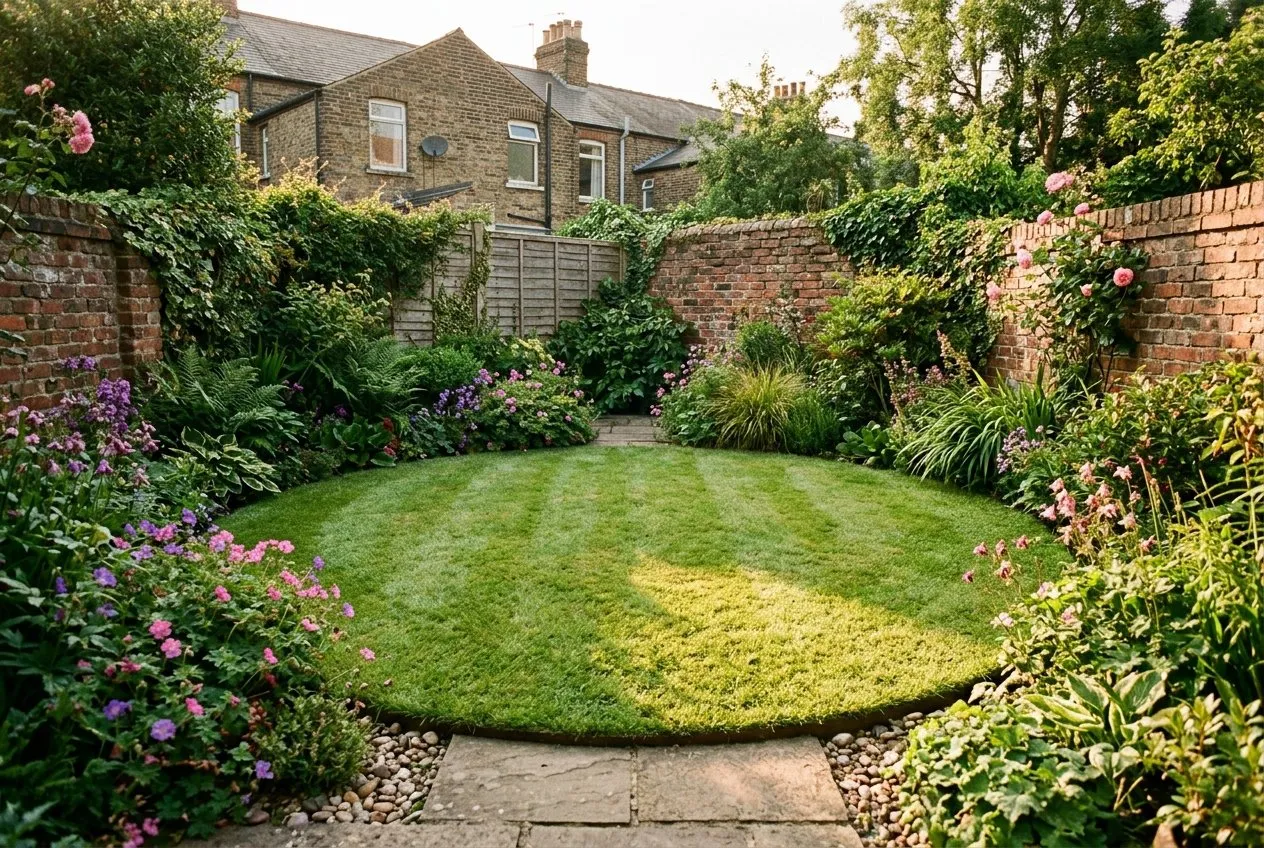 A round lawn ignores the angled fences, and the leftover corners become planting.
Idea 3: Divide into zones
A triangle looks odd mainly because you can see the whole outline at once. So don’t let anyone see it all.
Split the plot into two or three “rooms”. A slatted screen, an arch, a low hedge or even a single step up or down breaks the view, so you only ever see part of the garden. Our guide to designing a long thin garden uses the same idea, and it works just as well here.
A simple plan for a garden that tapers away from the house:
- A wide patio closest to the house, where the plot is broadest
- Lawn or planting in the middle, behind a low screen or arch
- A quiet bench or a working corner at the narrow far end
Each zone feels like a space of its own, and walking from one to the next makes the garden feel bigger than it is. Best of all, the narrowest part ends up tucked away in the last room, where it doesn’t matter.
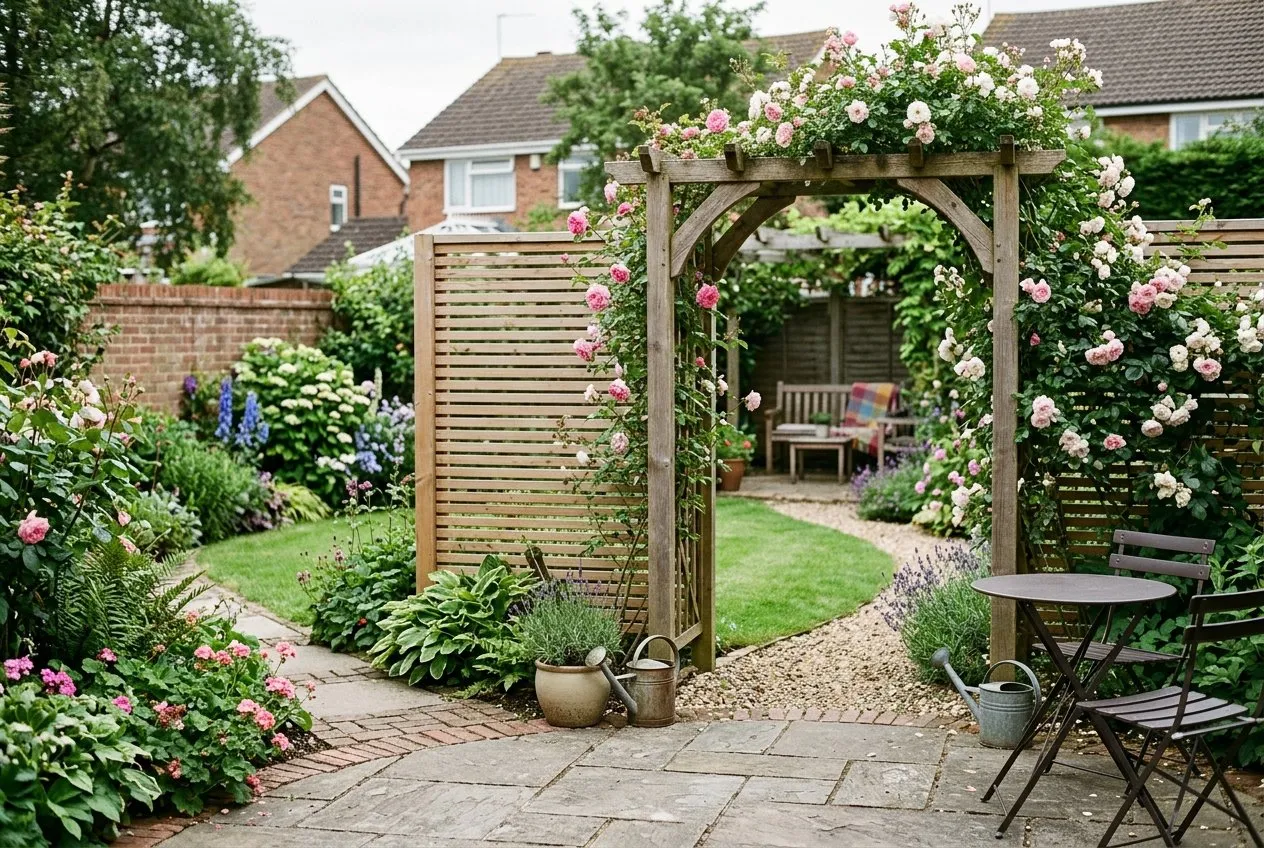 A wedge plot split into rooms with a timber screen and an arch. You never see the whole triangle at once.
Idea 4: Make the narrow point do a job
The tip is going to catch your eye whatever you do, so put something there that deserves the attention.
Ideas for the narrow point:
- A small tree, such as Amelanchier lamarckii or a multi-stem birch
- An obelisk with a climbing rose or clematis
- A bench, screened off so it’s a little surprise
- A shed, store or bin store slotted into the angle
- A small raised pond or a water bowl
Do this and the tip stops being the problem and becomes the reward at the end of the view.
Idea 5: Blur the boundaries with planting
A thin strip of border along the fence does nothing for a triangle. Make borders at least 1.2m deep and they start to soften the boundary and swallow the sharp corners.
Plant in layers: tall shrubs or small trees at the back, medium perennials in the middle and low plants along the front edge. Your eye then sees a bank of green rather than two fences meeting at an angle. Our guide on how to plan a mixed border explains the layers in more detail.
A few tips for triangles in particular:
- Make the corner borders the deepest, 1.5m or more if you can spare it
- Plant the sharpest corner thickly so the angle never shows
- Include evergreens so the corners stay hidden through winter
- Repeat two or three favourite plants around the whole garden
That last one makes a bigger difference than you’d think. In an odd-shaped plot, seeing the same grass or shrub in every border ties the space together.
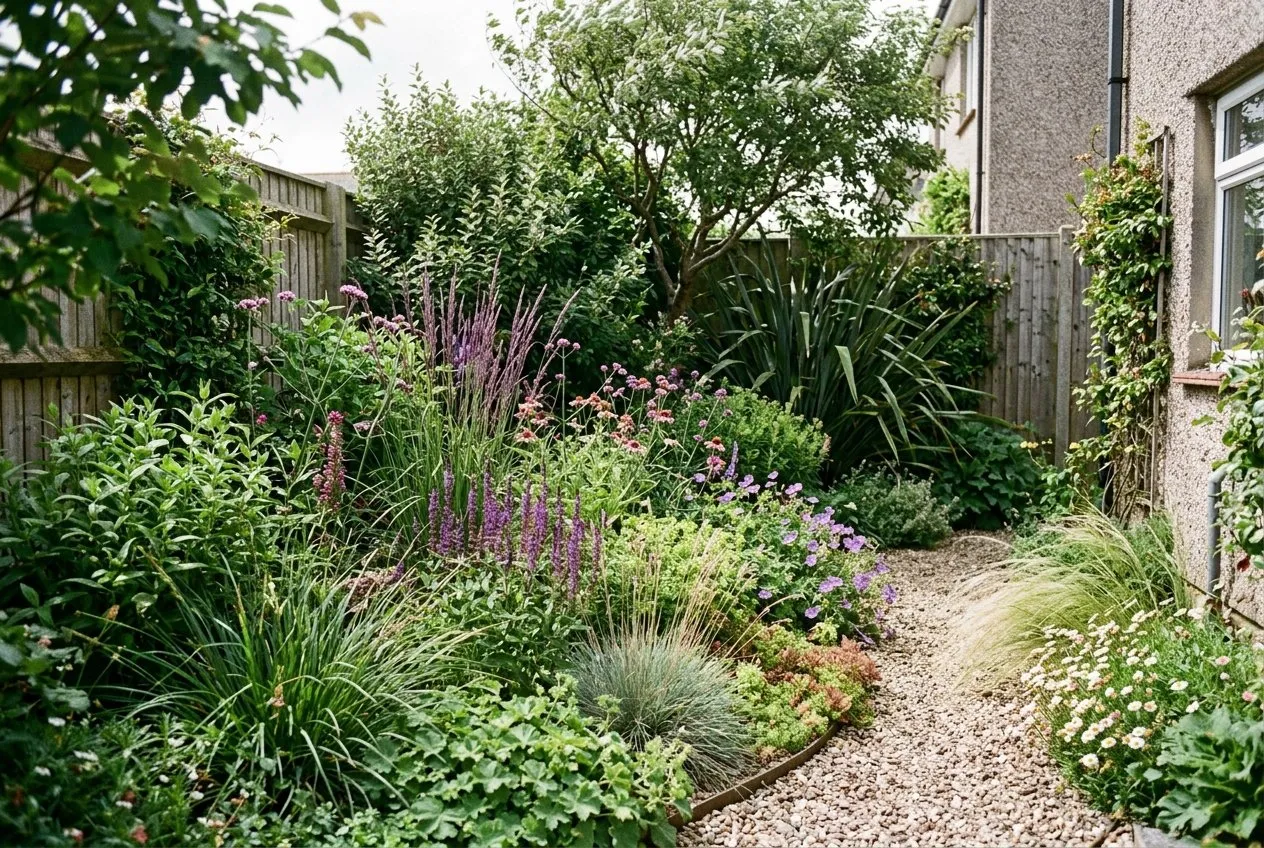 Deep, layered borders hide where two fences meet. Evergreens keep the corner covered all winter.
Idea 6: Make a triangle look bigger
A wedge already tapers, so you can use that to make the garden look longer than it is.
Put bold, warm colours and big leaves near the house. Save cooler colours, finer leaves and smaller plants for the narrow end. Warm colours seem to come towards you and cool ones seem to drift away, so the whole garden reads as deeper.
Other tricks that help:
- Let the path narrow slightly as it heads towards the tip
- Use a smaller bench or a smaller feature at the far end
- A bit of water or a garden mirror at the point adds a sense of depth
- Silver and pale green leaves seem to sit further back, so they suit the tip
Corner plots and front triangles
On a corner plot the big challenge is privacy. You’re often overlooked from two or three roads at once.
Layered hedging does a better job than one tall fence. A solid 2m fence wrapped round a corner feels like a fortress, and anything over 1m next to a road usually needs planning permission anyway. Plant a hedge of hornbeam, yew or beech behind a low front border instead. Stagger the heights so it looks like planting rather than a wall.
For a small front triangle, keep it simple. A small tree, a clipped evergreen or two and some gravel or low planting look smart from the pavement and need very little work.
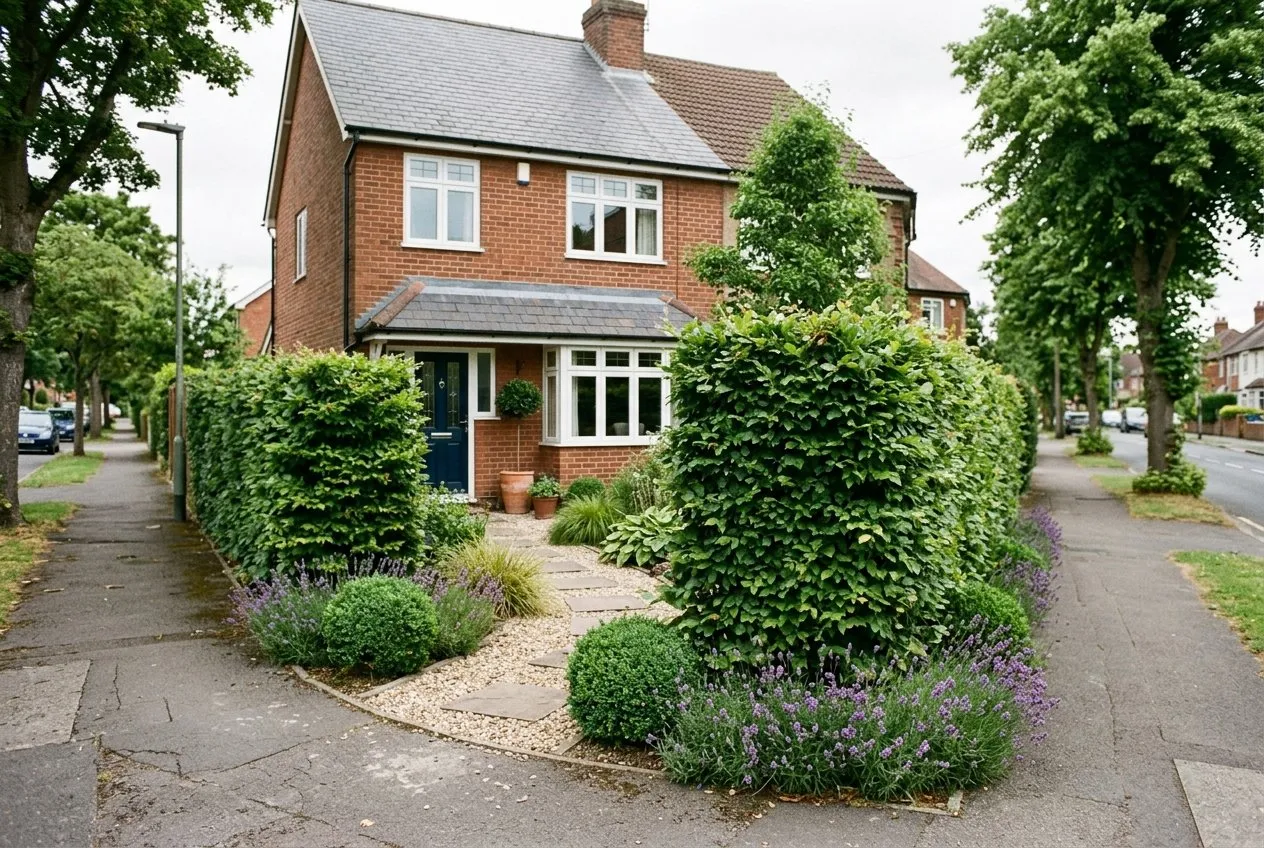 A hornbeam hedge behind a low border gives a corner plot privacy from two roads, without the fortress look.
Which triangle garden idea suits your plot?
Different plots suit different ideas. Here’s a quick guide.
| Idea | Best for | Effort | What it hides |
|---|---|---|---|
| Diagonal layout | Any triangle | Easy | The narrow point |
| Circular lawn or patio | Medium and large plots | Medium | The angled fences |
| Zones | Long tapering gardens | Harder | The whole shape at once |
| Feature at the tip | Sharp corners | Easy | The dead-end feeling |
| Deep borders | Every triangle | Medium | The sharp corners |
| Colour and size tricks | Narrow tapering plots | Easy | The short length |
| Layered hedging | Corner plots | Harder | Being overlooked |
Most good designs combine three or four. A diagonal lawn, deep corner borders, a tree at the tip and a screen across the middle will rescue almost any wedge.
For more inspiration, have a look at our garden design trends guide. If you’d rather hand it over to a professional, the Society of Garden Designers lists designers across the UK.
Frequently asked questions
How do you design a triangular garden?
Turn the layout 45 degrees to the fences. That gives the longest possible view across the plot and draws attention away from the narrow point. Then add a round lawn or patio, break the space into zones and put something worth looking at in the tip.
Why does a wedge-shaped garden look awkward?
Because your eye gets dragged straight to the narrow point. Most people make it worse by lining the lawn and path up with the longest fence, which only exaggerates the taper. A diagonal or circular layout breaks those lines and makes the shape look deliberate.
What can I put in the narrow point of a triangular garden?
Something that turns it from dead space into a destination. A small tree, an obelisk with a climber, a tucked-away bench, a shed or bin store, or a small pond all work. Once the tip has a purpose, nobody notices the angle.
How do I make a corner plot garden private?
Layer hedging instead of putting up one long fence. Corner plots are often overlooked from two or three roads. A hornbeam or yew hedge behind a low front border gives privacy without the fortress look. Stagger the heights so it reads as planting rather than a wall.
Where should the patio go in a triangular garden?
Not necessarily by the back door. Put it where it gets the sun and the best view back across the garden, which is often at an angle in the widest part. A round patio set away from the fences follows the sun rather than the fence line.
Now plan your own triangular plot
Grab a pencil and a rough sketch of your garden, then try turning the lawn 45 degrees. Once the layout feels right, our guide on how to plan a mixed border will help you fill those corners with plants.
Our team produces practical UK gardening guidance from source research, contributor records and established horticultural practice. Editorial standards are overseen by Matt W.