Key takeaways
- Kangaroo paw is tender, so grow it in a pot you can move under cover for winter
- Use gritty, free-draining compost and stand it in your sunniest spot
- Feed lightly with a low-phosphate feed and never use bonemeal
- Tall Anigozanthos flavidus lasts longest; compact Bush Gems types often only last a year or two
- Black streaks on the leaves are usually ink disease, which good airflow helps prevent
Kangaroo paw is one of the most eye-catching plants you can grow on a sunny UK patio. Its fuzzy, paw-shaped flowers come in red, yellow, orange, pink and green, held high on slender stems. It’s an Australian plant and it’s tender, so in the UK it’s grown in a pot that comes under cover for winter.
Get three things right, sun, sharp drainage and a frost-free winter, and it will flower year after year. This guide covers which types to buy, compost, watering and feeding, winter care and the common leaf problem known as ink disease.
What is kangaroo paw?
Kangaroo paw (Anigozanthos) comes from south-western Australia. The name comes from the flowers, which are curved, furry tubes that split open at the tip like a small paw. The fuzz is made of tiny coloured hairs.
Plants grow from a creeping underground stem and make fans of long, strappy, evergreen leaves. Flower stems rise well above them, from about 40cm on compact types to 2m on the tall Anigozanthos flavidus.
It grows in a dry climate with only light frosts, so a cold, wet British winter is the main danger. Combine cold and wet, and the roots rot.
Which kangaroo paw should I grow?
Choose between the tall, tougher species and the compact, colourful hybrids.
Anigozanthos flavidus is the tall species, up to 1.5-2m in flower. It’s the toughest and longest-lived, with flowers in yellow-green, soft orange or dusky red. Start here if you want a plant to keep for years.
The Bush Gems series are compact hybrids with bright colours, such as pink ‘Bush Pearl’ and orange-red ‘Bush Ranger’. They flower quickly and freely in their first summer, making great patio colour, but often only last a year or two in the UK.
Macropidia fuliginosa, the black kangaroo paw, has striking green-and-black flowers. It’s the trickiest to keep going and is one for enthusiasts.
| Type | Height | Flowers | How long it lasts in the UK |
|---|---|---|---|
| Anigozanthos flavidus | 1.5-2m | Yellow-green, orange, red | Several years with a frost-free winter |
| ’Bush Pearl’ | About 40-50cm | Pink | Often a year or two |
| ’Bush Ranger’ | About 50-60cm | Orange-red | Often grown as a summer plant |
| Bush Gems mixes | 40-80cm | Red, yellow, pink, orange | Often a year or two |
| Black kangaroo paw (Macropidia) | 60cm-1m | Green and black | Short-lived, needs care |

Compact Bush Gems types give bright colour in their first summer. Treat them as a bonus if they come back.
Why kangaroo paw needs full sun
Full sun is the biggest factor in how well it flowers. More sun means more flower stems.
Give it at least six hours of direct sun a day. A south-facing patio, sunny balcony or warm wall is ideal. Our guide to south-facing gardens has more plants for hot spots.
In shade, kangaroo paw barely flowers and the leaves stay damp, which invites disease. There’s no shade-tolerant type.

A big pot on a sunny patio is the easiest way to grow kangaroo paw in the UK. You can move it under cover when frosts arrive.
Growing kangaroo paw in pots
Pots are the best way to grow kangaroo paw in the UK. You control the drainage and can move the plant indoors for winter.
- Use a pot with good drainage holes, at least 30cm wide for tall types and 20-25cm for compact ones. Terracotta is ideal as it dries out faster.
- Fill with a gritty mix: two parts John Innes No. 2, one part grit and one part perlite. Don’t add fertiliser or bonemeal.
- Plant with the crown level with the compost, never buried.
- Stand it in your sunniest, most sheltered spot.
Kangaroo paw looks good grouped with other sun-lovers like lavender, salvias and grasses. Our guide to Mediterranean-style planting has more ideas.

A sunny balcony suits kangaroo paw well. Grouping it with other sun-lovers makes a bright, easy display.
Watering and feeding kangaroo paw
Water moderately in summer and sparingly in winter. Kangaroo paw copes with dry spells far better than with soggy compost.
From May to September, water when the top few centimetres of compost feel dry. In hot weather that might be a couple of times a week. Let the pot drain freely and never leave it standing in a saucer of water. In winter, water only enough to stop the compost drying out completely, in the morning so the leaves dry by evening.
Feed lightly. Kangaroo paw grows naturally in very poor soil and dislikes rich feeding, especially high levels of phosphate. From spring to late summer, give a half-strength, low-phosphate liquid feed every three or four weeks. Never use bonemeal, which is very high in phosphate.
Can kangaroo paw grow in a border?
In most of the UK, no, it’s best kept in a pot. In the mildest coastal and city gardens you can try tall Anigozanthos flavidus in a sunny, gravelly, sharply drained bed against a warm wall. Treat it as a gamble, as a cold, wet winter can still kill it. It sits well among other drought-tolerant plants like lavender and euphorbia.

In the mildest gardens, kangaroo paw can join a sunny gravel border. Most UK gardeners keep it in a pot instead.
How to overwinter kangaroo paw
Move pots under cover before the first frost, usually by mid-October in most of the UK, and earlier in the north and Scotland. Keep them somewhere bright and frost-free: a cool greenhouse, a porch, a conservatory or a bright windowsill in an unheated room. A dark shed or garage won’t do.
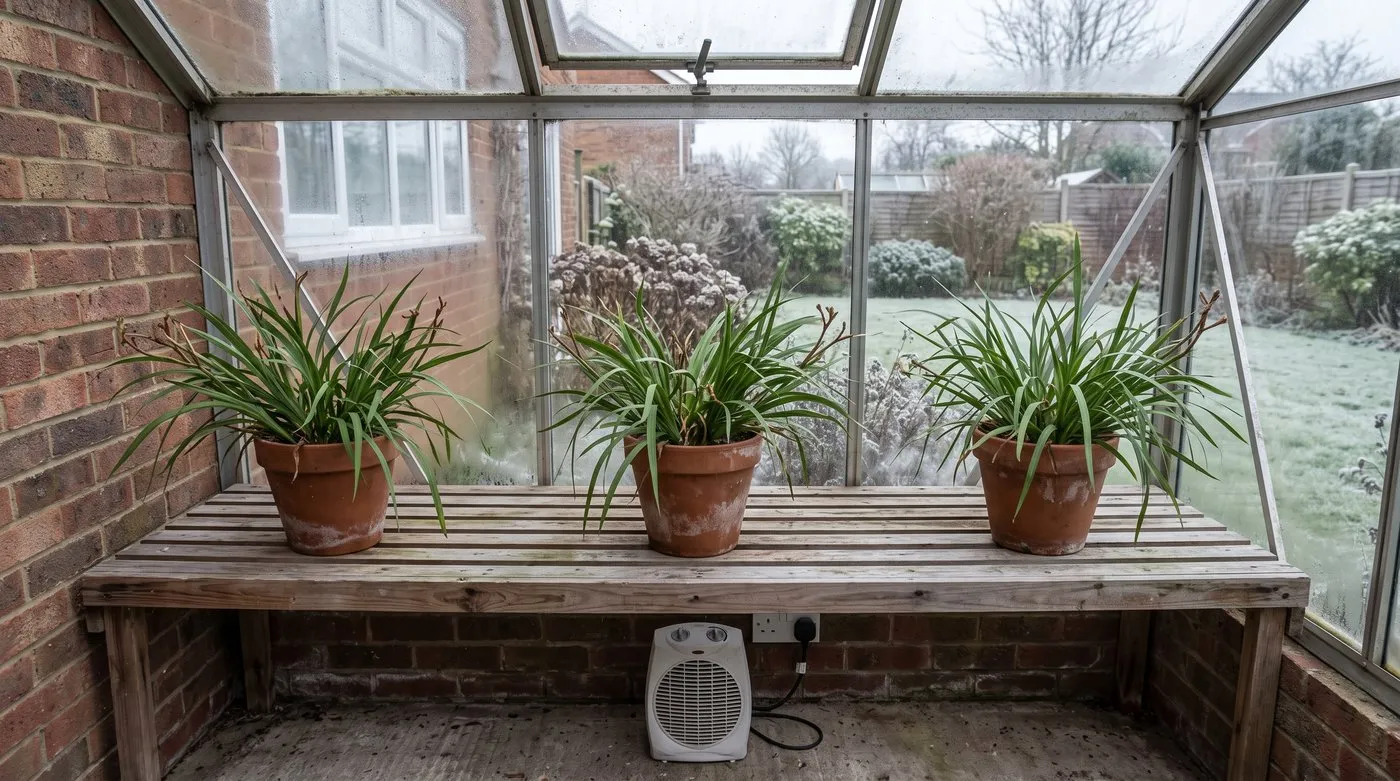
Bright, frost-free and well spaced is the winter recipe. A cracked vent on mild days keeps ink disease at bay.
- Cut old flower stems down to the base.
- Remove tatty or marked leaves.
- Water sparingly through winter.
- Keep air moving. Open greenhouse vents on mild days.
- Harden off in May, putting the pot out by day and bringing it in at night for a week.
- Move it back outside for good in late May, once frosts have passed.
Our guide to overwintering plants covers other tender plants that need the same treatment. Another tender patio plant that needs a frost-free winter is bougainvillea in a pot.
Ink disease: why kangaroo paw leaves turn black
Ink disease is the most common kangaroo paw problem in the UK. It’s a fungal disease that causes black streaks and blotches on the leaves, as if someone has dragged an inky pen down them. It spreads in cool, damp, still air, which is exactly what a British autumn and winter bring.
It rarely kills an established plant, but it spoils the leaves. Prevention is easier than cure:
- Space pots apart so air can move.
- Water the compost, not the leaves, and do it in the morning.
- Ventilate the greenhouse on mild days.
- Cut off badly marked leaves at the base and put them in the bin, not the compost heap.
If a plant blackens badly every year, try a different, tougher type such as Anigozanthos flavidus.

Left, a fan marked by ink disease. Right, clean, healthy leaves. Airflow and dry foliage make all the difference.
Cutting back and dividing kangaroo paw
Once a flower stem fades, cut it right down to the base. Each fan of leaves flowers once, so removing old, finished fans makes room for new ones.
Division is the easiest way to make more plants and to refresh a crowded clump. In spring, knock the plant out of its pot and pull or cut it into sections, each with healthy roots and at least two fans of leaves. Pot each piece into fresh gritty compost and water lightly.
You can also grow kangaroo paw from seed sown in warmth in spring, but germination is patchy and seedlings take a few years to flower. Most gardeners buy plants or divide them instead.

Divide crowded clumps in spring, keeping healthy roots and at least two fans of leaves on each piece.
Pests that attack kangaroo paw
Pests are a minor problem compared with cold and ink disease.
- Aphids cluster on new flower stems in spring. Squash them or wash them off with water. Our guide to protecting container plants from pests has more ideas.
- Slugs and snails nibble new leaves in damp weather. Check pots at dusk and clear hiding places nearby.
- Mealybugs can appear on plants kept under glass, as white, waxy clusters at the leaf bases. Wipe them off with a damp cotton bud, or use the mealybug ladybird, a biological control, in a warm greenhouse.
Month-by-month kangaroo paw calendar
| Month | What to do |
|---|---|
| January to February | Keep bright and frost-free. Water sparingly. Watch for ink disease |
| March | Divide crowded clumps. Repot into fresh gritty compost |
| April | Water a little more as growth starts. Begin light feeding |
| May | Harden off, then move outside in late May |
| June to August | Full sun outside. Water when dry. Feed every 3-4 weeks. Cut off faded stems |
| September | Last feed early in the month. Water less as it cools |
| October | Tidy up and move under cover before the first frost |
| November to December | Keep bright, frost-free and on the dry side. Ventilate on mild days |
Common mistakes with kangaroo paw
Leaving it outside in winter. Frost and wet together kill it. Move it under cover before the first frost.
Rich feeding. Bonemeal and heavy feeding harm it. Feed lightly with a low-phosphate feed.
Soggy compost. Wet roots rot and invite ink disease. Use a gritty mix and empty saucers.
Growing it in shade. It barely flowers without sun. Give it your sunniest spot.
Crowding pots in still air. Cramped plants in damp air go black with ink disease. Space them out and ventilate.
Now you know how to keep kangaroo paw going, try another sun-loving pot plant with our guide to growing agapanthus. You’ll find more unusual plants on our growing hub.
Frequently asked questions
Is kangaroo paw hardy in the UK?
No, kangaroo paw is tender and can’t be trusted outside in winter. It may cope with a brief light frost but not cold, wet weather. Grow it in a pot and move it into a bright, frost-free space before the first frost.
Can kangaroo paw be grown outside all year in Britain?
Only in the very mildest gardens, and even then it’s a gamble. Frost and winter wet kill most plants. If you try, use a sunny raised bed with gritty soil against a warm wall, grow tall Anigozanthos flavidus, and be ready to lose it.
Why are my kangaroo paw leaves turning black?
Black streaks are usually ink disease, a fungal problem. It spreads in cool, damp, still air, like a UK autumn. Cut off badly marked leaves at the base, water the compost rather than the leaves, and give plants space for air to move.
What compost should I use for kangaroo paw?
Use a gritty, free-draining mix with no added fertiliser. Two parts loam-based John Innes No. 2 to one part grit and one part perlite works well. Water should drain through quickly, not sit on top.
How often should I water kangaroo paw?
Water when the top few centimetres of compost feel dry. In summer that may be a couple of times a week in a sunny spot. In winter, water only enough to stop the compost drying out completely. Never leave the pot standing in water.
Are Bush Gems kangaroo paws perennial or annual in the UK?
They’re perennials, but often short-lived here. Bush Gems types flower quickly in their first year, making great summer patio colour. Many fade after a winter or two. For a longer-lived plant, grow Anigozanthos flavidus.
Why is my kangaroo paw not flowering?
Too little sun is the usual reason. Kangaroo paw needs at least six hours of direct sun. Rich feeding and an overcrowded pot also reduce flowering. Move it to your sunniest spot and divide crowded clumps in spring.
How do I overwinter kangaroo paw in the UK?
Move it under cover before the first frost, somewhere bright and frost-free. A cool greenhouse, porch or bright unheated room works well. Cut off old flower stems, water sparingly and keep air moving. Put it back outside in late May.
Our team produces practical UK gardening guidance from source research, contributor records and established horticultural practice. Editorial standards are overseen by Matt W.