Key takeaways
- A passionflower needs a pot of at least 30cm (30L) to start, ideally 45cm (45L) within two seasons
- Use John Innes No.3 with 20-25% added grit for weight, drainage and steady nutrients
- Passiflora caerulea is hardy to roughly -10°C to -15°C top growth, but pot roots freeze far sooner
- Feed a high-potash tomato feed (around NPK 4-3-8) fortnightly from May to September
- Move pots to a porch or unheated greenhouse, or wrap with two layers of fleece, from late November
- Hand-pollinate in a warm summer and fruit can ripen on a sheltered south wall by October
A passionflower in full bloom stops people in their tracks. The purple-and-white flowers of Passiflora caerulea look almost too exotic for a British garden, yet this is one of the toughest climbers you can grow here. The good news for anyone short on borders is that it takes happily to a pot. A container plant on a sunny patio, terrace or balcony will climb 2-3m in a single season and flower from June to October. The trade-off is winter: roots in a pot freeze sooner than roots in the ground, so a little protection makes all the difference.
This guide is the container-specific companion to our how to grow passionflower in the ground article. Here the focus is pots, compost, support and overwintering, the details that decide whether a potted passionflower thrives or sulks.
Can you grow a passionflower in a pot?
Yes, and a pot suits passionflowers better than many gardeners expect. Passiflora caerulea, the blue passionflower, is the standard choice for UK containers because it is the hardiest and the most vigorous. A slight root restriction in a pot can even improve flowering, since the plant stops pouring energy into endless top growth.
The one real challenge is the cold. In open ground, the soil insulates the roots. In a pot, the whole rootball can chill to air temperature. That single fact shapes everything else, from pot choice to where the plant spends December. Get the winter right and a potted passionflower will come back stronger every year.
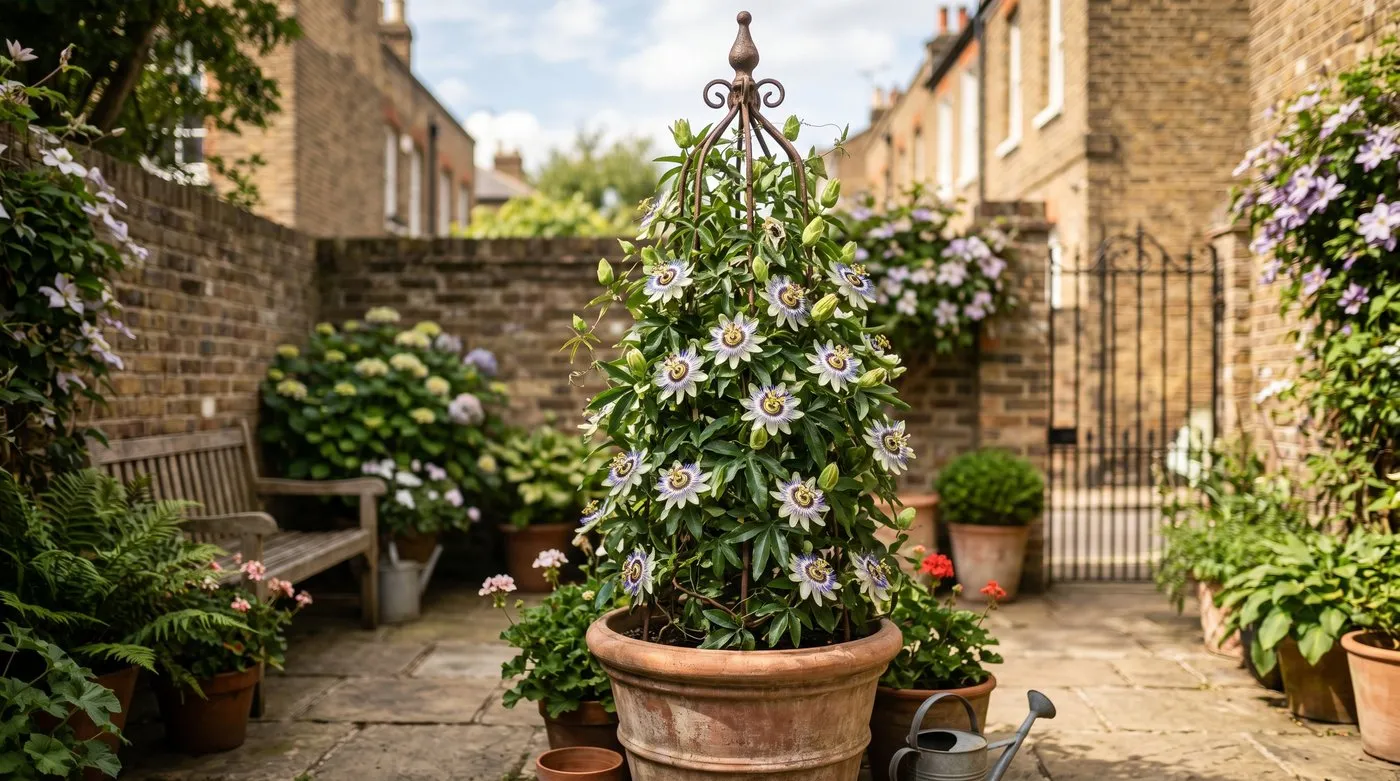
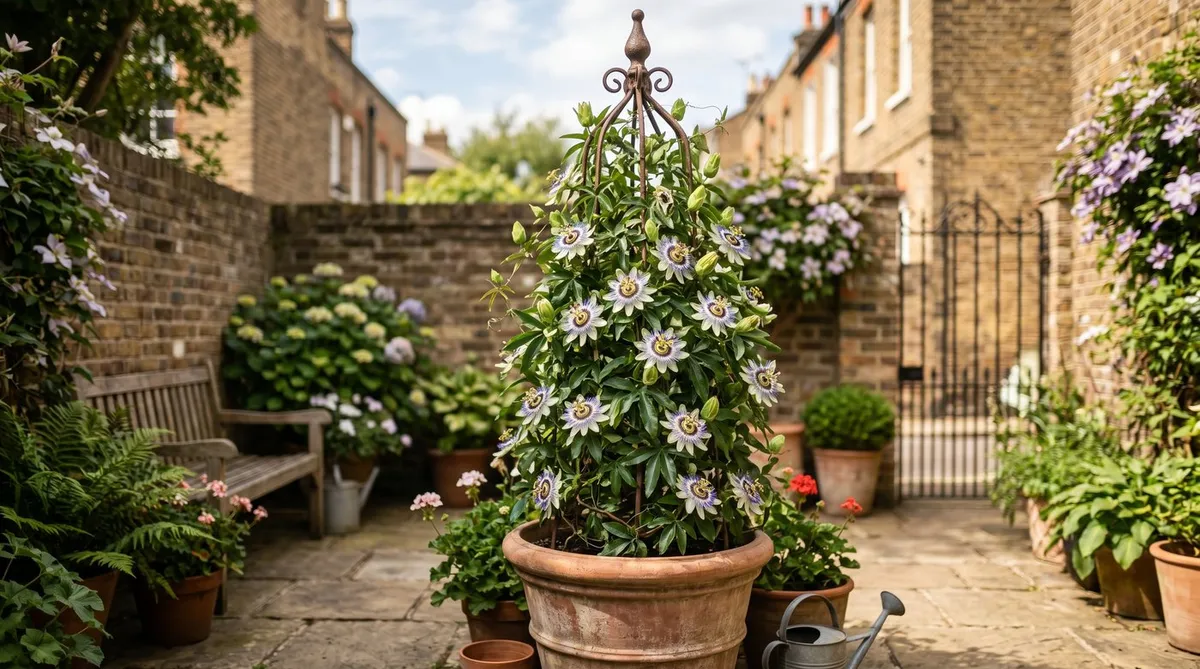
A potted Passiflora caerulea on an obelisk brings height and exotic flowers to a small London courtyard, where there is no border to plant into.
How big a pot does a passionflower need?
Start with a pot at least 30cm wide and deep, holding around 30 litres. A young plant will fill this in its first season. Within two years, move up to a 40-45cm pot (40-45 litres). That is the practical ceiling for most patios, and it gives the plant enough root run to support 3m of growth.
There is a balance to strike. Too small a pot dries out in hours during a July heatwave and limits the plant. Too large a pot stays cold and wet, which roots dislike, and a vigorous passionflower in a huge container becomes a tarpaulin of leaf with few flowers. Mild restriction encourages blooming.
Weight matters too. A leafy passionflower on an obelisk acts like a sail. A heavy terracotta or frost-proof glazed pot anchors it; a flimsy plastic one blows over. If you must use plastic for weight reasons, stand it inside a heavier decorative pot or weigh the base with bricks.
| Pot diameter | Volume | Best for | Notes |
|---|---|---|---|
| 25-30cm | 25-30L | First-year young plant | Dries out fast, water twice daily in summer |
| 35-40cm | 35-40L | Established plant, years 2-4 | Best all-round size for patio growing |
| 45-50cm | 45-50L | Long-term mature plant | Heavy and stable, slower to dry, repot every 3-4 years |
| Over 50cm | 50L+ | Large specimen on a big terrace | Risk of lush leaf and fewer flowers if over-fed |
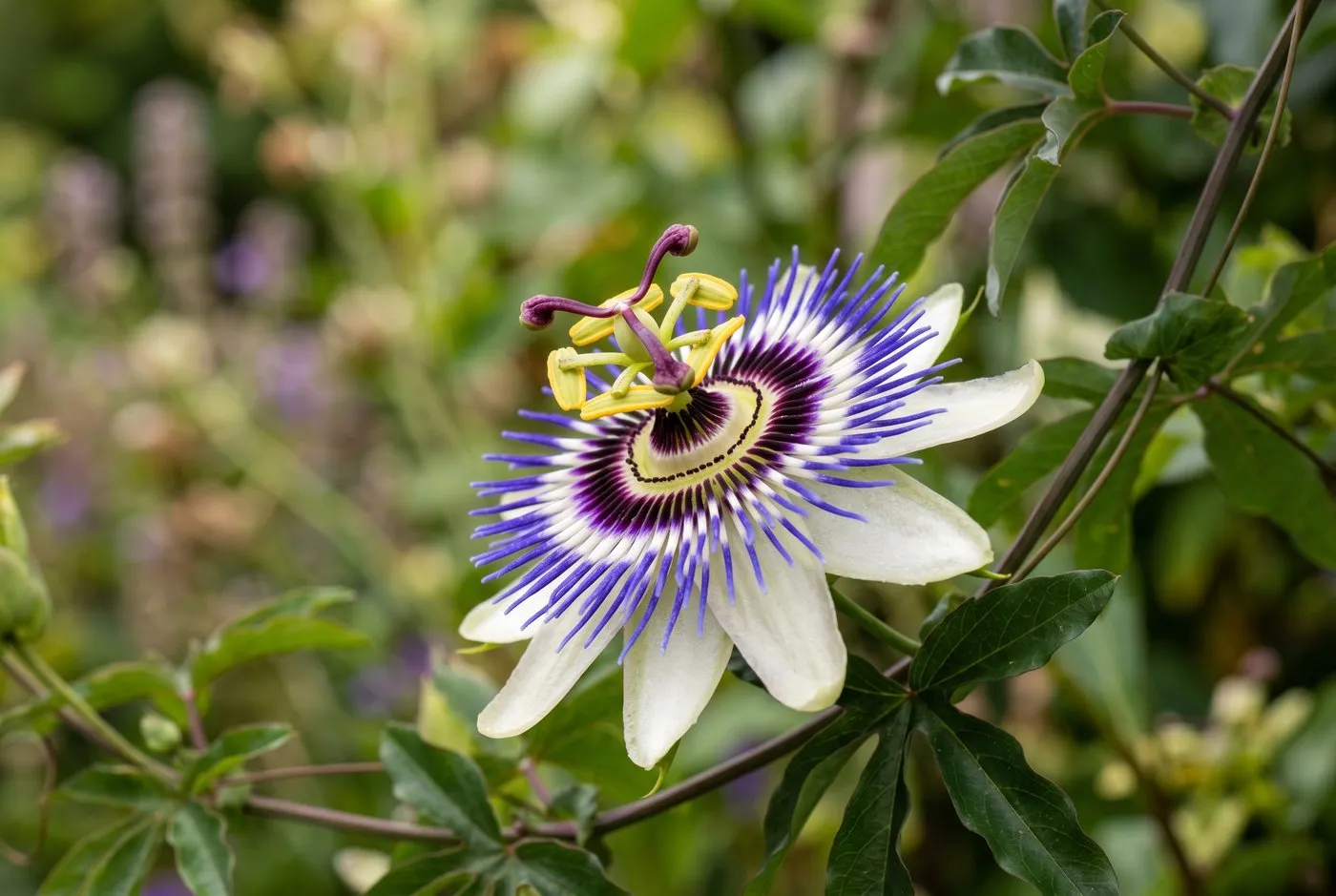
The flower of Passiflora caerulea is the reason most people grow it. Each bloom lasts a single day, but a vigorous potted plant opens fresh flowers in succession from June to October.
What compost suits a passionflower in a pot?
Use a loam-based compost, specifically John Innes No.3, mixed with 20-25% horticultural grit. This combination gives three things a passionflower needs in a pot: steady nutrients from the loam, weight to anchor the plant, and free drainage so roots never sit in water.
Loam-based compost holds onto feed and water far better than a bag of peat-free multipurpose. Multipurpose composts are light, dry out in a flash, and shrink away from the pot sides by midsummer. They also break down within a season, leaving roots in a soggy sludge. John Innes No.3 keeps its structure for years.
To mix your own, use roughly four parts John Innes No.3 to one part grit by volume. Add a handful of slow-release fertiliser granules at potting time for a gentle background feed. Crock the drainage holes with a few pieces of broken pot or polystyrene so they do not clog.
When planting, set the rootball so its top sits 3-4cm below the pot rim, leaving room to water. Firm the compost gently but do not compact it. Water in well to settle everything around the roots. Each spring, scrape off the top 5cm of old compost and top-dress with fresh John Innes to renew nutrients without disturbing the roots.
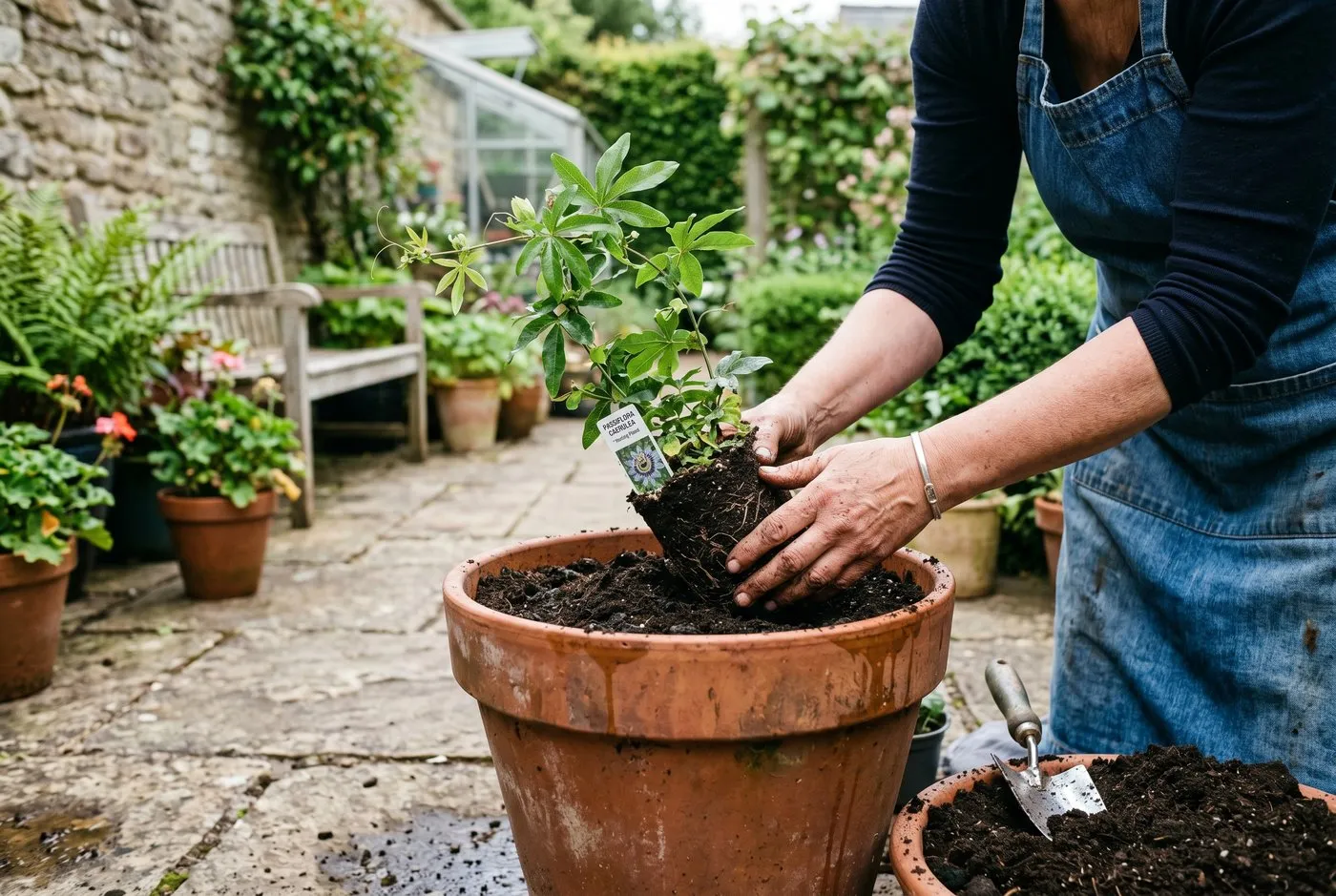
Potting up into a loam-based John Innes No.3 mix with added grit. Set the rootball 3-4cm below the rim so there is room to water, then firm gently.
Gardener’s tip: Save your grit for the mix, not a layer at the bottom. A gravel layer in the base of a pot does not improve drainage; it actually raises the saturated zone. Mix the grit through the whole rootball instead, and the water moves freely.
Where should a potted passionflower stand for support?
Stand the pot against a full-sun, south-facing wall and give the plant a structure to climb. Passionflowers flower best in the warmest, brightest spot you have. A south or south-west wall stores heat and pushes earlier, heavier flowering. In a shaded corner the plant grows leggy and shy of bloom.
Support is non-negotiable. The tendrils need wires, trellis or an obelisk to grip. A 1.8m obelisk dropped into a 40cm pot is the neatest free-standing option for a patio; the plant winds up it and you can move the whole thing. Against a wall, fix horizontal wires 30cm apart and tie in new stems as they extend.
The shelter of a wall does double duty. It speeds flowering in summer and lifts the winter minimum by a degree or two, which can be the margin between survival and loss. A pot tucked into a wall recess or a corner sheltered from north and east winds will always do better than one stranded in the open.
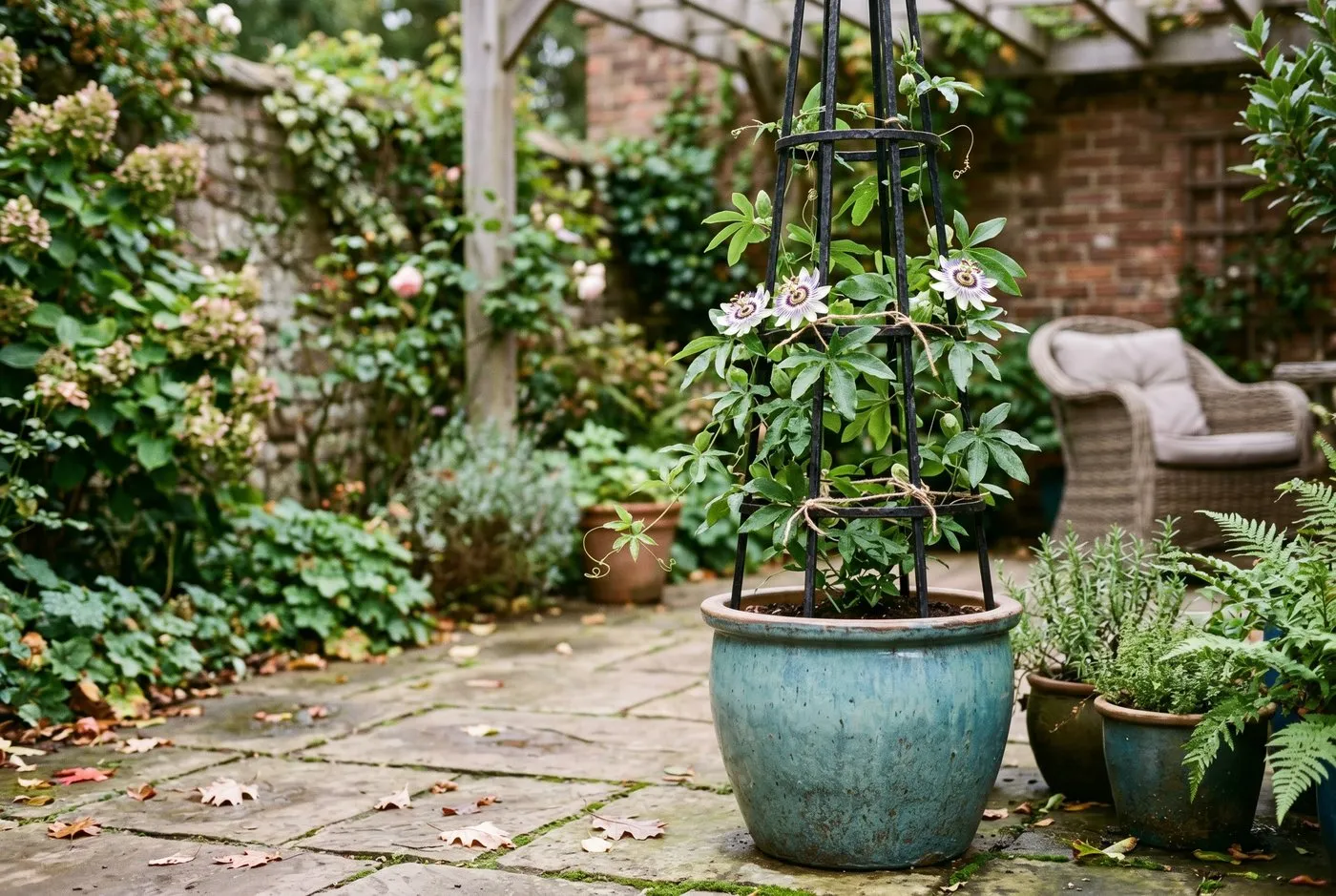
An obelisk dropped straight into the pot gives the tendrils something to grip and keeps the whole plant portable, which matters when winter protection means moving it under cover.
How do you water and feed a passionflower through the season?
Water freely in summer and feed high-potash fortnightly from May. A passionflower in full growth is thirsty. Container compost dries far faster than open ground, so a 40cm pot against a hot wall may need watering every 2-3 days through June and July, and daily in a heatwave. Check by pushing a finger 3cm into the compost; water when that depth feels dry.
Avoid the opposite error. Roots left standing in saturated compost rot, and a passionflower that wilts in a wet pot has usually drowned, not dried. The grit in your mix guards against this, but always let the surface 2-3cm dry between waterings.
Feed is what drives flowering. From May to September, give a high-potash liquid feed every two weeks. A standard tomato feed, around NPK 4-3-8, is ideal: the high potassium pushes flowers and fruit, while modest nitrogen keeps leaf growth in check. Skip general high-nitrogen feeds, which give you a thicket of foliage and few blooms.
| Month | Watering | Feeding |
|---|---|---|
| April | Moderate, as growth resumes | Top-dress with fresh John Innes |
| May-June | Every 2-3 days, more in sun | High-potash feed every 2 weeks |
| July-August | Daily in heat, check twice daily | High-potash feed every 2 weeks |
| September | Every 2-3 days, taper off | Final feed early in the month |
| October-March | Sparingly, keep barely moist | None |
Ease right back as autumn arrives. Over winter the plant is dormant or semi-dormant, and wet, cold compost is the fastest way to kill the roots. Water just enough to stop the compost drying out completely, perhaps once a fortnight in a frost-free spot.
How do you prune a passionflower in a pot?
Prune hard in early spring, cutting back to a strong framework before new growth starts. Passionflowers flower on the current season’s growth, so spring pruning loses you nothing and keeps the plant in bounds. In a pot, this annual cut is what stops a 3m climber turning into an unmanageable mass.
Through summer, light tying-in and the odd trim are all that is needed. If growth races ahead, you can shorten over-long stems by a third in midsummer without harming flowering. Just avoid a hard cut after July, which can trigger soft regrowth that will not harden before winter.
How do you overwinter a passionflower in a pot?
This is the single most important task, because pot roots freeze long before roots in the ground. Passiflora caerulea top growth shrugs off -10°C to -15°C once established in open soil, but a rootball in a pot can sit at full air temperature. Roots start to suffer below about -8°C. Protect the pot and you protect the plant.
There are three reliable approaches, in order of safety:
Keep the compost barely moist all winter, never wet. Standing in cold, sodden compost kills more potted passionflowers than frost does. The same principles apply whether you overwinter tender plants under glass or in situ, and our guide to how to protect plants from frost covers fleece, cloches and timing in detail.
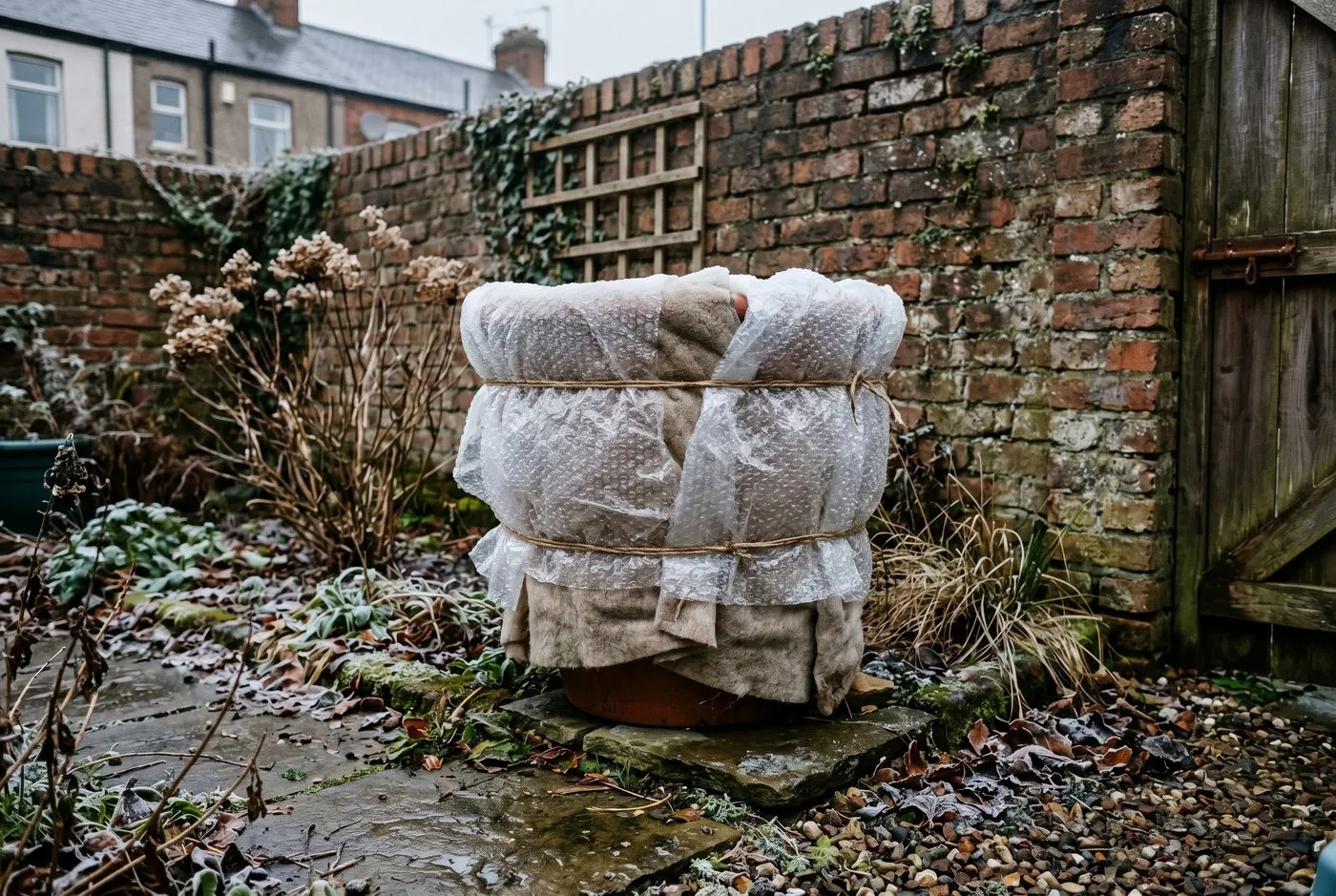
Where there is no greenhouse, wrapping the pot in fleece and bubble wrap protects the roots. In milder, damp western gardens like this Belfast plot, keeping the compost on the dry side matters as much as the wrapping.
Can you get passion fruit in the UK from a pot?
Yes, in a warm summer and a sheltered spot, though the fruit of Passiflora caerulea is more curiosity than crop. The egg-shaped orange fruits are edible but bland, with watery, seedy flesh. They are safe to eat ripe, but no rival to the shop-bought passion fruit, which comes from the tender Passiflora edulis.
To improve your odds, hand-pollinate. On warm, still days, dab a soft brush from flower to flower to move pollen, since our cool summers and scarce pollinators often leave blooms unfertilised. Fruit set follows within a week or two on successful flowers, and the fruits ripen from green to deep orange over summer.
For real eating quality, grow Passiflora edulis, the purple passion fruit, in a pot under glass. It is tender and will not survive a UK winter outside, so it needs a frost-free greenhouse or conservatory and the same high-potash feeding regime. It also crops more reliably indoors than P. caerulea does outside. It behaves like mandevilla, another tender climber that earns its place under cover rather than out in the cold.
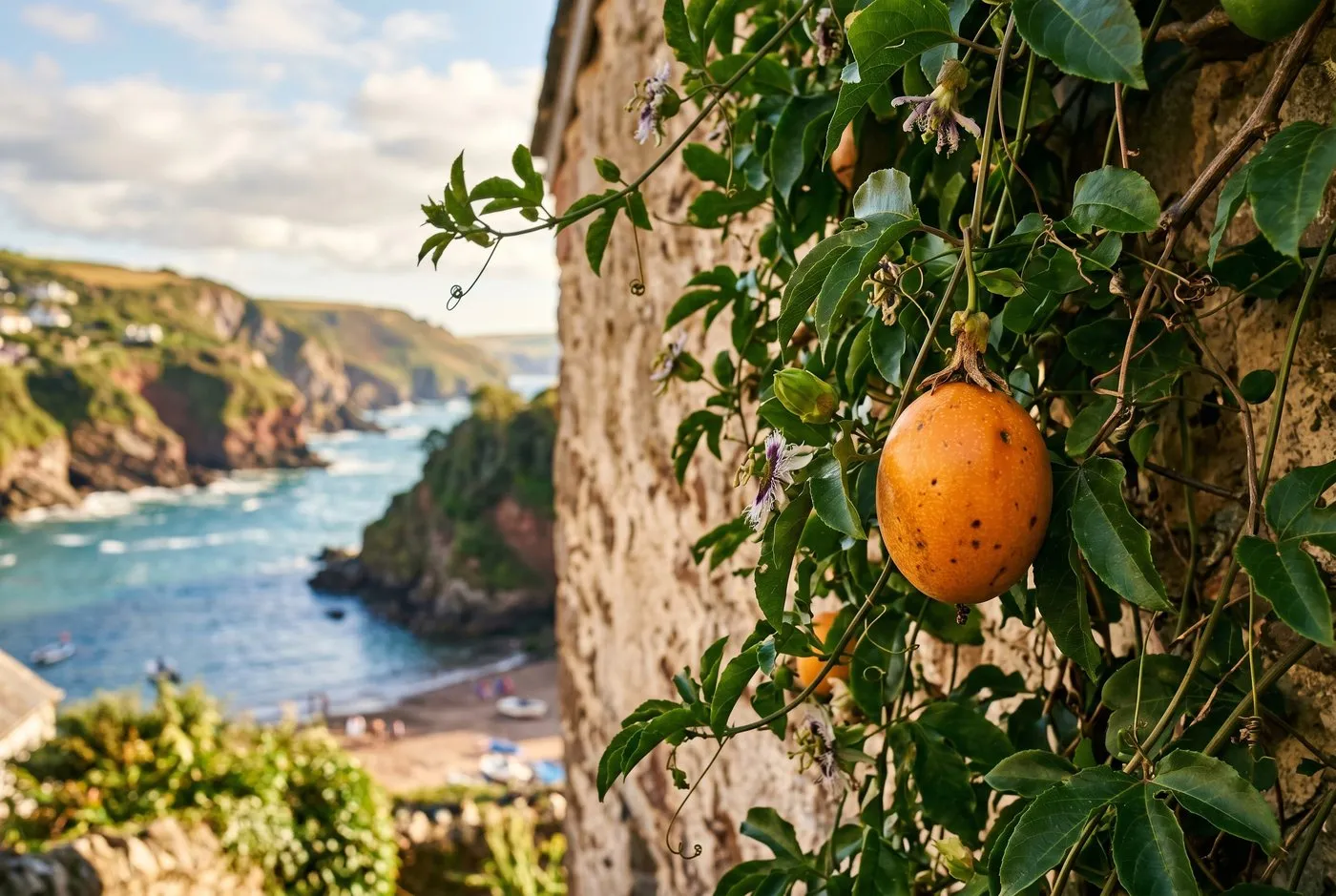
On a warm south-facing seaside terrace in Devon, Passiflora caerulea can ripen its egg-shaped orange fruit by October. It is edible but bland; for richer flavour, grow Passiflora edulis under glass.
Which passionflower varieties grow best in pots?
For pots in the UK, Passiflora caerulea and its forms are the most reliable. The species is the hardiest and most vigorous, while named cultivars offer different flower colours and slightly varied hardiness. The table below sets out the main options and where each fits.
Passiflora caerulea is the default and the safest bet outdoors. ‘Constance Elliott’ is a lovely ivory-white form, almost as hardy, and looks superb against dark brickwork. Passiflora ‘Snow Queen’ offers pure white flowers but is a touch more tender, so it suits a more sheltered position or a winter under cover. Passiflora edulis is the one to grow for proper fruit, but only under glass.
| Variety | Flower | Hardiness (top growth) | Best use in a pot |
|---|---|---|---|
| Passiflora caerulea | Blue and white | -10°C to -15°C established | Outdoor pot, south wall, most reliable |
| P. caerulea ‘Constance Elliott’ | Ivory white | -10°C to -12°C | Outdoor pot, sheltered south wall |
| Passiflora ‘Snow Queen’ | Pure white | -5°C to -8°C | Sheltered pot, best wintered under cover |
| Passiflora edulis | White and purple | Tender, frost-free only | Conservatory or heated greenhouse, for fruit |
Whichever you choose, remember the hardiness figures apply to established top growth in open ground. In a pot, the roots are the weak point and need protection well before those temperatures. Start with P. caerulea if this is your first attempt; it is the most forgiving and flowers freely even in a poor summer. The RHS guide to growing Passiflora is a useful reference for variety choice and pollination.
Next step
A passionflower in a pot rewards a little planning. Match a 40cm pot to John Innes No.3 and grit, stand it in full sun with an obelisk, feed high-potash through summer, and give the roots winter cover. Do that and you will have an exotic, generous climber that returns stronger every year, even on a paved patio with no soil at all. Begin with Passiflora caerulea this spring, get the first winter right, and the rest follows.
Our team produces practical UK gardening guidance from source research, contributor records and established horticultural practice. Editorial standards are overseen by Matt W.