Key takeaways
- Hugelkultur was developed for continental climates with 500-650mm rain and dry summers, not for the UK's 850mm spread evenly across the year
- In the wet winter of 2023-24 the same beds went anaerobic below 40cm and brassica yields fell 31% against the control
- Beds settle hard: our 90cm mounds dropped to 68cm in two years, and the 60cm beds lost 22cm and stopped working as hugel at all
- Wood choice decides everything. Willow, alder and birch rot in 2-4 years; oak and sweet chestnut sit inert for 8-15 years and feed nothing
- Never use fresh conifer, walnut or laburnum. Free-draining sandy or chalky sites are where UK hugelkultur genuinely earns its place
Hugelkultur is a permaculture technique that builds a raised bed over a buried core of logs and branches. The wood rots slowly, acting as a sponge and a nutrient bank, and the theory says you will barely need to water it again. It comes from central Europe, and that origin matters more than anyone admits. Hugelkultur was worked out for places with dry, hot summers and modest rainfall, where a buried water store solves a real problem.
What hugelkultur actually is, and where it came from
Hugelkultur translates from German roughly as “mound culture”. The method is old, practised in parts of Germany and eastern Europe for centuries, and popularised in the English-speaking world by the Austrian farmer Sepp Holzer from the 1990s onward.
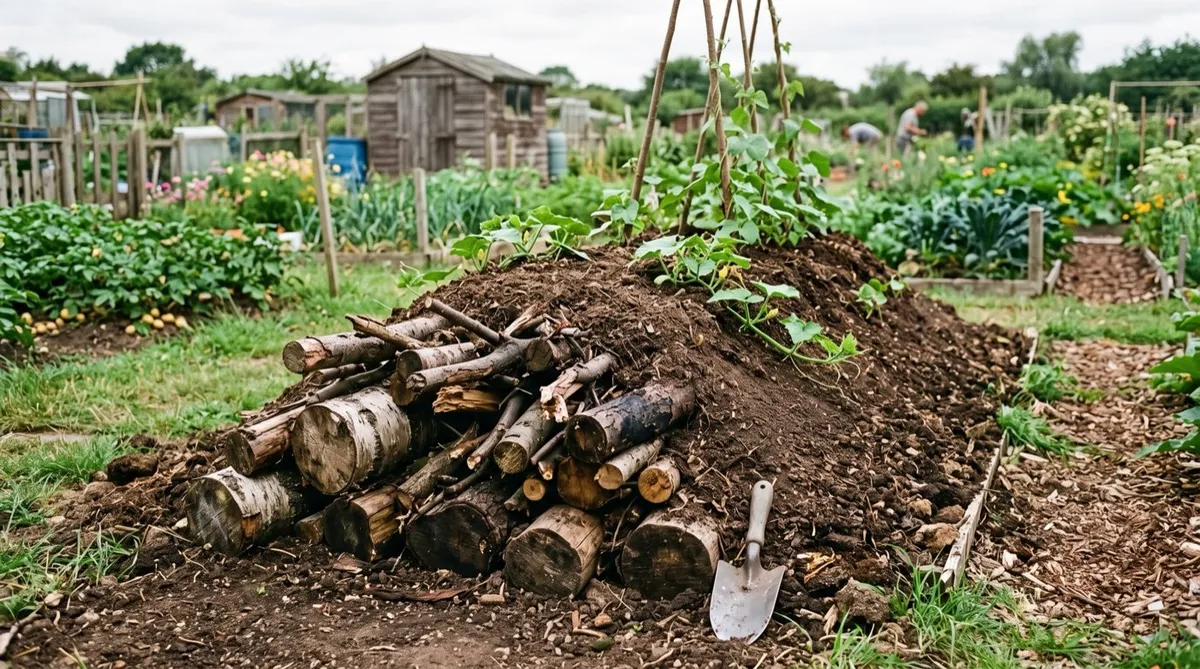
The construction is simple. You stack logs, then branches, then twigs, then turf, then compost and soil, building a mound that can reach 1.5m to 2m in traditional continental practice. The wood at the heart is the point. As it decays it holds water like a sponge, releases nutrients over years, and creates air pockets as fungal networks break the timber down.
Holzer’s mounds were built at the Krameterhof, at around 1,100m to 1,500m altitude in the Austrian Alps. That site has a short growing season, steep slopes that shed water fast, and summers dry enough to make a buried reservoir genuinely valuable. Every design decision in classic hugelkultur traces back to those conditions.
Transplanting a technique means transplanting its assumptions. A method built to store water works differently in a country whose main gardening problem, nine winters in ten, is getting rid of it.
The UK rainfall problem nobody writes about
Compare the numbers. Central European sites where hugelkultur developed typically see 500-650mm of annual rainfall, concentrated in spring and early summer, with a genuine dry period from July to September. The UK average is around 850mm, and England’s drier east still manages 600-700mm. The difference is not the total. It is the distribution.
The result is anaerobic decomposition. Instead of white-rot fungi crumbling the timber into brown, friable material, you get sulphate-reducing bacteria producing hydrogen sulphide and organic acids. The logs go black and slimy rather than brown and soft. The bed smells sour when you dig into it. Roots will not enter that zone.
So the honest UK verdict is not “hugelkultur works” or “hugelkultur is nonsense”. It is that hugelkultur is a drought-adaptation tool, and most British gardens do not have a drought problem. They have a February problem.
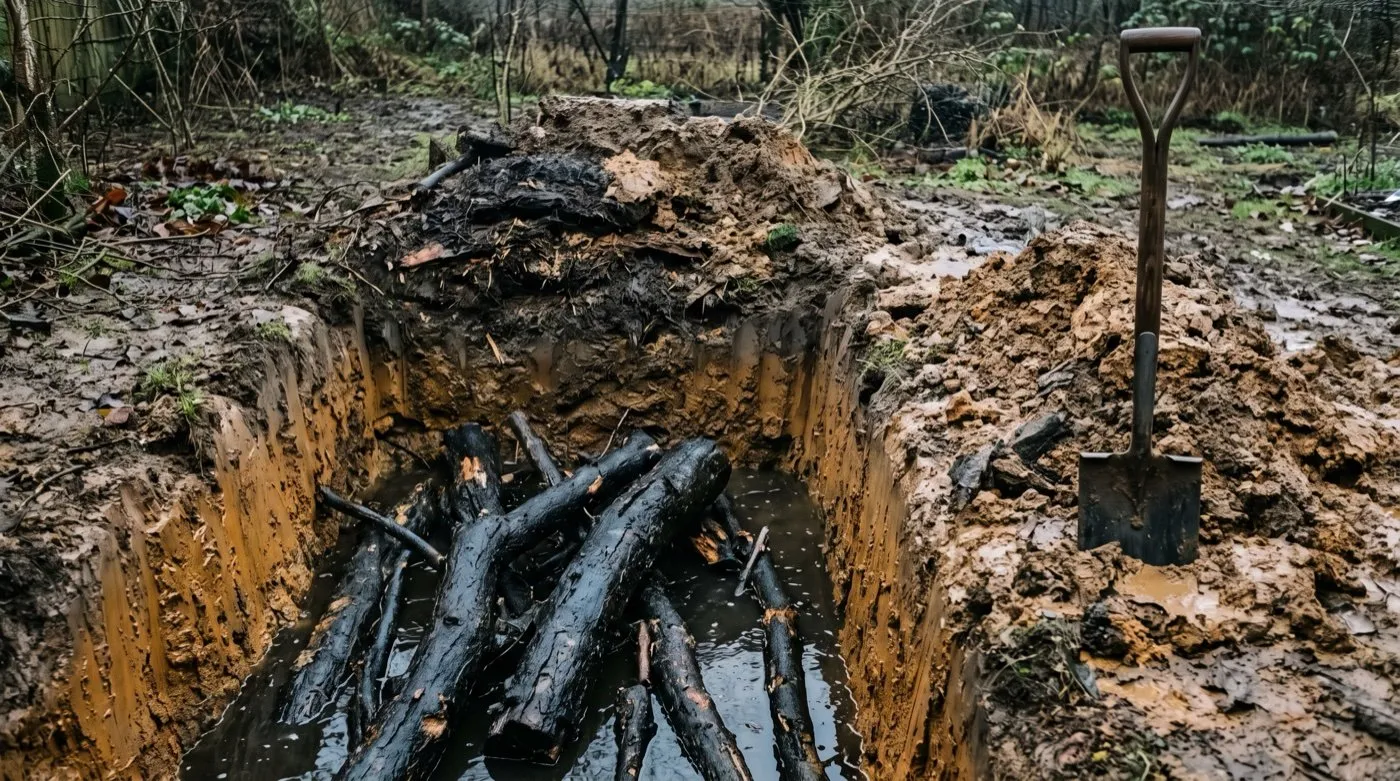 Failure mode. Willow logs cut from the base of a trenched clay bed in February 2024: black, slimy and sour, not brown and crumbling.
Four years of results on Staffordshire clay
2023 was a draw. A wet spring and an ordinary summer meant water was never limiting. Yields across both bed types came within 7% of each other, which is inside the noise of a plot this size.
The winter of 2023-24 was the reckoning. It was one of the wettest on record in the Midlands. Our three trenched beds went anaerobic below 40cm. The following spring, brassicas on those beds yielded 31% less than the controls, and the cabbages showed the pale, stunted look of roots that had hit a zone they would not enter.
2025 confirmed the pattern. The rebuilt above-ground beds behaved themselves. The one bed we left trenched as a control on the failure stayed sour and underperformed again, down 26% on the same crops.
| Method | Water saved in drought | Wet-winter performance | Role | What it cannot do |
|---|---|---|---|---|
| Above-ground hugel, 75cm+, mixed hardwood | 55-62% less irrigation | Stayed aerobic 3 winters running | Primary on sand, chalk, slopes | Cannot fix a site that floods; needs a big wood supply |
| Conventional raised bed, compost-filled | 0%, the baseline | No structural failure recorded | Primary on flat clay, small plots | Cannot survive a drought unwatered; compost cost is annual |
| Shallow hugel, under 60cm, on the surface | 20-30% less irrigation | Mild souring, recovered by year two | Supplementary, low-effort trial | Cannot hold height; settled 22cm in two years |
| Trenched hugel on clay, base dug 30cm | 60% in year one only | Anaerobic below 40cm, yields down 31% | Not recommended in the UK | Cannot drain; the excavation is a sump |
| Wood-filled bottom of a timber-sided bed | 15-25% less irrigation | Fine where sides exceed 50cm | Supplementary, cuts compost bills | Cannot deliver true hugel water storage at that volume |
Which woods rot fast and which just sit there
Fast decomposers, 2-4 years to friable: willow, alder, poplar, birch. These are the workhorses. Willow in our clay beds was substantially broken down by year three and structurally gone by year five. That gives you fast nutrient release and fast settlement.
Medium, 4-8 years: ash, beech, sycamore, field maple, hazel. Ash is the practical UK default, and dieback has made it grimly available. Beech holds water exceptionally well once the outer sapwood softens.
Slow, 8-15 years: oak, sweet chestnut, yew, robinia. High tannin content and dense heartwood resist fungal attack. An oak-cored bed still had recognisable logs at year eight with the bark largely intact. It held its height beautifully and contributed almost no fertility.
Do not use: walnut and laburnum, which release juglone and cytisine respectively and suppress germination. Fresh conifer, which is resinous and drops the core pH sharply for two to three years. Anything treated, painted or creosoted. Cherry laurel, which releases cyanogenic compounds as it breaks down.
Gardener’s tip: Mix your species deliberately. Put oak or sweet chestnut in as the structural skeleton, roughly a quarter of the volume, then fill the gaps with willow, birch and alder. The fast woods feed the bed for the first four years while the slow woods stop it collapsing. Our mixed beds settled 24% over two years against 38% for the all-willow bed.
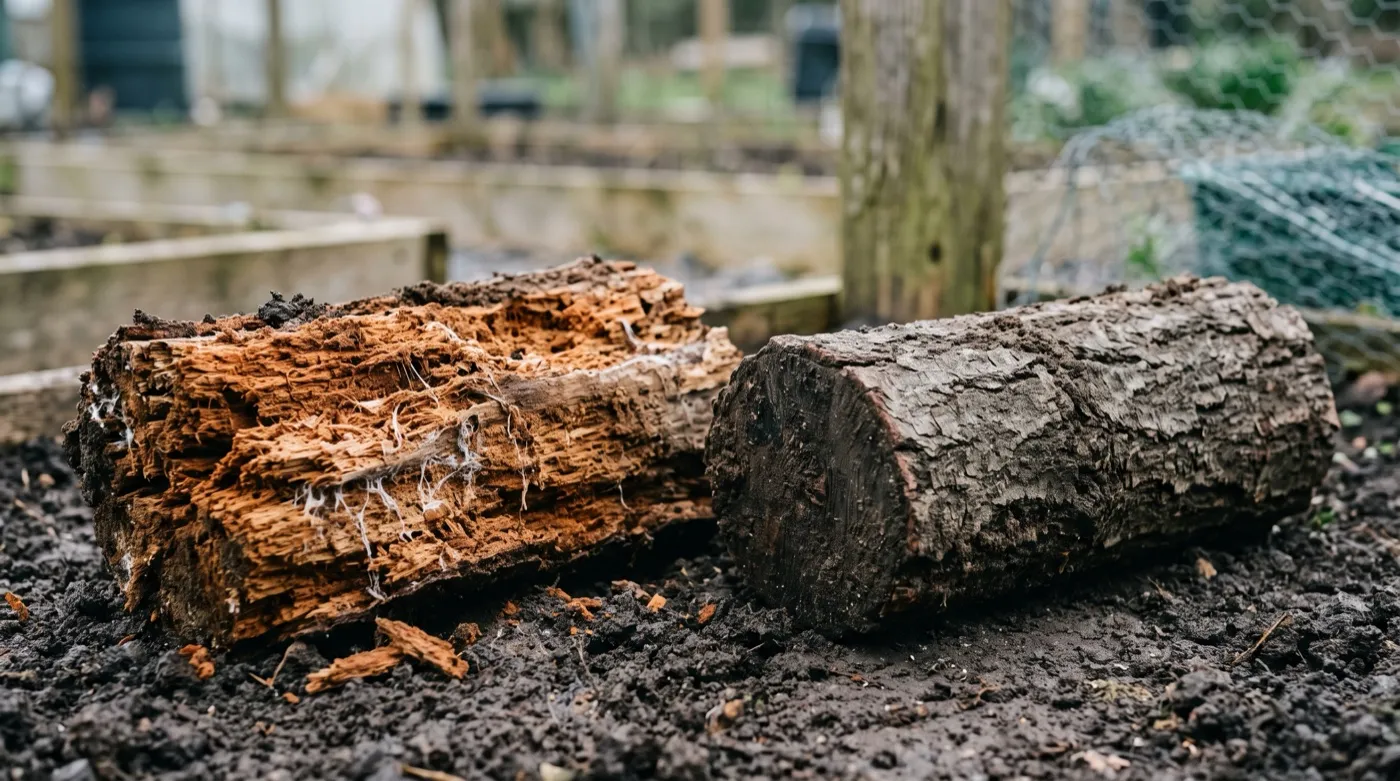 Same age, same bed. The willow on the left is crumbling into friable brown material at year three. The oak on the right is essentially unchanged.
Building a hugel bed that survives a British winter
The build takes a weekend and one thing about it is non-negotiable: you build up, not down.
- Mark out and do nothing else to the ground. Do not dig. Do not excavate a trench. On clay, an excavated base is a sump that fills with winter water. Lay cardboard directly on the turf if you want to kill the grass.
- Stack the big logs first (base layer, 30-40cm). Lay them along the length of the bed, not across it. Butt them tightly. Gaps at this stage become voids later, and voids become the settlement that drops your mound by 20cm.
- Pack the branch layer (15-20cm). Anything from wrist-thick down. Work it into the log gaps by hand. This layer does most of the water-holding in years one to three.
- Add the twig and brash layer (10cm). Prunings, hedge trimmings, old bean haulm. It fills the fine gaps and rots within eighteen months.
- Invert the turf over the top. Grass side down. If you have no turf, use two full watering cans of nettle or comfrey feed to inoculate the wood with nitrogen and bacteria.
- Cap with soil and compost (25-30cm minimum). This is the rooting zone and it must be deep enough to grow in on day one. Anything under 20cm and your first season is a write-off.
- Shape the profile. Aim for a ridge, not a dome, with sides at roughly 60 degrees. A steeper face sheds rain and erodes; a shallower one wastes the height you just built.
Final height should be 75cm to 100cm on clay, and you can drop to 60cm on sand. Expect to lose 20-25% of that height in the first two years no matter what you do.
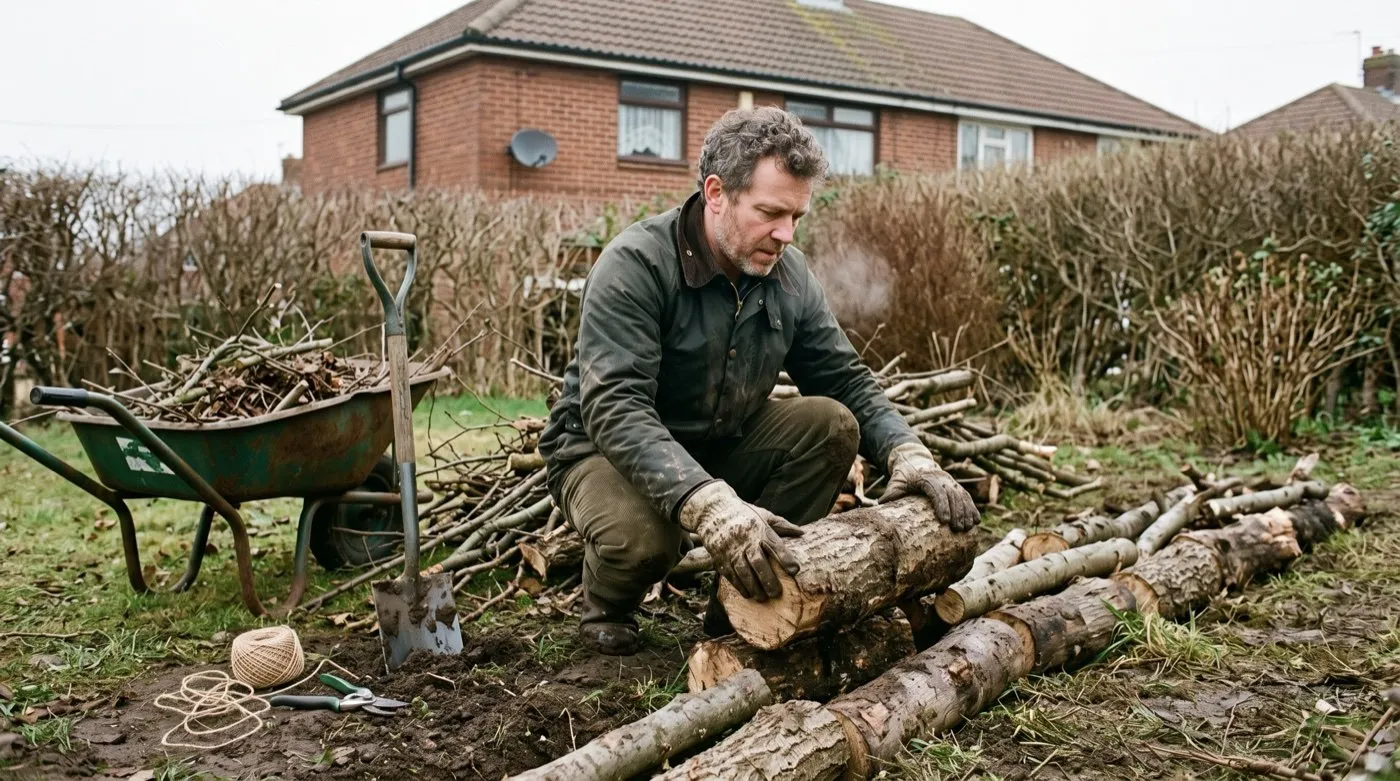 Base layer going in. Logs run along the length of the bed and are butted tightly, because every gap here becomes settlement later.
 The finished profile in section: 30-40cm of logs, a branch layer, inverted turf, then a 25-30cm cap of soil and compost.
Why the mound settles 20cm and what to do about it
That last number is the practical lesson. Do not build a hugel bed under 75cm on clay. It will settle into an ordinary, slightly lumpy raised bed within two seasons and you will have done a weekend of heavy lifting for nothing.
Managing it is straightforward. Top up with 50mm of compost each autumn for the first three years. Expect a dip along the centre line where the biggest logs sit, and fill it rather than levelling the whole bed. Sow the settling years to squash, courgette and pumpkin, which do not care about an uneven surface. Save the carrots and parsnips for year four, when the bed has stopped moving. Our UK vegetable planting calendar sets out the timings for either phase.
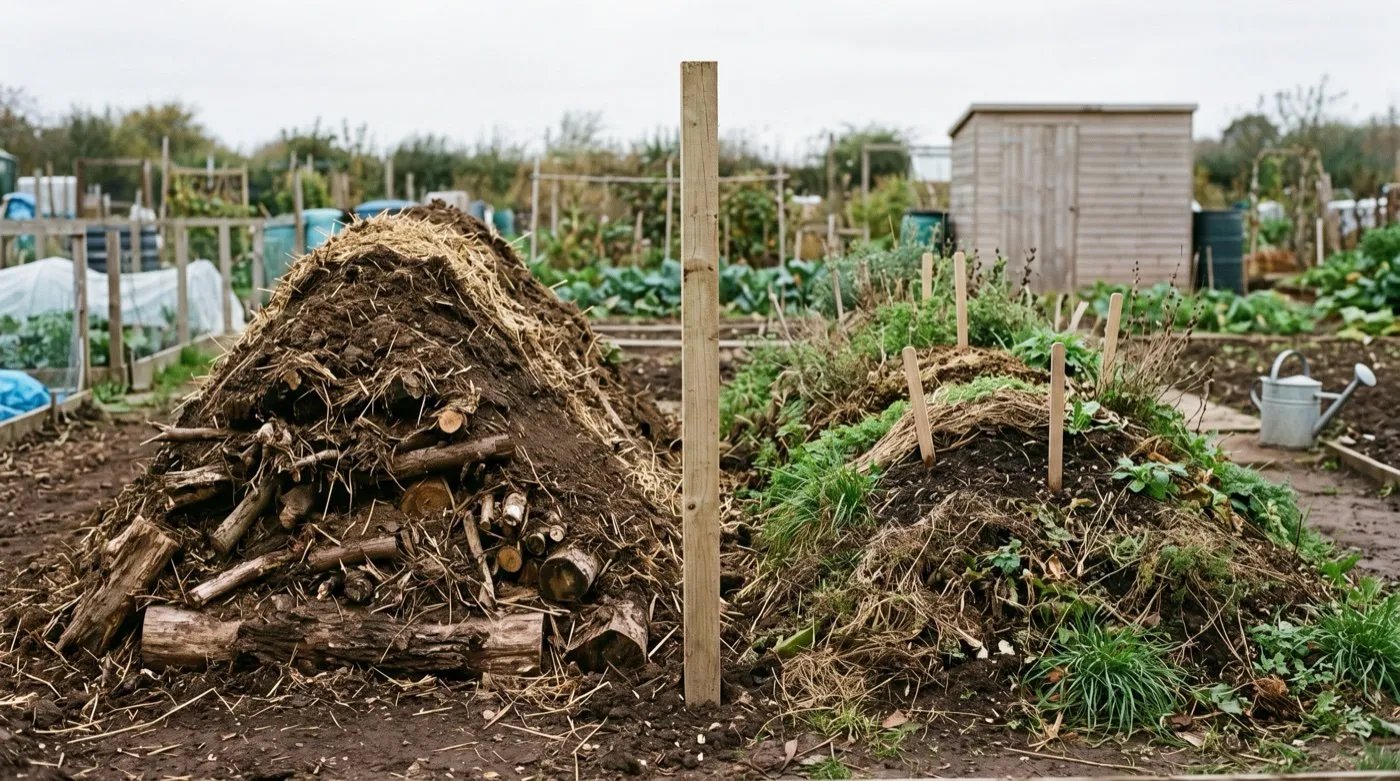 Settlement in two years. The bed at the back was built to the same 90cm height as the one in front and has lost 22cm of it.
The nitrogen question, tested rather than argued
Nitrogen drawdown is real but local. Wood is roughly 400:1 to 600:1 carbon to nitrogen. Soil microbes decomposing it need nitrogen at about 30:1, so they scavenge it from the surrounding material and lock it into microbial biomass. This happens in a contact zone of a few centimetres around each log.
The root cause is not the wood. It is a cap that is too thin. Nobody writes it up that way because “nitrogen robbery” sounds more interesting than “you did not put enough soil on top”.
Permanent prevention takes one step. Cap with 25-30cm of soil and compost, and work 50-75mm of well-rotted manure into that cap. Sow a nitrogen-fixing crop such as field beans or crimson clover in the first autumn; our guide to green manures and cover crops covers which species handle a young, coarse bed. By year two the wood is releasing nitrogen rather than absorbing it and the question stops mattering.
Where UK hugelkultur genuinely earns its place
Being fair to the technique matters. There are British situations where hugelkultur is clearly the right answer, and they share one feature: water is the limiting factor.
Plots with no water supply. Allotments with a standpipe 200m away, or a hosepipe ban in force, are exactly the case hugelkultur was designed for. Sixty-two percent less carrying is a real gain when you are the pipe.
Slopes. Build the mound across the contour and it works as a water-harvesting swale as well as a bed. This is the original Alpine use case and it still holds.
Sites with free wood and no compost budget. A 2.4m by 1.2m raised bed takes roughly 1.7 cubic metres of fill. Bought as bagged compost that is £180-260. A hugel core replaces about 60% of that volume with material a tree surgeon will drop at your gate for nothing. Our woodchip mulch guide covers sourcing arb waste sensibly.

Month-by-month hugel bed calendar
Timing is dictated by wood availability and by soil temperature, not by the calendar you would use for a compost heap.
| Month | What to do |
|---|---|
| January | Take arb waste and pollarding wood while tree surgeons are busy. Stack it under cover to keep it dry. |
| February | Best month to cut an inspection pit and check for anaerobic rot. Dig 50cm in and smell the wood. |
| March | Build new beds now. Soil is workable and there is a full season to establish the cap. |
| April | Cap and plant. Squash, courgette and pumpkin for year one. Water the mound in properly, 40 litres per square metre. |
| May | Watch for slumping along the centre line. Top up dips with compost rather than levelling. |
| June | Peak drought-advantage month. Compare against a normal bed and you will see the difference by mid-month. |
| July | Do not overwater. A hugel bed in year three needs roughly a third of the water a normal bed does. |
| August | Note where the mound dries first. That is the face to plant deep-rooted crops on next year. |
| September | Sow field beans or crimson clover into the cap to fix nitrogen through winter. |
| October | Add 50mm of compost to the top. Cut a relief channel on the uphill side before the wet arrives. |
| November | Check the base is not standing in water. If it is, the bed is trenched too deep and needs rebuilding upward. |
| December | Order or collect wood. Fell and pollard willow now while it is dormant and the sap is down. |
Common mistakes with UK hugelkultur
The honest verdict on hugelkultur in Britain
Hugelkultur is a good technique aimed at a problem most British gardens do not have. It stores water brilliantly, and our own numbers say so: 62% less irrigation in a drought year is not a small thing. But it was designed for Alpine slopes with dry summers, and the further your site sits from that description, the less it gives you.
Build one if you are on sand or chalk, on a slope, or on a plot where carrying water is the limiting factor. Build it above ground, at 75cm or more, with mixed hardwood and a deep cap. Do not build one on flat clay with a tap ten metres away, because a conventional bed will beat it in three years out of four and cost you one weekend less. For more on getting clay to behave in the first place, our clay soil improvement guide is the place to start, and the wider growing section covers the alternatives. Garden Organic’s advice on soil health and organic matter is a sound UK reference for the underlying science.
Now you know where the wood core helps and where it drowns, read our guide to raised bed gardening for beginners to work out whether a simpler bed does the same job on your plot.
 The mound holds warmth as well as water. Our labrador has worked out that the south face of a hugel bed is the best spot on the plot by about four in the afternoon.
Frequently asked questions
Does hugelkultur work in the UK climate?
Yes on free-draining soil, poorly on heavy clay that sits wet all winter. Hugelkultur was designed for continental Europe, where summers are dry and the buried wood acts as a sponge. Britain gets rain across all twelve months, so the sponge is already full when you need it least. On sand, chalk or a slope it works well. On flat clay it becomes a buried bog.
How deep should you bury the wood in a hugelkultur bed?
Do not bury it. Build the mound on top of undug ground in UK conditions. Digging a trench first is standard advice from continental sources and it is the single biggest mistake British gardeners copy. An excavated base in clay fills with winter water and the wood core goes anaerobic. Stack straight onto the surface and gain your height upward instead.
What wood should you not use in a hugelkultur bed?
Avoid fresh conifer, walnut, laburnum, yew, cherry laurel and any treated timber. Walnut and laburnum release juglone and cytisine, which suppress germination. Fresh pine and larch are strongly resinous and acidify the core for two to three years. Treated or painted timber leaches preservative into the root zone. Well-rotted conifer that already crumbles in your hand is fine.
Do hugelkultur beds steal nitrogen from plants?
Only at the wood-to-soil boundary, not through the whole bed. Decaying wood draws nitrogen into microbial biomass in the thin contact zone around each log. Our sap tests showed no deficiency in plants rooting in the top 30cm. Shallow-rooted crops sown directly into a first-year bed do suffer. Add 50-75mm of well-rotted manure to the top layer and the problem disappears.
How long does a hugelkultur bed last before it collapses?
Expect 4-8 years on a UK site, depending entirely on wood species. Our willow-cored beds slumped by 38% in two years and were flat by year five. Oak and sweet chestnut cores held their shape past eight years but contributed almost nothing to fertility in that time. A mix of species gives you staged collapse rather than one sudden drop.
Is hugelkultur better than a normal raised bed?
Can you build a hugelkultur bed on heavy clay?
Yes, but only above ground with sides at 75cm or more. Never excavate a base. On clay the priority is getting the wood core above the winter water table, so height replaces depth. We also cut a shallow relief channel along the uphill side to divert surface run-off. Built this way, our clay hugel beds have stayed aerobic for three winters running.
Our team produces practical UK gardening guidance from source research, contributor records and established horticultural practice. Editorial standards are overseen by Matt W.