
Key takeaways
- A 1.2m x 1.2m bed split into 16 squares of 30cm is the classic starting size
- Plant 1, 4, 9 or 16 plants per square depending on how big the crop grows
- Fill the bed with a mix of peat-free compost, vermiculite and other compost
- Make the bed at least 20cm deep so carrots and other roots have room
- Replant each square as soon as you harvest it to keep crops coming
Square foot gardening is a brilliant way to grow lots of veg in a small UK garden. You split a small raised bed into a grid of 30cm squares. Then you fill each square with just the right number of plants for its size. It’s tidy, easy to manage and great fun to plan.
What is square foot gardening?
Square foot gardening splits a raised bed into a grid of 30cm squares. Each square gets a set number of plants, depending on how much room the crop needs. Big plants like tomatoes get one square each. Small ones like radishes fit sixteen to a square.
The idea came from Mel Bartholomew, an American engineer, in his 1981 book Square Foot Gardening. He noticed that rows waste a lot of space on paths and gaps. A grid packs plants in neatly instead.
A classic bed is 1.2m x 1.2m (4ft x 4ft), marked into a 4 by 4 grid. You work from the edges and never step on the soil, so it stays loose and crumbly. The bed sits on top of the ground and is filled with a special light mix, so there’s no digging.
It suits British back gardens really well. One bed takes up very little room but keeps you in salad and veg all summer. If you’re short on space, see our small garden ideas too.
Why square foot gardening works so well
It works because there are no paths, the soil is rich and plants grow close together. That’s the whole secret.
Close spacing
Plants sit closer than in a normal veg patch. That’s fine because the soil mix is rich, loose and full of food. In poor soil, close planting would leave plants small and hungry. This is why the special soil mix really matters.
Shade and moisture
Once the plants grow, their leaves cover the soil. That shades it, keeps it damp for longer and leaves little room for weeds. You’ll water and weed less than you would in a row patch of the same size.
How to build a square foot garden bed
Building a bed takes an afternoon. All you need is a saw, a drill and a tape measure.
What you need
| Material | What to get |
|---|---|
| Timber planks | Four 1.2m lengths of untreated larch, 15cm or more deep |
| Corner brackets | Four galvanised L-brackets with screws |
| Grid | Wooden laths, bamboo canes or garden twine |
| Weed membrane | Only if the bed goes on paving |
| Soil mix | Enough to fill the frame (see below) |
Untreated larch lasts for years without any treatment. Douglas fir works too. Our raised bed gardening guide has more on materials and building.
Step-by-step build
- Pick a level, sunny spot with at least six hours of sun a day. Avoid overhanging trees.
- Cut four planks to 1.2m. Sand off rough edges.
- Screw the frame together with the corner brackets. Check it’s square by measuring both diagonals. They should match.
- Put the frame in place on bare soil. On paving, lay weed membrane first.
- Level it with a spirit level, packing under low corners with offcuts.
- Fix the grid across the top every 30cm. Three lines each way give you 16 squares.
- Fill with soil mix to the top. Water well and let it settle for a couple of days before planting.
Gardener’s tip: Make the grid from thin wooden laths rather than string. String sags within weeks. Laths stay put for years.
How deep should it be?
Many books say 15cm, but 20cm or more is better in the UK. Our wetter weather means shallow beds get soggy. Carrots and parsnips also need the extra depth to grow long and straight.
A UK-friendly soil mix
The original Mel’s Mix is one third peat, one third vermiculite and one third compost. In the UK, swap the peat for peat-free compost. Digging peat damages precious bog habitats. The RHS peat-free gardening guidance explains why.
The mix
| Part | What it does |
|---|---|
| One third peat-free multipurpose compost | Feeds plants and holds moisture |
| One third coarse vermiculite | Keeps the mix light and airy, and soaks up spare water |
| One third mixed compost, ideally from a few different sources | Adds goodness and life to the soil |
Vermiculite is the priciest part, but don’t skip it. It keeps the mix light and stops it going soggy. Buying a big bag is much cheaper than lots of small ones. The mix should feel like a wrung-out sponge when you squeeze it.
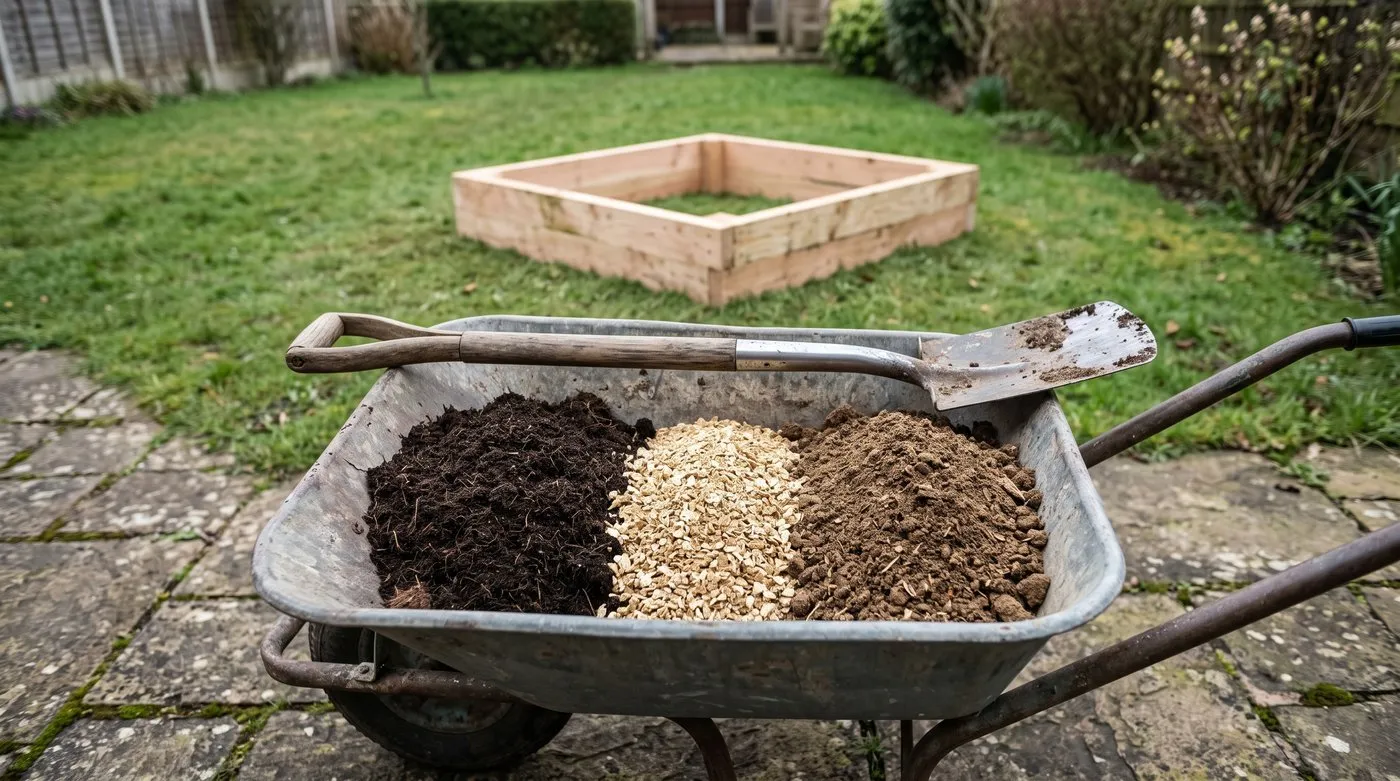
Equal parts of the three, mixed well, give a light, rich fill that holds water without going soggy. Squeeze a handful: it should feel like a wrung-out sponge.
Topping up each year
The mix sinks and gets hungrier over time. Each spring, add a 5cm layer of fresh compost to the top. Every few years, fork through the top layer and mix in a little fresh vermiculite and compost.
The 1-4-9-16 planting grid
Every crop fits into one of four groups, depending on its size. Instead of learning lots of spacing charts, you just remember four numbers.
| Plants per square | Spacing | Crops |
|---|---|---|
| 1 (extra large) | 30cm | Tomatoes, peppers, aubergines, cabbages, broccoli, cauliflower |
| 4 (large) | 15cm | Lettuce, chard, basil, parsley, marigolds, pak choi |
| 9 (medium) | 10cm | Beetroot, turnips, onions, leeks, dwarf beans, spinach |
| 16 (small) | 7.5cm | Radishes, carrots, spring onions, chives, coriander |
Our companion planting guide shows which crops make good neighbours.
 A square foot grid in action, with each square holding 1, 4, 9 or 16 plants.
How to plant a square
Poke evenly spaced holes with a dibber or your finger. Use a 4 by 4 pattern for 16 plants, 3 by 3 for nine and 2 by 2 for four.
Sow two or three seeds per hole. Thin to the strongest seedling once they’re a few centimetres tall. For young plants, put one in each hole.
Grow upwards too. Put a trellis on the north side of the bed so it doesn’t shade the other squares. Climbing beans, peas, cucumbers and small squashes then grow up instead of out.
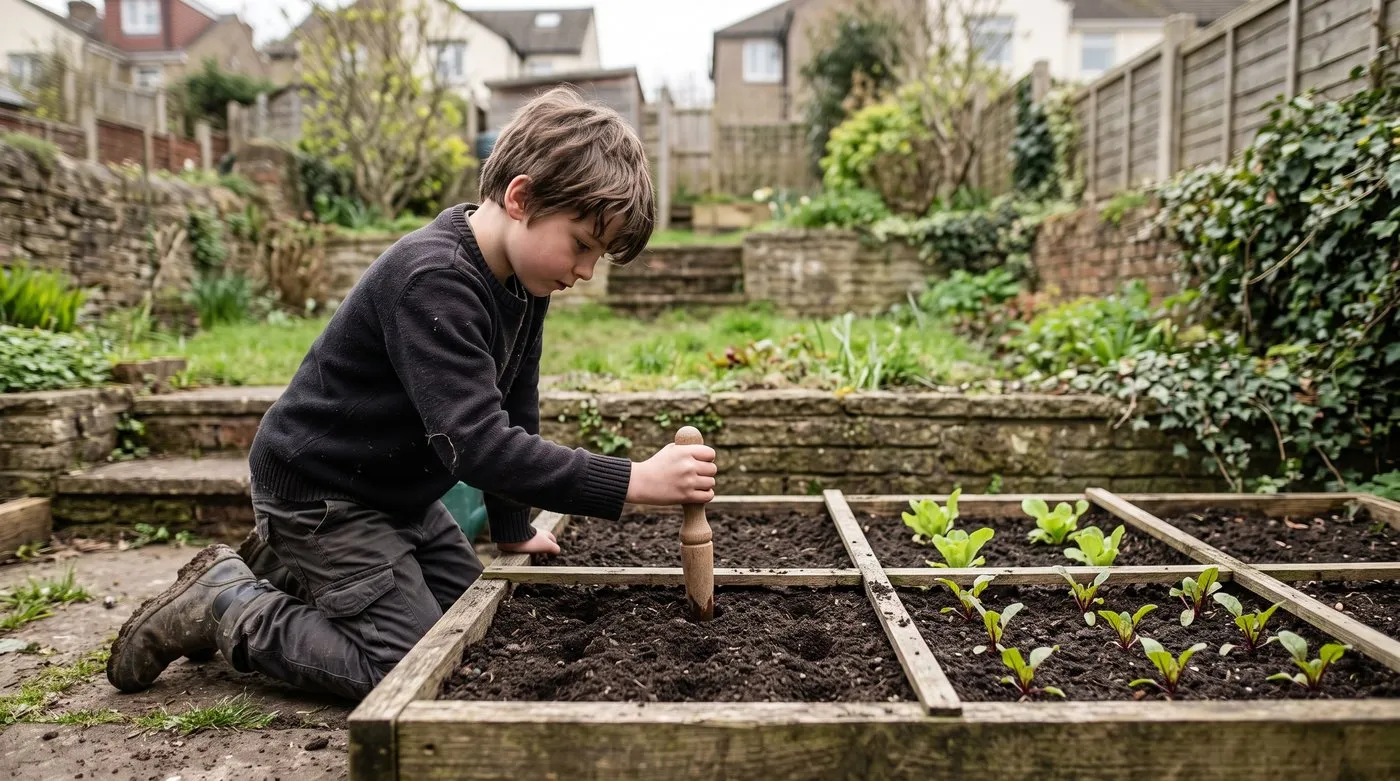
A 4 by 4 pattern of holes gives sixteen evenly spaced spots for radishes or carrots. Sow two or three seeds in each and thin to the strongest.
Rows or squares: which is better?
| Square foot bed | Traditional rows | |
|---|---|---|
| Space | Very little wasted | Lots of room taken by paths |
| Weeding | Easy, small area | More to do |
| Watering | Less, as leaves shade the soil | More |
| Set-up cost | Timber and soil mix to buy | Nothing if you already have a plot |
| Best for | Small gardens, beginners, patios | Big plots and allotments |
Rows only really win on set-up cost. If you already have open ground, rows cost nothing. A square foot bed needs timber and soil mix up front, but it lasts for years.
 A 1.2m x 1.2m bed built from untreated larch, with wooden laths marking the grid.
UK planting calendar for square foot gardens
You can plant from early March to September, and longer with a cloche. These timings suit the Midlands. Southern gardens can start a week or two earlier. Further north, wait a week or two longer.
| Month | What to plant | Good to know |
|---|---|---|
| March | Radishes (16 per square), peas (8), broad beans (1) | Cover with a cloche for a few weeks |
| April | Lettuce (4), beetroot (9), spring onions (16), spinach (9) | Sow straight into the bed |
| May | Tomatoes (1), peppers (1), French beans (9), courgettes (1) | Harden off young plants first, plant tender ones after the frosts |
| June | Cucumbers (1), runner beans (4), basil (4), chard (4) | Put up supports for climbers |
| July | More lettuce (4), carrots (16), beetroot (9) | Fill squares where spring crops finished |
| August | Kale (1), pak choi (4), radishes (16), salad leaves (4) | Autumn pickings follow |
| September | Garlic (9), overwintering onions (9), winter lettuce (4) | These grow on through winter |
Our succession planting guide has more on staggering sowings so you’re never without something to pick.
A first-year plan for one bed
Here’s a simple layout for a beginner’s 16-square bed:
| Row | Square 1 | Square 2 | Square 3 | Square 4 |
|---|---|---|---|---|
| North (back) | Tomato (1) | Runner beans (4) on trellis | Runner beans (4) on trellis | Pepper (1) |
| Row 2 | Lettuce (4) | Basil (4) | Chard (4) | Spinach (9) |
| Row 3 | Beetroot (9) | Carrots (16) | Onions (9) | Radishes (16) |
| South (front) | Spring onions (16) | Lettuce (4) | Parsley (4) | Marigolds (4) |
Tall crops go at the back so they don’t shade the rest. The marigolds add colour and bring in hoverflies, which help with aphids.
 Lettuce, beetroot and beans from a single square foot bed.
Common mistakes in square foot gardening
Most problems come down to the wrong soil, a bed that’s too shallow, or squeezing in extra plants.
Using garden soil instead of the mix
Ordinary garden soil packs down in a raised bed, drains badly and is too poor for close planting.
Fix: Always use the three-part mix. It costs more at the start, but it makes all the difference.
Building too shallow
Shallow beds get waterlogged in wet British weather. Root crops also hit the bottom and fork.
Fix: Build at least 20cm deep.
Planting everything at once
Planting all 16 squares on the same day gives you a glut in July and empty squares in August.
Fix: Plant a few squares each month from March to August. When a square finishes, replant it straight away. Our crop rotation planner helps you keep track of what went where.
Skipping a proper grid
Guessing the squares by eye leads to plants creeping closer together. Within a couple of seasons the bed is a jumble.
Fix: Fix wooden laths or canes to the frame and leave them there all season.
Forgetting to grow upwards
A flat bed wastes all the space above it.
Fix: Put a trellis or A-frame along the north edge and grow climbing beans, peas or cucumbers up it.
What does it cost, and is it worth it?
The main costs are the timber and the soil mix in year one. After that, it’s just compost and seeds.
Year one
- Timber frame and brackets
- Grid material
- Soil mix (the biggest cost, mostly the vermiculite)
- Seeds
- A trellis or canes for climbers
Year two onwards
- A bag or two of compost for the yearly top-up
- Seeds
- The odd replacement cane or string
What you get back
Fresh herbs alone make it feel worth it. A square of basil or parsley keeps giving all summer, for far less than buying pots from the shop.
New to growing veg? Our beginner’s guide to growing your own covers soil, sowing and harvesting.
Making square foot gardening work in the UK
The method comes from America, where summers are hotter and drier. A few small tweaks help it work here.
Cooler summers
Heat-lovers like aubergines and peppers do best in a sunny, sheltered spot or under cover. Cool-season crops like lettuce, peas and spinach do really well, as they’re slower to bolt in our milder summers.
A cloche or fleece over the bed stretches the season by a few weeks at each end. A 1.2m x 1.2m bed is a handy size to cover.
Rain and drainage
Britain is wet, so good drainage matters. On heavy clay, fork the ground under the bed before you put the frame down. On paving, make sure water can escape and line the base with membrane so the soil doesn’t wash out.
The vermiculite soaks up spare water and lets it go slowly. That’s why it’s so important in the mix. Beds filled with plain compost can turn soggy by October.
Going peat-free
The original mix uses peat moss. Use peat-free multipurpose compost instead. Modern peat-free composts work well here, especially with the vermiculite helping to hold water.
If you like the no-dig method, square foot gardening fits right in. Both leave the soil undisturbed and add compost on top.
Square foot gardening in containers
You don’t need a garden at all. Any container at least 30cm x 30cm and 15cm deep works. Container vegetable gardening gets much more productive with the grid spacing.
A large planter, an old Belfast sink or a wooden crate all work. Even a window box fits a row of squares for herbs and salad.
The big difference is watering. Pots dry out faster than beds, so water daily in summer, and twice a day in a heatwave. Shelves or tiered stands let you fit more on a small balcony.
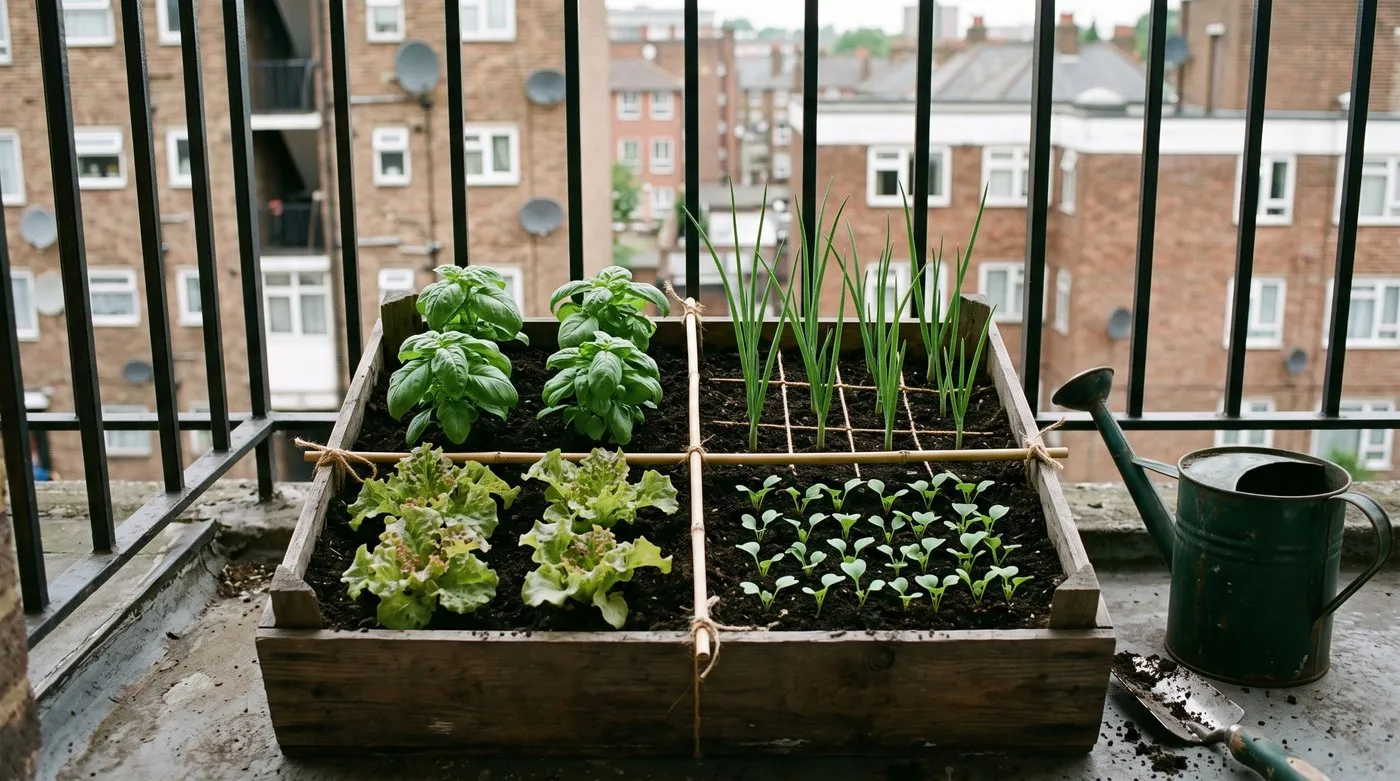
The grid works in any container at least 30cm square. On a balcony, water daily in summer, as crates dry out faster than beds.
Starting your first square foot bed
Begin with one bed and five easy crops: lettuce, radishes, spring onions, beetroot and herbs. They’re quick, forgiving and ready in a few weeks. Leave the other squares empty until you feel confident.
By midsummer you’ll have picked your first crops and replanted those squares. That’s when most people build a second bed for tomatoes, beans and courgettes.
Frequently asked questions
How big should a square foot garden be?
A 1.2m x 1.2m bed is the classic size. That gives you 16 squares you can reach from the sides without stepping on the soil. Start with one or two beds, and add more once you’re hooked.
What soil mix do you use in square foot gardening?
Equal parts peat-free compost, vermiculite and mixed compost. It’s the UK version of Mel’s Mix, which uses peat in the original. The mix stays light, holds moisture and doesn’t get soggy.
How many plants fit in each square foot?
It depends on how big the crop grows. One for big crops like tomatoes and cabbages, four for lettuce, chard and herbs. Nine for beetroot and onions, and sixteen for radishes, carrots and spring onions. That’s the 1-4-9-16 rule.
Does square foot gardening work in the UK?
Yes, it works really well here. A raised bed warms up sooner in spring and drains better in wet weather. Just swap peat for peat-free compost and pick varieties that suit cooler summers.
How much does a square foot garden cost to build?
The timber and soil mix are the main costs. Vermiculite is the priciest part of the mix. After the first year you only need compost and seeds, and an untreated larch frame lasts for years.
Is square foot gardening better than traditional rows?
For small spaces, yes. There are no paths, so you grow more in less room. Weeding and watering are easier too. Rows are cheaper to start if you already have a big plot.
Can I do square foot gardening in containers?
Yes, any container at least 30cm square and 15cm deep works. Planters, old sinks and wooden crates are all fine. Use the same mix and spacing, and water daily in summer.
Our team produces practical UK gardening guidance from source research, contributor records and established horticultural practice. Editorial standards are overseen by Matt W.


