
Key takeaways
- Sow indoors from mid-March to mid-April, and plant out from late May once frosts are over
- Space plants 60cm apart in firm, rich soil
- Keep young plants warm, as a cold spell can make them form a tiny head
- Net plants on planting day to keep cabbage white butterflies and pigeons off
- Cut the head while the spirals are tight and bright green
- Each plant gives one head, so grow several
Romanesco is one of the most eye-catching vegetables you can grow. Its lime-green head is made of spirals within spirals, and it tastes like a nutty cross between cauliflower and broccoli. It’s delicious roasted.
It’s not hard to grow once you know its one weak spot: it hates getting cold while it’s young. Get the timing right and you’ll cut heads that look almost too good to eat. If you’re new to this family of plants, our guide to growing broccoli and calabrese covers the basics.
What is romanesco and why grow it?
Romanesco is a close cousin of cauliflower, broccoli, cabbage and kale. It comes from Italy, and the name comes from Rome. Seed catalogues sometimes call it romanesco broccoli or romanesco cauliflower.
Each little floret is a mini copy of the whole head, arranged in a spiral. It’s a real talking point on the allotment, and a great way to get children interested in veg.
The best reason to grow it is the flavour. It’s hard to find in the shops, and home-grown heads cut fresh are sweet, nutty and firm. Try it roasted with olive oil and garlic.
Which romanesco varieties grow best in the UK?
Pick a variety that copes with cooler weather. Modern F1 varieties tend to be more reliable here than old Italian ones.
Romanesco variety comparison table
| Variety | Head size | Copes with cold | Good for |
|---|---|---|---|
| Veronica F1 | Large | Well | Reliable crops |
| Romanesco Natalino | Medium | Fairly well | Sheltered gardens |
| Gitano F1 | Large | Well | Show-quality heads |
| Romanesco Precoce | Small to medium | Not so well | An early harvest |
| Celio F1 | Medium to large | Very well | Northern gardens |
How to sow romanesco seeds

Romanesco seedlings in module trays, ready to pot on once their first true leaves appear.
Sow indoors from mid-March to mid-April. Starting under cover keeps seedlings away from the cold that can spoil the heads later. If you haven’t done it before, our guide to how to harden off seedlings explains how to get them used to the outdoors.
Sowing step by step
- Fill module trays with moist, peat-free seed compost and firm gently.
- Sow one seed per cell, 1-2cm deep. The seeds are big enough to handle one by one.
- Put the trays somewhere bright and warm, around 15-20C. A windowsill or greenhouse bench is fine. Seedlings appear in about 1-2 weeks.
- Keep the compost moist but not soggy, as soggy seedlings can collapse and die.
- Pot on into 9cm pots when they have 3-4 true leaves.
Avoiding premature buttoning
Buttoning is the biggest romanesco problem. The plant makes a tiny head instead of growing on. It usually happens when young plants get too cold, below about 10C, for several days.
Keep seedlings warm until planting out, and don’t rush them outside. Harden them off slowly over a week or so, starting with daytime only. If frost is forecast, bring them back in.
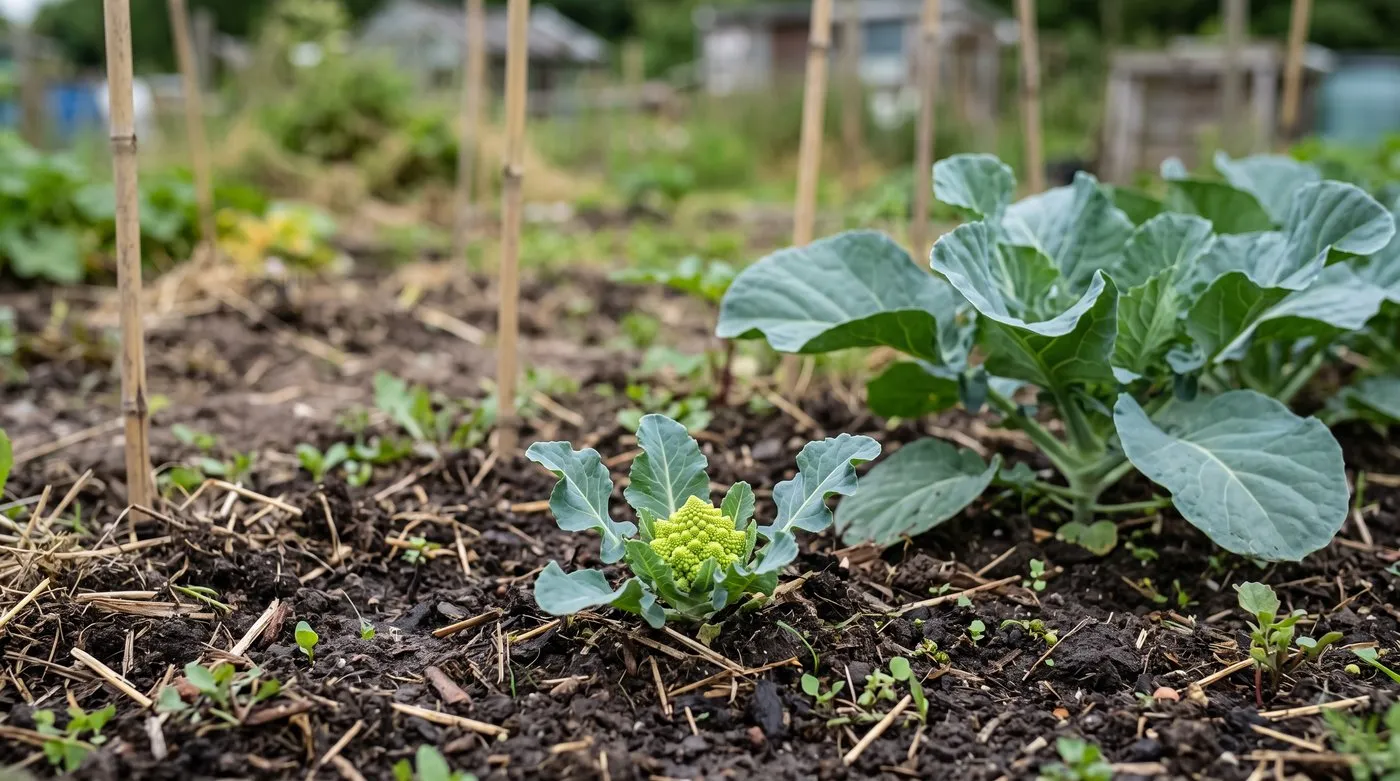
A tiny head on a small plant is buttoning, usually from a cold spell when young. Keep seedlings warm and harden them off slowly.
How to transplant and grow romanesco
Plant out from late May to mid-June, once frosts are over and plants have 5-6 true leaves. In northern England and Scotland, wait until early June.
Site and soil preparation
Romanesco likes firm, rich soil that holds moisture. Like its relatives, it struggles in loose, sandy soil, because the roots can’t hold the heavy plant steady. On light soil, tread it firm before planting.
Dig in plenty of well-rotted manure or garden compost the autumn before. Romanesco is hungry and thirsty. If your soil is acid, add some garden lime, which also helps prevent club root.
Planting and spacing
- Space plants 60cm apart, in rows 60cm apart. They get big and need air around them.
- Plant firmly. Set each plant so the lowest leaves sit just above the soil, then firm it in with your knuckles. A wobbly plant gives a poor head.
- Water in well after planting.
- Mulch with compost to keep moisture in and weeds down.
Feeding schedule
- First month after planting: Give a nitrogen-rich liquid feed every two weeks to build big leaves.
- Until the head forms: Keep feeding every two weeks, then switch to a balanced feed once a tiny head appears in the middle.
- While the head grows: Keep the soil evenly moist. Dry spells now can give brown edges and uneven heads.
If you’re planning where brassicas go each year, our crop rotation planner shows how to fit them in.
How to protect romanesco from pests

Netting at the allotment stops cabbage white butterflies laying eggs on the leaves.
Pests are the main challenge. The big soft leaves attract caterpillars, pigeons and slugs. An unprotected plant can be stripped in a week in summer. Our guide to cabbage white butterfly control has more detail.
Cabbage white butterfly caterpillars
Large and small white butterflies lay eggs on the leaves from spring to early autumn. Large white caterpillars are yellow-green with black spots and feed in groups. Small white caterpillars are pale green, feed alone, and sometimes tunnel into the head.
Best defence: Cover plants with butterfly netting or fine insect mesh from the day you plant. Hold it up on hoops so it doesn’t touch the leaves. The RHS advice on pest barriers explains the options. Check underneath every week for any caterpillars that got there first.
Pigeons
Pigeons love brassica leaves and can strip young plants. The same netting keeps them off, as long as it’s held clear of the leaves.
Slugs and snails
Newly planted romanesco is the most at risk, and slugs can finish one off overnight. Water on slug nematodes around new plants at planting time. Copper tape around raised beds helps too. If you use pellets, choose ones based on ferric phosphate.
Cabbage root fly
The flies lay eggs at the base of the stem, and the grubs eat the roots, so the plant wilts. A brassica collar, a disc of card or carpet underlay around the stem at planting time, stops them. Fine insect mesh helps too.
Club root
This soil disease makes the roots swollen and knobbly, and the plants stunted. It stays in the soil for many years. Lime acid soil, rotate your crops, and only use plants from a trusted source. Bin infected plants rather than composting them.
How to harvest romanesco

Two freshly cut romanesco heads with their bright green spirals.
Heads are usually ready from late August to October, depending on when you sowed and where you live. Don’t wait too long, as they go past their best quickly once the spirals loosen.
Signs of readiness
- Tight, bright green spirals that feel firm. This is perfect.
- About 12-15cm across for most varieties.
- No gaps between the florets. Once you can see gaps, it’s past its peak.
- The leaves still wrap round the head. If they’re pulling away, it’s getting old.
How to cut
Cut the stem with a sharp knife about 10-15cm below the head, keeping a few leaves on to protect it. Cut in the morning while it’s cool. Romanesco doesn’t make side shoots, so once the head is cut, the plant is done.
Storage
Keep the head in the fridge with its leaves on, and eat it within a few days for the best flavour.
Romanesco month-by-month growing calendar
In northern England and Scotland, everything is about 2-3 weeks later.
| Month | What to do |
|---|---|
| March | Sow indoors in module trays somewhere warm. Keep above 10C |
| April | Pot on seedlings. Start hardening off late in the month |
| May | Plant out from late May, 60cm apart. Firm well and net straight away |
| June | Water regularly. Feed every 2 weeks. Check for caterpillars |
| July | Keep feeding and watering. Tiny heads start to form |
| August | Switch to a balanced feed. Keep watering steadily. Early heads ready |
| September | Main picking time. Cut while the spirals are tight |
| October | Pick late heads. Clear old plants and plan next year’s rotation |
Five common mistakes when growing romanesco
1. Sowing too early
February sowings risk getting cold and buttoning. Mid-March is early enough for most gardens.
2. Planting in loose soil
Romanesco is top-heavy. In loose soil the wind rocks it, damaging the roots. Tread the soil firm before planting, and firm each plant in well.
3. Forgetting to net
One day without netting in summer can mean lots of eggs on the leaves. Net on planting day, not when you first see butterflies.
4. Irregular watering
Dry spells followed by a soaking give brown edges and uneven heads. Water steadily, especially in dry weather.
5. Harvesting too late
As the head ages, the spirals loosen and the texture goes grainy. Cut while the spirals are tight, even if the head looks a bit small. A small, perfect head beats a big one that’s opening up.
For more ideas, see our guide to the best vegetables to grow at home, or try some companion planting on your plot.
Frequently asked questions
When should I sow romanesco seeds in the UK?
Sow indoors from mid-March to mid-April. Romanesco takes a good few months to make a head, and young plants dislike cold. Starting them somewhere warm and bright gives them a steady start before they go outside.
Can I sow romanesco directly outdoors?
You can, but it’s less reliable here. A cold spell in April or May can make young plants form a tiny head too early. Sowing indoors and hardening off works much better.
Why did my romanesco form a tiny head instead of a full one?
That’s called buttoning, and it’s usually caused by cold. If young plants sit in chilly weather for several days, they make a small head too soon. Don’t plant out too early, and cover young plants with fleece on cold nights.
Is romanesco the same as cauliflower?
No, but they’re close cousins. Romanesco is related to both cauliflower and broccoli. It tastes milder and nuttier than cauliflower, with a firmer bite. Those pretty spirals are what make it stand out.
How many romanesco heads does each plant produce?
Just one main head per plant. Unlike sprouting broccoli, it doesn’t make side shoots after you cut it. Grow several plants, and sow a couple of weeks apart to spread out the picking.
What pests attack romanesco in the UK?
Cabbage white caterpillars are the biggest problem. They can strip leaves to the ribs in days. Pigeons, slugs and cabbage root fly cause trouble too. Butterfly netting keeps caterpillars and pigeons off, and collars stop root fly.
Can I grow romanesco in containers?
Yes, in a big pot at least 40cm across, filled with rich compost. It’s a large, leafy plant, so it needs more room than most veg. Water daily in warm weather and feed every two weeks. Expect slightly smaller heads.
Related growing guides
Our team produces practical UK gardening guidance from source research, contributor records and established horticultural practice. Editorial standards are overseen by Matt W.


