Key takeaways
- Spring is the best time to clean, with a second go in early autumn for shady patios
- Pull weeds out of the joints first, or they'll be back within weeks
- Pressure wash concrete and porcelain at 1,500-2,000 PSI with the green nozzle, about 30cm away
- Go gentle on sandstone and limestone, under 1,200 PSI or a brush and bucket
- Never use bleach or acid on natural stone
- Seal after two dry days to slow the green coming back
A clean patio is safer to walk on and lasts longer. Algae and moss make slabs slippery, and the longer you leave them, the harder they are to shift.
Here’s how to clean yours, whatever it’s made of, from pressure washing concrete to scrubbing sandstone by hand. Getting the method right for your slabs matters more than elbow grease. Once it’s sparkling, our guide to patio garden ideas for small spaces has ideas for making the most of it.
What makes UK patios dirty?
Algae, moss, lichen and everyday grime. Our wet weather, mild winters and grey skies are perfect for things growing on paving.
Algae is the slippery green film you see from autumn to spring. It loves damp and shade, so north-facing patios and spots under trees go green first.
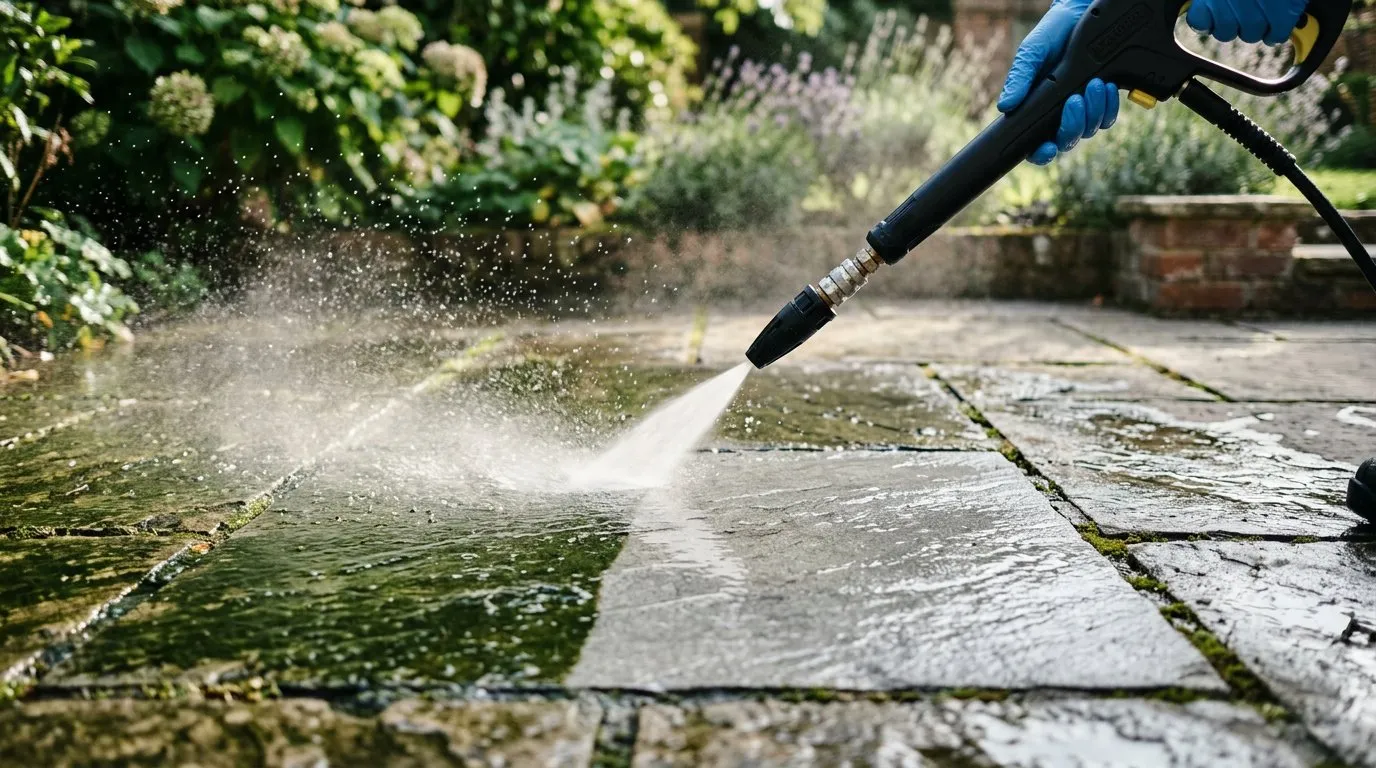
Concrete and porcelain clean up well at 1,500-2,000 PSI with the green nozzle, held about 30cm away.
Moss grows in the joints and on rough or cracked slabs. It keeps the stone damp and, over time, pushes out the pointing so slabs work loose.
Lichen shows up as black spots or pale grey-green crusts. It grows very slowly but is the hardest thing to get off. Normal cleaning won’t touch it, so you’ll need a specialist product.
Grime from shoes, blown soil and fallen leaves stains soft stone like sandstone and limestone. A scrub with the right cleaner usually sorts it. Plain water rarely does.
Knowing what you’re dealing with tells you what to use. Algae comes off easily. Lichen needs a targeted treatment. Moss needs scraping out first, then a cleaner to stop it coming back.
Should you remove lichen from a patio?
Only where it makes things slippery. The RHS advice on algae, lichens and moss on hard surfaces says lichens don’t damage the surfaces they grow on.
Lichen is good for insects and other wildlife, so patches on walls, edging and out-of-the-way steps can stay. Deal with it on paths and steps, where it gets slippery when wet. Black spots on pale sandstone are the usual target, mostly because people don’t like the look. Expect to use a specialist remover a few times. A pressure washer rarely shifts old lichen, and blasting soft stone does more harm than the lichen ever would.
When is the best time to clean a patio?
Late spring, around April or May. The worst of the rain has passed and the barbecue season hasn’t started.
By then the winter green is easy to see and still soft. It’s mild enough for cleaners to work properly, and the longer days help the slabs dry out, which matters if you want to seal.
A second clean in September helps patios that go green quickly, especially north-facing ones, shady spots and anywhere under trees. Getting the summer’s leaves and muck off before winter stops it all getting worse. If moss keeps coming back, our guide on how to get rid of moss has more ideas.
Don’t clean when it’s freezing. Water soaked into the stone can freeze, expand and flake the surface. Avoid hot summer days too, as cleaners dry on warm slabs and leave marks.
Step-by-step patio cleaning guide
Clear, weed, wet, clean, rinse, dry and seal. That order works for every patio. Only the products and pressure change with the material (see the tables further down).
Step 1: Clear the patio
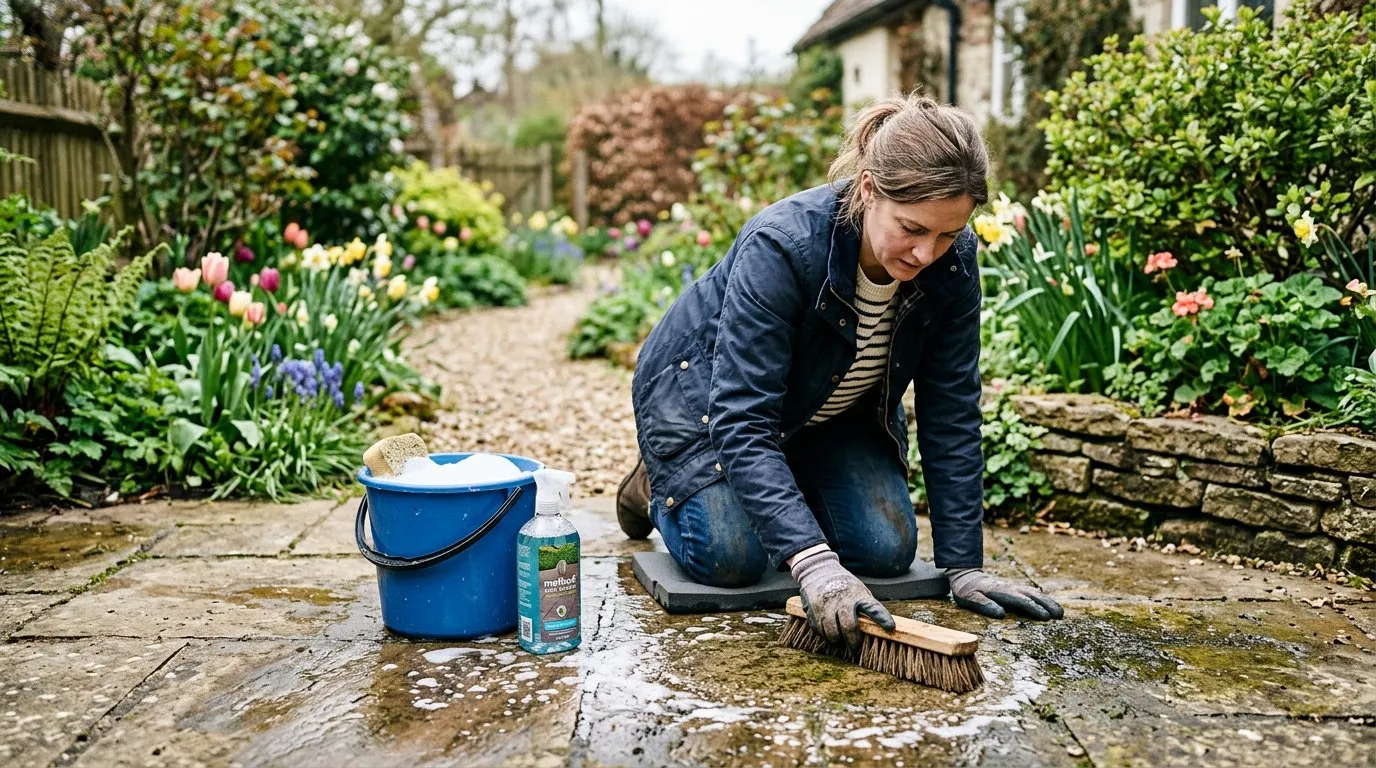
A stiff brush and a bucket are the safest way to clean sandstone. If you do use a pressure washer, keep it under 1,200 PSI.
Move the furniture and pots off. Give the whole patio a good sweep with a stiff broom to get rid of leaves, soil and loose bits. That stops mud being pushed into the joints and lets you see any stains or damage.
Step 2: Remove weeds from joints
Pull or scrape the weeds out from between the slabs before you get anything wet. A patio knife or an old screwdriver does the job. Skip this and they’ll be back within weeks, because the roots are still there. If weeds are creeping into the lawn too, our guide to lawn weed identification will help you work out what they are.
The RHS guide to weeds on hard surfaces suggests a weeding knife for joints and a dandelion weeder for deep-rooted weeds. If you can’t get the roots out, keep cutting the tops off and they’ll weaken. If you use a weedkiller, pick one made for paths and patios and follow the label.
Step 3: Pre-soak the patio
Wet the whole patio with the hose. This softens dried-on dirt so it lifts more easily. It also fills the pores in the stone, so the cleaner sits on top and works instead of soaking in and staining.
Give natural stone 10-15 minutes of soaking. Concrete and porcelain need less, but still wet them well.
Step 4: Apply cleaner
Mix your cleaner as the label says. Work in patches of about 3-4 square metres, and use a watering can or pump sprayer so it goes on evenly.
Leave it for the time on the label, usually 10-20 minutes for most cleaners. Biological cleaners are different: you leave them for a few weeks. Don’t let a cleaner dry on the slabs. On a warm day, splash a bit more water on any patch that starts to dry.
Step 5: Scrub or pressure wash
By hand: use a stiff brush (not a wire one, which scratches stone) and scrub in overlapping strokes. Start at the top of any slope so dirty water runs away from the clean bits.
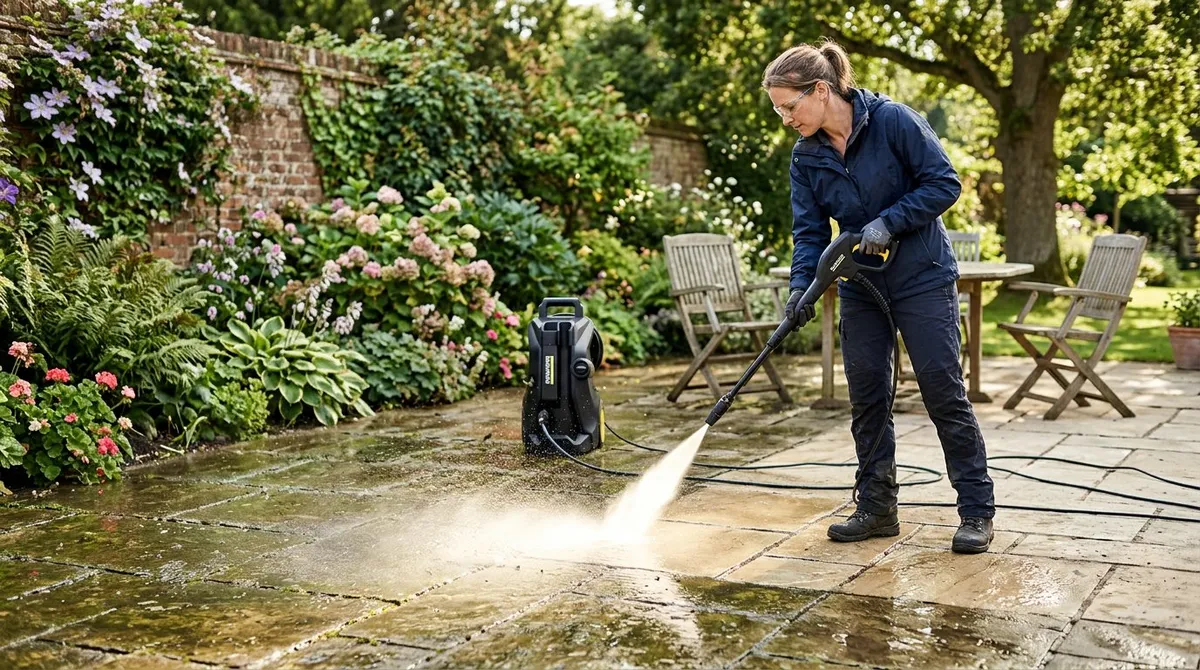
With a pressure washer: use the right nozzle and pressure for your slabs (see the table below). Keep the nozzle about 30cm away and move in steady, overlapping sweeps. Never hold the jet in one spot.
Step 6: Rinse thoroughly
Hose the whole patio down with clean water to get every bit of cleaner off. Anything left behind picks up dirt faster and can leave white marks on stone. Point the water away from borders and the lawn.
Where should rinse water go?
If you’ve used a cleaner, let the rinse water soak into gravel or bare soil away from plants and ponds, not down a drain. In many UK homes, outside drains run straight to local streams without any treatment.
Bleach and lots of patio cleaners are harmful to fish and pond life. If you’re not sure where your drain goes, assume it goes to a stream. For small areas, a bucket and brush means less runoff. Never pour leftover cleaner down any drain. Keep it for next time, or take it to your local recycling centre.
Step 7: Allow to dry completely
Natural stone takes a day or two to dry right through. Concrete takes about a day. Keep off it and leave the furniture off until it’s fully dry. This matters most if you’re sealing next, because sealant on damp stone traps the water and leaves a white haze.
Step 8: Seal (optional but worth it)
Once the patio is completely dry, put on an impregnating sealant. It soaks into the stone instead of sitting on top, so it won’t change the look or make the patio slippery. One coat is usually enough. A paint roller or pump sprayer works well.
How do you clean a patio without a pressure washer?
Scrub it with a stiff brush, warm water and a suitable cleaner, then rinse with the hose. It’s the safest way to clean sandstone, limestone and other soft stone, and it works on any patio.
Sweep, then wet the slabs. For light green and grime, a bucket of warm water with a squeeze of washing-up liquid is plenty. For heavier growth on concrete, use a patio cleaner mixed as the label says. Do a few square metres at a time with a stiff deck scrubber, then rinse. A paving brush with angled bristles gets moss out of the joints. For a no-scrub option, water on a biological cleaner and let the rain do the rest. Don’t use vinegar on natural stone. It’s an acid and can etch limestone and marble.
Cleaning methods by patio type
Each type of paving needs its own approach, and the wrong one can do lasting damage. Here’s what to use on each.
| Surface | How to clean it | Safe to use | Avoid |
|---|---|---|---|
| Natural stone (sandstone, limestone, slate) | Scrub with a pH-neutral cleaner. Rinse under 1,200 PSI | pH-neutral stone cleaner, biological cleaner | Bleach, acid, high pressure, wire brushes |
| Concrete slabs | Pressure wash at 1,500-2,000 PSI, green nozzle. Cleaner for stubborn stains | Bleach diluted 1 part to 10 water, biological cleaner | Red (0-degree) nozzle, acid on coloured concrete |
| Porcelain | Pressure wash at 1,500-2,000 PSI. Porcelain cleaner for grease or food | Porcelain cleaner, diluted sugar soap, biological cleaner | Acid, scouring pads, wire brushes |
| Block paving | Pressure wash at 1,200-1,500 PSI, green nozzle. Re-sand the joints after | Bleach diluted 1 part to 10 water, block paving cleaner, biological cleaner | Turbo or rotary nozzles (they blast the sand out), acid |
| Indian sandstone | Scrub by hand. Gentle rinse under 1,000 PSI if needed | Neutral stone cleaner, biological cleaner | Bleach, acid, pressure over 1,000 PSI, coloured sealants |
The golden rule: start gentle and only step up if you need to. You can always add more pressure or a stronger cleaner. You can’t undo damage to the stone.
Pressure washer settings by surface type
Use the lowest pressure that does the job, a fan nozzle, and keep a steady distance. These settings suit ordinary home pressure washers, electric or petrol.
| Surface | Pressure (PSI) | Nozzle | Distance | Tip |
|---|---|---|---|---|
| Concrete slabs | 1,500-2,000 | 25-degree (green) | 30cm | Steady, overlapping sweeps |
| Porcelain tiles | 1,500-2,000 | 25-degree (green) | 30-40cm | Don’t aim straight at the grout |
| Block paving | 1,200-1,500 | 25-degree (green) | 30cm | Follow the line of the blocks |
| Sandstone | 800-1,200 | 40-degree (white) | 40-50cm | Light passes, test a hidden spot first |
| Limestone | 800-1,000 | 40-degree (white) | 50cm | Rinse only, don’t scrub with the jet |
| Slate | 1,000-1,500 | 25-degree (green) | 30-40cm | Careful not to lift the layers on riven slate |
| Granite | 1,500-2,500 | 25-degree (green) | 25-30cm | Takes more pressure than other stone |
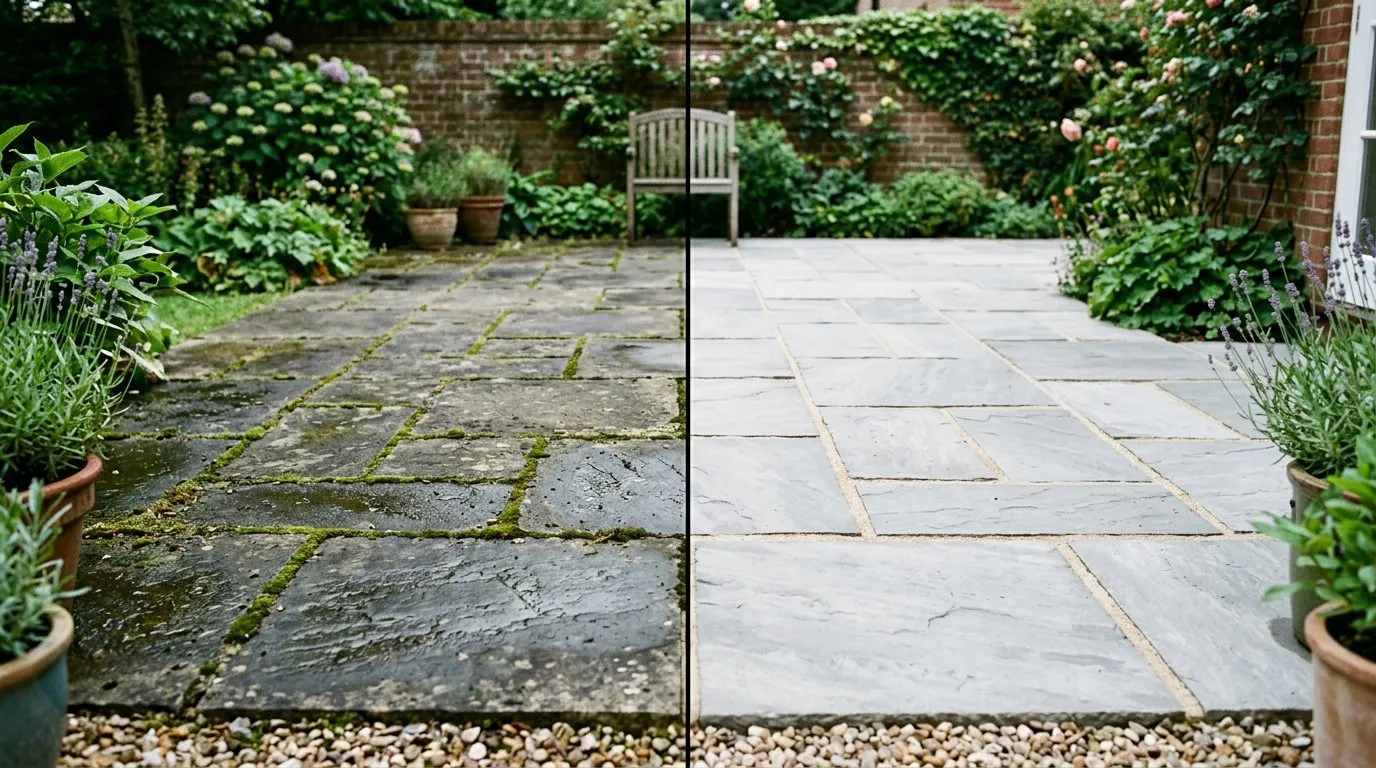
What one good clean can do. Keep on top of it and the next one is much easier.
Nozzle colours: white (40-degree) is the gentlest. Green (25-degree) is your everyday cleaning nozzle. Yellow (15-degree) is for tough stains on hard surfaces only. Never use red (0-degree) on a patio. It puts all the force into one tiny point and will gouge any surface.
Most home electric pressure washers run at roughly 1,400-2,100 PSI. If yours is stronger than your slabs need, stand further back until it looks safe on a test patch.
Products comparison: bleach-based vs biological vs specialist
Biological cleaners suit most patios. Bleach is for concrete and block paving away from plants. Specialist cleaners are for lichen and tough stains.
| Bleach | Biological | Specialist | |
|---|---|---|---|
| How fast | Within an hour | A few weeks | Hours to days |
| On algae | Very good | Good, slower but lasts longer | Very good |
| On lichen | Poor | Poor | Good (black spot removers) |
| Safe on natural stone | No, it discolours | Yes | Check the label, some are acid |
| Near plants and ponds | No, it kills plants and pond life | Gentler, but keep it off plants | Keep out of drains and ponds |
| Keeps working after | No | Yes, for weeks | Some do |
| Best for | Concrete and block paving away from plants | Any patio, especially near borders | Black spots and stubborn stains |
Biological cleaners are the best all-rounder for most UK patios. They’re kinder to stone than bleach and keep working after you’ve put them down. You just need patience: put it on and let the rain work it in over a few weeks. Still keep it off plants and out of ponds.
Bleach is cheap and quick but comes with the most rules. Never on natural stone. Keep it away from borders, lawns and ponds. Dilute it at least 1 part bleach to 10 parts water.
Specialist cleaners are worth it for particular jobs. Black spot removers are the only thing that really shifts lichen. Porcelain cleaners lift grout haze. Neutral stone cleaners look after pricey Indian sandstone.
What cleaning can and cannot fix
Cleaning gets rid of green growth, grime and light stains. It can’t fix worn stone, crumbling pointing or deep stains.
What cleaning fixes
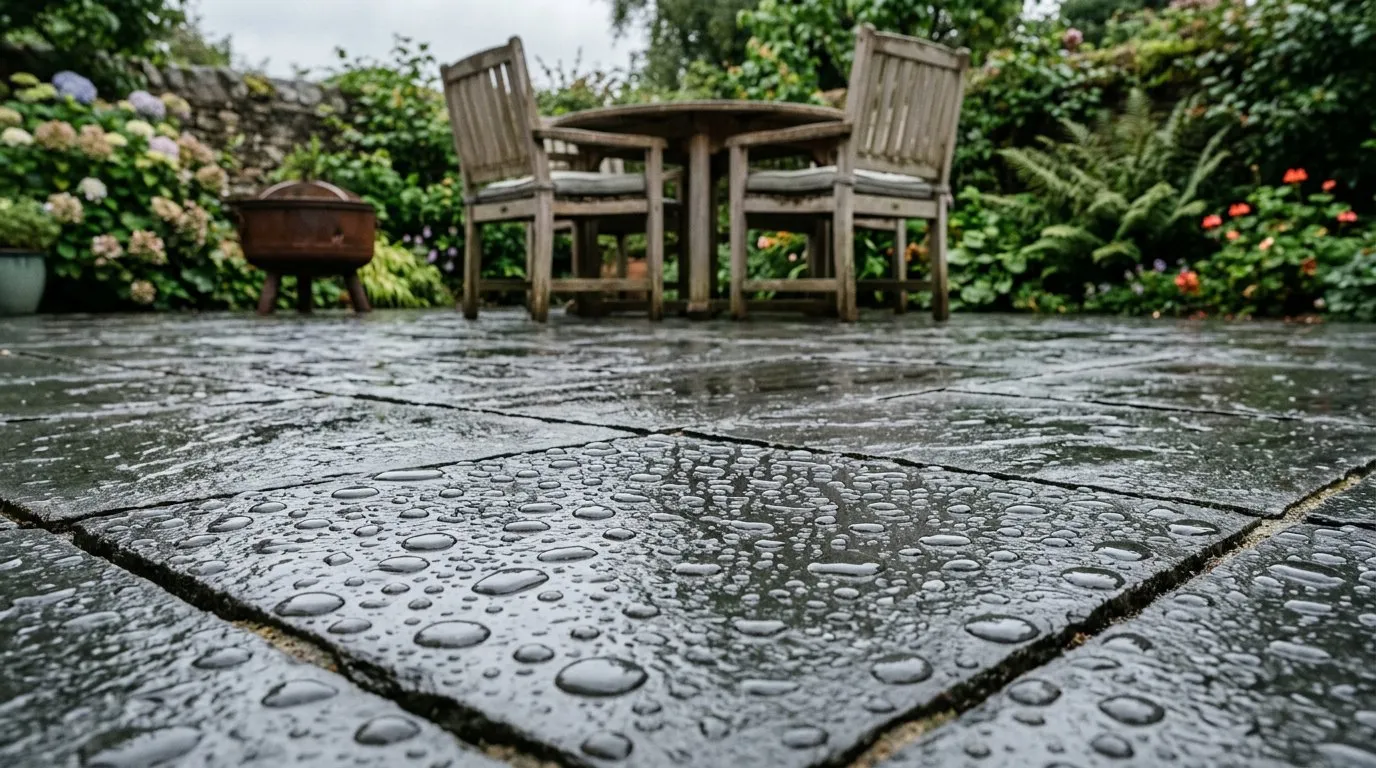
Water beading on a sealed patio. When it stops doing this, it’s time to seal again.
- Green slime and slippery slabs
- Moss in the joints and on the slabs
- Everyday grime, leaf stains and mud
- Light oil and grease marks (with a degreaser)
- Weeds between the slabs
What cleaning cannot fix
- Deep stains in soft stone. Once rust, oil or red wine has soaked into sandstone, no cleaner gets it all out. A poultice can draw some out, but rarely all.
- Worn stone. Soft stone that has been weathered by years of frost won’t look new again. Cleaning shows the stone underneath, but the surface itself has changed.
- Crumbling pointing. If the mortar between slabs has broken up, cleaning won’t help. Re-point it with mortar or jointing compound once you’ve cleaned.
- Cracked or sunken slabs. A clean patio actually makes damage easier to see. Lift and re-lay cracked slabs on fresh mortar.
- White powdery marks on new paving. These are natural salts coming out of new concrete or stone. They usually fade by themselves within a year or two. Acid washing only hides them for a while, so time is the best fix.
Five common patio cleaning mistakes
Too much pressure, the wrong angle, acid on stone, skipping the soak and sealing too soon. Here’s how to avoid each one.
1. Too much pressure on soft stone
Sandstone, limestone and Indian stone are soft enough for a home pressure washer to damage. Blast sandstone at 2,000 PSI and you strip the top layer, leaving softer stone that wears faster. Keep any natural stone under 1,200 PSI and use the white 40-degree nozzle.
2. Wrong angle with the pressure washer
Pointing the jet straight down drives water into the joints and under the slabs. That loosens the mortar and can lift slabs that weren’t laid well. Hold the lance at a shallow angle, about 30-45 degrees, so the water sweeps across the slabs towards a drain or the edge.
3. Using acid on natural stone
Brick acid shifts mortar stains and white salt marks from concrete, but it eats into limestone and sandstone. Even watered down, it can leave permanent yellow-brown stains on stone. Only use it on concrete and engineering brick, and cover any stone nearby.
4. Skipping the pre-soak
Put cleaner on dry stone and it soaks deep in instead of sitting on top where the algae is. It then seeps back out over the following weeks, leaving white marks. A good soak with plain water first keeps the cleaner where you want it.
5. Cleaning and sealing on the same day
Sealant on damp stone traps the water inside. As it tries to escape over the next few weeks, you get a cloudy white haze. The only fix is to strip the sealant off and start again. Wait for 48 hours of dry weather after cleaning before you seal.
How to seal a patio after cleaning
Use an impregnating sealant once the patio has had at least two full dry days. Sealing slows down the green and helps stop stains.
Types of patio sealant
Impregnating sealants soak into the stone. They don’t change the look, don’t make it shiny and don’t make it slippery. This is the right choice for most UK patios.
Topical sealants sit on top as a film. They give a richer “wet look” colour and a tougher surface, but they can be slippery when wet, need redoing more often, and can peel if water gets underneath.
How to apply sealant
- Make sure the patio is bone dry. Wait for at least two full dry days.
- Sweep it clean of dust and leaves.
- Put the sealant on with a roller, brush or pump sprayer, working in patches of 2-3 square metres.
- Go for an even coat. Two thin coats are better than one thick one.
- Leave it 4-6 hours before walking on it, and a day or two before putting furniture back.
- Seal again when water stops beading on the surface, or when the maker says.
How far a tin goes depends on how thirsty your stone is, so check the label and buy a bit extra for sandstone.
How often should you clean your patio?
Once a year in spring for most patios, and twice a year for shady ones or those under trees.
| Your patio | How often | Notes |
|---|---|---|
| Sunny, open, sealed | Once a year (spring) | Barely goes green. A brush and rinse may be enough |
| Sunny, open, not sealed | Once a year (spring) | Put on a biological cleaner in autumn to keep it at bay |
| North-facing or shady | Twice a year (spring and autumn) | Algae grows all year in shade |
| Under trees | At least twice a year | Leaves stain soft stone. Sweep weekly in autumn |
| Busy paths and doorways | Full clean once a year, plus spot cleans | Deal with spills and mud straight away |
| Block paving drive | Once a year, then re-sand the joints | A weed membrane helps if you’re laying new paving |
Between big cleans, a regular sweep does more than anything else. It clears the leaves and bits that algae feeds on. The RHS also suggests cutting back overhanging plants so sun and wind can dry the patio out.
Looking after your patio goes hand in hand with the rest of the garden. A garden path that drains well stops puddles spreading onto your patio. Garden lighting near the patio helps you spot moss early, and lets you enjoy the space for longer in the evening.
Removing specific stains
Oil, rust, paint and bird droppings each need their own treatment.
Oil and grease
Blot fresh spills straight away with kitchen roll or cat litter. Don’t rub, as that spreads it. Squeeze neat washing-up liquid on the stain, scrub with a brush, and rinse. For old oil on concrete, use a degreaser, or mix baking soda and water into a paste. Spread it about 1cm thick, cover with cling film, leave for a day, then scrape off and rinse.
Rust
Rust marks come from metal furniture legs, some fertiliser granules, or iron in the stone itself. On concrete, use a rust remover. On natural stone, use one that says it’s safe for stone. Never use brick acid on stone. Plastic feet on metal furniture stop the marks happening in the first place.
Paint
Scrape off as much as you can with a plastic scraper (metal ones scratch stone). Put on a paint stripper made for masonry, leave it for the time on the label, then scrub and rinse. You’ll probably need a few goes. Fresh paint is much easier to get off, so act fast if you spill.
Bird droppings
Bird droppings are acidic and will mark natural stone if you leave them. Scrape off what you can, then scrub with soapy water. For a stain on pale stone, dab on 3% hydrogen peroxide from the chemist and rinse it off after 10 minutes.
Now your patio’s clean, read our guide to patio garden ideas for small spaces to make the most of it.
If you’re replacing worn slabs, find out why frost-proof porcelain garden tiles survive a UK winter when cheap ceramic ones flake.
Frequently asked questions
How often should I clean my patio?
Once a year in spring is enough for most patios. If yours is north-facing or under trees, give it a second clean in early autumn. Little and often is easier than tackling a thick green layer.
Will a pressure washer damage my patio?
It can if your patio is soft stone. Sandstone and limestone etch easily at high pressure or close range. Concrete and porcelain are fine up to 2,000 PSI. Always try a hidden corner first and keep the nozzle at least 30cm away.
What is the best patio cleaner for natural stone?
A pH-neutral stone cleaner is the safest choice. Look for one labelled for natural stone, which lifts algae without marking the surface. Steer clear of bleach and anything acid-based, including brick acid.
Can I use bleach to clean my patio?
Yes on concrete and block paving, but never on natural stone. Diluted bleach kills algae and moss well, but it discolours stone. Keep it well away from the lawn, borders and plants, because it kills them too.
How do I stop algae growing back on my patio?
Seal it, let the light in and keep it swept. A sealant stops the slabs soaking up so much water. Trim back overhanging branches for more sun and air. Sweep up leaves, as they hold damp and feed the algae.
Is it worth sealing a patio after cleaning?
Usually, yes, especially for sandstone and limestone. An impregnating sealant slows the green coming back and helps stop oil, food and drink stains. Check the label for how far a tin goes, and redo it when water stops beading on the surface.
When is the best time of year to clean a patio?
Late spring, around April or May, is best. The winter green is easy to see, it’s mild enough for cleaners to work, and the slabs dry quickly. Early September is a good time for a second clean before winter.
How do I remove black spots from my patio?
Black spots are usually lichen, which normal cleaners won’t shift. Use a specialist black spot remover, leave it for the time on the label, then scrub and rinse. Old lichen often needs a few goes.
Our team produces practical UK gardening guidance from source research, contributor records and established horticultural practice. Editorial standards are overseen by Matt W.