Key takeaways
- One 1.2m tower holds 15-25 plants in a 40cm footprint, replacing 3-4 metres of row
- A central perforated watering core is essential: without it the top dries while the base stays wet
- Space planting holes 20cm apart and offset around the pipe so roots do not compete
- Mix 2 parts John Innes No 2 to 1 part multipurpose plus 30g slow-release feed per tower
- Perpetual types 'Albion', 'Flamenco' and 'Mara des Bois' crop June to October, 3-5kg per tower
- Feed weekly with high-potash tomato feed at 10ml per litre once flowers open
Building a vertical strawberry tower is the smartest way to grow a heavy strawberry crop where floor space is tight. A single tower turns a 40cm patch of balcony, patio or doorstep into a column of 15 to 25 plants, cropping from early summer into autumn. The trick that makes or breaks it is a central watering core, and most shop-bought towers skip it.
This guide covers five build options, from stacked pots to a wooden pallet, then walks through the best design in detail: a drainpipe tower with a perforated core down the middle. You will learn the compost mix, spacing, variety choice, feeding, netting and winter care, plus realistic yields and a full cost breakdown. Everything here was built and cropped on an exposed Staffordshire patio over two summers.
Why strawberry towers fail and how the core fixes it
The number-one reason home-built towers fail is uneven watering. Water obeys gravity. Pour it on top and it sheets straight down the centre to the base before it ever soaks sideways into the upper pockets. Within a week the top three or four plants are crisp and dying while the bottom sits waterlogged. People blame the plants. The real fault is the design.
The fix is a central perforated watering core. This is a thinner pipe running down the middle of the tower, drilled with small holes along its length and wrapped in mesh. You water into the core, not the compost surface. Water seeps out sideways at every level, so the top pocket drinks at the same time as the base. A buried column of holed plastic bottles does the same job if you have no spare pipe.
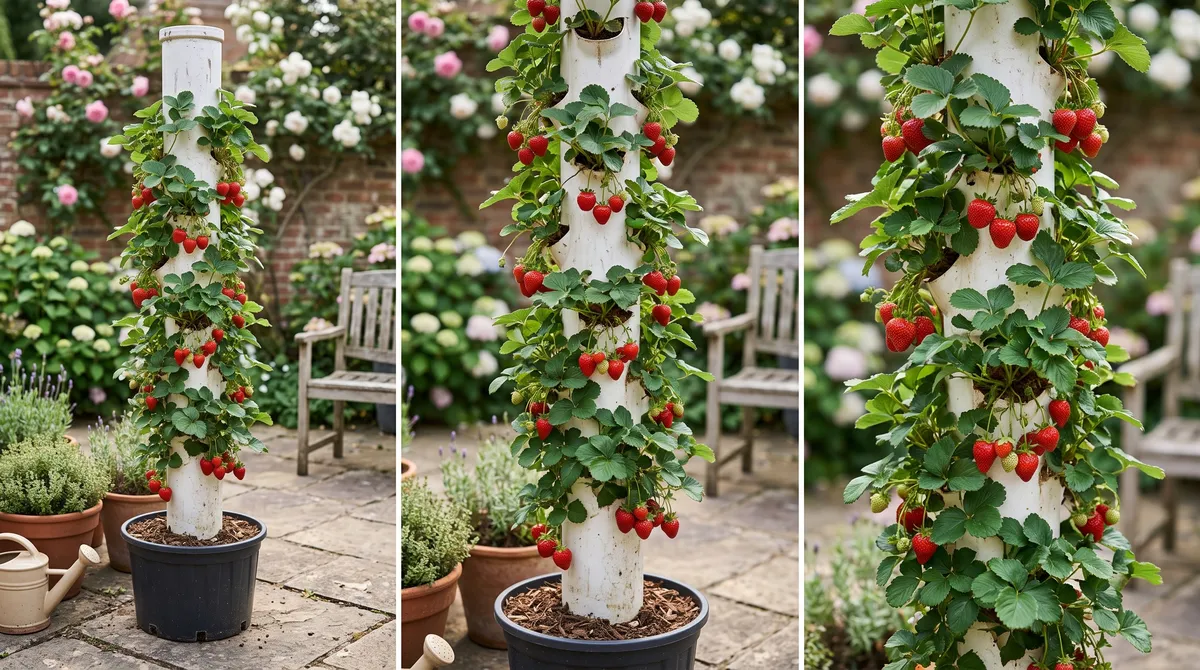
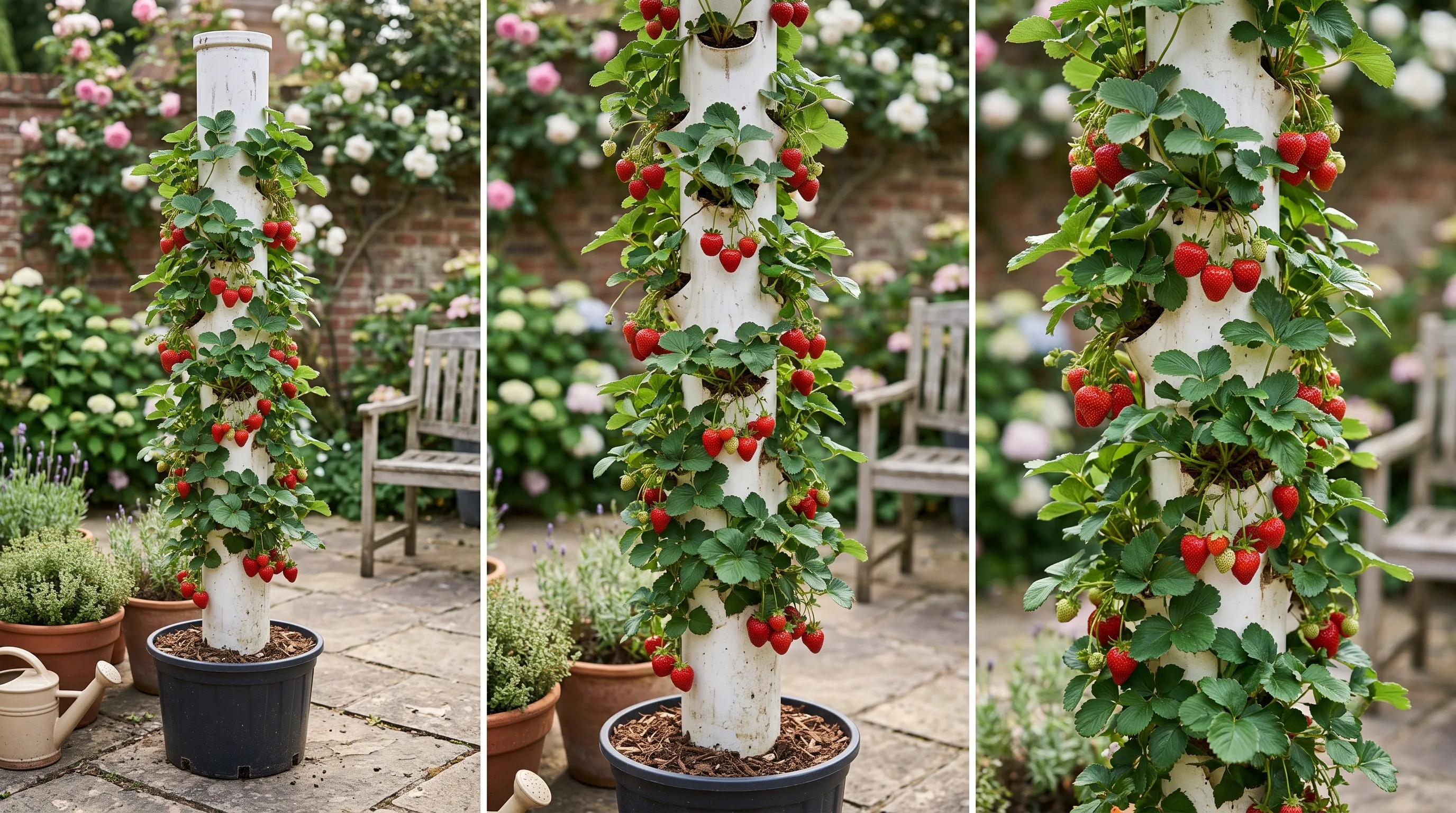 A well-built tower crops from June into October. The secret is even watering, delivered through a hidden central core, not poured over the top.
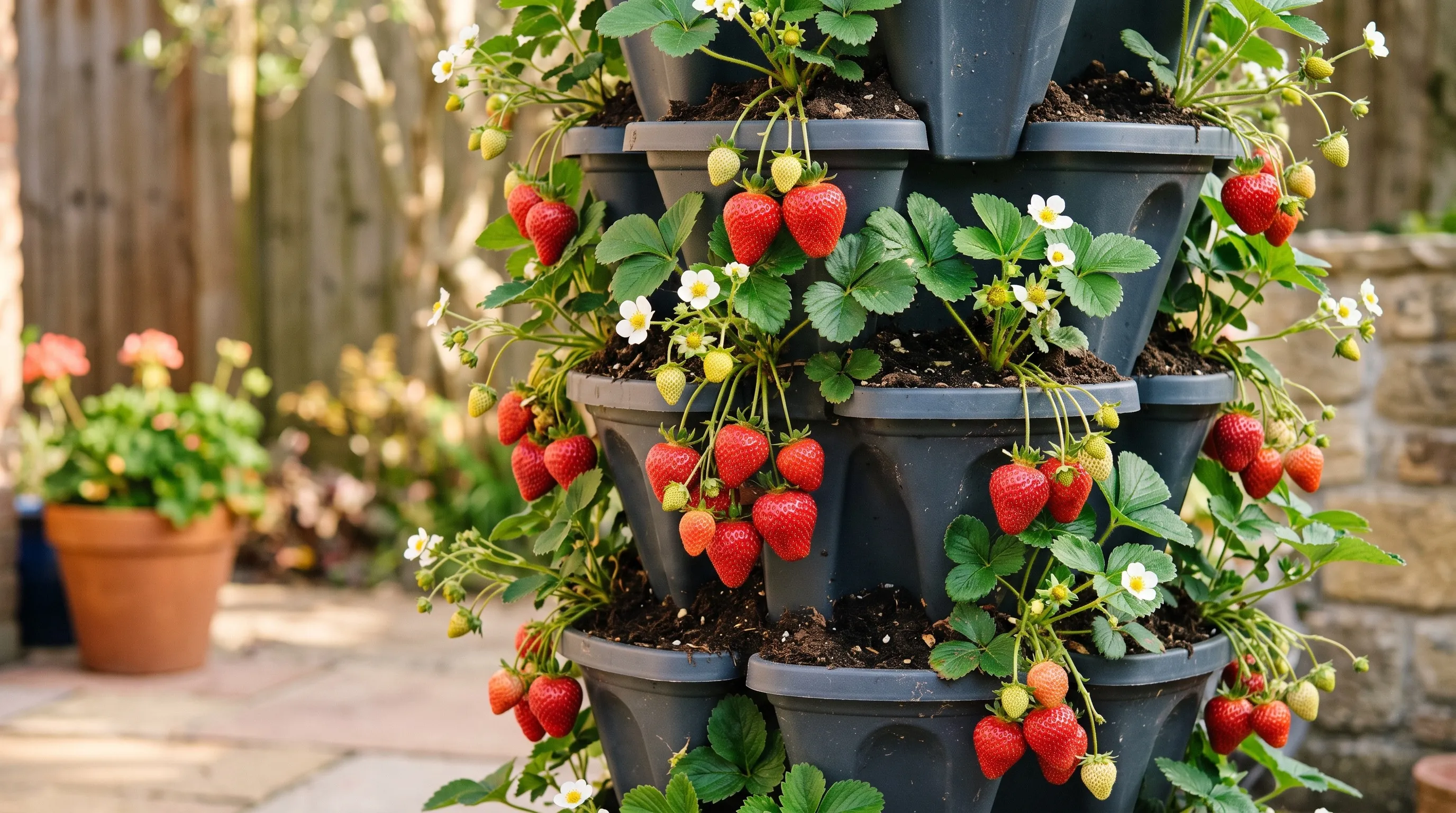 Perpetual varieties fruit and flower at once, so a cored tower carries ripe berries and fresh blossom on the same day from June onward.
Five ways to build a strawberry tower
There is no single right build. Your choice depends on budget, tools and looks. Here are the five practical options for a UK small space, ranked by how well they hold moisture and how many plants they carry.
Stacked planter pots are the easiest. Graduated pots sit inside each other, each tier planted around its exposed rim. No tools needed, but they dry fast and hold only 8 to 12 plants. A purpose-made tower pot is the tidy shop option, often with a built-in central reservoir, but costs £25 to £50 for one that works.
For weight, capacity and even moisture, the drainpipe tower wins. The rest of this guide builds that design step by step.
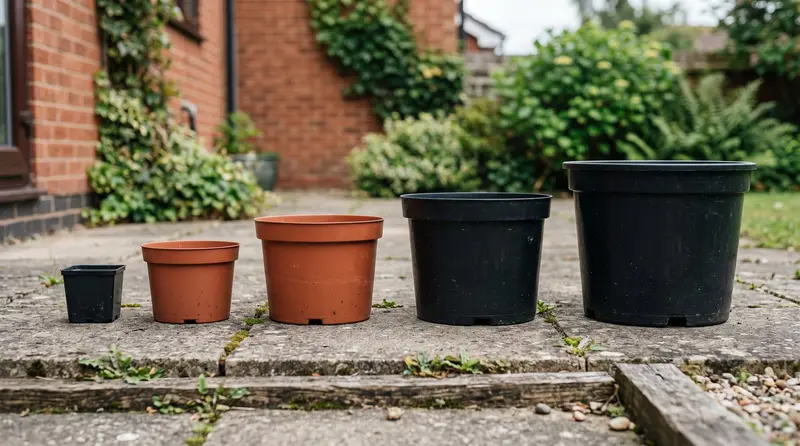
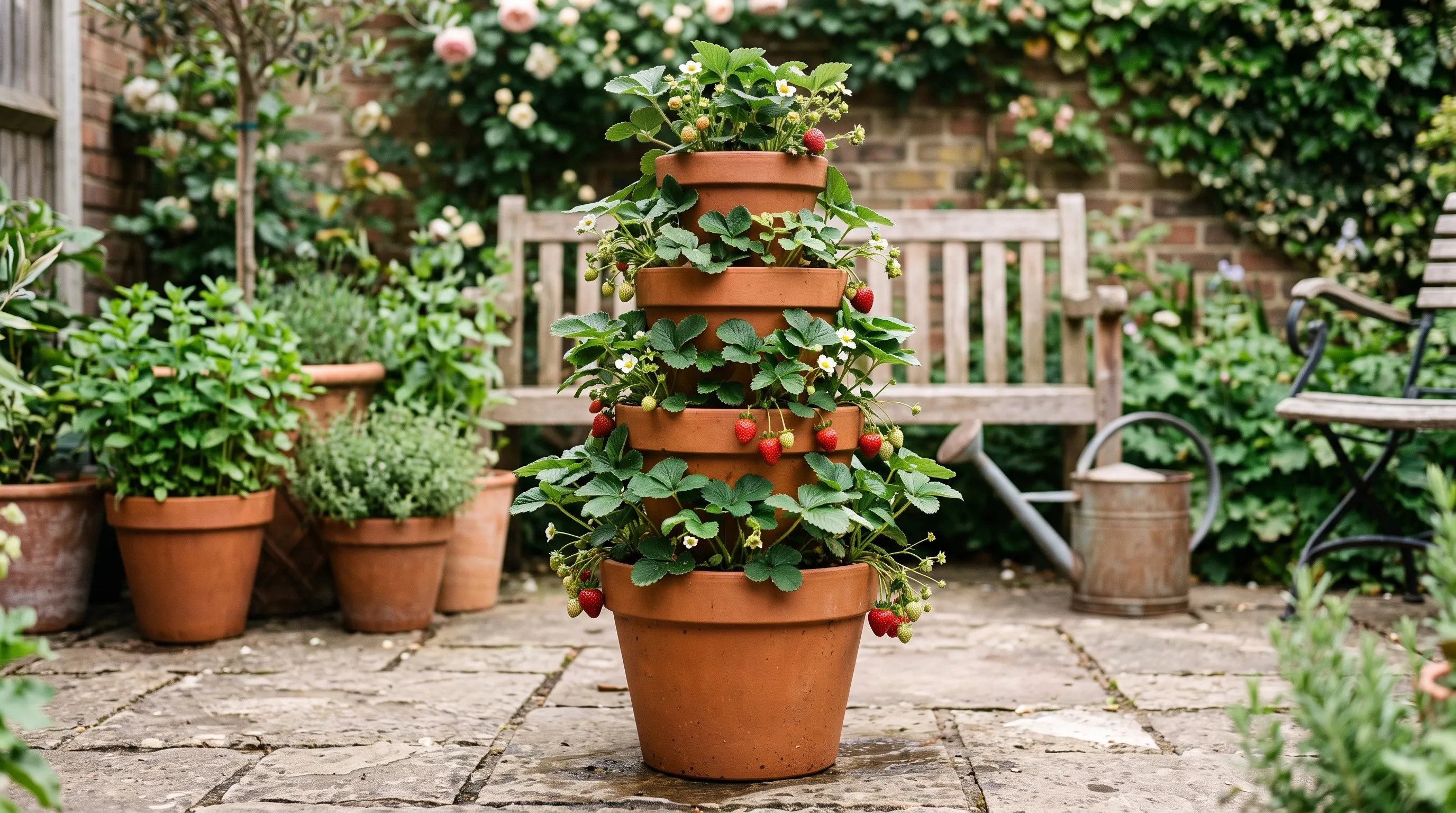 Stacked graduated pots are the no-tools option. They look neat but dry fast and hold fewer plants than a drainpipe tower.
Build option comparison
Each build handles water, capacity and lifespan differently. This table ranks them by how forgiving they are day to day, with the drainpipe tower as the gold standard for a UK patio.
| Build | Plants | Approx cost | Moisture holding | Lifespan | Best for |
|---|---|---|---|---|---|
| Drainpipe tower with core | 15-25 | £35-55 | Excellent with core | 8-10 years | Patios, best all-round |
| Purpose-made tower pot | 12-20 | £25-50 | Good, often has reservoir | 5-8 years | Tidy, low-effort setups |
| Stacked planter pots | 8-12 | £20-40 | Poor, dries fast | 5-8 years | Beginners, no tools |
| Wooden pallet planter | 15-20 | £10-25 | Moderate | 3-4 years | Rustic look, cheap |
| Stacked rain gutters | 10-18 | £20-35 | Poor, very fast drying | 6-8 years | Narrow balconies, fences |
The drainpipe build costs a little more in effort but rewards you with the most plants and the least daily worry. The pallet is cheapest but shortest-lived. Gutters suit the tightest balcony where nothing else fits.
Cutting the pipe and drilling the planting holes
Start with a 150mm diameter plastic drainpipe, cut to about 1.2m long. This diameter gives roots enough compost. Anything narrower dries out too fast and starves the plants. A hacksaw or pipe cutter trims it to length.
Mark the planting holes in a spiral, 20cm apart vertically and offset around the circumference so no two holes sit directly above each other. Offsetting stops the roots of one plant crowding the plant below. Leave the bottom 25cm hole-free so the pipe sits deep and stable in its base pot. A 1.2m pipe takes roughly 18 to 20 holes.
Cut each hole with a 40-50mm hole saw in a cordless drill. That size lets a strawberry plug push through while holding the crown snug. Clean the plastic burrs off with a knife so they do not damage stems. Wear gloves, the cut edges are sharp.
Gardener’s tip: Drill the holes with the pipe laid flat and clamped, never freehand and upright. The hole saw grabs hard on curved plastic. A block of scrap wood inside the pipe behind each hole stops the saw snatching and gives a cleaner cut.
 Cut 40-50mm holes with a hole saw, spaced 20cm apart and offset in a spiral so plant roots do not compete.
Making and fitting the perforated watering core
The core is the single most important part. Take a 32-40mm pipe the same 1.2m length as the drainpipe. Drill 4-5mm holes every 5cm along the lower two thirds. Leave the top third solid so water does not just gush out near the surface and never reach the base.
Wrap the drilled section in fine mesh, weed membrane or an old pair of tights. This stops compost washing into the holes and blocking them. Without the wrap, fine peat clogs the core within a fortnight and you are back to square one. Tie the mesh with garden twine every 20cm.
An alternative core costs nothing. Cut the bottoms off three or four 2-litre plastic bottles, pierce their sides with a bradawl, and stack them open-neck-down into a column down the centre. Fill through the top bottle. It is fiddlier than a pipe but works on the same principle: deliver water at depth, at every level, so it spreads sideways evenly.
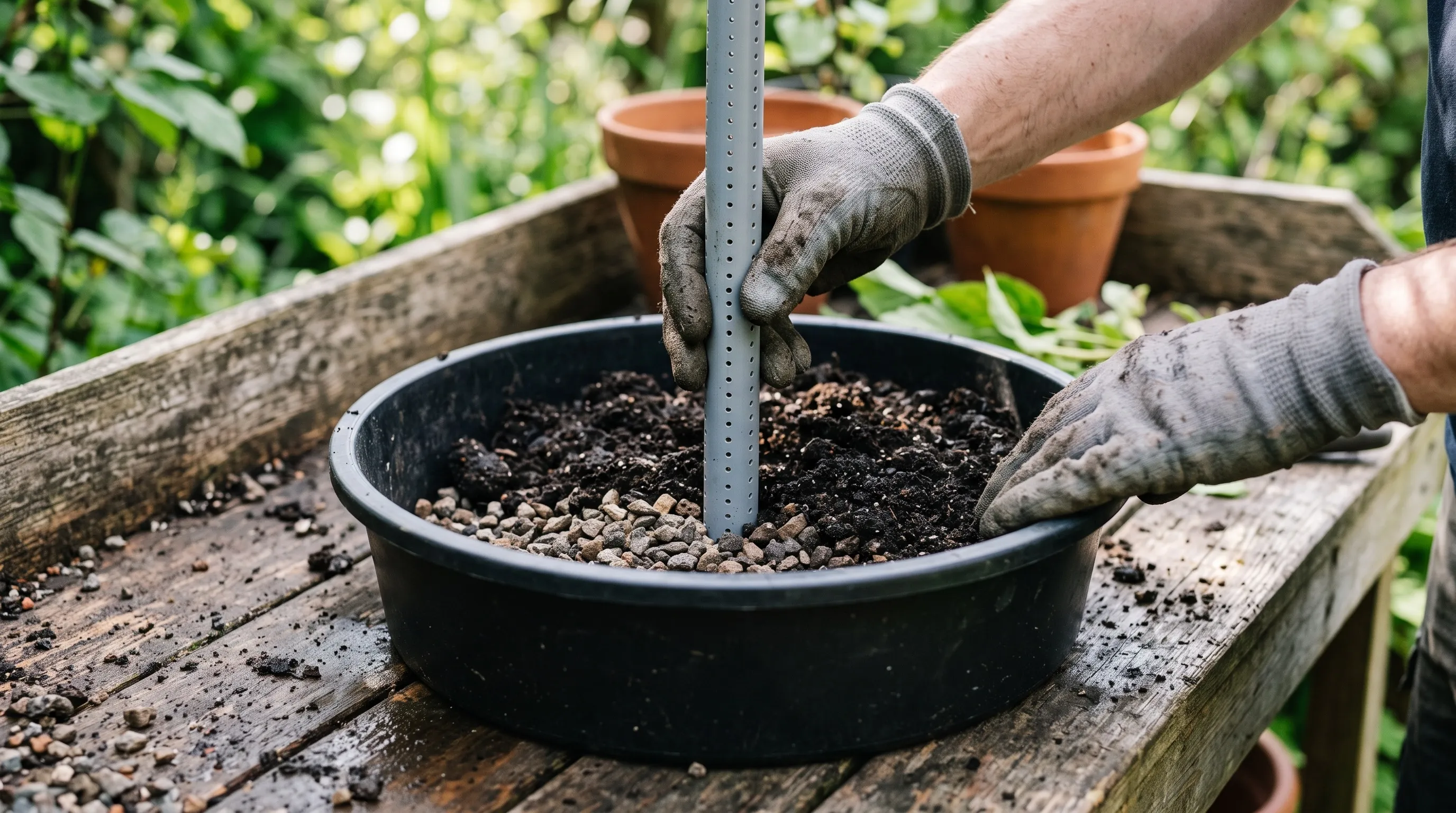 The perforated core runs down the centre, wrapped in mesh. Water goes in here, not on the compost surface, so every level drinks evenly.
Setting up the base, core and compost mix
Stand the drainpipe in a wide, heavy base, a large pot or a bucket weighted with a paving slab. A tower carries 30 to 40kg of wet compost and catches the wind, so stability matters. Add 5cm of gravel in the base for drainage and ballast. Centre the watering core inside the drainpipe before you start filling.
The compost mix decides how well the tower holds water and feed. Use two parts John Innes No 2 to one part multipurpose compost. The loam-based John Innes holds nutrients, weight and moisture far better than peat-free multipurpose alone, which shrinks and dries to dust in a tall column. The multipurpose keeps the mix open and lighter. Add 30g of slow-release fertiliser per tower.
Fill around the core in layers, firming gently as you go, keeping the core upright and central. Bring the compost level up to each planting hole before you plant it. Do not overfill or ram it hard: strawberry roots need air as well as water. Firm just enough that the mix does not slump when watered.
Warning: Never fill a tower with garden soil or pure peat-free multipurpose. Garden soil sets like concrete in a container and drains badly. Straight multipurpose collapses and shrinks from the sides within weeks, leaving gaps where water escapes and roots dry out.
Planting the pockets and choosing varieties
Push a strawberry plug through each hole from the outside, spreading the roots inward into the compost. Firm the mix around the roots and keep the crown level with the hole, never buried. A buried crown rots, an exposed crown dries. Plant the top opening last with two or three crowns. Water in through the core once every pocket is filled.
Variety choice sets your whole season. Perpetual, or everbearer, types crop in flushes from June to October and suit a tower best because they spread the harvest. Grow ‘Albion’ for firm, sweet, disease-resistant fruit, ‘Flamenco’ for heavy autumn crops, and ‘Mara des Bois’ for intense wild-strawberry flavour. Add one June-bearer, ‘Cambridge Favourite’, for a heavy early glut of reliable fruit.
Match the vigour to the space. Avoid varieties that throw masses of runners, which choke the pockets and steal energy from fruit. A tower of mostly perpetuals with a couple of June-bearers gives fruit from midsummer right through to the first frosts. For the full growing detail behind these choices, see our guide to growing strawberries in the UK.
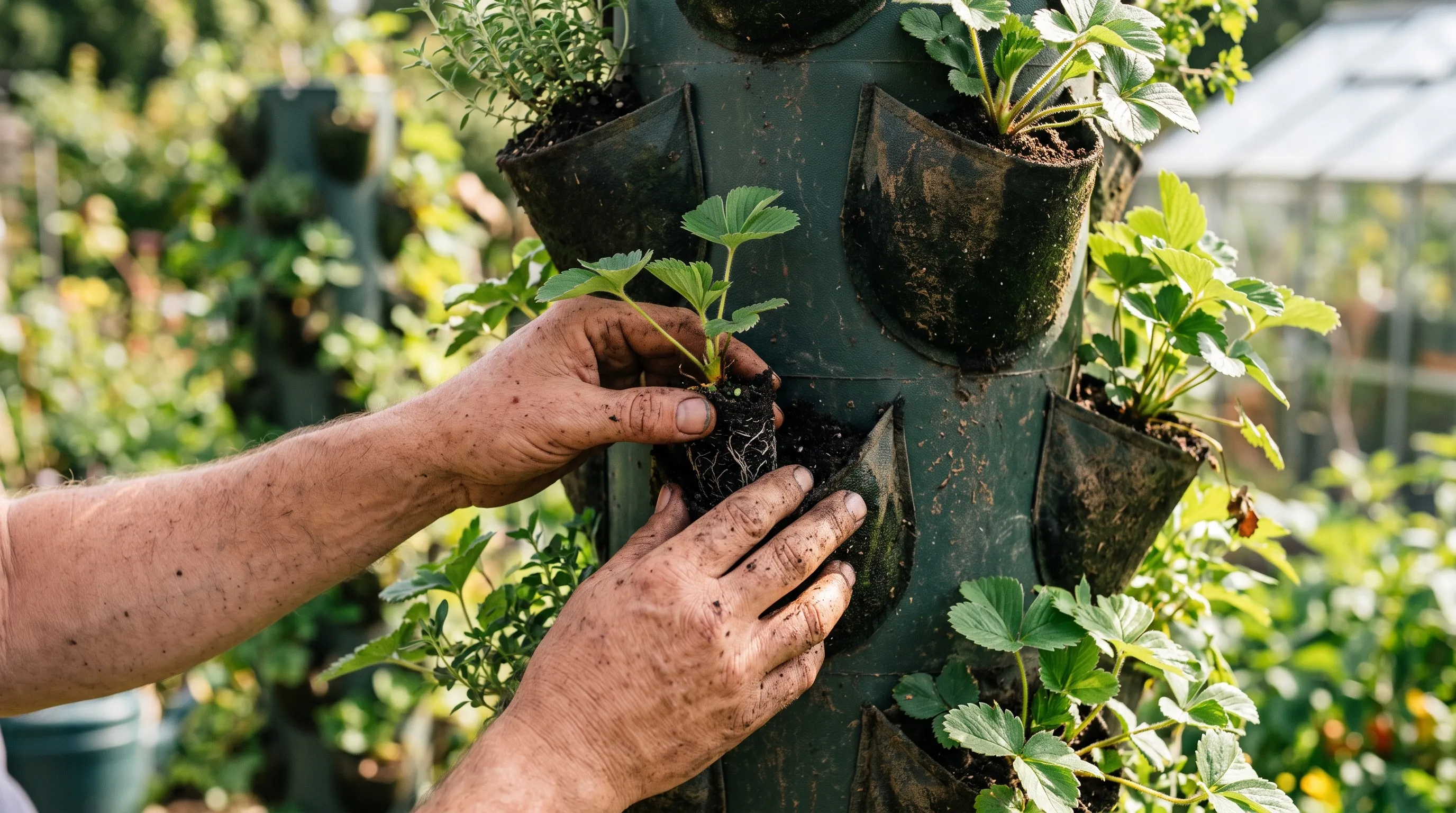 Push each plug through from outside and keep the crown level with the hole. Buried crowns rot, exposed crowns dry out.
Watering, feeding and managing runners
Water only through the central core from planting onward. In summer, fill it once every morning, twice on hot days. A planted tower on an exposed patio loses 4 to 6 litres a day in July. Vertical planters dry far faster than a bed because wind hits every side. Check the top pockets by finger: if they are dry, the base still has more to give.
Feeding matters because container compost runs out of nutrients fast. The slow-release granules cover the first six weeks. Once the first flowers open, feed weekly with a high-potash tomato feed at 10ml per litre, poured into the core. Potassium drives flower and fruit production. Stop feeding in September so plants harden off before winter. Our guide to growing fruit in pots and containers covers the same feeding logic across other crops.
Manage runners every week. Runners are the long stems that grow baby plants at their tips. In a tower they dangle and clog the pockets, and they drain energy from fruiting. Snip them off flush unless you want two or three to pot up as free replacement plants for next year. Our strawberry runner propagation guide shows how to turn those spares into a full bed of free plants.
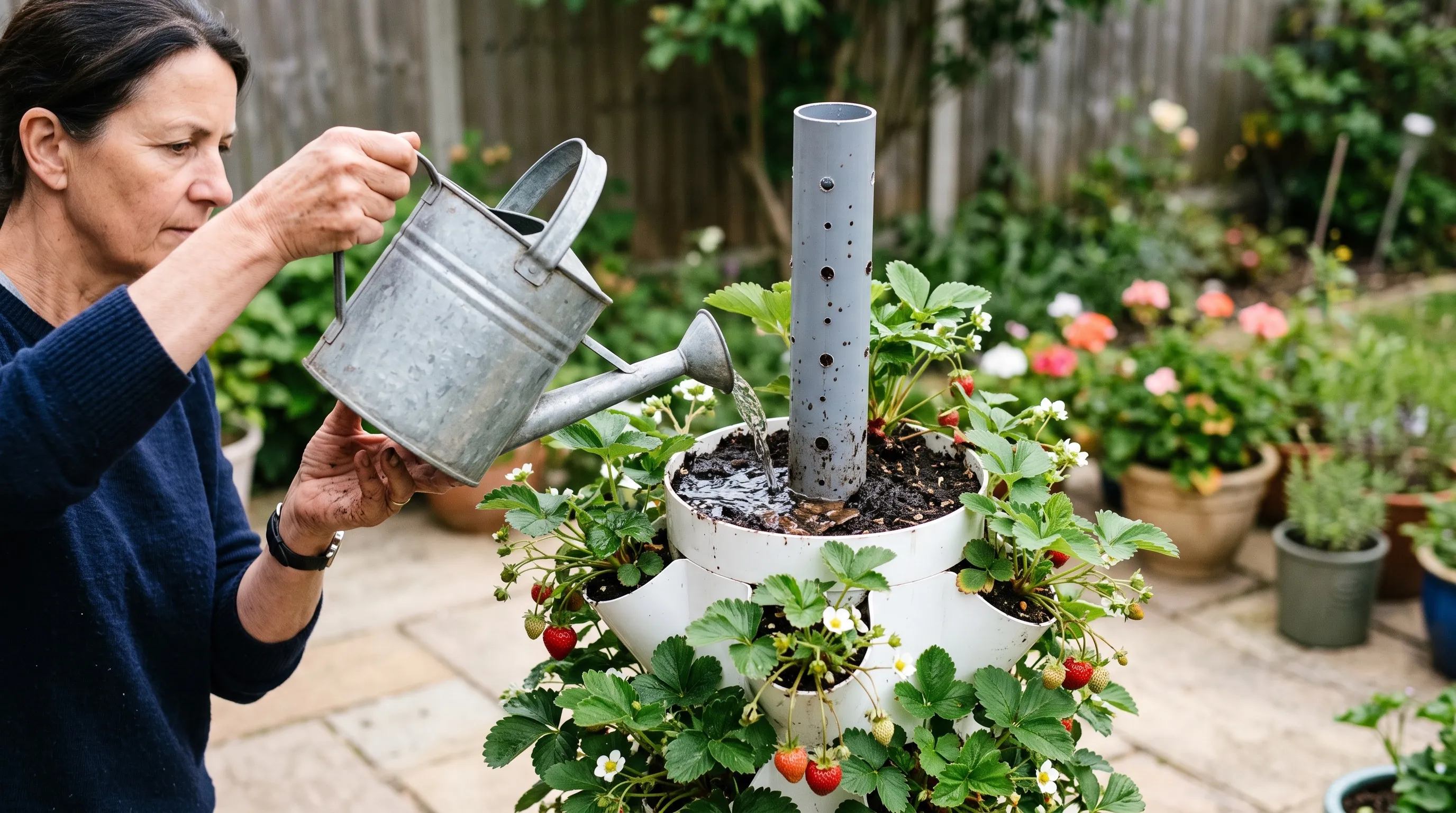 Fill the core, never the surface. The water spreads sideways at every level, so the top and base drink at the same rate.
Netting against birds and protecting the crop
Birds find ripe strawberries within hours. Blackbirds and pigeons will strip a tower faster than you can pick it. As the first fruit starts to colour, drape fine garden netting over the whole tower, secured loosely at the base so nothing gets trapped underneath. Netting with a mesh of 15 to 20mm stops birds while letting pollinators reach the flowers.
A tower is easy to net because it is a single narrow column. A ring of three canes pushed into the base pot, taller than the tower, holds the net clear of the fruit. Keep the net off the berries themselves, as fruit touching the mesh gets pecked through it. Check daily and free any trapped bird at once.
Beyond birds, watch for grey mould (botrytis) in damp spells, which rots fruit touching wet compost. The vertical design helps here, because most fruit hangs in free air rather than resting on soil. Pick ripe berries every day or two and remove any mouldy ones fast before the rot spreads along a truss.
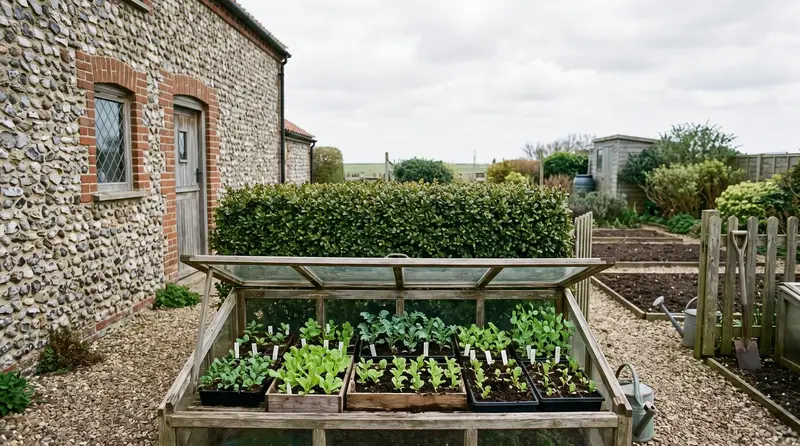
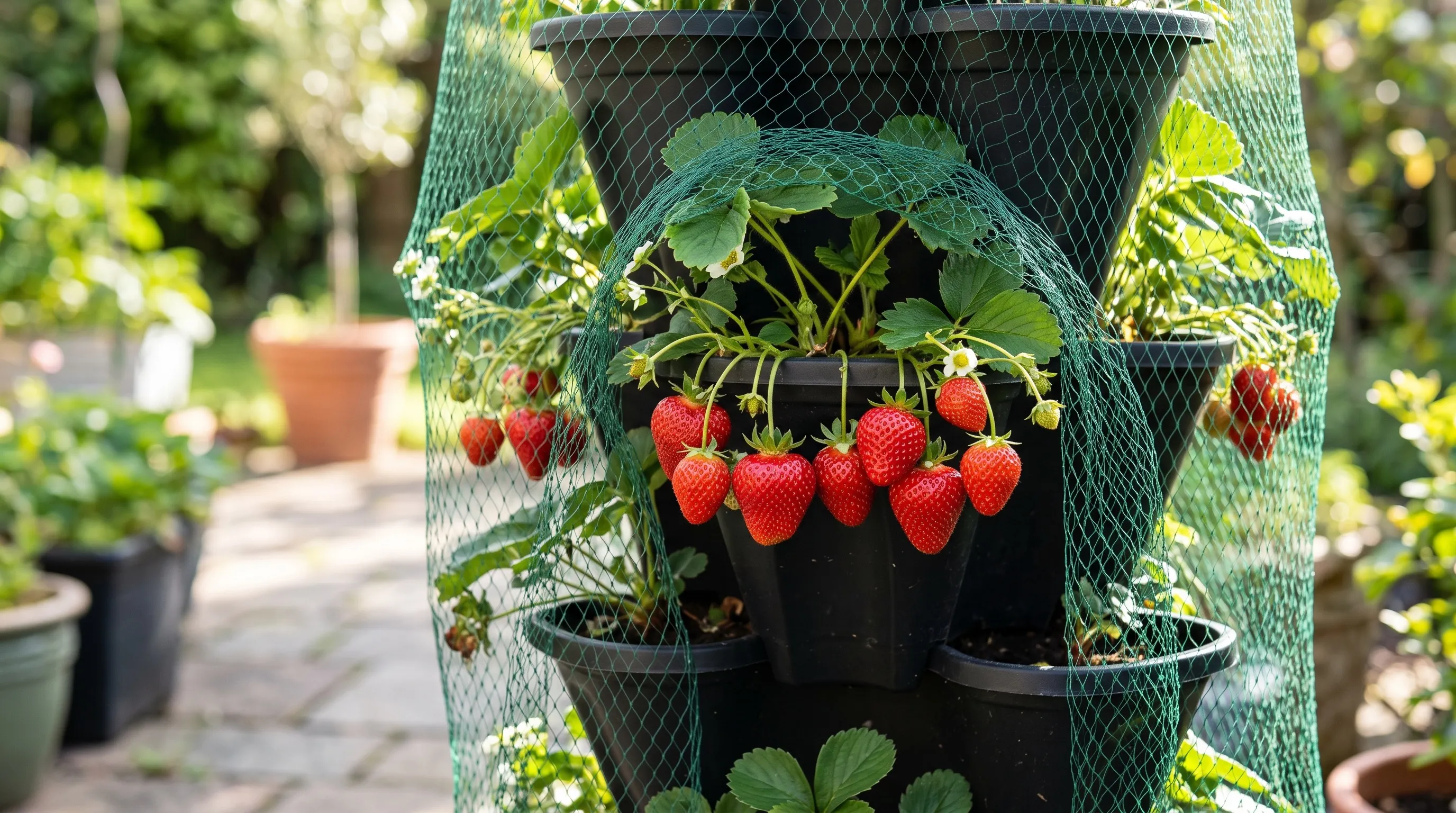 Fine netting held clear on canes keeps birds off without trapping them. Keep the mesh off the berries so they are not pecked through it.
Realistic yields and winter care
Winter care protects the crown and roots. Strawberries are hardy, but roots raised in a column freeze faster than roots in the ground. Move the tower to a sheltered spot against a wall, out of the wind. Wrap the pipe in fleece or bubble wrap once hard frost threatens, usually from late November. Exposed container roots can be killed below minus 8C.
Month-by-month strawberry tower calendar
This calendar assumes a tower planted in spring in a typical UK climate. Shift by a week or two later for Scotland and the north, earlier for the mild south-west.
| Month | Task |
|---|---|
| March | Build the tower. Fit the core. Mix compost with slow-release feed. Plant if plugs are available. |
| April | Plant plugs if not done. Water through the core. Watch for late frost and fleece if needed. |
| May | Growth speeds up. First flowers on June-bearers. Start weekly tomato feed as flowers open. |
| June | Peak of early crop. Fill the core daily. Net against birds. Pick every two to three days. |
| July | Heavy cropping. Water twice daily in heat, 4-6 litres a day. Feed weekly. Snip runners. |
| August | Perpetual varieties in full flush. Keep feeding and picking. Remove any mouldy fruit fast. |
| September | Final flush. Stop feeding late month so plants harden. Pot up a few runners for spares. |
| October | Last berries from perpetuals. Cut off spent leaves. Clear pockets of debris and slugs. |
| November | Move tower to a sheltered spot. Wrap with fleece before hard frost. Keep compost just moist. |
| December | Dormant. Leave wrapped and sheltered. Check compost is not bone dry or waterlogged. |
| January | Rest. No feed, minimal water. Plan variety top-ups and order bare-root plants if replacing. |
| February | Late dormancy. Refresh top compost. Add fresh slow-release feed before spring growth starts. |
Build materials and cost breakdown
Costs assume you buy new. Scrounged pipe and a spare bucket cut this by half. The table below is a realistic UK budget for a drainpipe tower in 2026.
| Item | Cost | Notes |
|---|---|---|
| 150mm drainpipe, 1.2m | £12-18 | The tower body, from a builders’ merchant |
| 32-40mm pipe for core | £4-6 | Or free from offcuts or plastic bottles |
| Heavy base pot or bucket | £6-12 | Must be wide and stable |
| John Innes No 2 compost | £6-9 | Two thirds of the mix |
| Multipurpose compost | £4-6 | One third of the mix |
| Slow-release fertiliser | £3-5 | 30g per tower, tub lasts years |
| Strawberry plugs x20 | £12-20 | Perpetual and June-bearer mix |
| Fine netting | £4-8 | Reusable for years |
| Total | £35-55 | Under £3 per plant, cropping for years |
Common mistakes to avoid
Most tower failures come from a few repeat errors. Fix these and your tower crops for years.
Skipping the central watering core
This is the big one. Without a core, water sheets to the base and the top dries out. What happens: the top plants die within a fortnight while the base rots. Why it happens: people water the surface and assume it soaks in evenly. The fix: always fit a perforated core and water into it, never over the top.
Using the wrong compost
Filling with garden soil or straight multipurpose ruins a tower. What happens: garden soil sets solid and drains badly, multipurpose shrinks and pulls from the sides. Why it happens: it seems cheaper and easier. The fix: use two parts John Innes No 2 to one part multipurpose, so the mix holds both water and structure in a tall column.
Planting too many crowns
Overcrowding starves every plant. What happens: 40 plants in a tower built for 20 gives tiny, sparse fruit. Why it happens: it feels like more plants means more berries. The fix: stick to 20cm spacing, roughly 18 to 20 plants in a 1.2m pipe, so each has enough compost and feed.
Forgetting to net
Leaving fruit unprotected feeds the birds, not you. What happens: blackbirds strip ripening fruit in a single morning. Why it happens: people net too late, after the first berries colour. The fix: drape fine netting the moment the first fruit starts to turn, held clear on canes.
Neglecting winter protection
Exposed roots freeze in a column. What happens: unwrapped towers lose plants in a hard frost below minus 8C. Why it happens: strawberries are assumed fully hardy, which they are in the ground but not raised in a pipe. The fix: move the tower to shelter and wrap it in fleece from late November.
Frequently asked questions
How many strawberry plants fit in a vertical tower?
A 1.2m tower holds 15 to 25 plants. Space holes 20cm apart and offset them around the pipe. A 150mm drainpipe takes roughly 18 to 20 plants comfortably. Cram them tighter and the fruit shrinks as roots compete for compost and feed.
Why does the top of my strawberry tower dry out?
Water runs to the base by gravity before it soaks sideways. Without a central watering core, the top pockets stay parched while the bottom sits wet. Fit a perforated pipe or a buried bottle column down the middle so water is delivered at every level evenly.
What compost is best for a strawberry tower?
Mix two parts John Innes No 2 to one part multipurpose. The loam-based John Innes holds nutrients and weight, the multipurpose holds moisture. Add 30g of slow-release fertiliser per tower. Pure multipurpose dries to dust and shrinks away from the sides.
Which strawberry varieties are best for a tower?
Perpetual types like ‘Albion’, ‘Flamenco’ and ‘Mara des Bois’ crop longest. They fruit from June to October in flushes, spreading the harvest. Add one June-bearer like ‘Cambridge Favourite’ for a heavy early glut. Avoid vigorous runners that clog the pockets.
How often should I water a strawberry tower?
Fill the central core daily in summer, twice on hot days. A planted tower on an exposed patio can lose 4 to 6 litres a day in July. Check the top pockets by finger. Vertical planters dry far faster than a bed because wind hits every side.
Do I need to feed strawberries in a tower?
Yes, container strawberries exhaust their compost fast. Feed weekly with high-potash tomato feed at 10ml per litre once the first flowers open. Slow-release granules at planting cover the early weeks. Stop feeding in September so plants harden before winter.
How do I protect a strawberry tower over winter?
Move it to a sheltered spot against a wall and wrap the pipe with fleece or bubble wrap. Roots in a raised column freeze faster than in the ground. Strawberries are hardy but exposed container roots can be killed below minus 8C. Keep compost just moist.
Now you can build a tower that crops evenly from top to bottom, take your small-space growing further with our guide to the best vegetables for container growing, or browse more projects in our how-to guides.
Our team produces practical UK gardening guidance from source research, contributor records and established horticultural practice. Editorial standards are overseen by Matt W.