
Key takeaways
- Prune straight after flowering in June, never in winter
- Give lilac full sun and soil that drains well
- Chalky and neutral soils suit it best
- 'Palibin' is the lilac to choose for pots and small gardens
- Established lilacs don't need feeding, which only gives you leaves
- Pull off rootstock suckers as soon as you see them
Lilac is one of the loveliest flowering shrubs you can grow in the UK. Every May and June it’s covered in big, scented flower heads, and one bush can perfume a whole front garden. Common lilac, Syringa vulgaris, has been in British gardens for centuries. It’s fully hardy, copes with wind and actually likes the chalky soils that many shrubs dislike.
Here’s how to pick a variety, plant it, prune it at the right time and keep it flowering. There’s a lilac for a big border and one for a pot on the patio.
What types of lilac grow well in the UK?
Three kinds of lilac do well all over the UK. Pick by the space you have.
Common lilac (Syringa vulgaris) is the classic. It grows into a big, many-stemmed shrub 3-5m tall and 2-3m wide. The cone-shaped flower heads come in purple, lilac, white, pink and bicolours. It’s very hardy and happy on chalk, limestone and clay. The RHS lilac growing guide is handy if you want to browse more varieties.
Japanese tree lilac (Syringa reticulata) is a proper small tree. It has big creamy-white plumes in late June and July, a few weeks after common lilac. It’s one for a larger garden.
Syringa meyeri ‘Palibin’ is the compact one. It forms a neat, rounded bush, usually around 1.5m, with lavender-pink flowers. It’s the best lilac for pots and small gardens.

Four lilac colours: deep purple, pale lavender, pure white (‘Madame Lemoine’) and soft pink (‘Beauty of Moscow’).
Best lilac varieties for UK gardens
Buying a named variety means you know the colour you’re getting, and it should flower within two or three years. These are lovely, reliable choices.
‘Sensation’ has purple flowers with a crisp white edge to every petal. It’s a real eye-catcher. It grows 3-4m and flowers in mid-May.
‘Madame Lemoine’ is the classic double white, bred in France in 1890. Cream buds open to heavy heads of pure white, and the scent is strong. It looks wonderful against red brick or a dark hedge.
‘Charles Joly’ has the darkest flowers: rich wine-purple doubles that hold their colour well. It smells sweet and copes with heavy clay.
‘Beauty of Moscow’ has pink buds that open pale pink and fade to almost white. You get all three shades on one flower head at once. It’s strongly scented and great for cutting.
‘Palibin’ is your pick for a pot or a tiny garden. It has good scent for its size and is happy in a 45cm pot for years.
Lilac variety comparison table
| Variety | Colour | Height | Scent | Flowers | Good for |
|---|---|---|---|---|---|
| ’Sensation’ | Purple with white edge | 3-4m | Medium | Mid-May | A standout feature |
| ’Madame Lemoine’ | Double white | 3-4m | Strong | Late May | Against red brick |
| ’Charles Joly’ | Double dark purple | 3-4m | Strong | Mid-May | Heavy clay |
| ’Beauty of Moscow’ | Pink fading to white | 3-4m | Strong | Late May | Cut flowers |
| ’Katherine Havemeyer’ | Double lavender-pink | 3-4m | Very strong | Mid-May | The most scent |
| ’Palibin’ | Lavender-pink | About 1.5m | Medium | May | Pots, small gardens |
Handy tip: Named lilacs are often grafted onto a different rootstock. Pull off any shoots coming up from below the graft. If you leave them, they can take over the plant.
Where to plant lilac
Lilac wants two things: full sun and soil that drains well.
Sun: Choose a spot with at least five or six hours of direct sun a day. South, west and open east-facing spots all work. Lilac flowers poorly in shade, so if your garden is shady, look at some plants that enjoy shade instead.
Soil: Neutral to chalky soil suits lilac best. Loam, chalk and reasonably drained clay are all fine. On very acid soil, dig in some garden lime before planting, following the pack.
Drainage: Lilac hates sitting in water. On heavy clay that stays soggy in winter, plant on a low mound or mix coarse grit into the planting area.
Spacing: Leave 2.5-3m between common lilacs, and keep a single bush about 3m from the house. ‘Palibin’ can go 1.5m apart for a low hedge.

‘Madame Lemoine’ against a cottage wall. White lilac really shines in front of red brick.
How to plant lilac
October and November are the best months to plant. The soil is still warm, and winter rain does the watering for you. March and April work too, but you’ll need to water every week through the first summer.
- Dig a hole twice as wide as the rootball and just as deep.
- Loosen the soil at the bottom with a fork.
- Set the plant so the top of the rootball is level with the ground. Don’t bury the stem.
- Backfill with the soil you dug out. On acid ground, mix in a handful of garden lime.
- Firm gently with your foot and give it a good soak, about a bucketful.
- Spread 5-8cm of garden compost around it, keeping it a hand’s width from the stem.
- Stake tall bare-root plants for the first two winters so the wind doesn’t rock them.
Skip the fertiliser. Lilacs aren’t hungry plants, and extra feed just gives you leaves instead of flowers. A handful of bone meal in the hole is plenty if you want to add something.

Keep the top of the rootball level with the ground and skip the fertiliser. Autumn planting lets winter rain do the watering for you.
How to prune lilac
Get the timing right and your lilac will flower every year. Lilac makes next year’s flower buds over the summer, on the new shoots. Those buds wait through winter and open in May.
When to prune: Straight after flowering, within a couple of weeks of the last flowers fading. That’s usually June. For more on technique, see our guide to pruning shrubs.
What to cut:
- Spent flower heads, back to the first pair of strong side shoots below.
- One in five of the oldest, thickest stems, right down to the ground. This keeps fresh growth coming from the base.
- Anything dead, damaged or rubbing.
- Suckers from below the graft. Their leaves look different from the rest of the plant.
What to avoid:
- Pruning in autumn, winter or early spring. You’ll cut off the flower buds.
- Clipping it with hedge trimmers. It spoils the shape and removes most of the flowering wood.
- Cutting every stem to the ground, unless you’re renovating an old plant (see below).

Snip off faded lilac flowers in June, just above the first pair of strong new shoots.
Renovating a neglected lilac
An old, overgrown lilac can be brought back over two winters. In the first winter, cut half the main stems down to about 60cm. The next winter, do the other half. You’ll miss a couple of years of flowers, but you’ll get a tidier plant that flowers well again. Sprinkle Growmore around it each March while it recovers, following the pack.
Month-by-month lilac care
| Month | What to do |
|---|---|
| January | Nothing. Lilac is dormant and very hardy. |
| February | Check stakes on young plants. Firm any lifted by frost. |
| March | Mulch with 5cm of garden compost. No feed needed. |
| April | New leaves appear. Water young plants in dry spells. |
| May | Flowering time. Cut a few stems for the house in the morning. |
| June | Prune straight after flowering. Deadhead and remove one in five old stems. |
| July | New shoots grow that will flower next year. Water only in long dry spells. |
| August | Flower buds start forming. Don’t prune. |
| September | Buds are set. You can start planting pot-grown lilacs. |
| October | Best month to plant. |
| November | Clear fallen leaves from the base. Still time to plant. |
| December | Nothing much. Pull off any suckers you spot. |
Growing lilac in containers
‘Palibin’ is happy in a pot for years. Common lilac varieties get too big to live in one long term.
Pot: At least 45cm wide and 40cm deep, with drainage holes. Terracotta or stone keeps roots cooler than plastic.
Compost: John Innes No. 3, with a few handfuls of perlite or grit mixed in. It holds water better than multipurpose compost, which dries out fast.
Watering: Water when the top few centimetres feel dry. In summer that might be every two or three days. In winter, just occasionally. Lilac copes with a bit of dryness better than soggy compost.
Feeding: A tomato feed every two weeks from April to June, then stop. Avoid high-nitrogen feeds.
Repotting: Move it up a size every three or four years in autumn. In between, scrape off the top layer and add fresh compost.
Common lilac problems
Lilac not flowering
Winter pruning is the usual cause. Too much shade, lawn feed washing into the border and a young plant are the others. Seed-grown lilacs can take years to flower, while grafted named ones usually flower within two or three. If a grafted lilac suddenly stops flowering, check whether rootstock suckers have taken over.
Lilac blight (Pseudomonas syringae)
Brown, soggy-looking patches appear on young shoots and leaves in spring, often after wet weather. The shoots then blacken and die back. Cut out affected shoots well below the damage and bin the prunings. Wipe your secateurs with disinfectant between cuts, and thin the plant so air can move through. There’s no spray for it, so good hygiene is the answer.
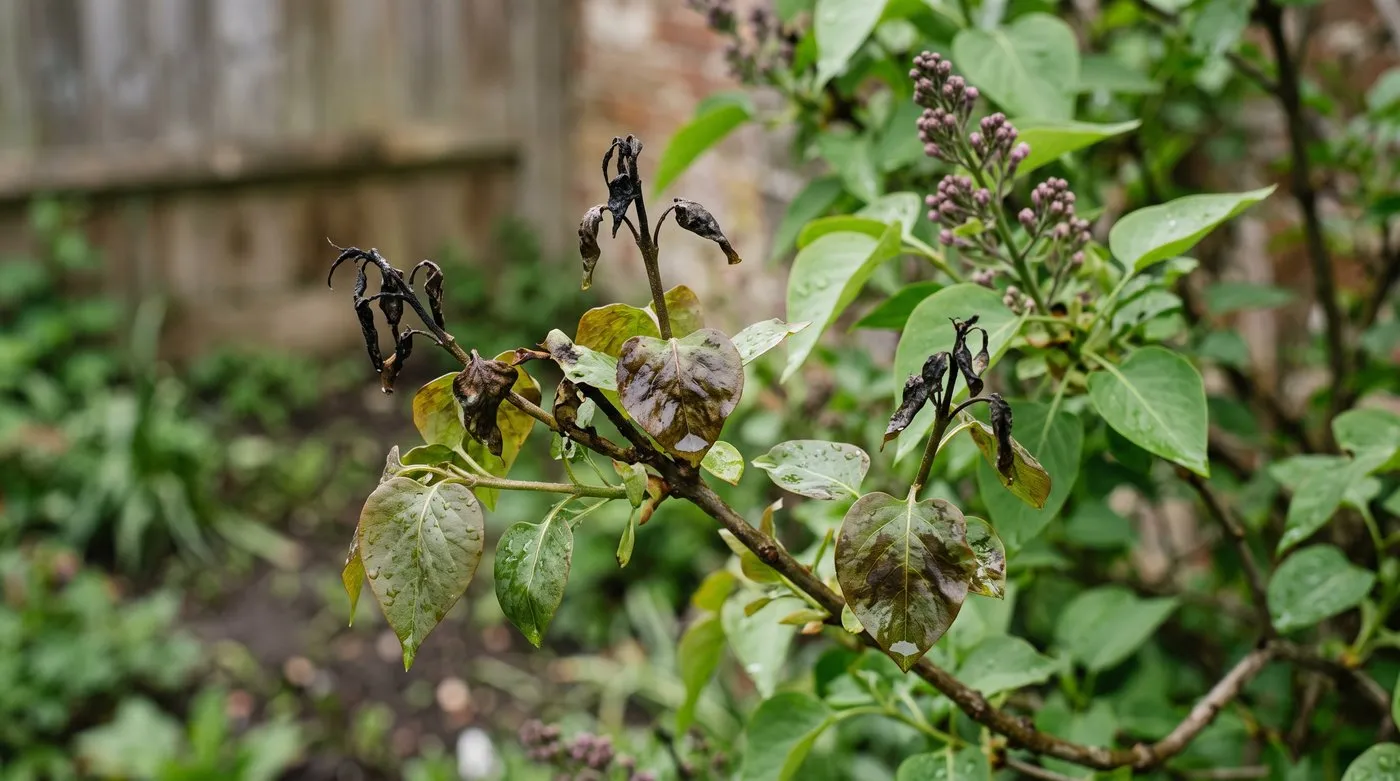
Cut blighted shoots out well below the damage and bin them. Wipe your secateurs between cuts so you don’t spread it.
Powdery mildew
A white, dusty coating on the leaves in late summer, usually in dry weather. It looks untidy but rarely does real harm, and it turns up after the flowers are over. Thin crowded branches, water at the base and pick off the worst leaves.
Lack of fragrance
Some varieties simply smell less than others, and a seedling may be weakly scented. For strong scent, choose ‘Katherine Havemeyer’, ‘Madame Lemoine’ or ‘Charles Joly’. Scent is always strongest on warm, still evenings.
Suckers from rootstock
Grafted lilacs often send up suckers from the rootstock. Their leaves are usually smaller, pointier and darker than the rest of the plant. Trace each one back to the root and pull it off sharply. Cutting at ground level tends to bring more back.
Propagating lilac
You can propagate lilac in three ways. The easiest is digging up a rooted sucker in autumn. This only works on a lilac on its own roots, not a grafted one. Slice it off with a sharp spade, pot it in John Innes No. 3 and grow it on for a year before planting out.
Softwood cuttings from non-flowering shoots in June will root with gentle bottom heat and a humid cover. Dip them in rooting hormone and push them into a half-and-half mix of perlite and peat-free compost.
Seed is possible after a spell in the fridge, but seedlings vary and take years to flower. Named varieties don’t come true from seed.
Lilac as a wildlife plant
Lilac flowers are full of nectar, and bees and butterflies love them in May and June. Long-tongued bumblebees are especially keen. A lilac in full bloom is as popular with pollinators as buddleja or lavender. Its twiggy branches also give birds cover for nesting. It’s one of the nicest scented plants you can grow for people and bees alike.
Give lilac sun and decent drainage and it asks for very little back. No feeding, not much watering once it’s settled, and one prune each June. Plant one this autumn and you’ll see why it’s a favourite in the spring garden.
Frequently asked questions
Why is my lilac not flowering?
Pruning in winter is the usual reason. Lilac flowers on last year’s stems, so a winter trim cuts off every bud. Too much shade, too much fertiliser and a young plant are the other common causes. A grafted named variety usually flowers within two or three years of planting.
When should I prune lilac?
Prune straight after the flowers fade, usually in June. That gives new shoots all summer to grow and set buds for next May. Don’t prune in autumn, winter or early spring. The one exception is a hard renovation of an old, overgrown plant, which costs you a couple of years of flowers.
Can I grow lilac in a pot?
Yes, choose the compact Syringa meyeri ‘Palibin’. Use a pot at least 45cm wide filled with John Innes No. 3. Water often in summer but let the top dry a little between drinks. Give a high-potash feed every two weeks from April to June, and repot every three or four years.
How fast does lilac grow in the UK?
Common lilac grows at a steady, moderate pace. It usually reaches 3-5m after 10-15 years. ‘Palibin’ grows more slowly and stays much smaller. Sun and good soil both help it along.
Is lilac poisonous to cats and dogs?
Common lilac is listed as non-toxic to cats and dogs by the ASPCA. That makes it a good choice for a garden with pets. As with any plant, check with your vet if a pet eats a lot of it.
How do I propagate lilac?
Digging up a rooted sucker in autumn is the easiest way. Slice it away from the parent with a sharp spade, pot it up in John Innes No. 3 and grow it on for a year. This only works on a lilac growing on its own roots, not a grafted one. Softwood cuttings in June also work with bottom heat.
What is the most fragrant lilac variety?
‘Katherine Havemeyer’ is one of the most strongly scented. Its double lavender-pink flowers smell rich and sweet. ‘Madame Lemoine’ (double white) and ‘Charles Joly’ (double dark purple) are lovely too. Common lilac varieties smell stronger than the compact ‘Palibin’.
Our team produces practical UK gardening guidance from source research, contributor records and established horticultural practice. Editorial standards are overseen by Matt W.


