
Key takeaways
- Prune straight after flowering, never in summer, autumn or winter, or you'll lose next year's flowers
- 'Lynwood' is a reliable, big-flowered variety for most gardens
- Plant in sun or light shade in almost any soil that drains well
- A forsythia hedge needs one trim a year, straight after flowering
- Cut stems in mid-winter and bring them indoors for early flowers in a vase
- Hardwood cuttings taken in autumn root easily outdoors
Forsythia is the first shrub to really light up UK gardens each spring. Its bare stems are covered in bright golden-yellow flowers from late winter in mild areas to April further north. It’s also one of the toughest, most forgiving shrubs you can grow. It copes with clay, chalk, sand, windy spots and town gardens, and needs little more than one prune a year.
Here you’ll find the best varieties, how to plant and prune, how to grow a forsythia hedge, how to bring branches indoors for early flowers, and how to grow new plants from cuttings.
What is forsythia and why does it grow so well in the UK?
Forsythia comes mostly from eastern Asia and is named after William Forsyth, a Scottish gardener. There are a few species, but most garden forsythias are Forsythia x intermedia, plus the arching Forsythia suspensa.
It does brilliantly here because it’s fully hardy and loves our cold winters. It flowers on last year’s stems before the leaves come out, so you get that bright burst of yellow on bare branches.
The RHS forsythia growing guide is a handy extra read.

A big forsythia in full flower. The show lasts a few weeks.
Which forsythia varieties grow best in the UK?
Forsythia x intermedia ‘Lynwood’ is a top choice for most gardens. It’s upright, with big, rich gold flowers, and suits borders and hedges alike.
Forsythia x intermedia ‘Spectabilis’ is the old cottage garden favourite. It’s a bit wider than ‘Lynwood’, with slightly smaller, paler flowers, and it’s very reliable.
Forsythia x intermedia ‘Weekend’ is more compact. It’s ideal for smaller gardens and lower hedges, with deep yellow flowers packed along the stems.
Forsythia suspensa (weeping forsythia) has long, arching stems that tumble over walls and fences. It’s great trained against a north or east-facing wall. The flowers are a little paler and a week or two later.
Forsythia x intermedia ‘Minigold’ is the baby of the family. It’s neat and dense, and suits the front of a border, a big pot or a very small garden.
Forsythia variety comparison
| Variety | Size | Flowers | Shape | Best for |
|---|---|---|---|---|
| ’Lynwood’ | Large | Big, rich gold | Upright | Borders, hedges |
| ’Spectabilis’ | Large, wide | Golden | Spreading | Cottage gardens, wide borders |
| ’Weekend’ | Medium | Deep yellow | Compact | Small gardens, low hedges |
| F. suspensa | Large | Pale yellow | Weeping | Walls, fences, banks |
| ’Minigold’ | Small | Yellow | Compact | Pots, front of border |
Where and how to plant forsythia
Forsythia isn’t fussy, which is part of its charm.
Light. Full sun gives the most flowers. Light shade is fine, though you’ll get fewer flowers. Forsythia suspensa copes best with shade and is happy on a north-facing wall.
When. October and November are ideal. The soil is still warm, rain does the watering and the roots settle in before winter. Spring planting works too, but water weekly through the first summer.
How to plant:
- Dig a hole twice as wide as the root ball and just as deep.
- Loosen the soil at the bottom with a fork.
- Set the plant so the top of the root ball is level with the soil.
- Fill back in with the soil you dug out.
- Firm gently with your foot and water well.
- Mulch around the base with bark, keeping it clear of the stems.
For a hedge, plant 60-90cm apart in a single row. Our hedge planting guide explains how to prepare the ground.

A forsythia hedge gives a wall of yellow in spring and a green screen in summer.
How to prune forsythia (the critical rule)
Forsythia flowers on stems that grew the year before. Remember that, and you’ll never get pruning wrong.
The flower buds form in summer and autumn on the new shoots, then sit through winter and open the next spring. Cut those shoots off any time between early summer and late winter, and you cut off the flowers.
So prune straight after flowering. Here’s what to do:
- Cut flowered stems back to a strong side shoot or a pair of fresh leaves.
- Cut about one in four of the oldest, thickest stems down to near the ground. Fresh new stems will replace them.
- Remove any dead, damaged or crossing branches.
- Take out any shoots sprawling beyond where you want them.
What to avoid:
- Pruning in summer, autumn or winter. You’ll lose next year’s flowers.
- Clipping it into a tight box with hedge trimmers. It goes twiggy and bare inside. Secateurs keep its lovely arching shape.
- Cutting every stem to the ground in one go, unless you’re rescuing a very neglected plant.
For more seasonal pruning jobs, see our spring pruning guide.

Prune straight after flowering, cutting back to a strong pair of new leaves.
Renovating a neglected forsythia
An old, leggy forsythia can be brought back over two years. Straight after flowering in the first spring, cut half the main stems down to about 15cm. The next spring, do the other half. A sprinkle of general feed each spring, following the packet, helps it bounce back. It’ll grow lots of fresh shoots from the base and should be flowering well again within a few years.
Growing forsythia as a flowering hedge
A forsythia hedge is one of the brightest spring flowering boundaries you can have, with a wall of gold for a few weeks each spring.
Best varieties. ‘Lynwood’ for a taller hedge, ‘Weekend’ for a lower one.
Planting. Dig a trench, plant 60-90cm apart in a single row, water well and mulch.
Trimming. Once a year, straight after flowering. Shape the top and sides, leaving plenty of fresh growth to flower next year.
Privacy. Forsythia drops its leaves in winter, so it won’t screen much then. For year-round privacy, plant an evergreen hedge behind it or mix in holly or laurel.
Speed. It grows quickly, much faster than box, yew or beech.
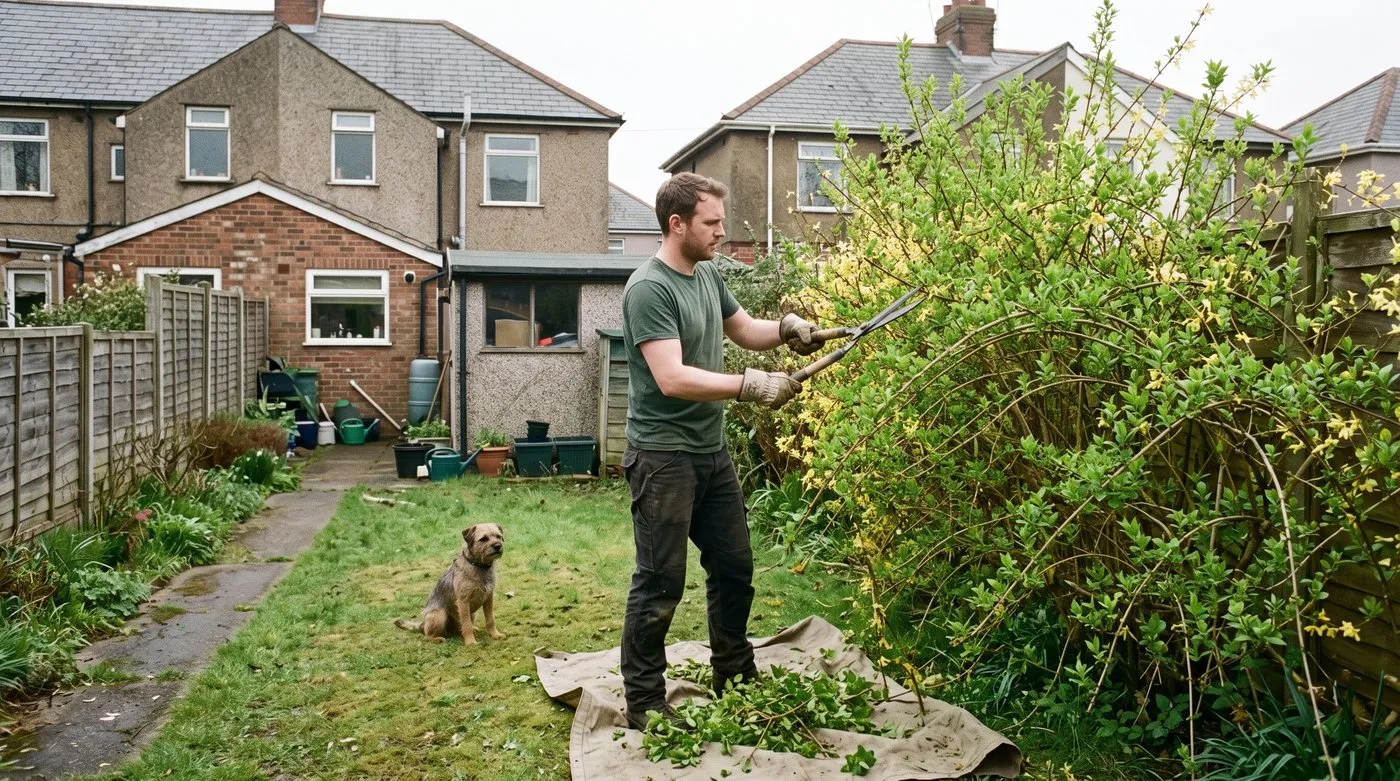
Give a forsythia hedge its one trim straight after flowering. Leave plenty of fresh growth, as that’s where next spring’s flowers come from.
How to force forsythia branches indoors
Bringing forsythia indoors in mid-winter is a lovely way to get spring flowers early. It’s simple and great fun.
When to cut. From mid-January. Earlier than that, and the buds often won’t open.
How to force:
- Cut stems about 45-60cm long. Choose ones with fat, round flower buds. Slim, pointed buds are leaf buds.
- Stand them in a vase of lukewarm water in a warm room.
- Change the water every few days and snip a little off the stem ends each time.
- The buds usually open within a couple of weeks.
They last about a week in the vase. They look great with other early branches such as lilac and quince. Our guide to forcing flowering branches indoors has more shrubs to try.

Forsythia brought indoors in January. A little sunshine on the windowsill.
How to propagate forsythia from cuttings
Forsythia is one of the easiest shrubs to grow from cuttings. You don’t need any special kit.
Hardwood cuttings (autumn):
- After the leaves drop, choose pencil-thick stems of this year’s growth.
- Cut them into 20-25cm lengths. Cut straight across just below a bud at the bottom, and at a slant just above a bud at the top, so you know which way is up.
- Remove the soft tip.
- Push two-thirds of each cutting into a slit in the soil, in a sheltered spot outdoors. A little grit in the slit helps on heavy soil.
- Firm the soil and water once.
- Leave them alone until the next autumn. They root over winter and spring.
- Move them to their new homes in autumn.
Layering. In autumn, peg a low, bendy branch down to the ground and cover that bit with soil. A year later, once it’s rooted, cut it free from the parent. You’ll get a bigger plant faster this way.
Young plants usually start flowering within a couple of years.
Companion planting with forsythia
Forsythia flowers before most perennials wake up, so spring bulbs underneath are perfect partners. Plant daffodils, grape hyacinths and crocuses beneath it in autumn. Blue grape hyacinths with yellow forsythia is a classic spring combination.
Later shrubs such as deutzia, philadelphus and weigela carry on the show from May. A border of forsythia, lilac, philadelphus and hydrangea gives you flowers from late winter to autumn with very little effort.
Lots of yellow in one spot can look a bit much, so put blue, white or purple flowers between yellow spring shrubs.
Common forsythia problems
No flowers (the most common problem)
Pruning at the wrong time is almost always the reason. Other causes are deep shade, soggy soil and late frosts on an exposed plant. Move it somewhere sunnier, or switch to pruning straight after flowering.
Forsythia gall
Round, knobbly lumps on the stems. They look odd but rarely do much harm. Cut out affected stems well below the lump, clean your secateurs afterwards and dispose of the prunings away from the garden.
Honey fungus
Forsythia can be hit by honey fungus. Look for yellowing leaves, dieback, white fungal sheets under the bark at the base and black bootlace-like strands in the soil. There’s no cure. Dig out the affected plant with as much root as you can, and don’t plant another shrub that’s prone to it in the same spot.
Bird damage to buds
Bullfinches love to strip forsythia flower buds in late winter, especially in the countryside. Draping light netting over the plant from December to March is the best protection. Or just enjoy the birds and a slightly smaller show.
Month-by-month forsythia care
| Month | Jobs |
|---|---|
| January | Cut branches for the vase. Check for gall. |
| February | First flowers in mild areas. No pruning. |
| March | Peak flowering in most of England and Wales. Enjoy it. |
| April | Prune straight after flowering. Take out one in four old stems. |
| May | New shoots grow fast. Nothing to do. |
| June | Next year’s buds start forming. Don’t prune. |
| July | Water new plants in dry spells. |
| August | Buds are set on this year’s stems. Don’t prune. |
| September | Growth slows. Get planting spots ready. |
| October | Best month to plant. |
| November | Take hardwood cuttings. Mulch with bark. |
| December | Fully dormant. Net against bullfinches if needed. |
Forsythia sometimes grows odd flattened stems. It’s a harmless quirk, explained in our guide to fasciation in plants.
Frequently asked questions
Why is my forsythia not flowering?
Pruning at the wrong time is the usual reason. Forsythia flowers on stems that grew the year before, so a trim in summer, autumn or winter cuts off next spring’s flowers. Deep shade, soggy soil, late frosts and hungry bullfinches can also be to blame. Move it somewhere sunnier or change when you prune, and the flowers should return.
When should I prune forsythia?
Straight after the flowers fade, usually in April. That gives the new shoots all summer to grow and form next year’s flower buds. Don’t prune in summer, autumn or winter. Hedges follow the same rule, with one trim a year right after flowering.
Can I grow forsythia as a hedge?
Yes, it makes a cheerful informal hedge. Plant 60-90cm apart and trim once a year, straight after flowering. You’ll get a wall of yellow in spring and a green screen in summer. It does lose its leaves in winter, so it won’t give privacy all year.
How do I force forsythia branches indoors?
Cut stems from mid-January, choosing ones with fat flower buds. Fat, round buds are flowers, and slim, pointed ones are leaves. Stand them in a vase of lukewarm water in a warm room and change the water every few days. They usually open within a couple of weeks, well before the ones outside.
How fast does forsythia grow?
Quite fast, so it fills a space within a few years. In good soil with enough water it puts on plenty of new growth each year. That makes it one of the quickest flowering shrubs to settle into a new garden.
Is forsythia poisonous to cats and dogs?
Forsythia isn’t known to be poisonous to cats or dogs. The ASPCA lists it as non-toxic for pets. Even so, it’s best not to let pets chew garden plants, and ask your vet if you’re worried.
How do I propagate forsythia from cuttings?
Take hardwood cuttings in autumn, after the leaves drop. Cut pencil-thick stems of this year’s growth into 20-25cm lengths. Push two-thirds of each one into a slit in the soil in a sheltered spot outdoors. Leave them alone until the next autumn, then move them to where you want them.
Our team produces practical UK gardening guidance from source research, contributor records and established horticultural practice. Editorial standards are overseen by Matt W.


