Key takeaways
- Wrens are the UK's most numerous breeding bird at around 11 million pairs (BTO)
- Cold winters can kill up to 50 percent of the UK population in one season
- Open-front nest boxes need a 4cm front slot, not a 32mm hole
- A record 63 wrens once roosted together in a single Norfolk nest box
- Wrens feed mostly on leaf-litter spiders, springtails and caterpillars
- Dense cover below 1m is more important than feeders for attracting wrens
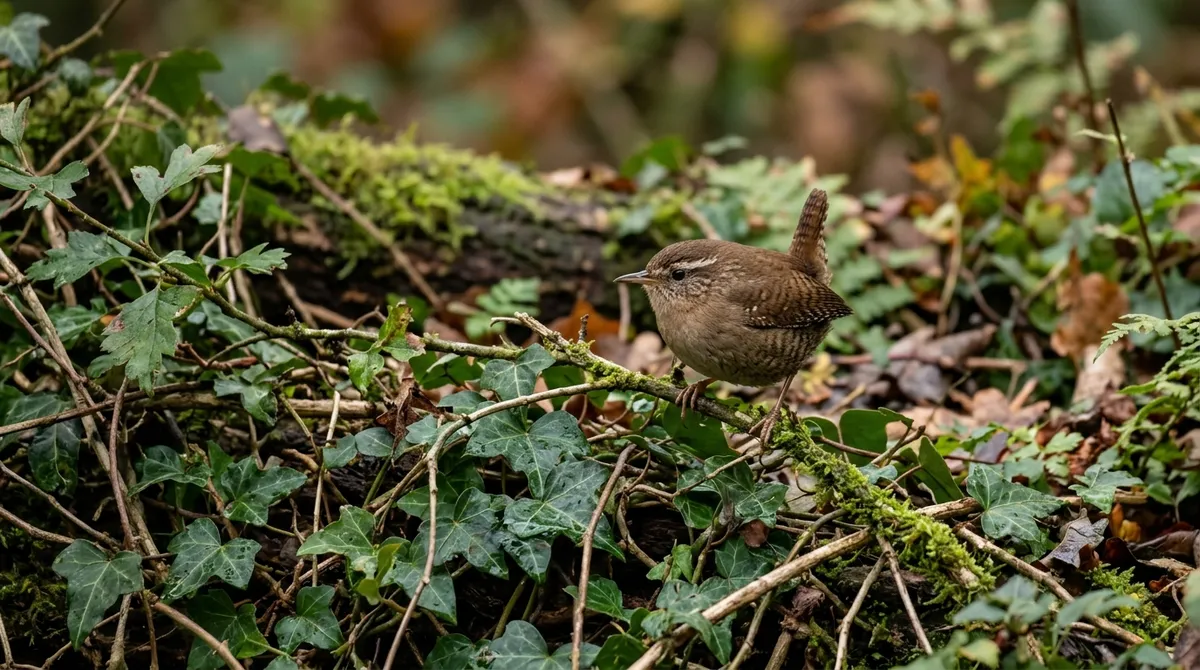
The Eurasian wren (Troglodytes troglodytes) is the most numerous breeding bird in the UK, with around 11 million pairs according to BTO Bird Trends, yet most gardeners struggle to see one. The bird is tiny, brown and skulking, and it lives almost entirely in dense cover below 1m. The phrase attract wrens UK garden is one of the steepest jumps in confidence between knowing a species exists and actually getting it to settle on your patch.
Why wrens are everywhere yet hard to see
Wrens sit at the top of the UK breeding bird table. BTO Bird Atlas 2007-11 puts the population at roughly 8.6 million territories, with the figure climbing past 11 million pairs in mild years. They are present in every UK county, every habitat from coastal cliff to Scottish pine forest, and the great majority of UK gardens.
Yet wrens are almost invisible. They weigh around 9g, stand 9-10cm tall, and move through low cover in fast, low flights. The cocked tail and loud rattling song give them away, not the sighting. A wren can spend an entire breeding season in a 30m square garden without the owner ever spotting it.
The implication for gardeners is simple. If you do not see wrens, you may already have them. If you do, more dense low cover almost always tips the garden into supporting a breeding pair plus winter roosts.
What dense low cover actually means
This is the single biggest lever in a wren-friendly garden. Wrens hunt and roost in cover below 1m, with the densest activity in the bottom 30cm. They want a continuous low canopy they can move through without exposing themselves to a sparrowhawk.
Four cover types work well in UK gardens:
- Ivy on walls and fences. A 4m run of English ivy (Hedera helix) on a north-facing wall gave us our first confirmed wren territory. Ivy supports over 50 invertebrate species and provides year-round shelter.
- Log piles. A 1.5m by 1m pile of oak, birch and beech logs stacked to 70cm is the gold standard. Wrens nest inside them, roost in them, and forage through the gaps.
- Dead hedges. Stacked brushwood between vertical stakes builds a permeable 1m wall. Wrens treat it as a continuous tunnel.
- Low evergreen hedging. Pittosporum tenuifolium, box (Buxus sempervirens), yew (Taxus baccata) and Lonicera nitida all give the layered foliage wrens use. Keep height between 60cm and 1m.
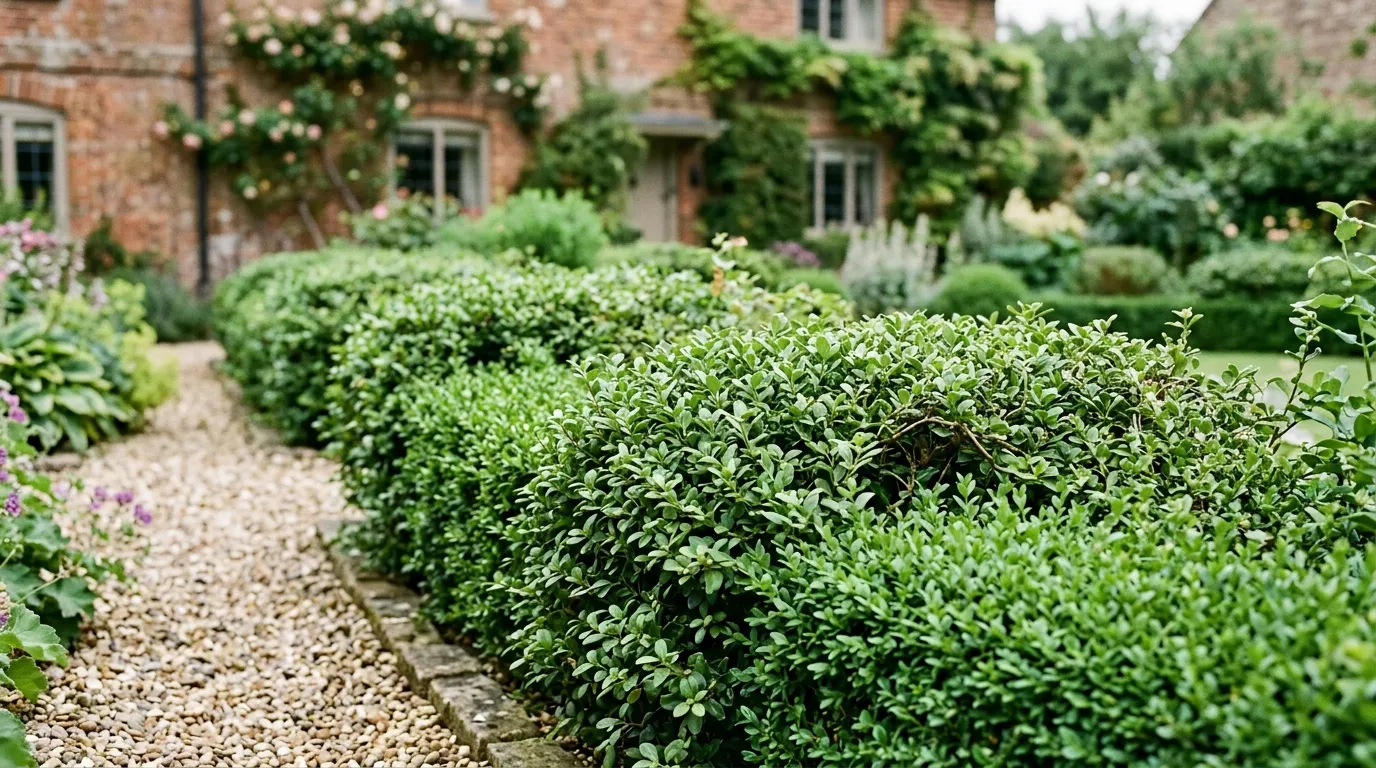 A continuous low evergreen corridor of pittosporum and box. The wren wants this band of cover between its food source and its nest box.
Open-front nest boxes: the 4cm rule
Wrens use open-front nest boxes with a horizontal front slot, not the round-hole boxes used by blue tits and sparrows. The opening should be 4cm tall by the full width of the box front, around 10-12cm wide. A 32mm round hole excludes them.
Two boxes work well in UK gardens:
- Vivara Pro Heritage Wren box (around £25). FSC plywood, lighter, simpler to mount on a fence panel.
Mount the box 1.5 to 3m off the ground, tucked behind ivy or honeysuckle. The foliage screen is non-negotiable. An open-front box on a bare wall stands out to predators, and the wren will not use it. Face the box north or east so the entrance avoids direct afternoon sun. Clean it out in October once chicks have fledged.
One quirk worth knowing: a male wren builds 5-8 cock nests every spring, all unlined, scattered across his territory. The female picks one and lines it with feathers. A garden with three boxes plus log piles and dense ivy can hold all those potential sites without crowding the bird.
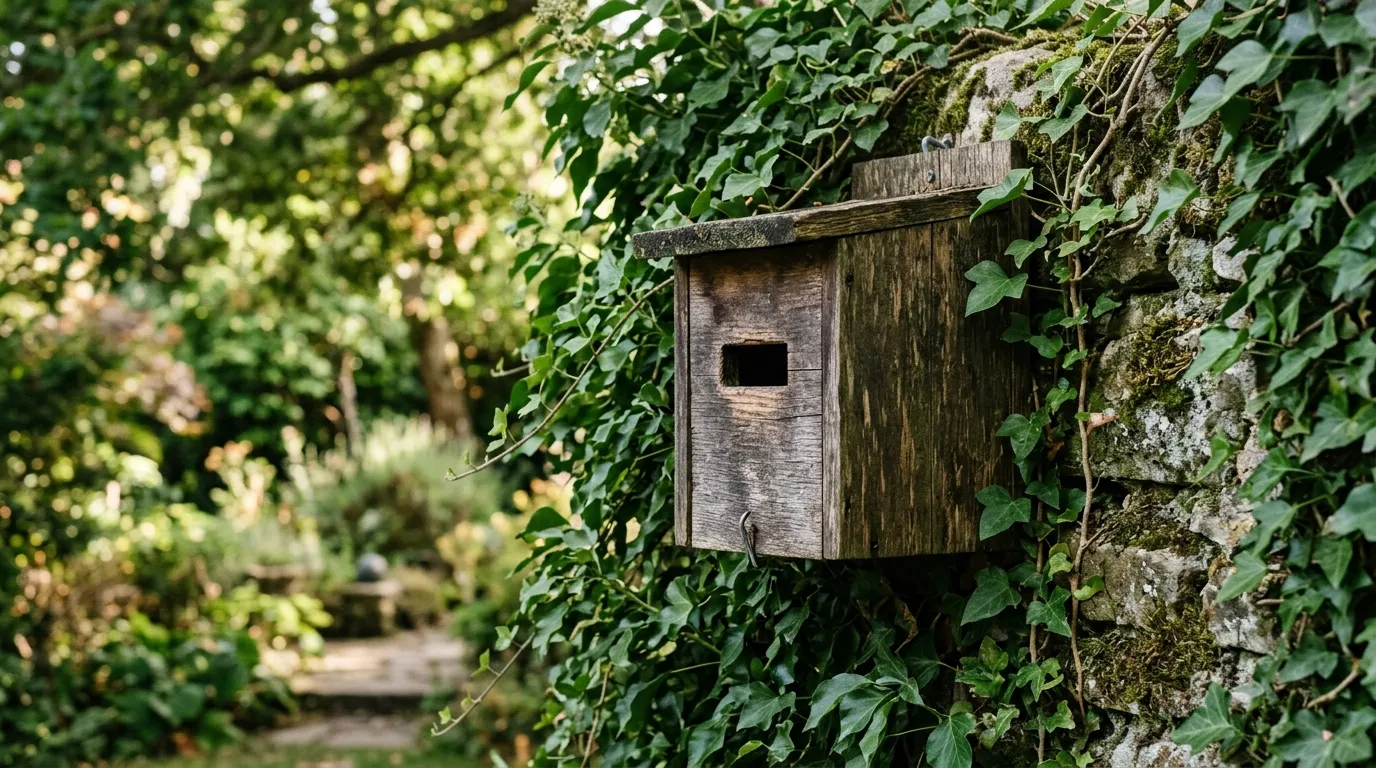 A Schwegler 2HW open-front box, tucked under ivy on a north-facing wall. The front slot is the key feature, and the foliage screen is what makes the bird use it.
Food: spiders, springtails, caterpillars
Wrens are almost entirely insectivorous. Stomach contents from BTO and university studies show diet dominated by spiders (around 35 percent of items), springtails, small beetles, caterpillars, woodlice and fly larvae. Seeds and berries make up well under 5 percent of the diet, even in winter.
This means feeders matter less than habitat. A garden with three filled feeders and no leaf litter will never hold wrens for long. A garden with leaf litter, log piles and damp shaded corners will, even with no feeders at all.
Three habitat features build the wren food chain:
- Leaf litter. Leave fallen leaves in borders and under shrubs from October through to April. A 5-8cm leaf layer supports springtails, woodlice and ground beetles, which is the wren larder.
- Damp shaded corners. Spiders, springtails and earthworms concentrate where soil stays damp. A north-facing wall, the base of a water butt, or under a log pile are all prime feeding zones.
- No pesticides. Slug pellets, neonicotinoid sprays and garden insecticides clear out the soft-bodied invertebrates wrens need. One spray in late May can wipe out a feeding station for weeks.
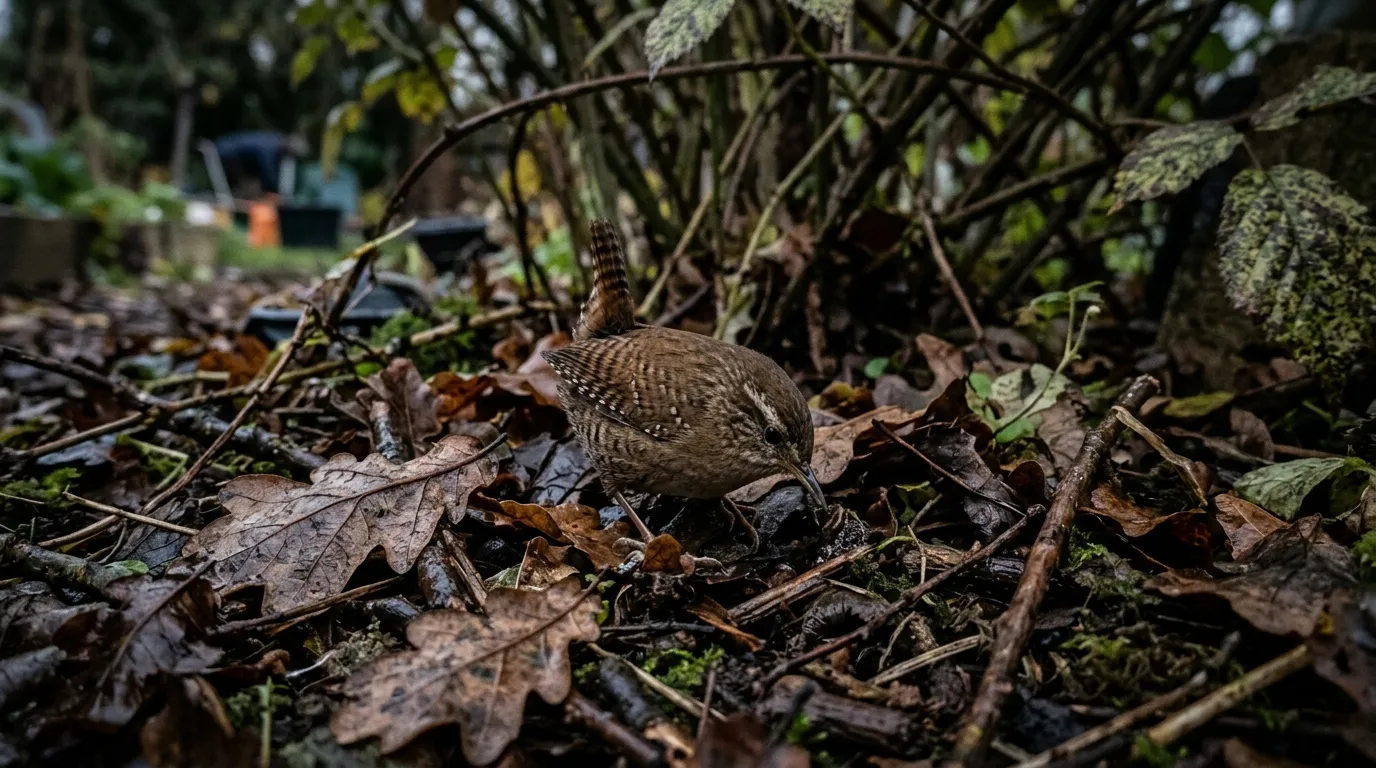 A wren working through oak leaf litter for spiders and springtails. This is the foraging behaviour the bird relies on for 95 percent of its diet.
Log piles and dead hedges: the wren highway
If you build only one wren feature, build a log pile. Ours is the single most productive structure in the garden after the ivy wall.
Stack hardwood logs 70cm to 1m high, in a footprint of 1.5m by 1m, in a partly shaded corner. Use a mix of diameters from 5cm wrist-thick branches up to 30cm trunk sections. Leave gaps between layers. Pack the centre with twiggy brash so the pile is solid but porous. The pile rots slowly over 6-10 years, providing habitat the whole time.
Dead hedges scale the same idea along a boundary. Hammer two rows of vertical stakes into the ground, 50cm apart, then fill between them with prunings, brushwood, twiggy material and old hedge clippings. A 6m dead hedge takes a Saturday afternoon to build and lasts 4-6 years before it needs topping up. Our hedge planting guide covers the full build, and our composting for wildlife piece explains how to chain log piles, dead hedges and compost heaps into one continuous wildlife strip.
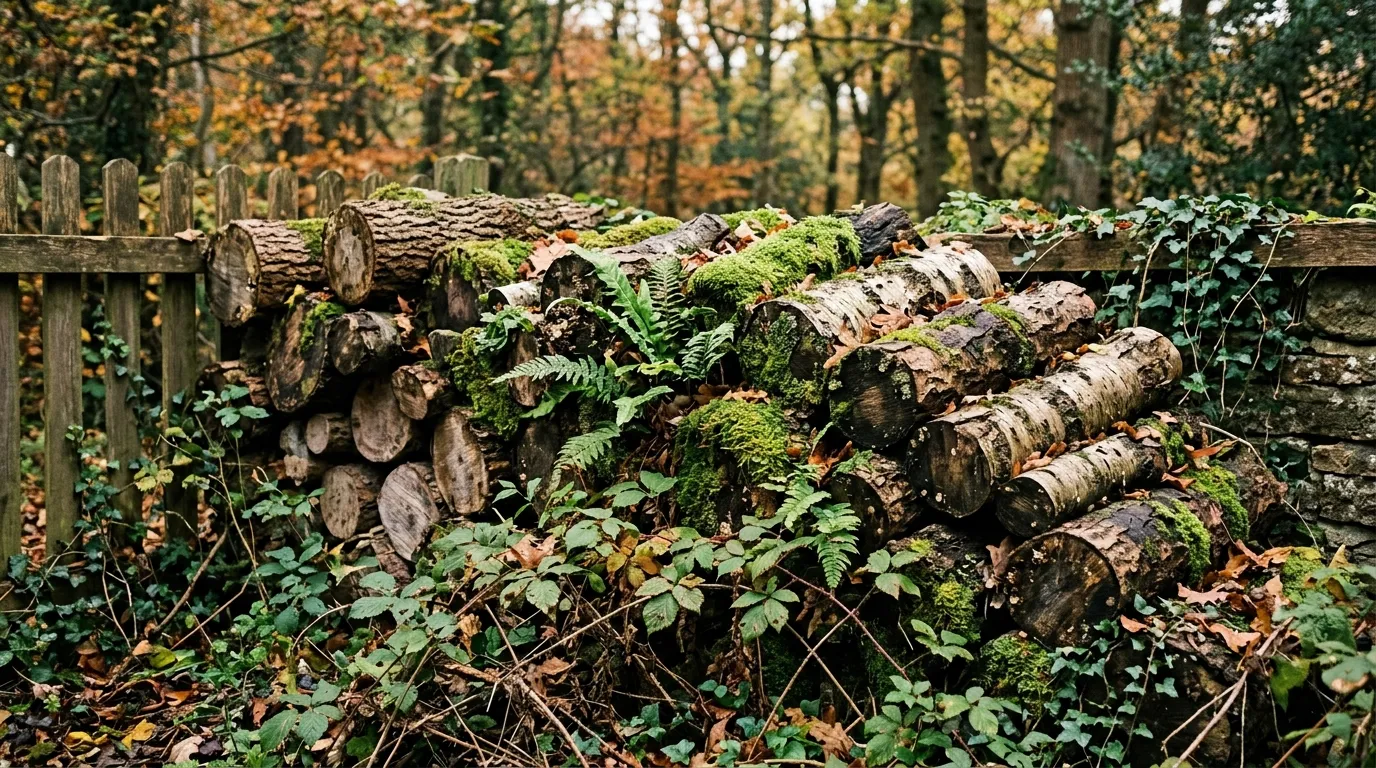 A working log pile 70cm tall in 5-30cm diameter logs. Wrens hunt and roost in piles like this all year round.
Winter survival: roost boxes and the cold mortality factor
Wrens are tiny and cold kills them fast. After the brutal 1962-63 winter the UK wren population fell by around 78 percent according to BTO Common Birds Census data. The 2010-11 cold snap caused a 27 percent drop in one year. The species then recovers fast through mild seasons, doubling within four years.
The wren’s main defence is group roosting. On cold nights, wrens pile into the same cavity to share body heat. The British record stands at 63 wrens crammed into a single nest box in Norfolk in 1969, witnessed by the box owner as the birds queued at dusk. Counts of 10 to 30 in one box are reported every winter to the BTO.
Two things help wrens through winter:
If you can fit a dedicated roost pocket as well, do. Vivara Pro and the Wildlife World UK both sell woven willow roost pockets at around £12 each. Tucked into thick ivy they hold 3-5 wrens on a cold night without competing with breeding-box use.
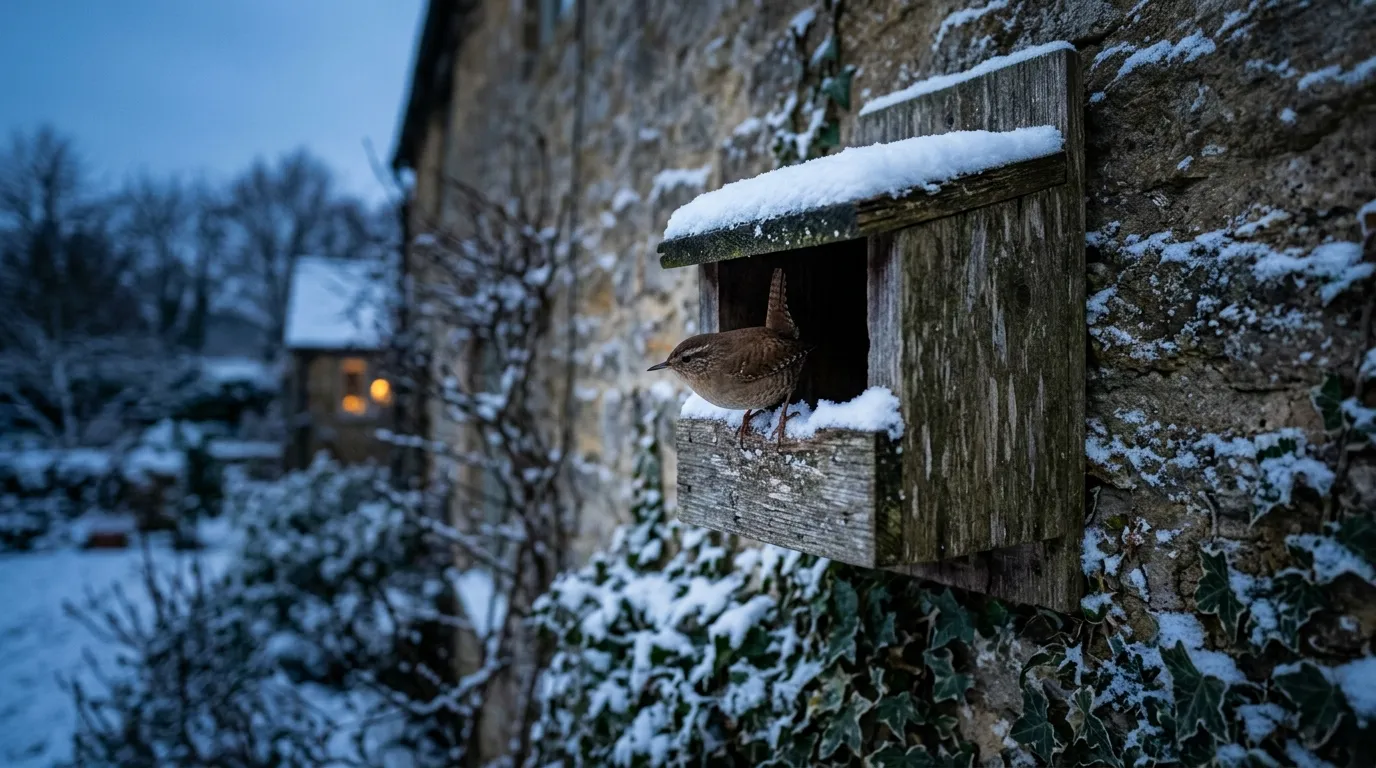 An open-front box in late January, doubling as a winter roost. Group roosting is the wren’s main defence against UK cold snaps.
Wildlife garden integration
Wrens slot into the same garden setup that supports the rest of the wildlife list. The features that bring in hedgehogs, common garden birds and other small birds are largely the same features wrens need.
Five integration points are worth planning around:
The Bumblebee Conservation Trust pollinator habitat guidelines overlap closely with wren cover needs, and the British Trust for Ornithology Garden BirdWatch dataset is the best place to cross-check your local wren numbers.
Comparison: wren cover and nest box options
| Feature | What wrens need | Effectiveness | Role | UK cost |
|---|---|---|---|---|
| Log pile (1.5m x 1m, 70cm high) | Hardwood logs, mixed diameters, partly shaded | Very high (food + nest + roost) | Primary habitat | Free if sourced from prunings |
| Ivy-clad wall (4m run minimum) | Mature English ivy, north or east-facing | Very high (nest + roost + invertebrates) | Primary habitat | Free if existing, around £30 for 5 plants |
| Schwegler 2HW open-front box | 4cm front slot, woodcrete, 1.5-3m up | High (breeding + winter roost) | Primary | Around £40 |
| Vivara Pro Heritage Wren box | 4cm slot, FSC plywood | High (breeding + roost) | Primary | Around £25 |
| Dead hedge (6m, 1m tall) | Brushwood between vertical stakes | High (food + cover) | Supporting habitat | Free, 1 afternoon to build |
| Pittosporum or box hedge (60cm-1m) | Dense layered evergreen foliage | Moderate (cover + flight line) | Supporting habitat | Around £8 per plant |
| Willow roost pocket | Woven willow, hung in ivy | Moderate (winter roost only) | Supplementary | Around £12 |
| Suet pellets and live mealworms | Offered under cover near hedge | Low (helps in hard weather only) | Emergency | Around £35 per 12.5kg suet bag |
Month-by-month UK wren calendar
| Month | What to do |
|---|---|
| January | Offer suet pellets, grated cheese and live mealworms after frosts. Check roost boxes are dry and intact. |
| February | Males begin building cock nests. Tidy up the base of ivy walls to make access easier. |
| March | First singing peaks. Do not cut hedges (legal hedge-cutting ban runs March to August). |
| April | Females select a cock nest and line it with feathers. Avoid disturbing log piles. |
| May | First broods fledge from mid-month. Continue no-pesticide regime. Caterpillars peak on hawthorn. |
| June | Second broods start. Leave grass uncut around hedge bases. |
| July | Fledglings often visible briefly before slipping into cover. Keep water dishes filled. |
| August | Adults moult. Birds become quieter and harder to see. Avoid heavy garden disturbance. |
| September | Top up log piles with fresh branch material. Plant ivy now for next year’s cover. |
| October | Clean out open-front boxes once chicks have left. Replace with fresh wood shavings if used as roost. |
| November | Bare-root native hedge planting window opens. Plant whips for low evergreen cover next year. |
| December | Daily food top-up in hard weather. Watch for group-roosting at dusk through open-front box entrances. |
Common mistakes to avoid
- Round-hole nest box. A standard 32mm hole tit box excludes wrens entirely. The bird needs a 4cm front slot, full width, open-front design.
- Exposed box on a bare wall. Even the right box fails if it sits in the open. Wrens approach through cover. Screen the box with ivy or honeysuckle before mounting.
- Tidy-garden syndrome. Sweeping up leaves, clearing log piles and trimming low shrubs strips out the wren larder. A wild corner is worth more than three feeders.
- Pesticide use during breeding. A single insecticide application in May can clear soft-bodied invertebrates for two to three weeks, exactly when chicks need them most.
- Taking down boxes in autumn. Open-front boxes serve as winter roosts. Leaving them up year-round is what gives the population a chance after a hard freeze.
Three pitfalls to plan around
- First-season disappointment. New open-front boxes often go unused for 12-18 months. Wrens survey sites slowly. Persist.
- Cat ambushes near log piles. A free-roaming cat can sit on a log pile waiting for wrens. Site log piles where cats cannot perch above them, and keep a 1m clear band around the pile so wrens see the cat first.
- Mid-summer hedge cutting. Trimming an ivy wall or low hedge between March and August can destroy active nests. Save trimming for September onwards. See our when to cut hedges UK guide for the legal window.
Bringing it all together
The fix for a wrenless garden is almost always more low cover. Three open-front boxes, a log pile, an ivy wall and a no-pesticide regime is enough for most UK gardens of any size. Wrens find suitable habitat fast once it is there, and a settled territory stays settled for years.
Frequently asked questions
What is the best way to attract wrens to a UK garden?
Plant dense low cover under 1m and fit an open-front nest box. Wrens need thick ground-level shelter for foraging, roosting and breeding. Log piles, dead hedges, ivy-clad walls and clipped pittosporum or box hedging all work. Add an open-front nest box with a 4cm front slot, tucked under cover on a north or east-facing wall.
Do wrens use nest boxes?
Yes, but only open-front boxes with a 4cm front slot. Round-hole boxes used by tits and sparrows are too enclosed for wrens. Open-front designs like the Schwegler 2HW or Vivara Pro Heritage Wren box sit best under ivy or honeysuckle on a shaded wall, 1.5 to 3m off the ground.
What do wrens eat in a UK garden?
Wrens eat small invertebrates, mainly spiders, springtails, caterpillars and beetle larvae. They forage in leaf litter, under logs, in ivy and along low walls. They will occasionally take suet pellets, finely grated cheese and live mealworms in cold weather, especially after January snow.
Why do wrens disappear after cold winters?
Severe winters can kill up to 50 percent of the UK wren population. The bird is tiny (around 9g), short-tailed and loses heat fast. After winters like 1962-63 and 2010-11, BTO Common Birds Census data showed numbers crashing, then recovering within three to five mild years.
Do wrens roost together in winter?
Yes, wrens group-roost in nest boxes and cavities in cold weather. The British record stands at 63 wrens packed into one nest box in Norfolk in 1969. Smaller groups of 5 to 15 birds are common in open-front boxes during freezing nights across UK gardens.
Where should I site an open-front wren box?
Fit the box 1.5 to 3m up on a shaded wall or fence, hidden inside ivy or honeysuckle. North or east-facing is ideal. The box must be screened by foliage so the bird can approach unseen. An exposed box on a bare wall almost never gets used by wrens.
Are wrens easy to attract to small UK gardens?
Yes, town gardens of 30 square metres or less support wrens if cover is dense. A single ivy-clad wall plus a small log pile in a damp corner is often enough. The bird’s tiny size and short flight range mean even a courtyard with two shrubs and a wall of ivy can hold a breeding pair.
Our team produces practical UK gardening guidance from source research, contributor records and established horticultural practice. Editorial standards are overseen by Matt W.