Key takeaways
- Split a long garden into two to four rooms, each with its own job
- Use the far end for something you'll walk to, such as a seat, studio, veg plot or wild corner
- A weaving or offset path and arches between rooms stop the corridor effect
- Put focal points off to one side, not dead centre at the back
- Plant the fences in mixed drifts so they fade into the background
- Hide the shed, compost and bins behind a screen in their own working zone
A long garden is a gift. You have room for a patio, a lawn and something special at the far end, as long as the plot doesn’t read as one long corridor. The trick is to treat it as a series of rooms, each with its own job, joined by a path that wanders.
Below are ten ideas for using the length well, from zoning and arches to a garden studio, veg plot or wildlife corner. If you want a step-by-step design process instead, our guide to designing a long thin garden walks you through it.
Why long gardens can feel like a corridor
A long garden feels like a corridor when the eye can run straight from the back door to the back fence. A straight path down the middle and two bare fences make that line even stronger.
Break that single view and the garden instantly feels bigger and more inviting. Every idea below does that in some way.

A straight path down the middle pulls your eye to the back fence in one go. This is the corridor effect to avoid.
Idea 1: Split the garden into rooms
Zoning is the most useful idea for a long garden. Divide the plot into separate rooms, so you never see the whole length at once. Two rooms suit a shorter garden, and three or four suit a longer one.
Give each room a clear job:
- Near the house: dining, cooking and pots you see every day
- The middle: lawn for play, or the main flower borders
- The far end: a quiet seat, a veg plot, a studio or a wild corner
Vary the size of each room. Equal-sized boxes feel mechanical.

Low hedges and a little arch split this long garden into rooms, so you never take in the whole length at once.
Idea 2: A path that weaves or crosses on the diagonal
A path that steps from one side to the other pulls the eye across the garden instead of down it. Run it along one side for a stretch, then cross over at each new room.
Laying paving or a lawn edge on a diagonal has a similar effect, because the longest line in a rectangle runs corner to corner. The leftover triangles in the corners make good spots for a tree, a bench or a water bowl. Our garden path ideas cover materials for every budget.
Idea 3: Arches and screens between the rooms
Something at head height between rooms stops the long view. Leave a gap to walk through and glimpse the next space. That glimpse is what makes people want to explore.
Good dividers include:
- An arch over the path, with a rose or clematis
- Trellis screens with climbers, which take up almost no ground
- A short hedge of hornbeam or yew, with a clear gap to walk through
- Tall grasses or shrubs for a softer break

An arch frames a peek at the next room. You can see there’s more to discover without seeing it all.
Idea 4: Focal points off to one side
A focal point gives the eye somewhere to rest. Put one dead centre at the far end and the eye races straight to it, making the garden feel longer. Put it part-way down and to one side, and the eye moves across instead.
Try a large pot, a stone urn, a small specimen tree or a bench framed by planting. Add a second one in another room so the eye hops from side to side. Our guide to garden focal points has plenty more ideas.

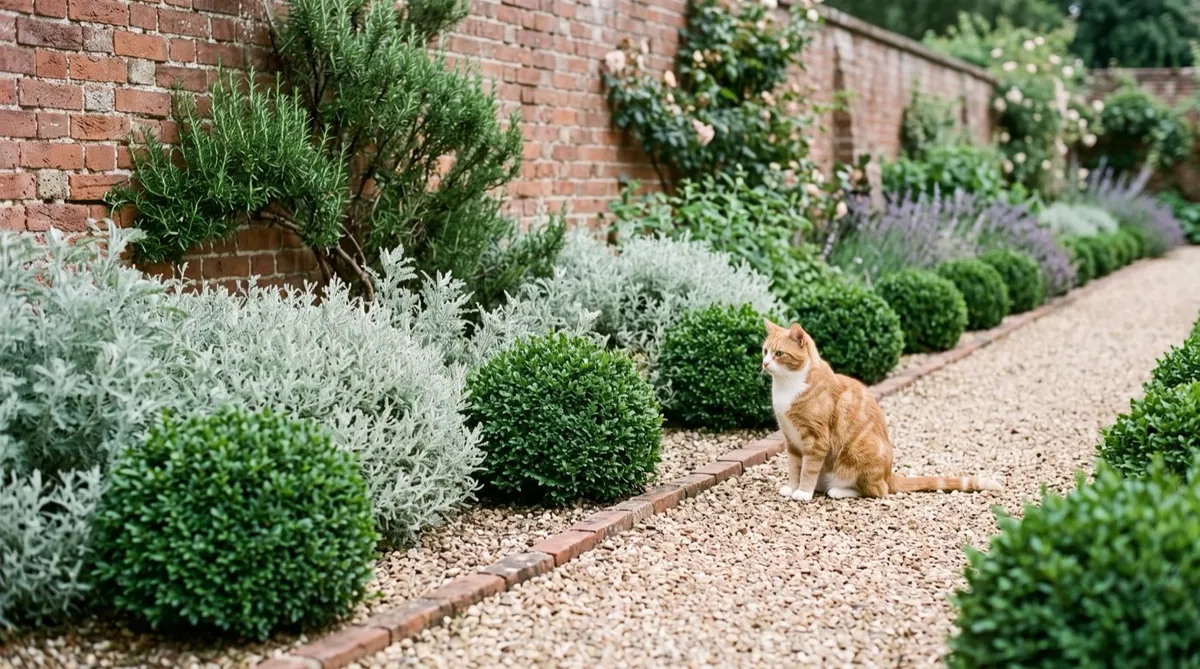
A focal point set in front of the back boundary gives the eye somewhere to stop before it reaches the fence.
Idea 5: Plant the fences in drifts
Two bare fences running the full length look like the lines of a running track. Plant them in drifts of mixed heights so they fade into green.
Repeat three or four key plants along the whole garden to tie the rooms together. Grasses, echinacea and rudbeckia make a long, relaxed border, as our guide to prairie planting shows. Avoid one straight ribbon of the same plant along each fence, as that only stresses the length.

Drifts of grasses and flowers soften a long fence so it reads as planting, not a hard line.
Idea 6: A seat or hideaway at the far end
The far end is the perfect place for a destination: somewhere you’ll want to walk to. A pair of chairs on gravel, surrounded by tall planting, makes a quiet retreat away from the house.
Check where the evening sun lands. In many gardens the far end gets sun long after the patio is in shade. Festoon lights or a lantern make it an evening spot too.

A hidden seat at the end of the garden gives you a reason to walk the whole length.
Idea 7: A garden room or studio at the bottom
A long garden often has room for a garden office, studio or summerhouse at the far end. It’s far enough from the house to feel like a separate place.
Many outbuildings can go up without planning permission, but there are limits. Within 2m of a boundary, they’re usually limited to 2.5m high. Listed buildings and some protected areas have stricter rules, so check with your council first. You’ll also need a path that’s usable in winter, and a qualified electrician for power. Our garden room ideas cover the options.
Idea 8: A veg plot or mini orchard
One room of a long garden can feed you. A few raised beds or a small fruit area works well in the sunniest stretch, often the middle or far end.
Plan for water. Hauling cans 30m down the garden gets old fast, so fit a water butt to a nearby shed or run a hose. Apples and pears on dwarfing rootstocks stay small enough for a garden. Our guide to growing fruit trees explains which to choose.
Idea 9: A wild corner for wildlife
The far end is a great place to let things get a little wild. Let a patch of grass grow long with a mown path through it, add a log pile and plant a native hedge along the back.
A small pond brings in frogs, newts, dragonflies and birds. Give it a shallow, sloping edge so wildlife can climb out. If small children use the garden, fence it off or wait until they’re older. Our guide to building a wildlife pond shows you how.
Idea 10: A tidy working zone behind a screen
Every garden needs somewhere for the shed, compost bins, greenhouse and water butts. In a long garden, give them their own small zone behind a trellis screen or hedge.
The far corner is often best, close to the veg plot if you have one. A path to it that you can use in all weathers makes it far more likely you’ll use the compost bins.
Which long garden ideas suit you?
| If you mainly want… | Try these ideas |
|---|---|
| Space for family and play | Rooms (1), weaving path (2), a lawn in the middle, a seat at the end (6) |
| Somewhere to work or relax | Garden room or studio (7), a hidden seat (6), arches (3) |
| To grow your own | Veg plot or orchard (8), working zone (10), water near the beds |
| Wildlife | Wild corner and pond (9), drift planting (5), a native hedge at the back |
| Something low-maintenance | Fewer, larger rooms, gravel paths, shrubs and grasses in drifts (5) |
Common mistakes in long gardens
- One straight path down the centre. It’s the main cause of the corridor look. Offset it or let it weave.
- Bare fences. Two empty parallel fences read like a track. Plant them or grow climbers.
- The only focal point dead centre at the back. It stresses the length. Put focal points off to one side.
- Walling rooms off completely. Solid, full-height barriers make dark boxes. Always leave a gap or arch.
- Forgetting the far end. If there’s no reason to go there, it becomes a dumping ground. Give it a job.
Gardener’s tip: Before building anything, push canes into the ground where screens and trees will go. Look from the back door and an upstairs window. If you can still see the back fence in one glance, move or raise them.
Frequently asked questions
How do you make a long narrow garden look wider?
Break it into zones and pull the eye across rather than down. A path that steps from side to side, diagonal lines and off-centre focal points all help. Plant the fences thickly so they disappear behind foliage.
How many zones should a long garden have?
Two to four, depending on length. Shorter gardens suit two rooms, and longer ones three or four. Give each zone a clear purpose, such as dining, lawn or a quiet seat, so the divisions feel deliberate.
What can I put at the bottom of a long garden?
Anything that gives you a reason to walk there. A seat in the evening sun, a garden room, a veg plot, a pond or a wild corner all work. Pick something you’ll use, not just look at.
Should the path go down the middle of a long garden?
No, an off-centre or weaving path works far better. A straight central path pulls the eye to the back fence in one go. Letting it cross from side to side between zones slows the journey and makes the garden feel bigger.
What can I use to divide a long garden into rooms?
Arches, trellis screens, short hedges or tall planting all work. The divider should block the view at standing height but leave a gap or arch to glimpse through. That glimpse makes you want to explore the next room.
Can I put a garden office at the end of my garden?
Often, yes, under permitted development, but there are limits. Within 2m of a boundary, outbuildings are usually limited to 2.5m high. Different rules apply to listed buildings and some protected areas, so check with your council before you build.
Got a narrow terraced yard rather than a long suburban plot? Our terraced house garden design guide tackles privacy and shade, and the garden design hub has plenty more ideas.
Our team produces practical UK gardening guidance from source research, contributor records and established horticultural practice. Editorial standards are overseen by Matt W.